
Understanding Cardamom
The Spice the Indian Ocean Made


There are spices that explain themselves.
Cinnamon is warmth, comfort, the smell of something sweet in the oven. Saffron is luxury, restraint, a pinch of gold dissolved into rice. And then there is cardamom, which is none of these things and will not be reduced to them - a spice that moves between savoury and sweet with an ease few other spices can match, that exists in two entirely distinct botanical forms doing two entirely different things.
It has been simultaneously indispensable to Arab coffee culture, Mughlai meat cookery, Persian rice dishes, Indian chai, and Scandinavian baking for centuries, without anyone seeming to notice that these are not the same spice being used in the same way.
Cardamom resists the easy explanation. This essay is an attempt to give it a harder one.
The Names of Cardamom
The English word cardamom is already a composite. The Greeks called it kardamōmon - compounding kardamon, meaning cress, with amomon, the name for an aromatic eastern spice plant of uncertain origin. The Greeks were doing what traders always do with unfamiliar goods: reaching for the nearest known category and attaching it to something that exceeded it. Kardamomon means, approximately, “the aromatic plant that is something like cress but not.” It is the name of an encounter, not an origin.
What makes the word remarkable is its age. Variants already appear in Mycenaean Greek, written in Linear B syllabic script on spice tablets found in the palace archives at Mycenae. Cardamom was in Greek palace records before Greece had an alphabet.
But beneath this chain lies a different and older naming tradition - one that begins not with trade but with cultivation.
The spice originates in the Western Ghats of Kerala, among Dravidian-speaking peoples, and their names for it are the deepest ones we have. In Tamil it is elakkai; in Malayalam, elam or elakka; in Kannada, yelakki. These are not borrowings. They are the names given by the people who grew the plant, long before it entered any trade network. The Sanskrit elā is itself borrowed from this Dravidian root - which means that even the ancient Indian learned tradition was receiving the word from the south, from the cultivators. And the botanical genus Elettaria - as in Elettaria cardamomum, the formal scientific name - is believed to derive from this same Dravidian root. The most authoritative name in modern botanical taxonomy is, at its base, a word from the Western Ghats. The spice-producing peoples named it first, and that name has outlasted every empire that carried it.
From the Dravidian root the word traveled in two directions simultaneously. Northward and westward through Sanskrit and Persian: elā became hel in Persian, the relay language that carried cardamom into Central Asia, into the Mughal courts, into Ottoman Istanbul, and into the Persianized Indo-Aryan forms that became Hindi and Urdu elaichi - the word used across the subcontinent today, in every spice market, every kitchen, every cup of chai, and in my family.
Southward and westward through Arab trade: the Arabic hail (هيل) developed as an independent naming lineage, embedded in Gulf and Yemeni culture, inseparable from gahwa, from hospitality, from the ritual of welcome.
Hail is the word Yemenite food writer Moshe David’s community would have used.
It is the word that crossed the Arabian Sea with every cargo of cardamom pods. It´s the word I am familiar with, for the spice that gives Arabic coffee its special taste.
”The word cardamom in English is the word of someone who received the spice from afar. The word elaichi is the word of someone who grew up with it. The word hail is the word of someone for whom it was never exotic at all.”
That the word for cardamom traces back to the cultivators of the Western Ghats, that it traveled through Persian courts and Arab dhows before arriving in English, that it exists today in two parallel naming traditions reflecting two parallel histories of use - all of this is not merely linguistic curiosity. It is a map.
The same map that traces the routes along which Baghdadi Jewish merchants moved, the same maritime spice ecology that made it possible for a cook in Aden to reach, without astonishment, for a cardamom pod.
Two Cardamoms
Most people never notice the distinction. For years, I didn’t either.
There are in fact two cardamoms, botanically distinct and culinarily separate.
Green cardamom (Elettaria cardamomum) is native to the Western Ghats of Kerala - a perennial herb with long lanceolate leaves and pale green pods containing fifteen to twenty seeds, their volatile oils producing cardamom’s signature sweetness, its floral lift, its faint eucalyptus edge.
Black cardamom (Amomum subulatum) is a different plant entirely, native to the Eastern Himalayas - larger, darker, smoke-dried over open flame, its aroma dominated by guaiacols - that is the compounds created during the smoking process, giving it notes of wood smoke, resin, pine, and the lingering scent of a campfire.
The two cardamoms are not interchangeable. Green cardamom moves between savoury and sweet with ease; black cardamom is almost exclusively savoury, rarely appearing in confectionery. They also belong to different culinary civilizations: green cardamom is the spice of the Arab world, the Persian kitchen, the Indian subcontinent; black cardamom, in its Indian form, is the spice of Mughlai cooking, garam masala, slow-braised northern dishes.
Its Chinese cousin (Lanxangia tsaoko) perfumes the long-simmered beef dishes of Sichuan and the broths of Vietnam - the same camphoraceous depth, the same governing logic in slow heat, arriving at the same conclusion through a different route.
And there is another Chinese cardamom - Amomum villosum - called 砂仁 (shārén) in Mandarin - which is primarily a medicinal spice in traditional Chinese medicine, where it's used for digestive complaints, nausea, and as a warming herb. It appears in some Cantonese cooking, particularly in slow-cooked soups and braised dishes, but it never achieved the culinary centrality that tsaoko did in Sichuan.
Understanding that distinction between the two Indian cardamoms is the foundation for understanding why a single Jewish cookbook from Aden - Moshe David’s - contains what it contains.
But we will get there.
What They Are, Chemically
What makes cardamom so uniquely suited to travel - to cross oceans, absorb into unfamiliar kitchens, and become indispensable wherever it arrives - is written into its chemistry.
Its flavour is not built around a single dominant compound but around a layered constellation of volatile molecules - each doing something different, and crucially, each responding differently to heat, fat, and time.
The main flavour molecules are terpenoids - a class of compounds that give spices their scent, flowers their colour, and cuisines their character. In green cardamom, the dominant terpenoids are 1,8-cineole, also called eucalyptol - the molecule that gives eucalyptus its fresh, cool warmth - and α-terpinyl acetate, which produces a citrus-floral brightness.
Together they create the green cardamom signature: simultaneously warm and cool, sweet and aromatic.
Crush a pod between your fingers and the fragrance arrives before you have done anything with it - floral, cooling, with a sweetness that seems to precede itself. It is the note that rises from a cup of gahwa before you have raised it to your lips, the scent that travels out of the chai glass first, so that what you taste has already announced itself a second earlier.
In black cardamom, the same 1,8-cineole is present but far more concentrated, joined by α-pinene and limonene - the compounds of pine trees and citrus peel - which produce a resinous, woody depth. And then black cardamom is smoked - in kilns called bhattis - which adds guaiacols: the molecules that give smoked whisky and wood-fire cooking their character.
Open a black cardamom pod and it does not announce itself the way green does. It settles into the room. It smells of smoke and forest floor and something that has spent a long time beside a fire. The result is a spice that carries resin, camphor, and earth simultaneously - operating at the base of a dish rather than at its top note, doing its work quietly over hours.
Green cardamom lifts. Black cardamom anchors. The distinction is written in molecules, but it is felt in the kitchen.
The Journey

The World Cardamom Built - from Kerala to Arabia, Baghdad, Aden, Hyderabad, Scandinavia and Guatemala.
Cardamom traveled. Not as a curiosity carried by adventurers, but as a traded commodity moving through the arteries of the ancient world - by dhow across the Arabian Sea, by caravan through Persia, by pilgrim ship along the Red Sea, by merchant vessel down the Swahili coast.
Cardamom appears in Mesopotamian trade records as far back as 3000 BCE, was taxed in Roman Alexandria, and carried by Vikings to Scandinavia in the ninth century. Its prestige was never purely culinary - in the ancient Indian medical tradition of the Charaka Samhita, cardamom appears as medicine: for purification, for skin disease, for headache and dental caries. The pharmacy and the kitchen shared the same shelf.
In the Arab world it became foundational: inseparable from gahwa, the Arabic coffee that is itself inseparable from hospitality, from the obligation of welcome, from the performance of generosity that structures Gulf social life. The coffee arrives bitter and almost sharp, but cardamom rounds the edge without removing it - not softening so much as refining, turning something austere into something you want to stay for.
To serve coffee without cardamom in much of the Arabian Peninsula is not simply a culinary choice - it is a social signal, a slight, almost a statement of intent. Recently in Qatar, I bought a tin of cardamom coffee in which the husks were only partly ground, deliberately visible so that no one could mistake what they were drinking.
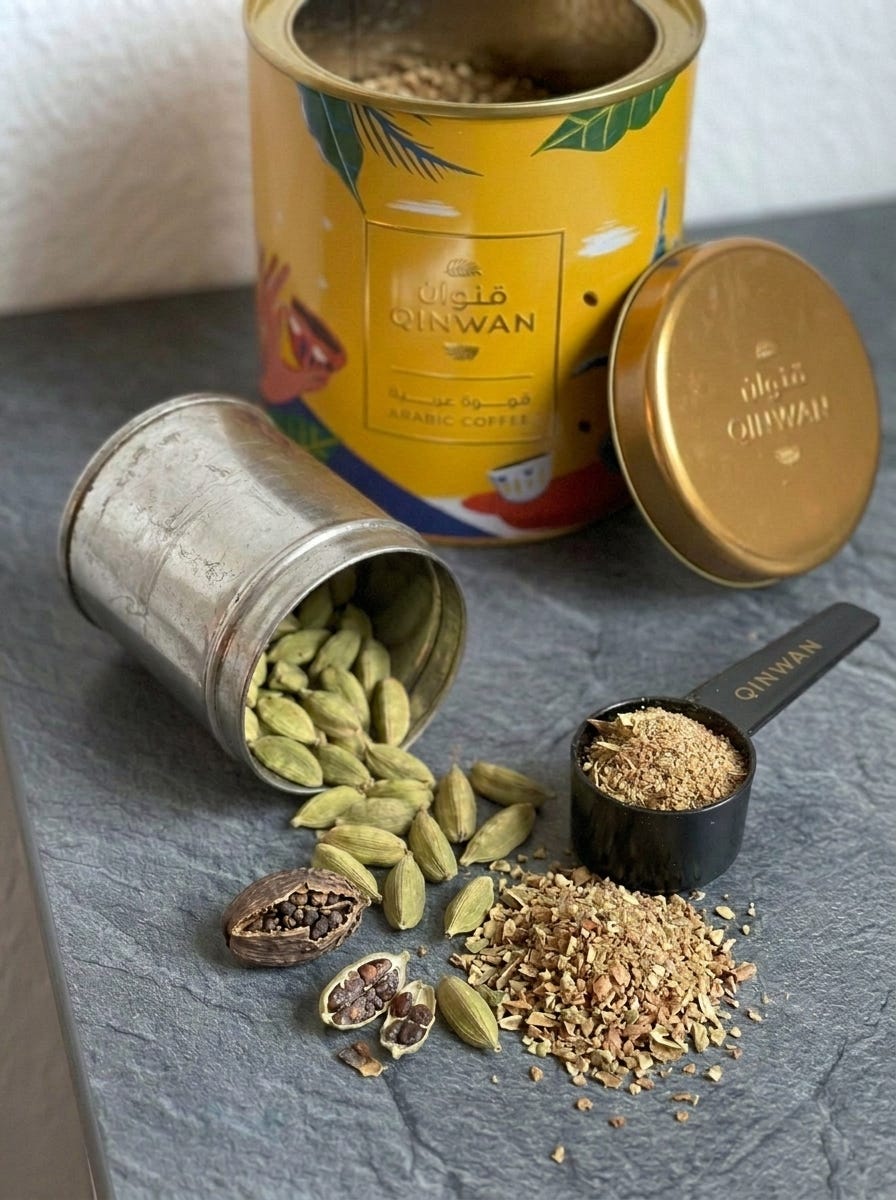
Qinwan Arabic coffee tin, Qatar - the cardamom husks ground coarse and left visible. The cardamom is not a flavouring. It is the identity of the drink.
Persia received cardamom and folded it into saffron rice, rose-scented sweets, and slow-perfumed meat dishes - used sparingly, with restraint, as one thread in a complex weave.
From Persia it moved into Central Asia, into the Mughal courts of northern India, and into Ottoman Istanbul.
In South Asia, cardamom slipped into almost everything: the chai that starts the morning, korma, halwa, kulfi, festive rice, and the steam rising from a freshly opened biryani. Southeast Asia received cardamom through Indian Muslim and Arab merchant influence - Malay curries, Indonesian spice pastes, Burmese Muslim cooking - always tracing the outline of those older maritime connections; through the overland Silk Road, black cardamom’s Chinese cousin Lanxangia tsaoko reached the kitchens of Sichuan and Yunnan, performing the same role in slow-cooked meat it performs in the Mughlai north.
In Scandinavia the story is narrower - and the narrowness is instructive.
Cardamom arrived through Viking contact with Byzantium and the edges of the Islamic trade network, but absorbed into one register only: the sweet, the baked, the domestic. Swedish kardemummabullar, Finnish breads, Norwegian pastries.
Finland today consumes more cardamom per capita than almost anywhere else on earth, and yet the spice never left the baking cabinet. Across the Indian Ocean world it moved simultaneously through coffee, rice, meat, sweets, and the rituals of hospitality. The difference is not a matter of degree. It is a different relationship entirely.
The pattern repeats, independently, in Africa.
The pattern has African echoes that deserve their own essay. In the highland forests of Ethiopia and Eritrea, Aframomum corrorima - korarima, Ethiopian cardamom, brought to our attention by travel writer and foodie Joel Haber - anchors berbere and mitmita, the foundational spice blends of Ethiopian cooking, and appears in the Ethiopian coffee ceremony in exactly the role green cardamom plays in Arab gahwa. Whether korarima's culinary logic developed locally or arrived via Yemen across the Red Sea - itself a node in the Indian Ocean network this essay traces - is a question we have not yet answered. We will return to it in a future essay, The Other Cardamoms.
Cardamom’s journey did not stop with the age of sail.
Today the world’s largest producer is not India, where the plant originated, but Guatemala. Introduced there in the early twentieth century by a German planter, cardamom found conditions so favourable that Guatemala eventually came to dominate global production. Much of that crop is exported to the Middle East, where it disappears into Arab coffee. The plant may be native to Kerala. The modern supply chain runs through Central America. The cup of coffee remains unmistakably Arab.
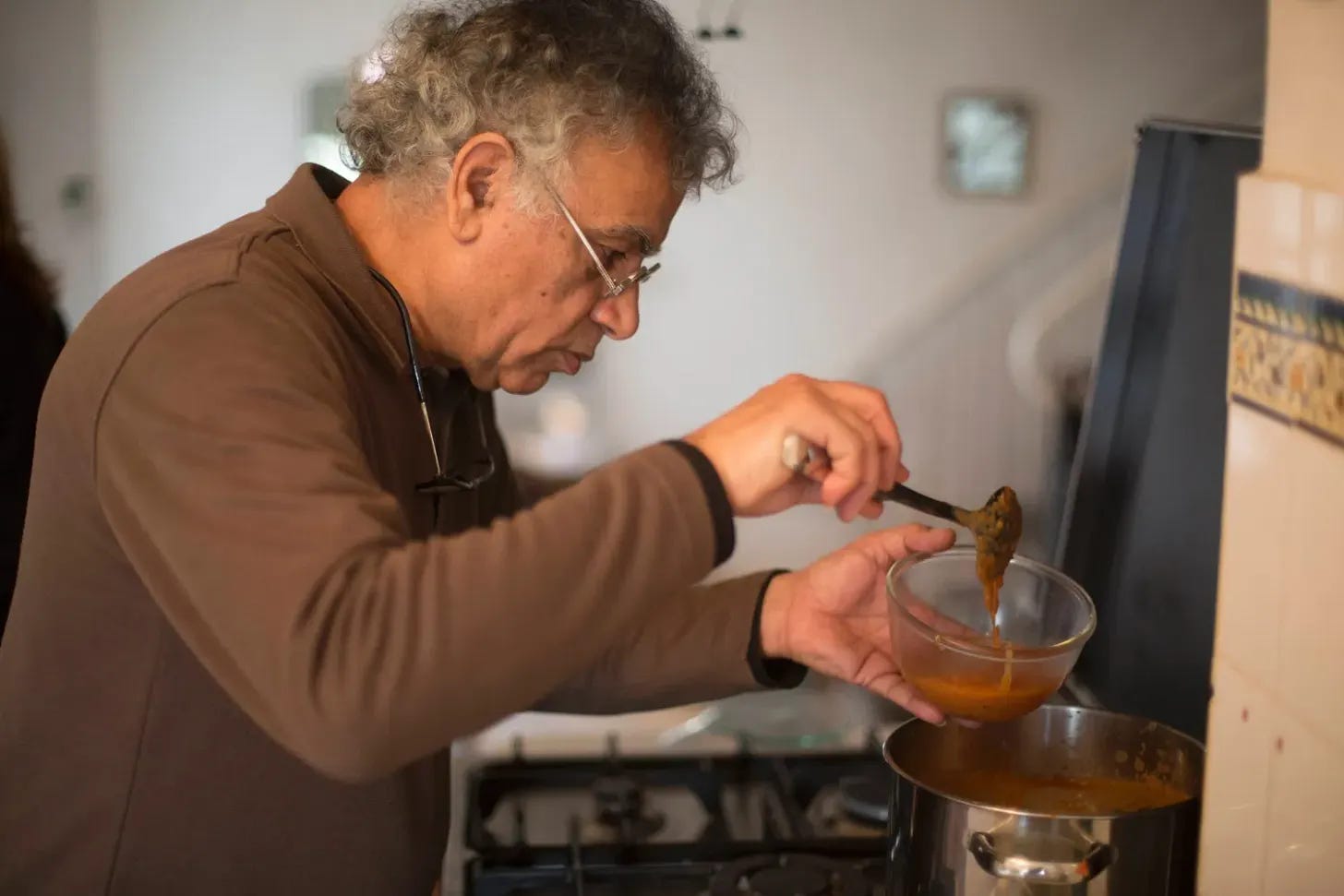
My collaborator in this exploration Khaja Zafarullah, who lives in Delhi and whose family roots lie in Hyderabad, grew up inside exactly this cardamom world.
His grandmother kept green cardamom pods in a small steel box beside the stove, reaching for them without looking, cracking them against her palm before dropping them into rice or tea - the sharp, brief fragrance of the crushed pod filling the kitchen for a moment before it folded into whatever was cooking.
She did not think of cardamom as Indian, or Arab, or Guatemalan, or as anything that had come from anywhere. It was simply what the dish required.
That unselfconsciousness is not ignorance of history. It is history’s deepest form of success.
Cardamom in the Jewish Kitchen
Crack a green cardamom pod and hold it to your nose.
What you smell - that cool, eucalyptus-bright lift with the sweetness underneath - is what a Mesopotamian Jewish merchant in tenth-century Baghdad would have known immediately.
Not as exotic, not as foreign. As the smell of wealth, of spice routes, of a kitchen that had been absorbing the Indian Ocean trade world for centuries.
The Cairo Geniza documents Jewish merchants trading in Indian Ocean spices with remarkable specificity: cardamom appears alongside pepper and ginger as a standard unit of value. By the tenth century, cardamom had become Iraqi before it was botanically anything other than Indian - appearing in coffee pots, fragrant rice dishes, milk sweets, and spice blends. It was a spice that had changed citizenship.
In the Yemenite Jewish kitchen, cardamom found one of its most distinctive expressions in zhoug. Today zhoug is often described simply as a chili sauce, but that misses the point. Remove the cardamom and what remains is a hot green herb paste.
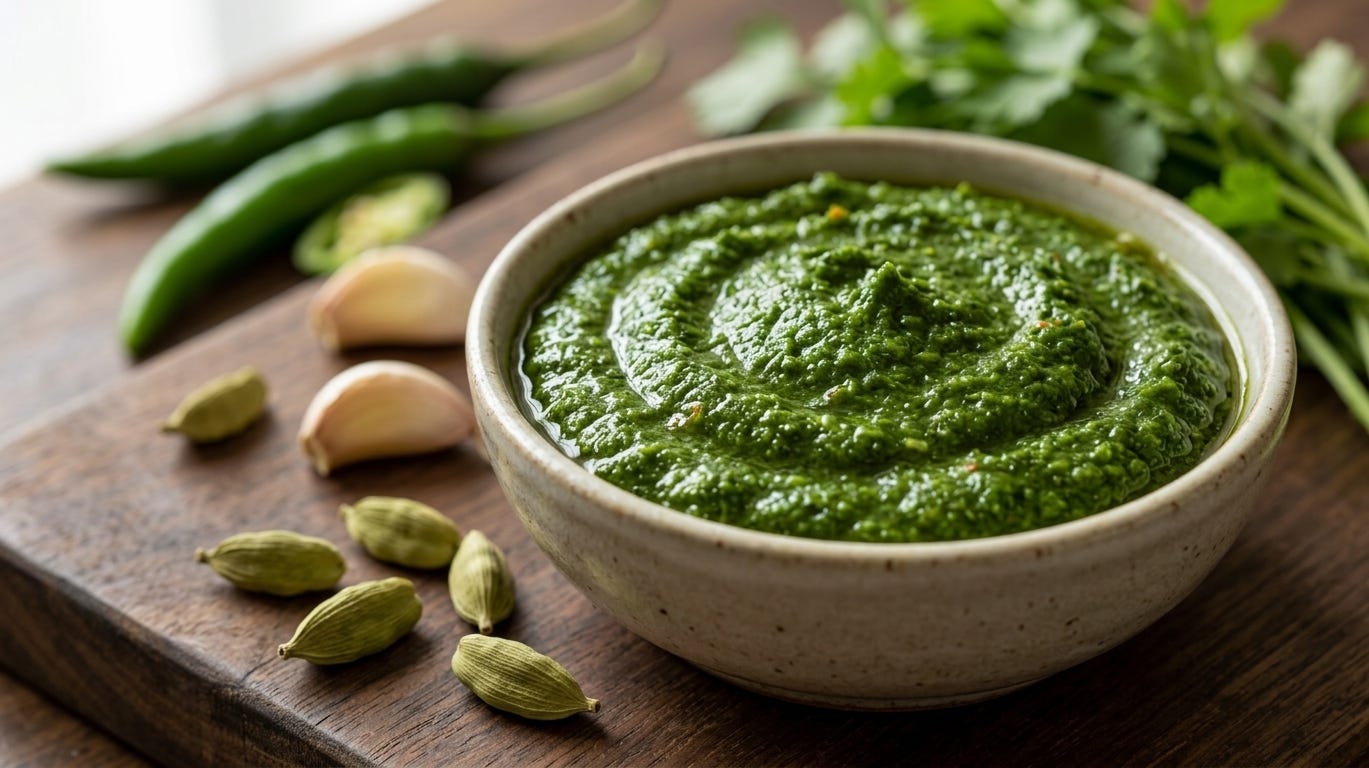
The cardamom is what gives the sauce its lift, its coolness beneath the heat, its unmistakably Yemenite identity. Like Arab coffee, zhoug is one of those dishes that reveals how deeply cardamom entered the Jewish and Arab kitchens of southern Arabia - not as an occasional spice, but as part of the flavour grammar itself.
Claudia Roden, writing about Jewish food across the diaspora, observed that each community carries its own aromatic fingerprint - Baghdadi and Yemenite Jews reach for cardamom, Turkish Jews for cinnamon and allspice, North Africans for orange blossom, Persians for saffron and rose.
These are not random preferences. They are sedimented history: the record of each community’s trade position, migration route, and kitchen culture, preserved in smell and taste.
”What a cook reaches for without thinking is often what a merchant carried for centuries.”
When Iraqi Jews migrated to India in the nineteenth century, they did not encounter cardamom as foreign. They arrived already knowing it.
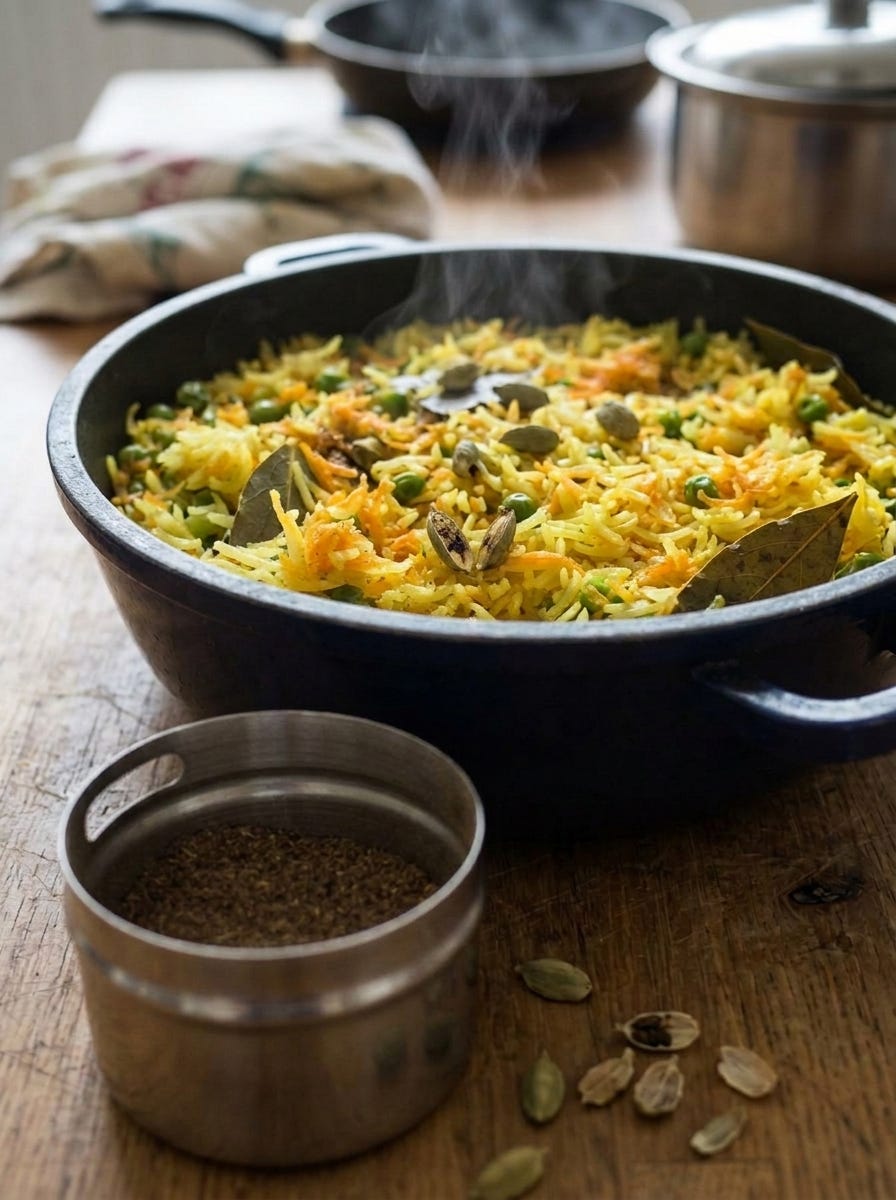
What intensified - turmeric, ginger, mustard, coriander, fresh chili - was genuinely new. What continued was the old Indian Ocean logic, completing a circuit.
That logic becomes visible, concretely, in Moshe David’s cookbook - from the Bihani community of Yemen, one of the most ancient and internally distinct Jewish populations in the world.
Not one fingerprint of Indian contact, but two. And they are not the same kind of fingerprint.
Two Fingerprints: What Moshe David’s Cookbook Actually Is
The first of his cardamom recipes is a recipe for poached fish in herb sauce.
It calls for whole green cardamom pods dropped intact into a savoury broth. This is rare in the Arab culinary record. Ground cardamom is the Arab and Persian tradition - the spice dissolved into sugar or fat, its identity dispersed into a larger aromatic structure.
Whole cardamom, left intact in a savoury liquid to perfume from within as it cooks, is the subcontinental technique - the logic of the biryani, the korma, the slow-simmered pot.
The chemistry explains why this matters. When whole cardamom pods are placed in hot liquid, the fat-soluble terpenoid molecules dissolve slowly and continuously into the surrounding medium, perfuming from within rather than evaporating from the surface. Ground cardamom releases its volatile oils immediately: a burst of aroma that fades quickly. Whole cardamom is a sustained release, a slow conversation between the pod and the liquid that surrounds it.
A cook who uses whole cardamom in a savoury broth understands not just that it belongs there - they understand how it behaves. This is not just the adoption of an ingredient, but of a technique - and of a knowledge of what that ingredient does.
The second fingerprint is more surprising. Moshe David’s chicken mandi - mandi being a slow-cooked meat and rice dish from Hadhramaut, one of the great identity dishes of Yemeni cooking - contains in its spice mix black cardamom, badi elaichi, Amomum subulatum.
This is a Himalayan spice. Its culinary home is the Mughlai northern Indian kitchen: nihari, slow-braised meat, garam masala in its northern form. It has no presence in traditional Yemeni or Gulf spice architecture. It has no business being in a mandi spice mix - except that it is there, in a Jewish Yemeni cookbook from Aden, doing something that requires precise knowledge of what that spice does to slow-cooked meat over long heat.
Black cardamom does not add freshness or lift. It adds depth: a smoky, resinous, camphoraceous foundation that meat absorbs slowly over hours. Not an accent. A load-bearing element. A cook who puts black cardamom into a mandi spice mix knows exactly what they are doing - and that knowledge could only have come from the northern Indian meat-cooking tradition.
Mandi is not a neutral vehicle. It is a Hadhrami identity dish, carried by Hadhrami merchants and migrants across the entire Indian Ocean world - to the Swahili coast, to Southeast Asia, to Hyderabad. The Hadhramis were in Hyderabad. They cooked there, traded there, settled there. That knowledge arrived in Moshe David’s kitchen not as a conscious borrowing, but as the natural residue of a port city where every community’s cooking was in permanent conversation with every other.
”It is not a Yemeni Jewish cookbook that shows traces of Indian influence. It is evidence of a third kitchen - Adeni Jewish - that had become something distinct from either of its parent traditions.”
A kitchen that had absorbed Indian technique into an Arab fish dish and Mughlai spice logic into a Hadhrami meat dish, without announcing either transformation, without marking either ingredient as foreign. The whole cardamom pod drifting in the fish broth and the black cardamom lending its smoky depth to the mandi spice mix are not exotic additions. They are, by the time Moshe David writes them down, simply what you do.
Aden, where this kitchen formed, was the hinge.
Under British administration from 1839, it became part of the British Raj and one of the most trafficked ports in the world, where Indian merchants, Somali traders, Arab sailors, Hadhrami diaspora communities, and Bihani Jewish cooks all converged. Moshe David’s cookbook is the record of what happened when those logics met a Jewish kitchen that was already, by centuries of Mesopotamian inheritance, entirely at home with cardamom - and learned, in Aden, that there was more than one way to use it.
The eight dishes that appear as evidence in this essay - Arabic Kahwa, Elaichi Chai, Swedish Kardemummabullar, Cardamom Kheer, Moshe David's Poached Fish, Moshe David's Chicken Mandi, Hyderabadi Biryani, and Sichuan Hot Pot - are available with full recipes and headnotes in the companion piece: Cardamom: Eight Recipes from Four Civilizations by Elli Benaiah and Khaja Zafarullah.
Conclusion
This essay began with a botanical fact: a plant from the Western Ghats, ancient and specific, whose name in the formal language of science is still, at its root, a Dravidian word.
It ends with two recipes from a Jewish cookbook in Aden - one fish dish using whole green cardamom pods in a savoury broth, one chicken mandi carrying black cardamom in its spice mix - and with a small steel box of pods beside a stove in Hyderabad, reached for without thinking.
These are the same story told from different positions along the same route.
What migratory kitchens carry is not recipes but grammar.
Recipes change - they absorb new ingredients, adapt to new markets, respond to circumstance. Grammar does not. The deep knowledge of how ingredients behave, what they do to fat and heat and time, which combinations are load-bearing and which are decorative - that knowledge is harder to displace than a dish, more durable than a technique, more resistant to assimilation than a language. A community can lose its language within three generations. The spice grammar of its kitchen often outlasts it by centuries.
Moshe David did not write a historical document. He wrote a cookbook. But the black cardamom in his mandi spice mix, and the whole green cardamom pods in his fish broth, tell us something no document we have found can match: that a cook in nineteenth-century Aden had absorbed the spice logic of two different culinary civilizations so completely that neither registered as foreign.
The seam had disappeared.
We began this essay from opposite ends of the Indian Ocean world. I followed the Jewish kitchen westward from Baghdad and eastward from Aden; Khaja followed the subcontinent’s spice logic outward from Hyderabad and Kerala.
We met over a cardamom pod - which is to say, over a grandmother’s steel box beside a stove, and a spice mix in a Yemeni dish that had no business containing a Himalayan ingredient, and yet did.
What stays is not the trade route, or even the chemistry. It is the image of that hand reaching into the steel box without looking. By then the journey from Kerala to Arabia and back again had become invisible. It had become instinct.
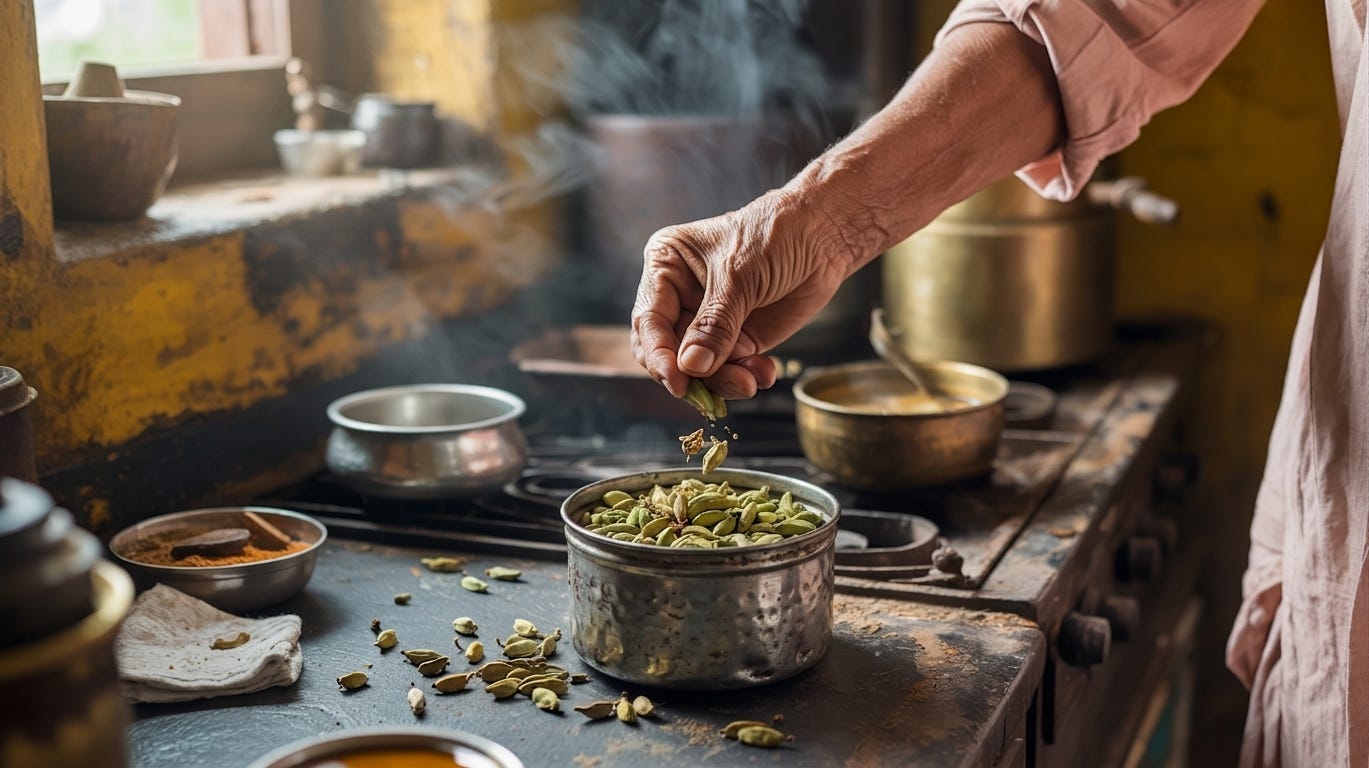
That steel box is still there, in every kitchen that reaches for cardamom without thinking about why. The journey is still happening. It just looks, by now, like habit.
My thanks to Khaja Zafarullah of Hyderabad for his generous correspondence and insights. Trained in biochemistry and human genetics, with an MBA in supply chain management, Khaja has pursued careers ranging from technology and marketing to professional cooking. Now retired, he describes himself simply as a lifelong traveler, a student of food history, and a passionate observer of the culinary traditions of the Indian subcontinent. His family memories and observations enriched this essay considerably.
If you enjoyed this essay, you might also like my previous dispatch on Part one: The Fizz
Beyond Babylon continues to trace Jewish life and food across unexpected geographies.
You’re welcome to subscribe or share the piece with someone who might enjoy it.
 | A guest post by
|
Tell me what you are interested in and I will translate the recipe, if he has it. It’s one of the best cookbooks I have owned. Not fancy but packed with knowledge.
What a fantastic essay. I could literally taste every recipe, because I know them. The memory of all the dishes literally awakens the Pavlovian taste buds.
If I happen to be in your geography or you in mine, allow me to make for you the exquisite Gujarati street chai- it is as much an ode to elaichi as it is to the entire spice box.