
The Condiment That Refuses to Take a Back Seat
How Yemenite Hilbeh Gets Baked into Saltah

A condiment is supposed to stay on the side. Hilbeh refuses.
Hilbeh - Yemen’s whipped fenugreek froth - usually behaves like a condiment. Smear it on saluf - Yemen's flatbread, often baked with hilbeh already worked into the dough - add it at the table, even spoon it into soup, take it or leave it.
I grew up on hilbeh and I actually eat hilbeh with white asparagus. But that’s me. The point is that hilbeh, like other condiments, chutneys, pickles, should live on the side of the plate, for that extra kick.
Even knowing that Yemenite Jews spoon hilbeh into the soup bowl at the table, what I hadn’t grasped was that it could be baked into a stew - fused, not added. That’s what saltah does.
In Yemen’s national dish - saltah - hilbeh stops being optional. The stew is assembled - meat, broth, vegetables - in a heat-retaining stone bowl.
The hilbeh goes on top. And then the whole thing goes back under heat until it bubbles. Not stirred in, not garnished on: poured over and fused, by heat, into the dish itself.
Saltah, the national dish of Yemen, Courtesy Youtube and @SeemaPankhania1
In most kitchens, hilbeh is a garnish you add at the table. In saltah, it’s poured on as a layer. And under that final blast of heat, it stops being an addition altogether and becomes a structural ingredient - the thing the dish is built around.
Every cuisine has a chutney, a relish, a hot sauce that rides alongside the main dish, present but separable. Saltah’s hilbeh shows what happens when that boundary collapses - when the side dish becomes the dish.
To be fair, there are dishes that cook chutney into the sauce - bobotie, chutney chicken - but there the chutney is an ingredient from the start. Saltah's hilbeh is prepared as if it were going to stay separate, and only becomes part of the dish through violent last-minute contact with heat.
Fenugreek itself is almost ordinary - one of the oldest cultivated plants in the Near East, found in Egyptian tombs, Mesopotamian medicine, Roman remedies, and kitchens from Morocco to India.
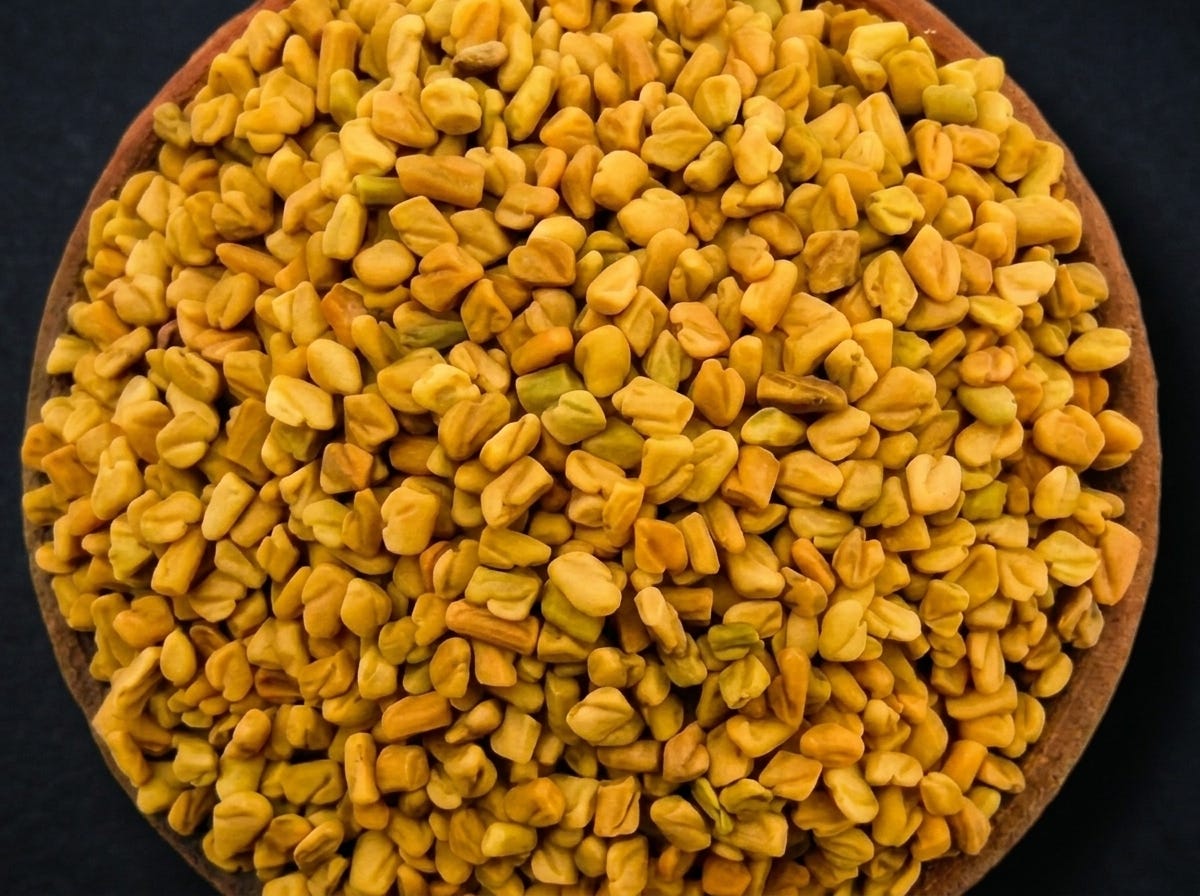
Fenugreek seeds. Ancient, widespread, almost ordinary.
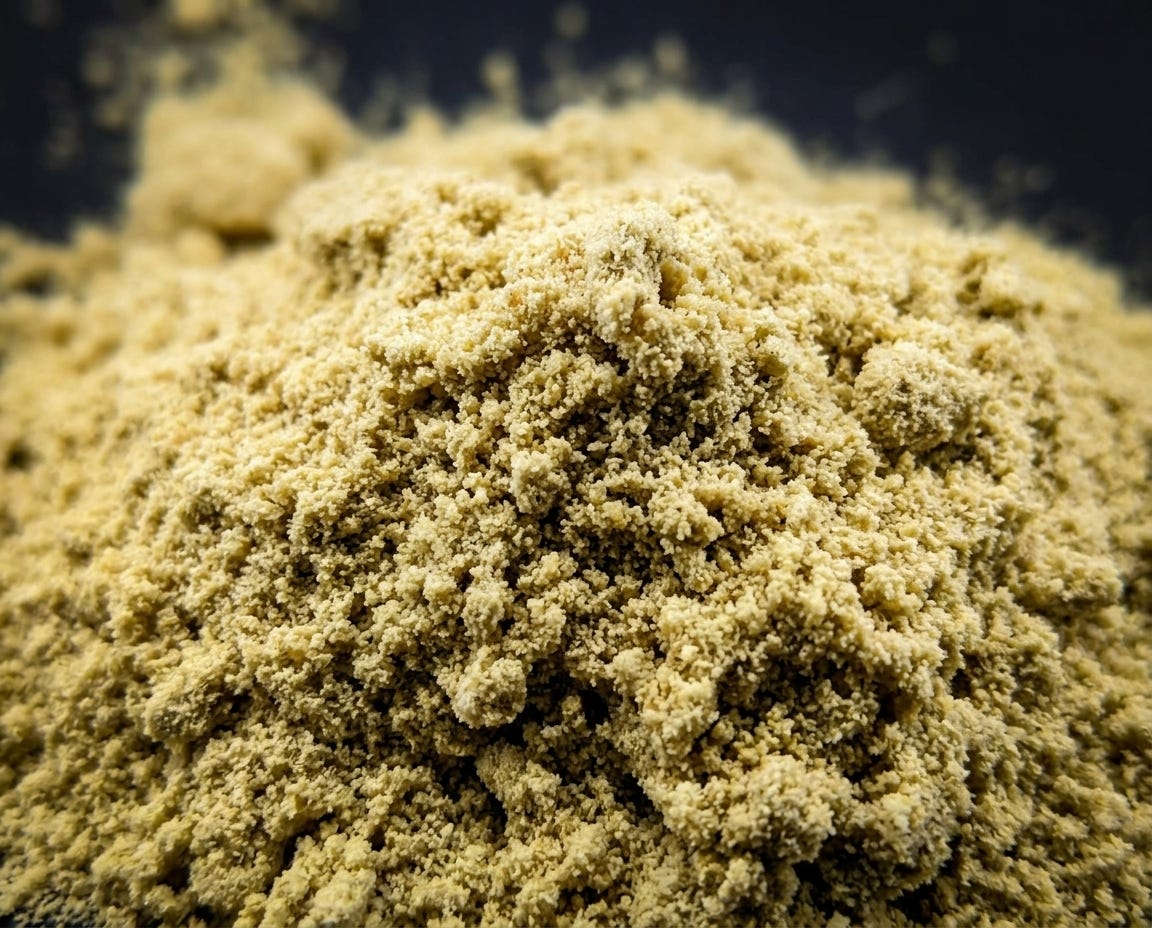
Ground fenugreek. In most cuisines, this is where the story ends.
Nearly everywhere, it's treated as a spice or herb: toasted and ground into blends like Ethiopia's berbere, dried as kasuri methi and scattered through North Indian dishes, or used fresh as a leafy herb, as in Persian ghormeh sabzi, where fenugreek leaves are cooked down for hours until they disappear into the stew itself.
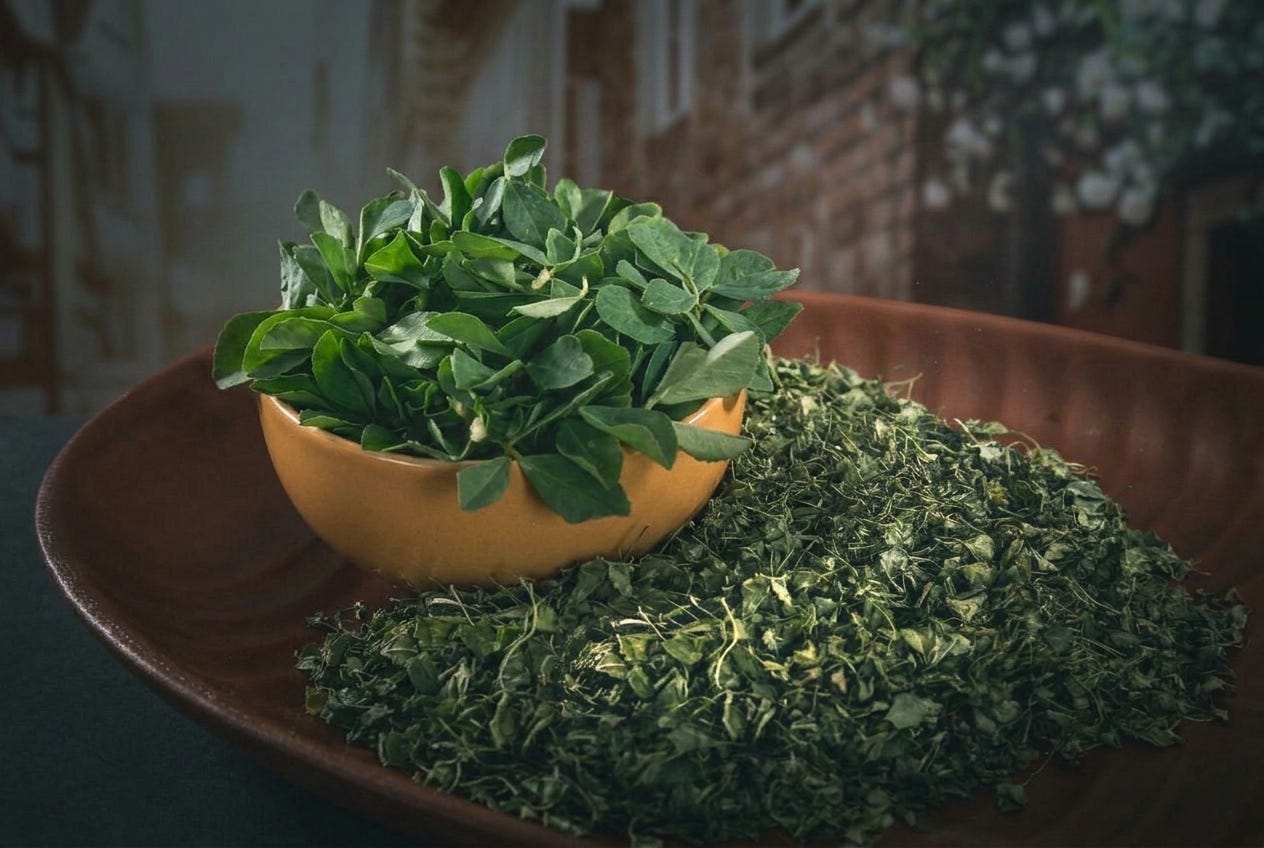
Fresh as a herb. Dried as a seasoning. Hilbeh is something else.
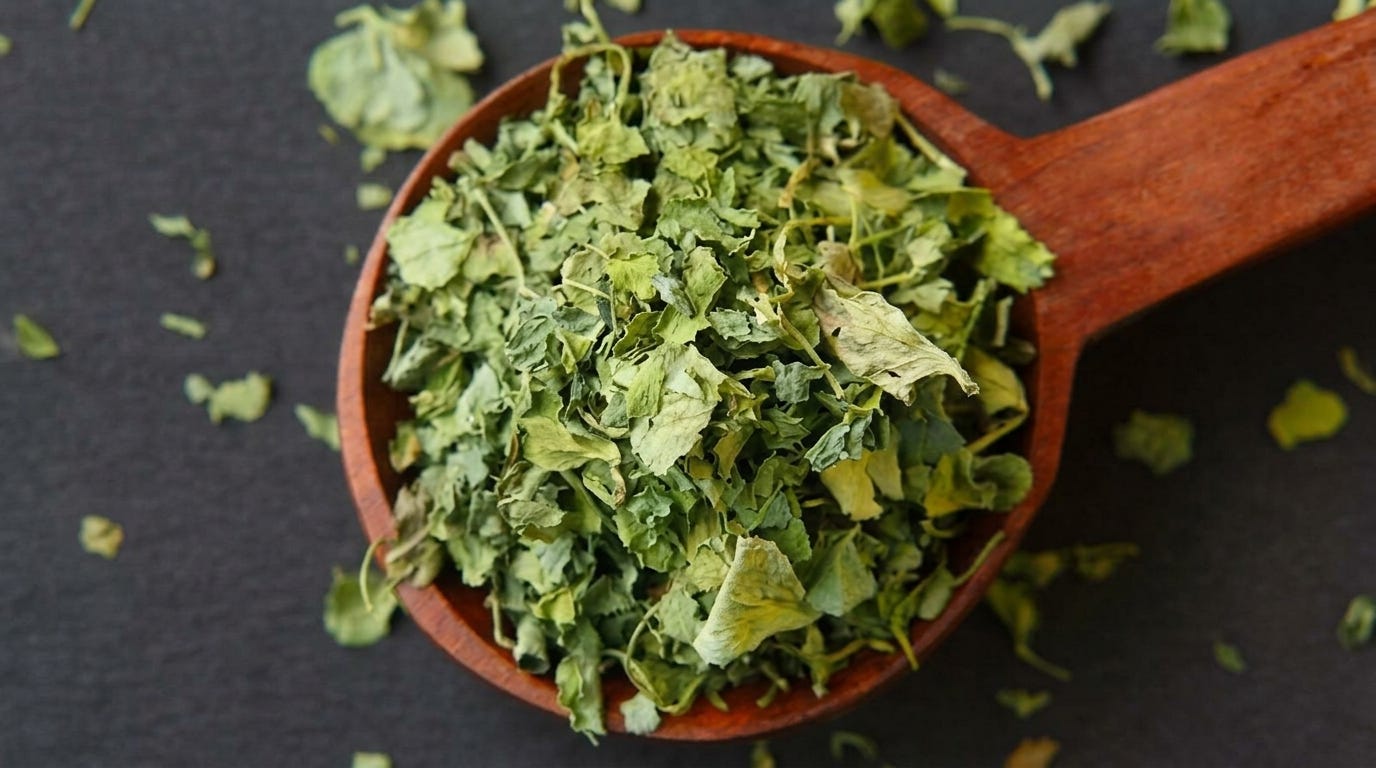
Kasuri methi (dried fenugreek leaves). Across the Indian Ocean world, fenugreek appears as a spice, a herb, and a medicine. Yemen transformed it into hilbeh - a dish in its own right.
Yemen did something almost no one else did with the same plant: instead of grinding the seed into a blend or melting the leaf into a sauce, it isolated fenugreek, gave it its own elaborate preparation - soaked for hours, drained, whipped until it turns from bitter brown to pale and foamy - and let it stand alone as hilbeh, a dish in its own right.
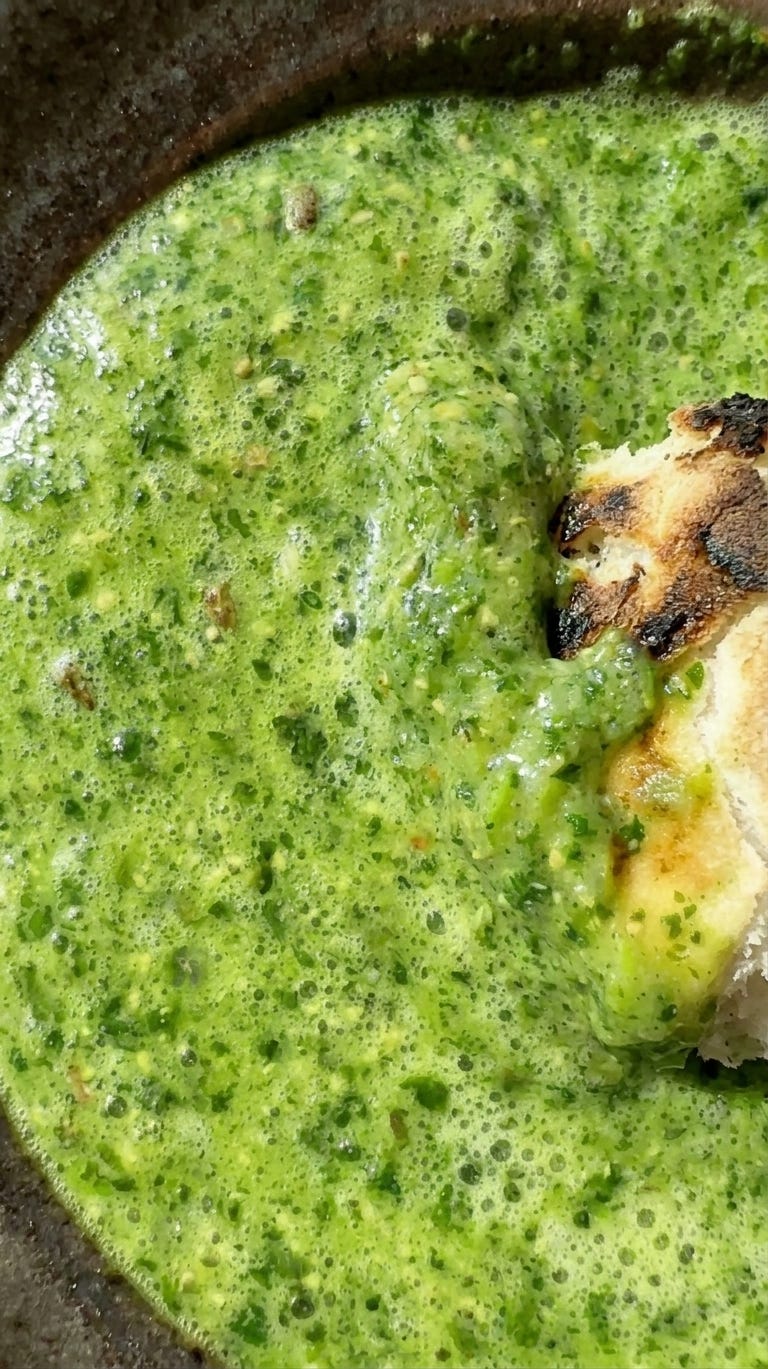
Hilbeh. Fenugreek transformed from spice into foam.
Even across the Red Sea in Ethiopia, where fenugreek is equally familiar, abish remained a spice. Yemen alone seems to have made this move - from ingredient to dip to dish.
But Yemen didn't keep it.
Jewish migration carried hilbeh outward in at least two directions: into Cochin and then Calcutta, where it survived for generations as olba and hulba, a softer, quieter, Friday-night fossil of the original; and later into Israel, where ḥilbeh became one of the few Yemenite foods most people outside Yemen have actually heard of.
What makes this whole story stranger still is that saltah isn’t one dish.
The cookbook I’ve been working from gives three versions side by side: a “regular” saltah, a central-Yemen saltah, and a southern saltah - and they don’t agree with each other about what saltah actually is.
The video clip above, of Abyr - a Yemeni food-truck cook - walking an Indian content creator through saltah’s regional variations, bears this out from the ground: ask people where saltah comes from and which version is “real,” and you get as many answers as people asked.
The “regular” version is the one closest to what most descriptions outside Yemen call the national dish: meat, onions, peppers, garlic, spices, sometimes egg or rice, cooked together, then hilbeh poured over at the end in a very hot vessel until everything bubbles. One pan, one motion.
Saltah is traditionally cooked and served in a stone or clay pot called madra or haradha, which retains heat at the table.
The southern version is something else entirely - it’s explicitly a leftovers dish. Yesterday’s lamb, yesterday’s rice, whatever’s in the pot, reheated in the same hot stone vessel and finished the same way: hilbeh on top, back under heat, bubble. This actually matches the most common origin story for saltah - that it began in Ottoman-era charitable kitchens, donated leftovers from wealthy households and mosques, stewed together for the poor in stone pots.
The name itself may carry this history: 'saltah' likely derives from the Arabic salatah (composition of mixed things), a word that arrived with Ottoman troops - which would make even the name an artifact of the leftovers-and-mixture origin story.
I can see its logic preserved, generations later, in a recipe that still says: take what’s left over, heat it until it’s one thing again, add hilbeh and call it saltah.
Saltah’s essence is a slow-simmered broth served bubbling in its own pot, and marak regel - a cheap, long-cooked beef-leg soup stripped of the foam, salsa, and stone-pot theatre - is its poor man’s distillation of that same idea.
And then there’s the central-Yemen version - the one that sent me down this path in the first place. This one is the most architectural of the three. It isn’t assembled from leftovers; it’s built in four separate parts - broth, vegetables, meat, hilbeh - each made on its own, then brought together only at the very end.
The broth is a tomato-and-onion base, built on hot water, the white parts of green onions, crushed tomatoes, garlic, tomato paste, and a soup hawaij - a spice blend in the cardamom-cumin-coriander-turmeric-clove family that I keep finding, in one form or another, in every kitchen this project touches. The vegetables - potatoes, okra, zucchini - are cooked separately in some of that broth.
The broth's garlic-and-chili backbone shares its DNA with zhoug, Yemen's other great green condiment - though here those flavours are cooked into the base rather than finished raw on top, the opposite move from what hilbeh does.
The meat - the recipe specifies neck, though it notes the original would have used lamb - is pressure-cooked in broth of its own until it falls apart. And the meat, it turns out, is the one part of saltah nobody seems to take seriously.
Beef, lamb, camel - every Yemeni I’ve asked insists theirs is the only correct version saltah. A dish that asks you to soak fenugreek for four hours, whip it into a foam, and fuse it onto a stew under violent heat - and then, apparently, a double-humped curry.
Saltah, it seems, will absorb almost anything except a fixed identity.
And the hilbeh, here, is its own small ceremony. Ground fenugreek, soaked for hours until it loses its raw bitterness and swells into something gel-like. Drained, then whipped until it turns pale and foamy - almost meringue-like, if meringue could be green and slightly funky. Then, only at the end, the fresh things go in: sometimes chopped leek, cilantro, finely chopped chili, lemon juice, salt. This is the part that’s still a condiment, technically - fresh, raw, assembled last, the way a salsa or a chutney would be.
And then it stops being a condiment. The stone bowls go into the oven to heat until they’re dangerously hot. Meat, broth, and vegetables go in first. The hilbeh - that pale, foamy, fresh-tasting thing - gets poured over the top. And the whole bowl goes back under heat, briefly, until it’s bubbling.
What comes out is not “stew with a fenugreek garnish.” The heat does something to the hilbeh that nothing else in the dish does to anything else - it’s the only element that goes in raw and finished, in the same dish, in the same minute. Everything else has already been cooked, separately, for hours. The hilbeh is cooked for seconds, by contact, fused onto the surface of everything else by a heat so sudden it’s almost violent. The dish needs that specific collision - cold-fresh meeting screaming-hot - to become what it is.
I went looking for similar dishes in the Yemeni kitchen, and the word that kept coming up wasn’t saltah - it was fahsa.
Saltah's closest relative turns out to be fahsa - but the difference isn't which animal. It's what you do to it. Fahsa uses chopped or shredded lamb, cooked until it falls apart; saltah keeps the meat in chunks. And where saltah makes room for vegetables, fahsa is meat only.
And when Yemeni Jews brought this dish to Israel, it thinned - the four-part architecture compresses, the stone bowl becomes a pot, and what’s left is marak temani, leaner and more portable than its ancestor.
The various names and permutations may point to different dishes, but the underlying idea remains the same: a hot soupy stew completed by hilbeh at the last possible moment.
Central-Yemen Saltah
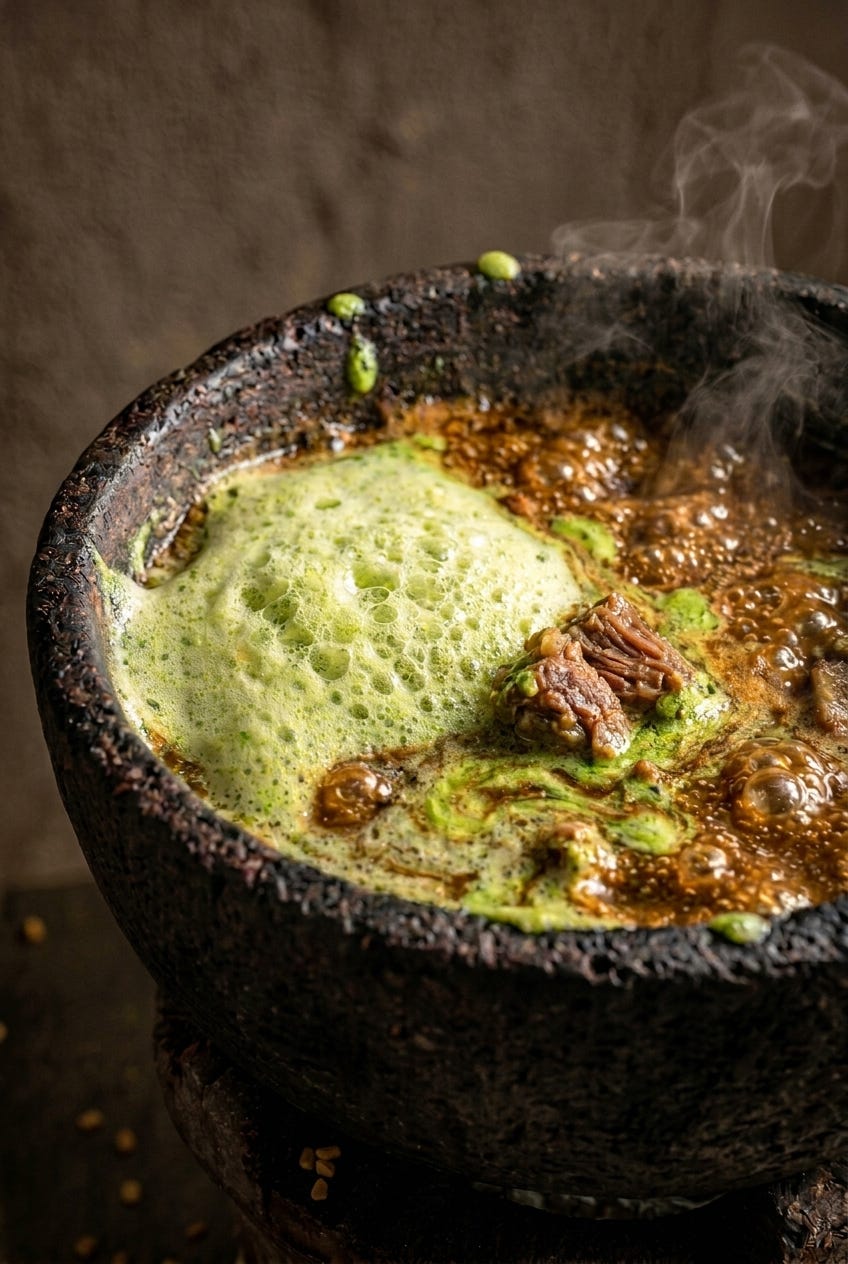
Saltah; Hilbeh, mid-collision: poured cold and fresh onto a screaming-hot stew, fusing into the dish in seconds.
What follows is the central-Yemen version from the cookbook that inspired this essay: a saltah assembled in separate layers and united only at the end by a blanket of bubbling hilbeh.
This version comes from Moshe David's Yemenite Jewish cookbook, which I've referred to a number of times in this project.
Serve with saluf or lahuh (Yemeni flatbreads - saluf thin and crisp, lahuh spongy and fermented, similar to Ethiopian injera).
Serves 6–8
Ingredients
For the broth:
3 tbsp vegetable oil
White parts of 5 green onions, finely chopped (reserve the green parts for the hilbeh)
2 ripe tomatoes, grated
6 cloves garlic, crushed
1 small can (140g / 5 oz) tomato paste
1–2 tbsp soup hawaij, or to taste
(a blend of black pepper, cumin, cardamom, coriander, turmeric, and clove)1.5 litres (6 cups) hot water
Salt to taste
For the vegetables:
3 medium potatoes, cut into large chunks
200g (7 oz) okra, trimmed
3 zucchini, cut into large chunks
For the meat:
1kg (2.2 lb) beef neck, trimmed and cut into chunks
(lamb neck or shoulder may be substituted)
For the hilbeh:
1 tbsp ground fenugreek
3 cups water
1 tbsp finely chopped fresh cilantro
Reserved green tops of the green onions, finely chopped
1 small hot green chilli, finely chopped
1–2 tbsp lemon juice
Salt to taste
To serve:
Saluf, lahuh, or other flatbread for scooping
Method
Prepare the Hilbeh
Place the ground fenugreek in a bowl and cover with the water. Leave to soak for 3–4 hours, or even overnight.
Drain off most of the soaking water and whisk vigorously until the fenugreek becomes pale, airy, and foamy. Traditionally this is done by hand; a whisk or immersion blender on low speed also works.
Fold in the cilantro, green onion tops, chilli, lemon juice, and salt. The finished hilbeh should remain light and textured rather than smooth. Set aside.
Prepare the Broth
Heat the oil in a large pot.
Add the chopped white parts of the green onions and cook until softened but not browned. Add the grated tomatoes and garlic and cook for several minutes until fragrant.
Stir in the tomato paste and hawaij. Cook for another minute, then add the hot water and salt.
Bring to a boil, reduce the heat, and simmer for about 20 minutes to allow the flavours to meld.
Cook the Vegetables
Transfer enough broth to a separate saucepan to comfortably cover the vegetables.
Add the potatoes, okra, and zucchini and simmer until tender but still holding their shape.
Set aside in their cooking liquid.
Cook the Meat
Place the beef neck in a pressure cooker with enough broth to cover.
Cook under pressure until exceptionally tender and beginning to fall apart, approximately 45–60 minutes depending on the cut.
No pressure cooker? No problem.
Use a heavy pot with a lid and simmer over low heat, covered, for 2.5–3 hours, topping up with broth as needed, until the meat is falling apart.
Reserve the cooking liquid.
Assemble the Saltah
Preheat the oven to its highest setting.
Place six to eight individual stone bowls, cast-iron crocks, or heavy ovenproof serving bowls into the oven and heat until very hot.
Divide the meat among the bowls. Add some vegetables to each bowl and ladle over enough broth to create a rich stew.
Generously spoon the hilbeh over the surface of each bowl. The hilbeh should form a distinct pale-green layer floating above the stew rather than being stirred in.
Return the bowls to the oven for several minutes until the contents are bubbling vigorously and the hilbeh begins to set around the edges.
Serve immediately.
The moment of transformation happens in the oven. The cool, fresh hilbeh meets the intensely hot stew beneath it and briefly becomes part condiment, part sauce, and part crust. That collision is the essence of central-Yemen saltah.
Hilbeh simply refuses to stay on the sidelines.
This is the recipe that sent me down the rabbit hole.
👉 Get your printable PDF recipe for Saltah here
Beyond Babylon continues to trace Jewish life and food across unexpected geographies.
If this piece found you, feel free to share it.
I am intrigued! I only know fenugreek as an ingredient in curries. I cannot imagine hilbeh taste 🤔🤔🤔 Well: only one way to find out… 🙏
Super interesting. I wonder if the ‘methi tadka’ arrived in the subcontinent with the diaspora, or if it is a homegrown innovation.