
Mocha
The Yemenite city that caffeinated the world

Many know that mocha is espresso, steamed milk, and chocolate - a latte with chocolate added.

Mocha. Photo by The Spruce Eats
It is also a colour: warm brown, the shade of the drink, or the bean. Fewer know that what we call mocha is clever marketing. The name actually comes from a Yemeni port city. Most people who order one have no idea they are ordering a city.
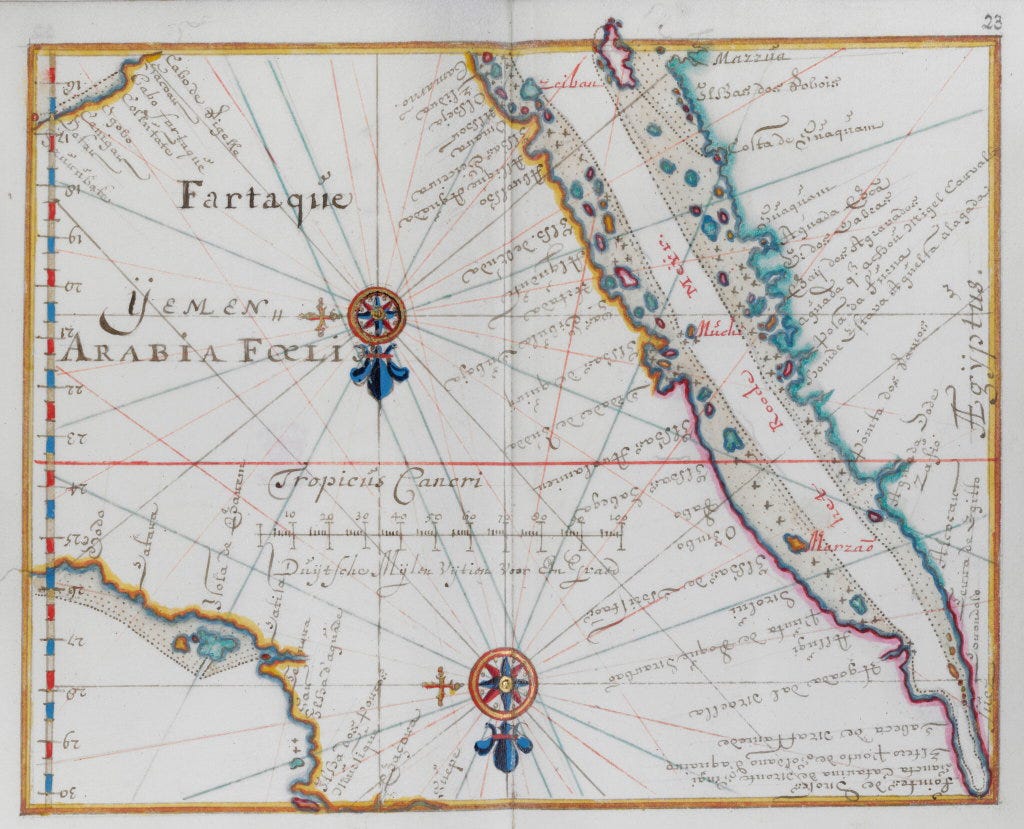
Yemen - Arabia Felix. Portuguese nautical chart, 16th century. Mocha (Méda) marked on the Red Sea coast, the port that would caffeinate the world.
The city is Al-Mukha - Mocha - which sits on Yemen’s Red Sea coast, a port that for nearly three centuries controlled the world’s entire supply of coffee.
Every bean that reached the Ottoman coffeehouse, the London counting house, the Amsterdam merchant ship, passed through this city first. The port’s name traveled with the beans. When the monopoly finally broke, but the name stayed - long after the city itself was forgotten.
The mocha you order today is not a distant echo of the port that named it. It is something else entirely - a chocolate drink that borrowed a flavour association that was itself already a metaphor.
The word traveled from city to bean to taste to confection, each transfer moving it further from Yemen, until what remains is a name with no address and no memory of how it got there.
This essay is an attempt to return it to the city where it all started.
Mocha’s founding in the 14th century is traditionally associated with the Muslim holy man Shaykh Shadhili, who is said to have introduced coffee drinking to Arabia. The Sufis began cultivating coffee on Yemen’s terraced mountain slopes at elevations between 1,500 and 2,500 metres, in volcanic soil and an arid climate that stressed the plants just enough to concentrate their flavours. These heirloom varieties - still grown today - carry genetics found nowhere else on earth.
When the Ottomans conquered Yemen in the 1530s, they understood immediately what they had. They made one simple rule: every ship passing through the Red Sea must stop at Mocha and pay customs and duties. To protect their monopoly, they partially roasted or boiled all export beans before shipping - killing the seeds, making them impossible to germinate abroad. For nearly two centuries, this strategy worked.
It worked until it didn’t. The Dutch broke the European monopoly first, smuggling a live plant out of Yemen in 1616.
Then, in the 17th century, a Sufi saint from southern India broke it for Asia. Baba Budan smuggled seven fertile coffee beans from Yemen after his pilgrimage to Mecca and planted them in the hills of Chikmagalur, laying the foundation for India’s coffee tradition. He hid the beans in his beard - seven beans, because seven is a sacred number in Islam - and carried them past the Yemeni guards who stood between the world and the plant they were trying to keep to themselves. The hills where he planted those seven beans are now called Bababudangiri. Some of Karnataka’s finest coffee grows there still. The Arabian Sea is still doing its work.
The plant never left Yemen.
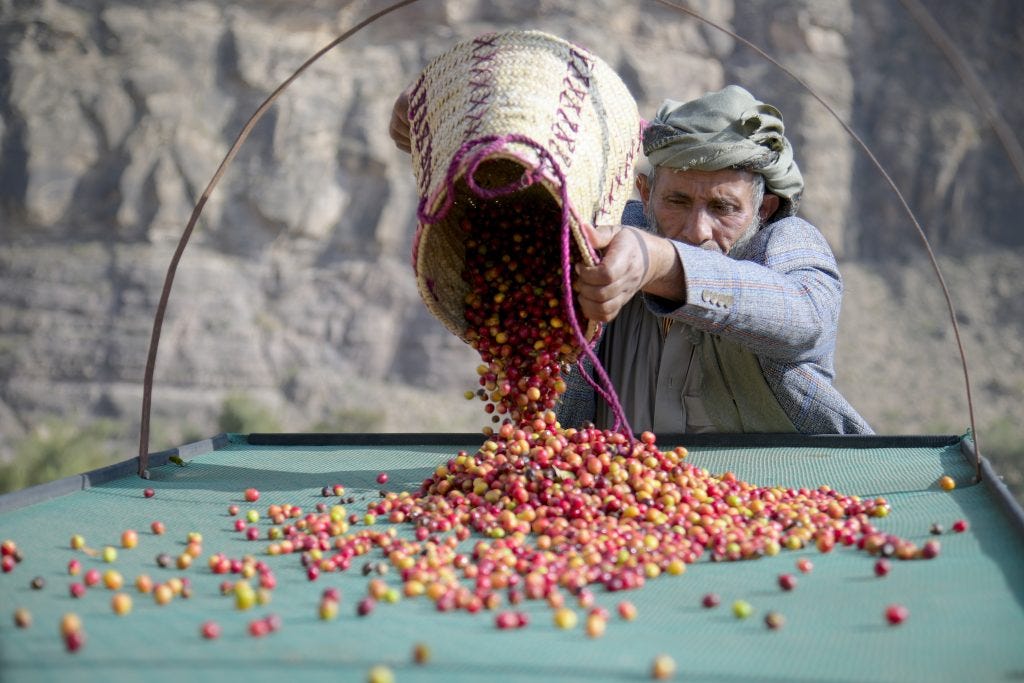
The same heirloom varieties still grow on the same highland terraces - Haraaz, Bani Matar, Wadi Shareef - cultivated by hand at the same altitudes, by farming families who never stopped.
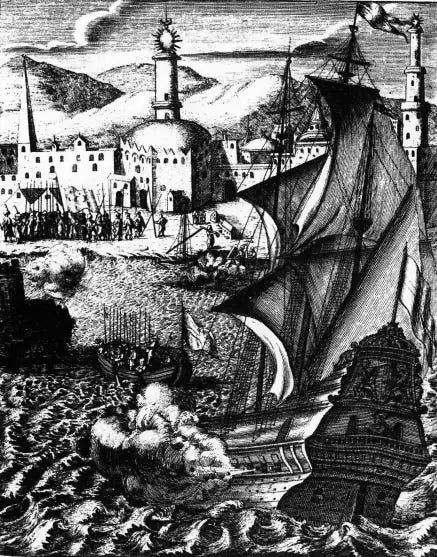
Arrival of a Dutch ship’s delegation at al-Mukha (Mocha), 1640, copper engraving. The city’s towers and citadel walls behind; the VOC ship in the foreground. Within a century of this image, the Dutch would relocate the entire coffee trade to Java. The city in the background would not survive the transfer.
What the Ottoman monopoly controlled, Indian merchants financed. Hindu Bania merchants from Gujarat had made themselves indispensable to Mocha's financial life - settled, some for generations, running brokerage houses, lending capital, connecting Arab, European, and Indian trading networks across the same sea that carried the beans.Even the unit of account was theirs. Everyone at Mocha kept books in an imaginary coin called the Mocha dollar - or, more revealingly, the Bania dollar.
The Ottoman empire controlled the port. The Bania merchants controlled the arithmetic.
Every year around twenty Gujarati ships sailed from Surat to Mocha, carrying textiles, spices, metals and sugar, returning with bullion, ivory and coffee.
Within the city, alongside the European trading factories, some four hundred Jewish households engaged in trade - part of the same network, occupying the same mercantile geography outside the citadel walls.
This connection did not survive the 18th century intact. From the 1720s onward, Bania merchants faced systematic persecution - extortion, beatings, families driven out. The trade declined. The city, deprived of the merchant infrastructure that had sustained it, began its long contraction.
A plague in the 18th century killed half the city's population. The trade had already been leaving. The people followed.
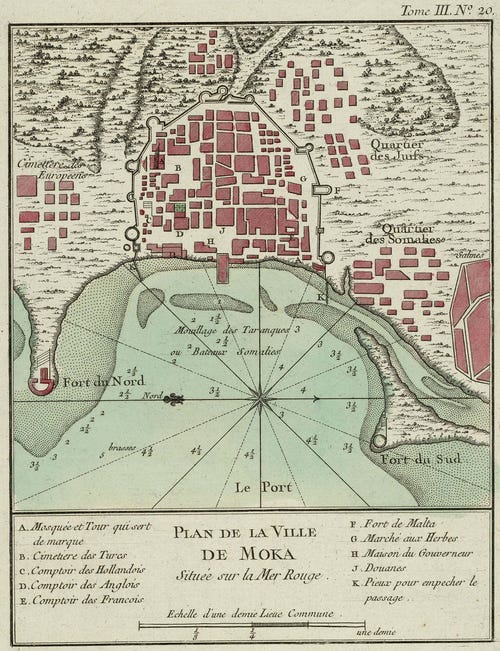
Plan de la Ville de Moka Située sur la Mer Rouge, Jacques-Nicolas Bellin, 1764. Hydrographer to Louis XV of France. The Jewish and Somali quarters are marked outside the city walls; the English, French and Dutch trading factories within. At its commercial peak, Mocha was a study in diaspora geography - each community in its place, each community indispensable.
The numbers tell the story with brutal precision. In 1721, ninety percent of Amsterdam’s coffee imports arrived through Mocha. By 1726 - five years later - ninety percent came from Java. The Dutch had not merely broken the monopoly. They had relocated it. A port city that had structured the world’s coffee trade for two centuries was rendered redundant in the span of a single decade.
What traveled with the beans was the name. Dutch colonial merchants retained the “Mocha” label on their Java exports to give a sense of authenticity to the new crop - even though coffee had never been grown in Mocha at all. It was traded there, shipped from there, priced there. But the plant had always grown elsewhere, in the highland terraces above the Tihamah plain, carried down to the port by camel. The name had been borrowed once from a city. Now it was borrowed again from a bean. Each borrowing carried it further from its origin.
Mocha the city fell silent. Mocha the word went everywhere.
By the time UNESCO surveyed Mocha in 1980, nearly half a century ago, much of the city that had once caffeinated the world was already in ruins. The survey describes collapsing buildings, abandoned mosques, sand-covered walls, and a port whose commercial importance had long since vanished. The name had become immortal. The place had not.
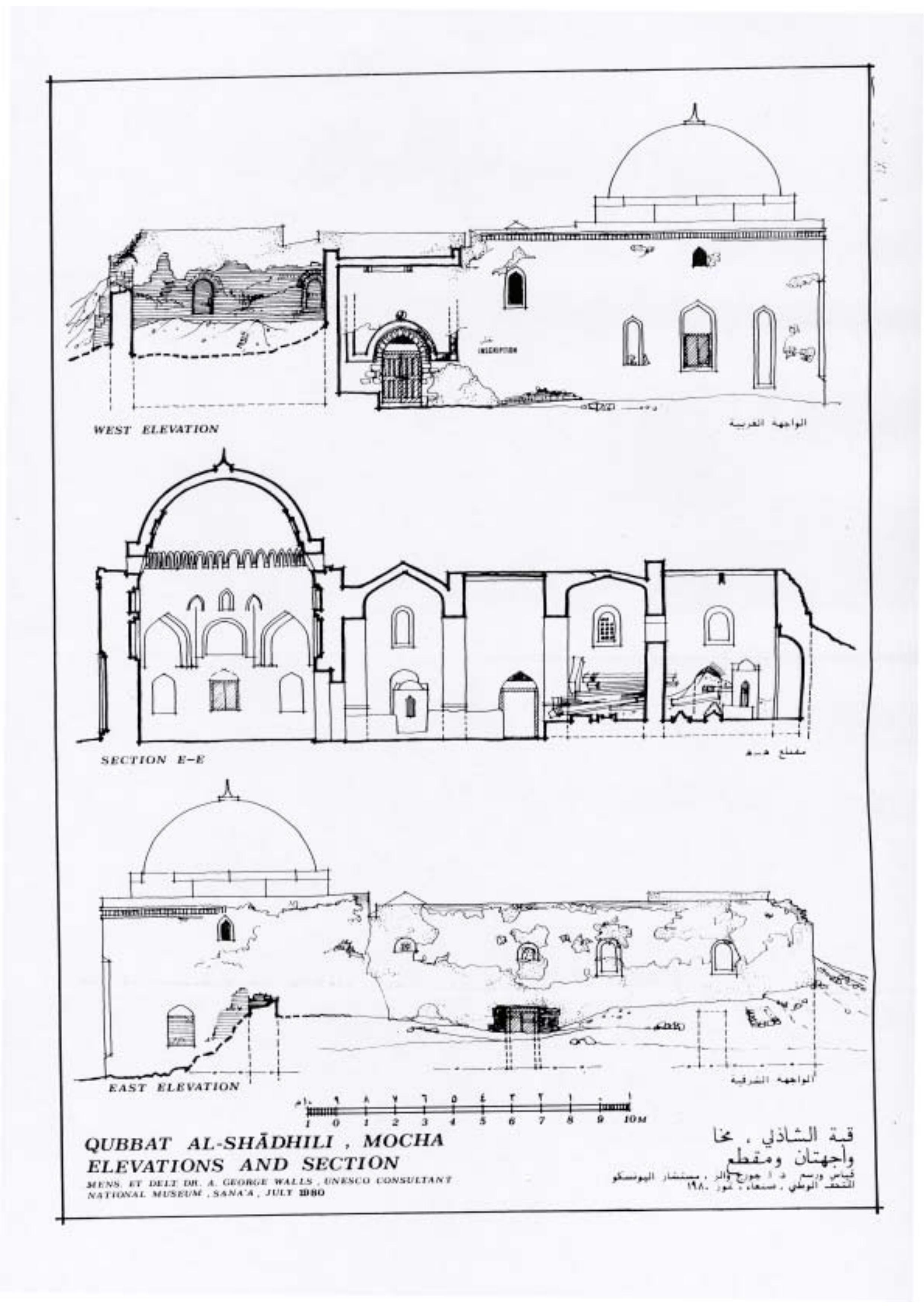
Qubbat al-Shadhili, Mocha: east elevation, drawn by UNESCO consultant Archibald G. Walls, July 1980. Sand dunes consuming the base of the tomb of Mocha’s founding patron. The survey found the city already disappearing into the desert.
This is what empires do to the places that made them possible. They extract the name, carry it forward, attach it to new products in new markets, and leave the original location to crumble.
And so the mocha you order today bears only the faintest relationship to the port that gave it its name - the word emptied of everything that once gave it meaning.
The plant never left. The port did.
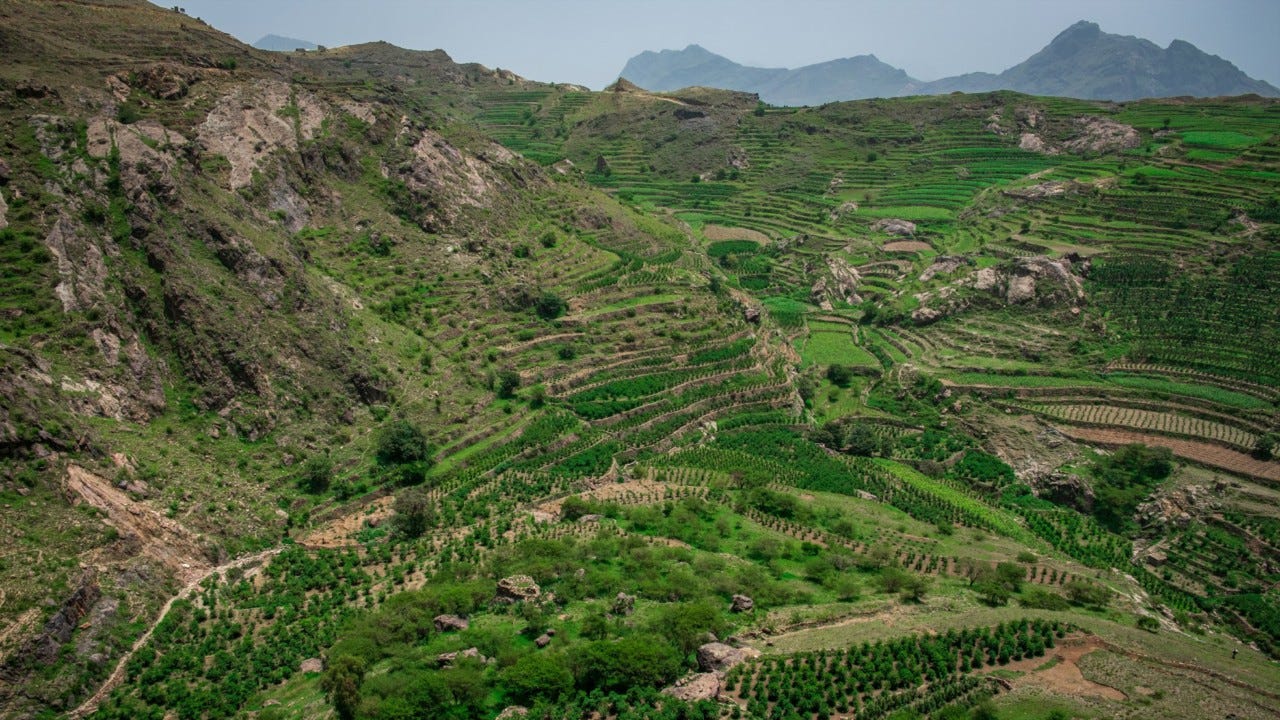
Wadi Shareef, Yemen. Coffee terraces carved by hand into the highland slopes at over 2,000 metres above sea level. The same heirloom varieties. The same farming families. The same mountains that supplied the port of Mocha.
Moshe David, whose Yemenite Jewish cookbook is one of the primary sources for this project, writes a first-hand account of Yemeni coffee that no trade history can give you. He describes the coffee grown in the Haraaz mountains - at 1,700 metres above sea level, organically cultivated in the Yemeni highland tradition - as producing a naturally winey, fruity cup unlike anything else on earth.
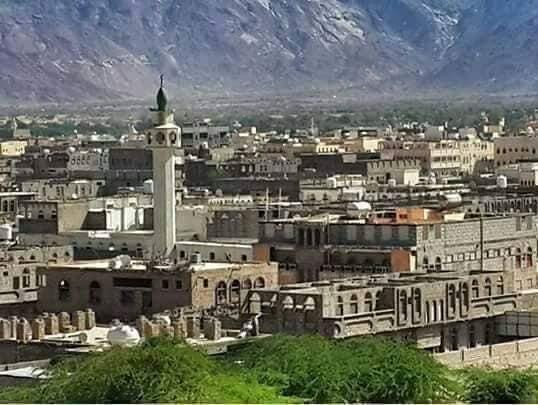
Haybān, Yemen. A highland city in the coffee-growing heartland - the interior world that supplied the port of Mocha for three centuries. The beans traveled down from mountains like these, by camel, to the Red Sea coast. The port is ruins. The mountains remain. (Courtesy Wikipedia).
He lists the varieties by grade and character - Matari and Ismaili at the top, the Ismaili light roast carrying notes of milk chocolate, banana, and field herbs. The dark roast carries notes of ripe fruit, cooked sugar, cinnamon and cardamom.
But what he describes next is not a trade good. It is a kitchen.
The gahwa that Moshe David’s grandmother prepared on Friday afternoons belongs to the same coffee culture traced in our earlier cardamom essay - the culture in which hail, the Arabic word for cardamom, is inseparable from the ritual of welcome, from the obligation of hospitality, from the cup that arrives before anything else is said. What the Baihan white coffee adds to that picture is the domestic interior: not the coffeehouse, not the merchant’s reception room, but the stone mortar, the Friday afternoon, the grandmother’s hands.
There were two white coffees in the Yemeni Jewish world Moshe David grew up in. The first was Qahwa Bayda Yafiee - Yafiee white coffee - made from lightly roasted beans ground fine, simmered with milk, cinnamon, and ginger, drunk morning and evening.
His father drank it every day of his life. This is the everyday version - the domestic rhythm, the cup that marks the beginning and end of each day.
The second was the Baihan white coffee, and this one belongs to a Friday afternoon.
On Sabbath eve, his grandmother would prepare the Baihan coffee from scratch. The beans - unroasted Arabian coffee - were spread in a baking tray and slow-roasted at 160 degrees for sixty-five minutes, watched without interruption. Then ground. Then the spices ground separately: ginger, green cardamom, saffron, cinnamon, sesame.
The grinding was done in the dalah kankan - the tall stone mortar - and the work was passed from grandmother to grandmother as a form of knowledge transfer that had nothing to do with writing anything down.
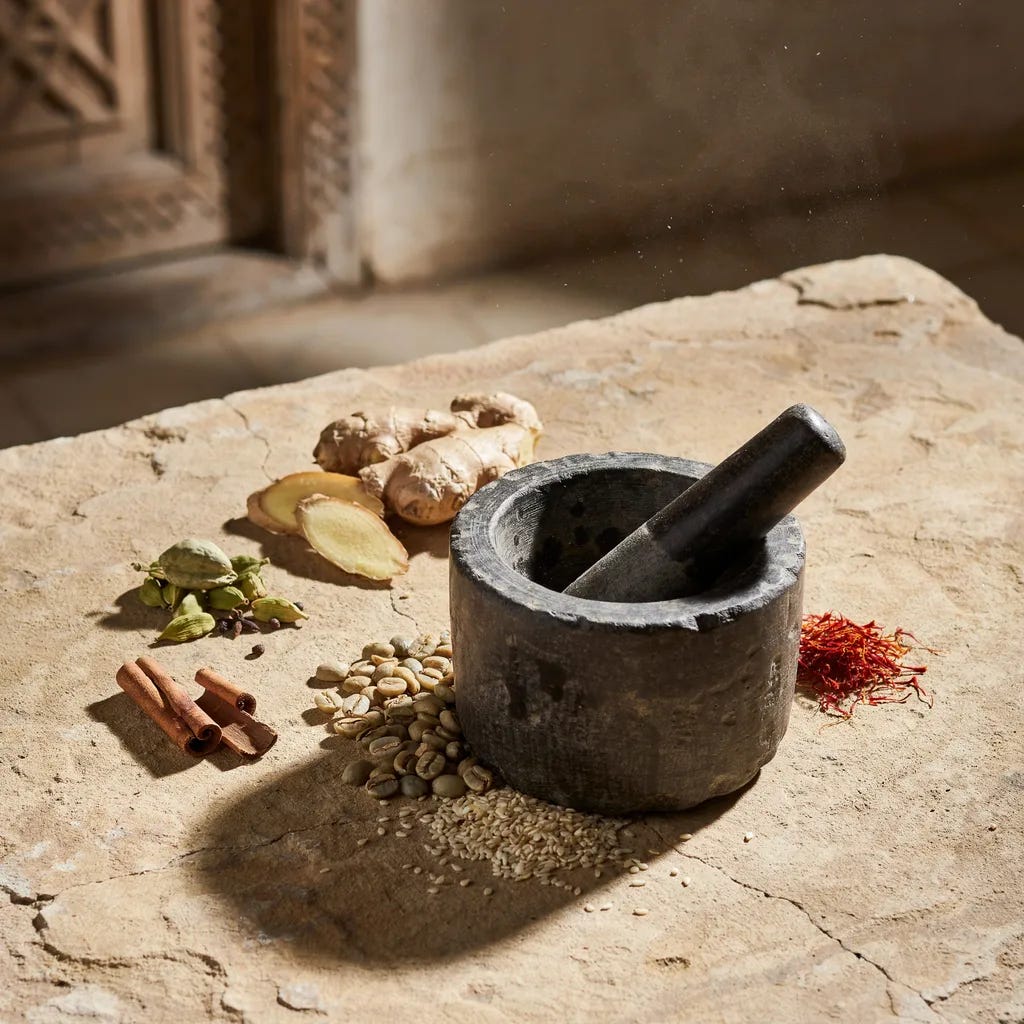
This is the knowledge that port monopolies cannot carry and empires cannot extract.
The Ottoman trade system could move beans across the Red Sea.
The Bania merchants could move capital and credit across the Indian Ocean.
But neither could move the knowledge of what to do with the beans on a Friday afternoon in a kitchen in Aden. That knowledge traveled in a different vessel - in the hands of a woman grinding spices in a stone mortar, passing the motion and the proportion and the timing to the next woman who would need to know it, and the next, until there were no more Friday afternoons in Yemen to prepare it for.
Mocha the city may have fallen silent. The word went everywhere. The grandmother’s mortar kept the meaning.
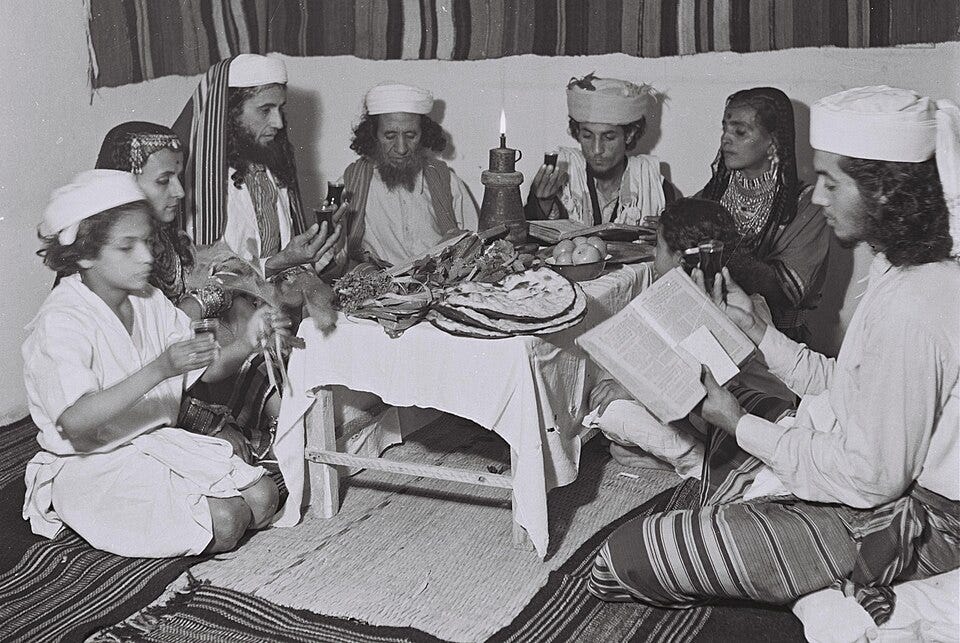
A Yemenite Habani family celebrating Passover in Tel Aviv, 1946.
The port disappeared. The people moved. The knowledge came with them.
Qahwa Bayda Yafiee - Yafiee White Coffee
Adapted from Moshe David’s Yemenite Jewish cookbook
In Yemen this is called simply white coffee - qahwa bayda. Mild, warmly spiced, drunk morning and evening. Moshe David’s father drank it every day of his life. This is the everyday version. The Baihan - the Shabbat ritual coffee, prepared in a stone mortar with saffron and cardamom - follows for paid subscribers.
Serves 2–3
2 cups water
½ to ¾ cup warm milk
¼ tsp ground cinnamon
¼ tsp ground mixed spice
½ tsp ground ginger
1 tsp black Yemeni coffee, lightly roasted and ground
Sugar to taste
Place the water in a pot. Add cinnamon, mixed spice, ginger and sugar. Heat gently - do not boil - over a low flame for 8–10 minutes until the spices have fully infused. Add the milk and warm through without boiling. Add the coffee and continue on the lowest heat for a further 2 minutes. Serve immediately.
A note on the coffee: Yemeni coffee for white coffee is lightly roasted - closer to green than to the dark roast of an espresso tradition. If you can find Yemeni Arabica, use it. If not, a light-roasted Ethiopian Arabica is the closest approximation - the winey, fruity notes of the East African highland bean are what the Yemeni cup was always reaching for.
Qahwa Baihan - Baihan White Coffee
For paid subscribers - adapted from Moshe David’s Yemenite Jewish cookbook
This is the Shabbat version. Moshe David’s grandmother prepared it every Friday afternoon - grinding the beans and spices separately in the dalah kankan, the tall stone mortar, the work passed from grandmother to grandmother as a form of knowledge that had nothing to do with writing anything down. The spice quantities below make a blend that keeps for weeks; the coffee itself is brewed fresh each time.
For the spice and coffee blend
1 kg unroasted Arabian coffee beans
300g fresh ginger
120g green cardamom, fine ground
20g saffron
80g cinnamon, fine ground
10g sesame seeds, untoasted
Spread the coffee beans on a baking tray and roast at 160°C for 65 minutes. Watch without interruption - this is a darker roast than the Yafiee version, stronger, suited to the occasion. Allow to cool completely. Grind the beans. Grind the spices separately. Remove the outer husk of the ginger after grinding. Combine everything and store in a sealed container.
To brew
Bring ¾ litre of water to a boil in a small kettle. Add one large spoon of the blend per person - two cups per person is standard. Two spoons of sugar per cup. His grandmother’s family added honey with black pepper. A spoon of roasted corn in the cup is the traditional accompaniment.
The simple method: place the blend directly in a cup, add boiling water, mix, add sugar. This is how Moshe David drinks it himself. He notes that his grandmother never approved.
A note on the stone mortar: The dalah kankan is not merely equipment. It is the vessel through which this recipe was transmitted. The grinding was the lesson. If you have a heavy stone mortar, use it. If not, a spice grinder works. But something is lost in the translation, and it is worth knowing what.
A note on the cardamom: The cardamom in this blend is not a flavouring. It is the identity of the drink. For the full argument, see our earlier essay: Understanding Cardamom - The Spice the Indian Ocean Made.
Beyond Babylon traces Jewish foodways across the Indian Ocean world. If this essay reached you, consider becoming a paid subscriber - the Baihan recipe lives there, along with the full archive.
Fascinating read.
I can talk to you about tea all day long, but it would seem I don't know much about coffee!
As someone who has long been fascinated by the history of coffee, I found this excellent.