
🌟 A Star Is Born
On Symbols, Misreadings, and Knowing Who we should be

A Beyond Babylon Essay | By Elli Benaiah
It all began with something small — a house up the hill from where I live in Germany, a quiet village just across the border from Switzerland.

The house on Xgasse 13
It was a winter evening before Christmas, and a balcony decoration glowed softly in the cold.
A six-pointed star. A hexagram.
Hanging there without self-consciousness, without history — simply as a seasonal ornament. A shape my people adopted as a Jewish emblem centuries ago in Europe, and later by the State of Israel, where I grew up.
And now a universally recognised symbol, complete with its own emoji.
There was no way the neighbours were Jewish. If they were — which I sincerely doubted — they would never announce it from a balcony. Not these days. Not ever.
And yet: a huge Star of David on a German balcony.
Instead of unsettling me, it made me pause.
Because this is where the story begins — with a symbol wandering far beyond the meaning it was born with. A reminder of how much of our attachment to symbols is constructed, inherited, or simply invented, and how those meanings harden when we stop questioning them.
That single star sent me down a path of research and reflection — a straight line connecting two shapes that originated in the East, migrated into Europe, and were eventually drafted into nationalist stories they were never meant to tell.
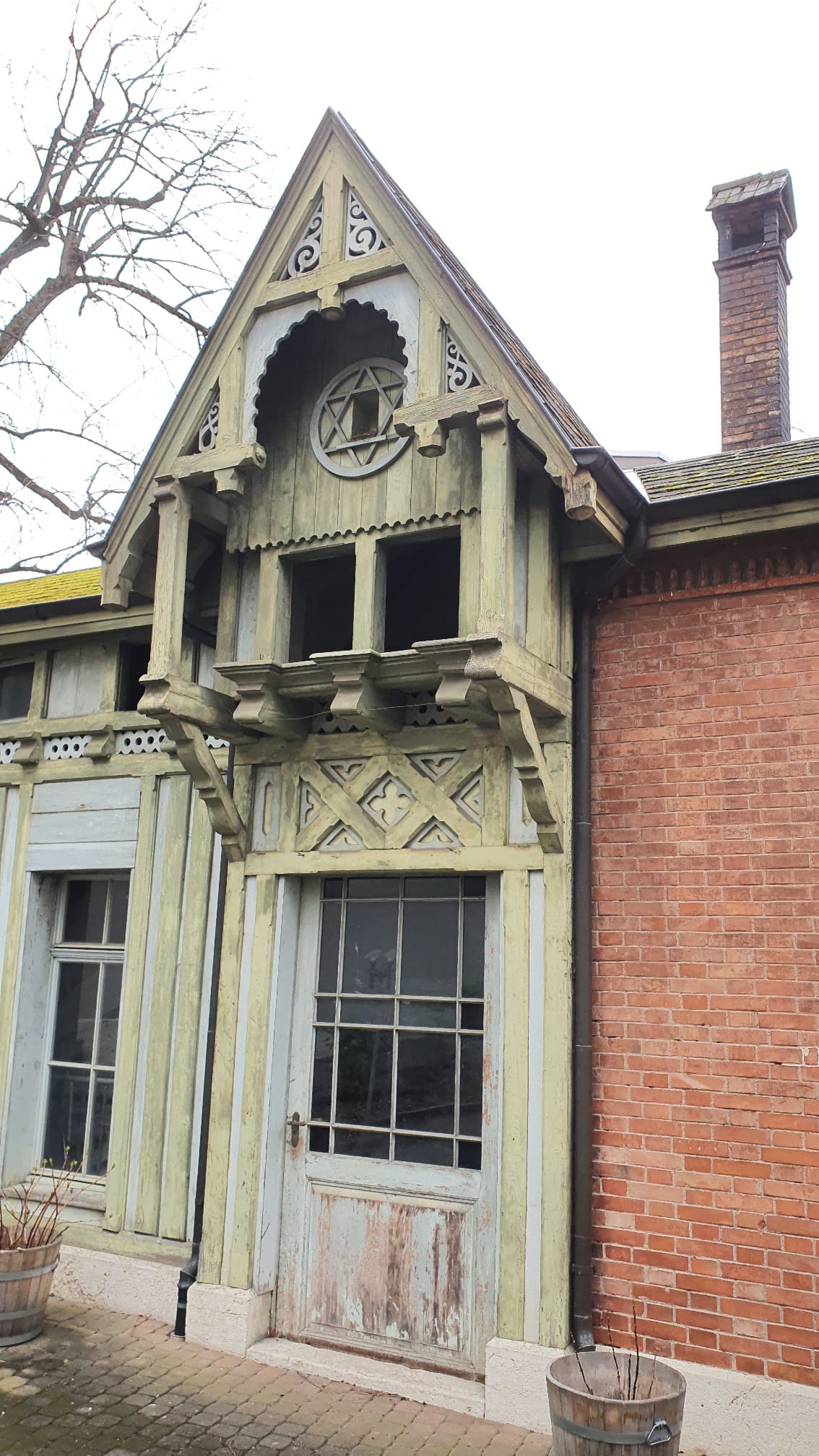
A forgotten star carved into old wood — a reminder that meaning shifts, but forms endure.
Years before, in Basel, Switzerland, someone drew my attention to a Catholic church with a carved hexagram tucked into its stonework — I did snooped around and found out it was the St. Marien Catholic parish church, built between 1898–1902. The hexagram window was a guild sign, a mason’s craftsman’s mark, centuries older than the Star of David as a Jewish identifier.
A forgotten star carved into old wood — a reminder that meaning shifts, but forms endure.
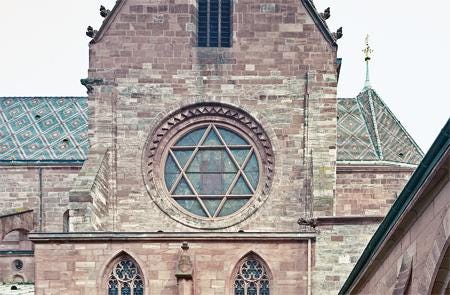
The Basel Münster, Basel’s main cathedral, tells the same story.
Its south transept contains a 13th-century window fitted, in the 14th century, with a wooden hexagram insert. In the Middle Ages, that shape meant many things: protection, cosmology, craftsmanship, even a beer brewers’ guild. It did not mean “Jewish.”
And then comes the quiet irony.
Less than 500 metres away stands the Great Synagogue of Basel, completed in 1868. Look up. Look around. Look anywhere. There is no Star of David on its façade — not in stone, not in stained glass, not even as ornament.
Why?
Because in the 1860s, the hexagram was not yet the Jewish emblem.
It had not been sanctified by Zionism, not yet weaponized by antisemitism, nor embraced as a national symbol.
Swiss Jewish communities of the time were conservative, integration-minded, and wary of signalling nationalism in a country deeply suspicious of political movements. Jewish architecture leaned on arches, tablets, non hexagramic geometric shapes, Hebrew inscriptions — signs of faith, not signs of peoplehood.
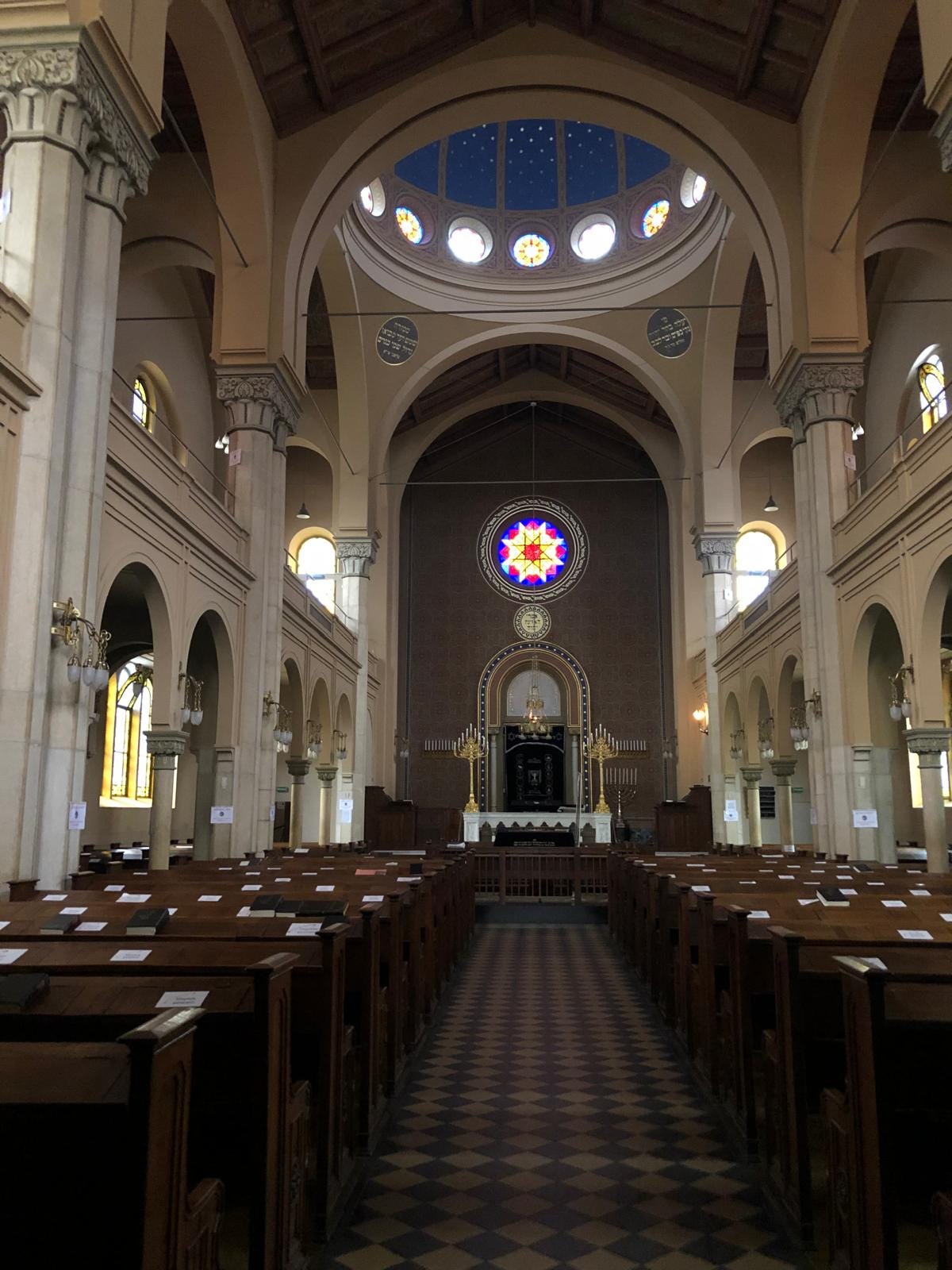
The Basel synagogoue. Starless Judaism
Which brings us to the most striking photograph in this story.
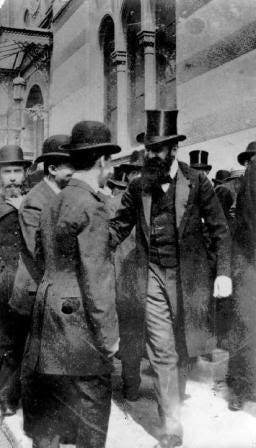
Theodor Herzl outside the Basel Synagogue, August 1897 — a starless façade on the eve of a movement that would place the hexagram at the center of Jewish national identity.
A little over 30 years later, in August 1897, Theodor Herzl stood at the entrance of that same starless synagogue, welcoming delegates to the First Zionist Congress (which as we will soon see would embrace the hexagram as its emblem).
A building without a star hosted the “star” of the very meeting that would soon give the hexagram its modern identity.
Within days, a shape that had wandered freely across Hindu temples, alchemical manuscripts, Christian churches, and Islamic geometry would be drafted into a national story it had never been born to tell.
⭐ From Sacred Geometry to National Emblem
Meanwhile, in another part of the world, far away from Europe, in that part of the world we are focusing on in Beyond Babylon, far far away from Judaism or Zionism, the six-pointed star — the shatkona — was already an established spiritual emblem .
And because it was never a Jewish national symbol (there were other: pomegranates, olive branches, doves, a menorah..), you will be rarely find the hexagram in East Asian synagogues, despite the fact (and maybe because) it was known as a Hindu/Buddhist/Jain religious symbol).
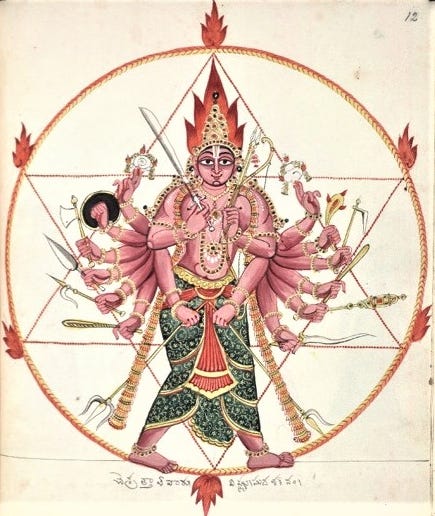
In Hindu philosophy, the double triangle symbol, is the marriage of opposites:
The △ upward triangle (Shiva, fire, masculine) and the ▽ downward triangle (Shakti, water, feminine).
A cosmic reconciliation of forces.
A symbol of Lakshmi, goddess of abundance.
In Buddhism it appears in mandalas as an object of meditation — a visual doorway into harmony.
Long before it meant “Jewish,” the hexagram simply meant balance.
Alchemy: The Star as Blueprint
Hexagrams also filled the manuscripts of medieval alchemists.
They were the graphic grammar of an early scientific imagination:
△ water
▽ fire
Combined, they mapped the unity of opposites.
With an added square, the hexagram also represented the four classical elements:
earth, water, air, fire — everything that exists.
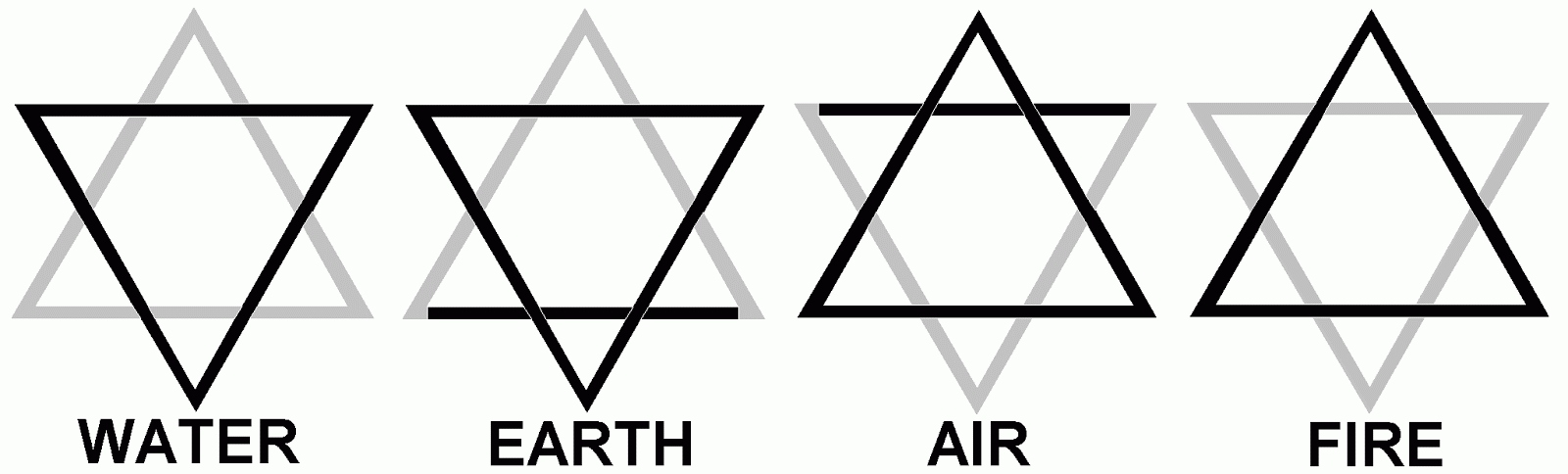
In this context, the six-pointed star was not a badge of peoplehood.
It was the ultimate alchemical symbol: a diagram of the world.
Micrography: A Jewish Appearance Before Jewish Meaning
Open the Codex Sassoon, an 1,100-year-old Hebrew Bible.
You will find micrographic Masorah (tiny Hebrew script arranged into decorative shapes, used by medieval scribes as ornament), forming a perfect six-pointed star —
not as a national emblem,
not as a theological flag,
but as a decorative flourish, but NOT a Star of David.
A shape used because it was beautiful, symmetrical, eternal.
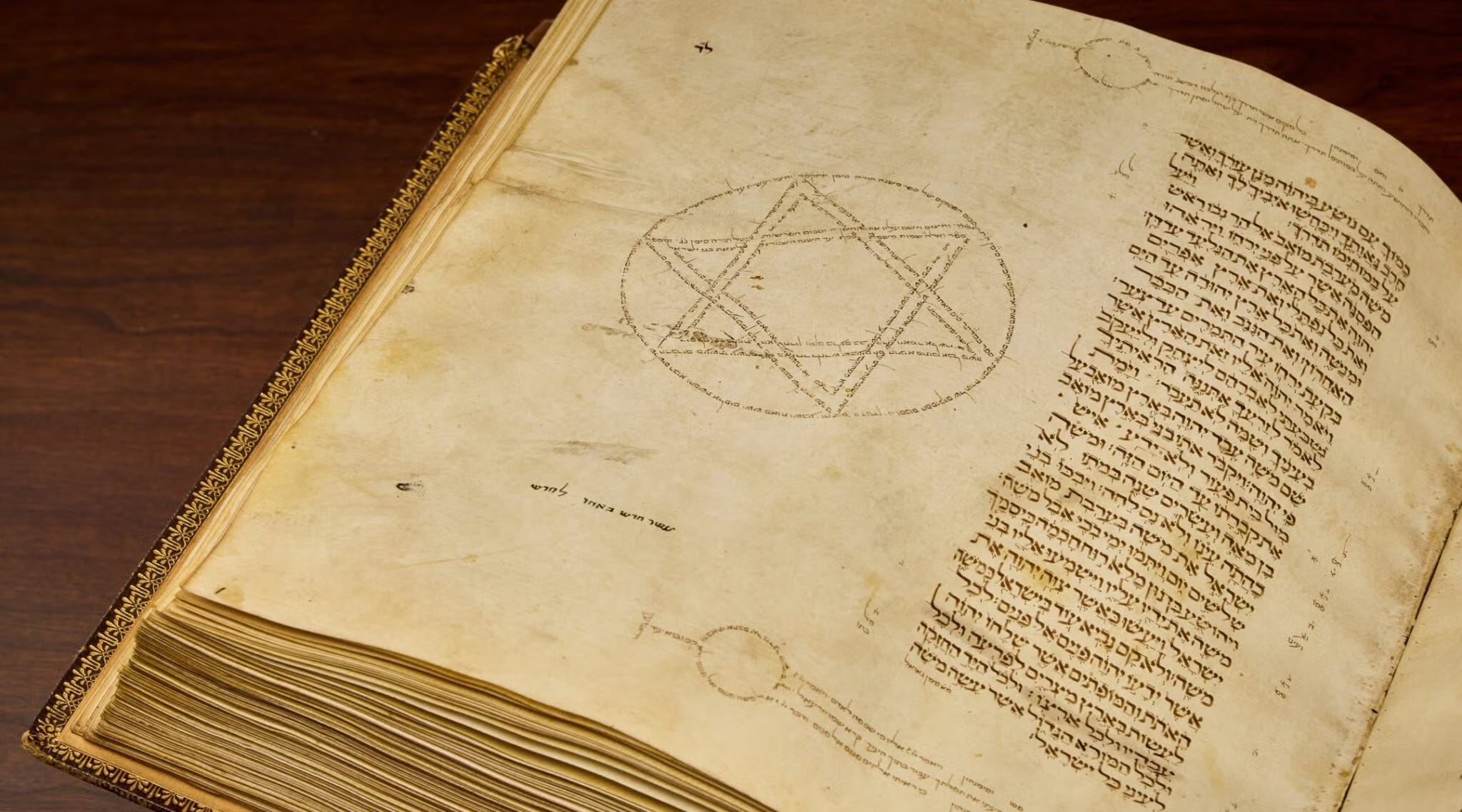
Jewish scribes borrowed it from the same shared visual culture that artists, astrologers, and alchemists used.
No politics.
No identity.
Just geometry.
The Seal of Solomon: Islam’s Hexagram
Across the Islamic world, the hexagram was known as the Seal of Solomon (Khatim Sulaymān).
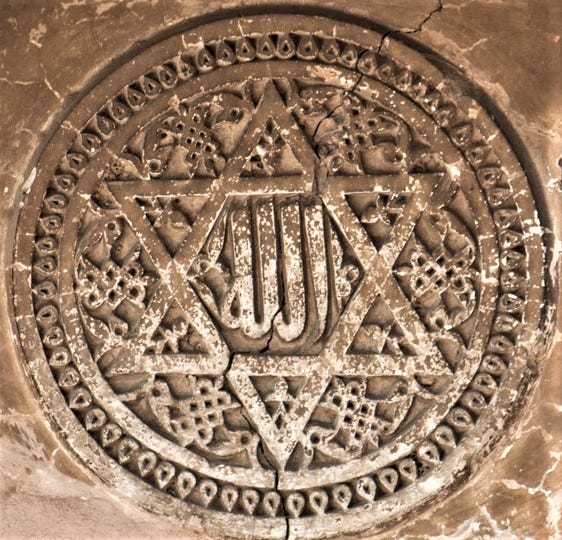
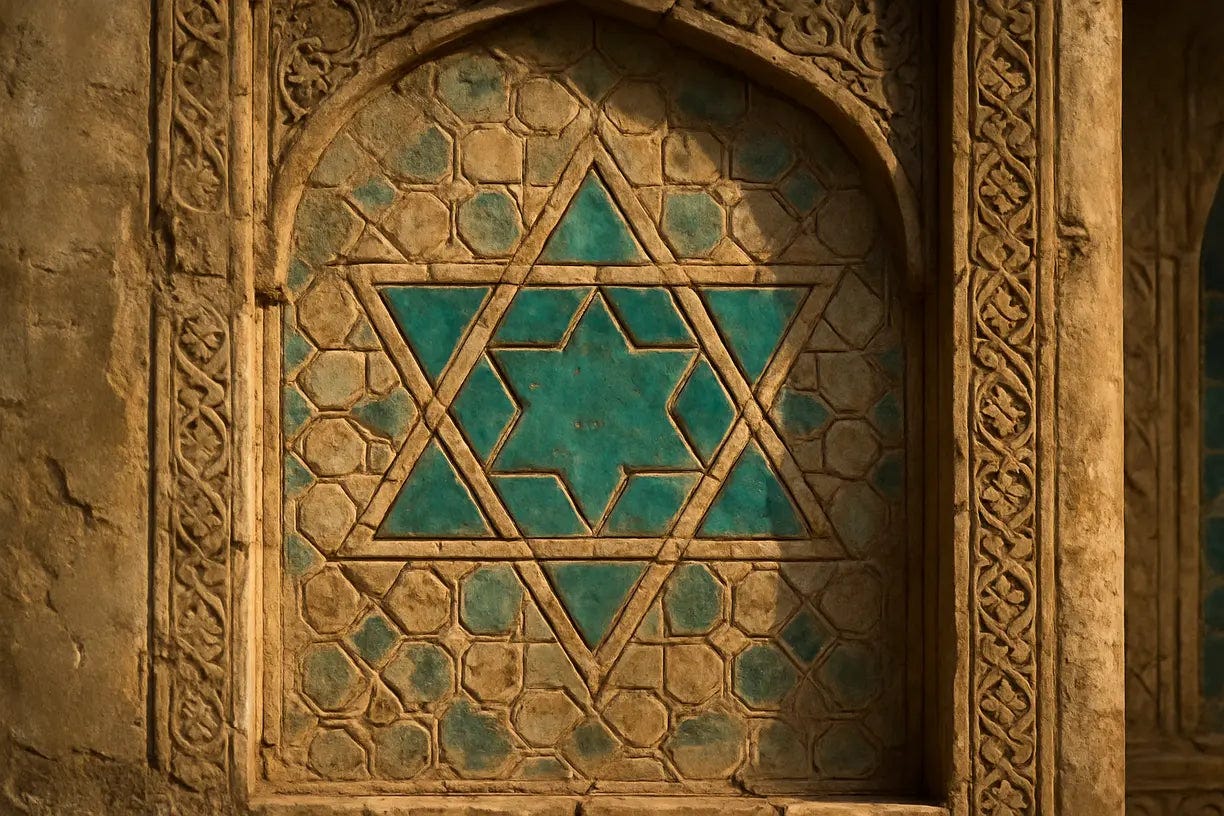
It adorned mosques, manuscripts, swords, ceramics —
a symbol of divine wisdom, protection, and the legendary authority of the prophet-king Solomon.
In one carving, the six-pointed star frames the word Allah —
a reminder that the shape served Islamic devotion centuries before it was tied to Jewish nationalism.
Symbols migrate.
Meaning does not travel with them; only we do.
⭐ The Moment Europe Made the Star Jewish
The hexagram became “ours” not in Jerusalem, not in Babylon, not in the Bible —
but in Prague, mid-14th century.
When Emperor Charles IV granted the Jews of Prague the right to carry a communal flag, they chose the six-pointed star.
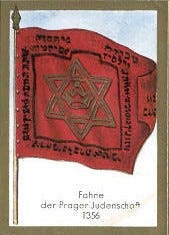
Why?
Because it was available, visually striking, and — crucially — carried no national meaning in Christian Europe. It was free to use. Prague’s prestige ensured that its emblem spread across Poland, Lithuania, Bohemia, Galicia, Hungary.
A local emblem became a continental marker of Jewishness.
Zionism embraced it by the 1897 Basel Congress.
Herzl dreamed of a flag with seven golden stars, but the movement chose the familiar single hexagram — the communal emblem from Prague, already woven into Jewish life.
And then came the predictable next step:
Once a symbol is adopted, communities begin back-projecting meaning onto it.
They search for biblical connections to the King David, the Maccabees, mystical roots, ancient precedents —
even when none existed (as a school kid, I didn`t dare question the narrative).
The Star of David was retrofitted into Jewish antiquity
because symbols gain power through story, not through truth.
⭐ And Then the Star Became a Target
What Prague and Zionism adopted voluntarily, the Nazis weaponised.
The yellow star — compulsory, public, degrading — turned the hexagram into a racial badge.
A stigmatised identity.
A target.
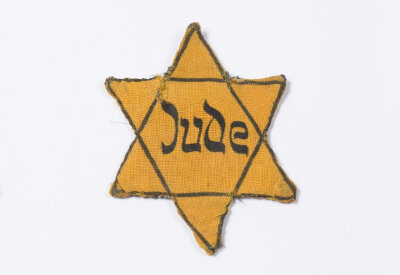
One historical footnote:
When Jews were interned in Asia as (British) enemies of the empire, Japan did not force them to wear the star (until a Nazi delegation arrived to persuade it was necessary).
I have read that the Japanese were eventually persuaded to use an armband for Jews, but I have found no evidence of this and, in any event, it did not sport a star, because the Star of David meant nothing in Japanese symbolic culture.
Europe had invented both its power and its poison.
⭐ Nationhood and the Final Shift
By the late 19th century, nationalism reshaped identities everywhere. Judaism — once centred on practice, memory, law — now needed a flag.
Zionism did not invent the hexagram.
It selected it.
Herzl, the same who had visited the starless Basel synagogoue, now was standing in the Basel Stadt casino only 10 minutes away, and envisioning a white flag with seven golden hexagrams.
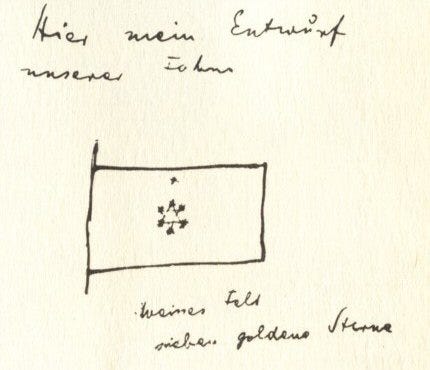
Herzl`s vision of a Jewish flag
Eventually, the Congress adopted the blue-and-white banner with one hexagram.
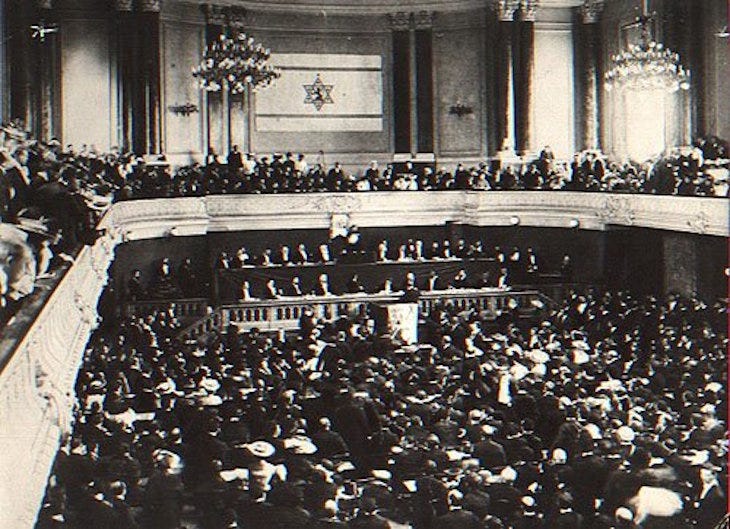
Basel, 1897 — the moment a wandering geometric form began its transformation into a national symbol (notice the flag in on the background wall).
A medieval guild mark, now a national emblem.
The Holocaust altered it again.
A symbol once chosen in pride was forced in terror.
And after 1945, Israel placed the same star at its centre as both political decision and cultural reclamation — a refusal to let the Nazis define its meaning.
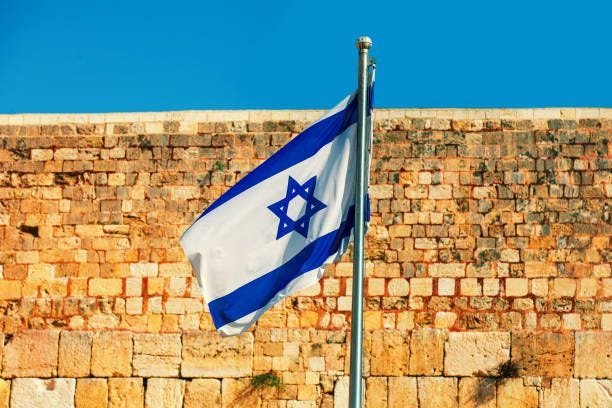
And so a wandering geometric figure had become over time:
• a religious symbol
• a national emblem
• a political identity marker
• and a lightning rod in global discourse
The same shape, carried across continents and centuries, now bears layers it was never designed to hold.
The Israeli flag flies at the Western Wall in Jerusalem.
It is praised, feared, contested, and misunderstood in equal measure.
But perhaps that is exactly the lesson:
A symbol’s power lies not in its six lines,
but in the meanings we attach to it,
the histories we impose on it,
and the battles we conscript it into —
or refuse to.
⭐ The Swastika: A Symbol With Two Worlds Inside It
In Europe, Israel and the United States, the word is radioactive.
In much of Asia, it remains what it has always been:
a blessing.
A Name That Means Good Fortune
In parts of India — Bengal, Odisha, Assam, Maharashtra — Swastika is a perfectly ordinary girl’s name.
From Sanskrit:
su — good
asti — to be
svastika — that which brings good fortune
A name as gentle as Grace or Hope.
Yet when it crosses into Europe, it becomes almost unutterable — not because of its meaning, but because of ours.
Same word, two worlds.
I know of a woman in Australia who carries this name.
Imagine needing that level of inner certainty simply to introduce yourself.
When Two Histories Collide
In 2022, an Indian family in New York painted a swastika on their doorway for luck.
Their neighbours called the police.
Not malice — collision.
A symbol of blessing walking into someone else’s wound.
The same shape that blesses marriages in India evokes genocide in Europe.
Symbols don’t carry inherent meaning — they carry the last meaning a culture assigns to them.
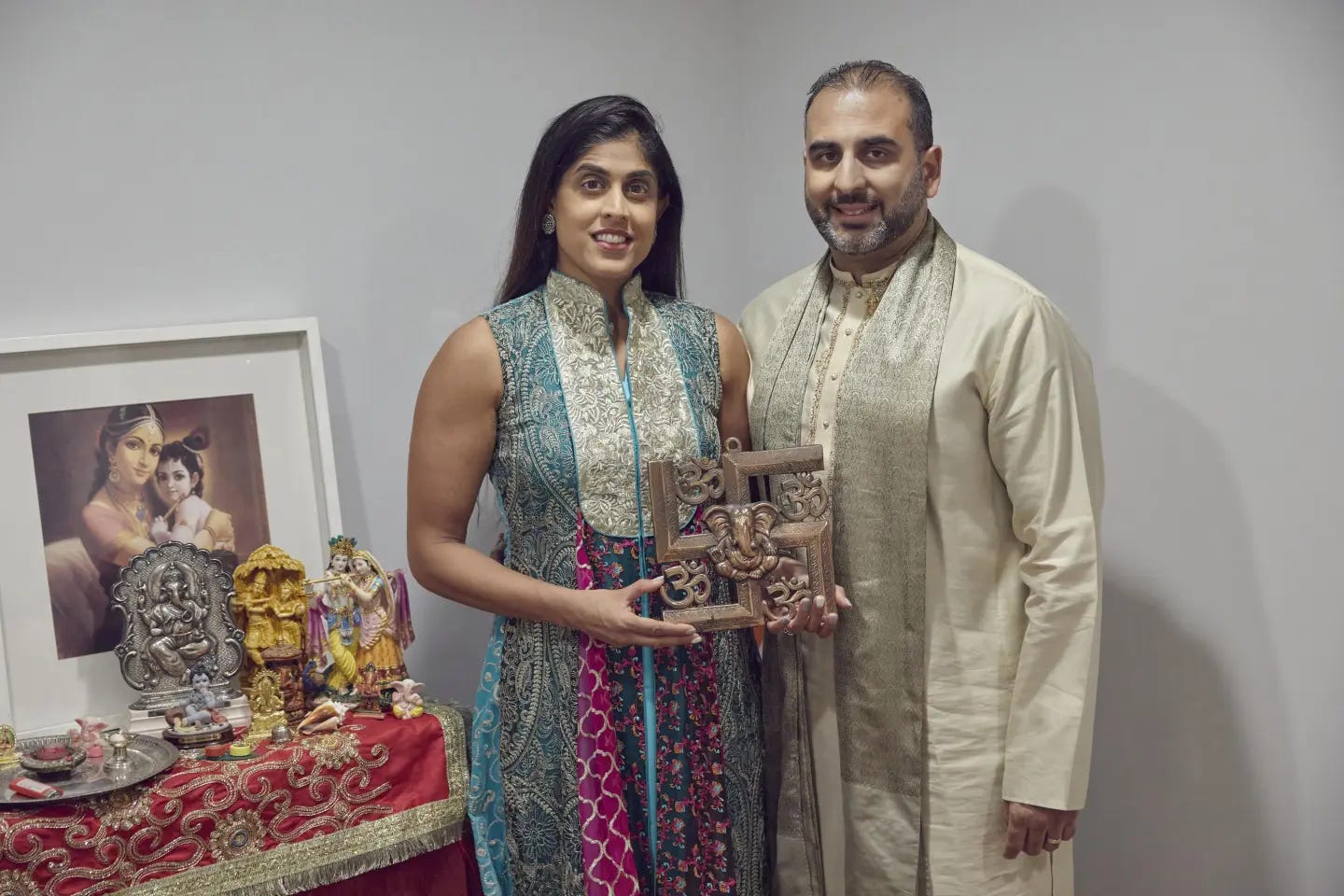
Dr. Sheetal Deo and her husband, Sanmeet Deo, hold a Hindu swastika symbol in their home in Syosset, NY, on November 13, 2022. (AP Photo/Andres Kudacki)
Before Hitler, There Was History
The swastika is at least 3,000 years older than Nazism.
It appears across Hinduism, Buddhism, Jainism, ancient Eurasia, Slavic textiles, Greek mosaics, Navajo weaving.
It meant luck, abundance, cosmic order.
Racial theorists in 19th-century Europe twisted it into “Aryan symbolism.”
Hitler embraced that fantasy, rotated the symbol 20 degrees to the right, and turned it into the emblem of totalitarian supremacist nationalism.
Its older meanings were erased almost instantly.
Finland: A Complicated Reminder
Finland adopted it in 1918 as a good-luck emblem — decades before Hitler — but retired it after WWII and again quietly in 2020.
Not from guilt — but from the recognition that symbols don’t stay neutral once the world invests them with new stories.

🎯 The Weight of the Last Story
That is the uncomfortable truth:
symbols do not carry fixed meanings —
they carry the weight of the last story told about them.
A symbol can travel from temple floors to death camps, from auspicious doorway to police report, without ever changing shape. Only we change.
George Carlin wasn’t joking when he said,
“I leave symbols to the symbol-minded.”
He meant: the danger begins when we mistake a shape for a truth.
A Symbol is not a slogan
Do I wear one? No. Not anymore.
I am not saying that the Star of David isn’t meaningful, but I do not need a geometric sign to know who I am, and I don’t need it to feel protected.
My identity comes from memory, ancestry, family, tradition, history, text, and a trail of recipes, including curry recipes, from Baghdad to Calcutta — and from the quiet knowledge that Judaism is bigger than any single emblem, or recipe.
When a shape or recipe becomes untouchable, unquestionable, unseeable except through one emotional lens, it stops being a symbol and starts being a prison for thought.
The hexagram existed for centuries as a decorative motif, a mason’s mark, a brewer`s mark, a cosmological diagram — and not as a defining Jewish badge. It only became that through modern history, through persecution, through the need for a collective identity at a time of emerging nationalism.
The Star of David didn’t choose me; it wasn’t divinely ordained or written in the Bible; the world chose the symbol for me. Which is why, perhaps, I have no need to wear a Star of David around my neck. I don’t need a logo to tell me who I am.
My identity is not a slogan and I do not need to rally around a symbol to belong. For these reasons I have no difficulty if someone uses a star to announce the birth of Jesus.
Symbols that coexist
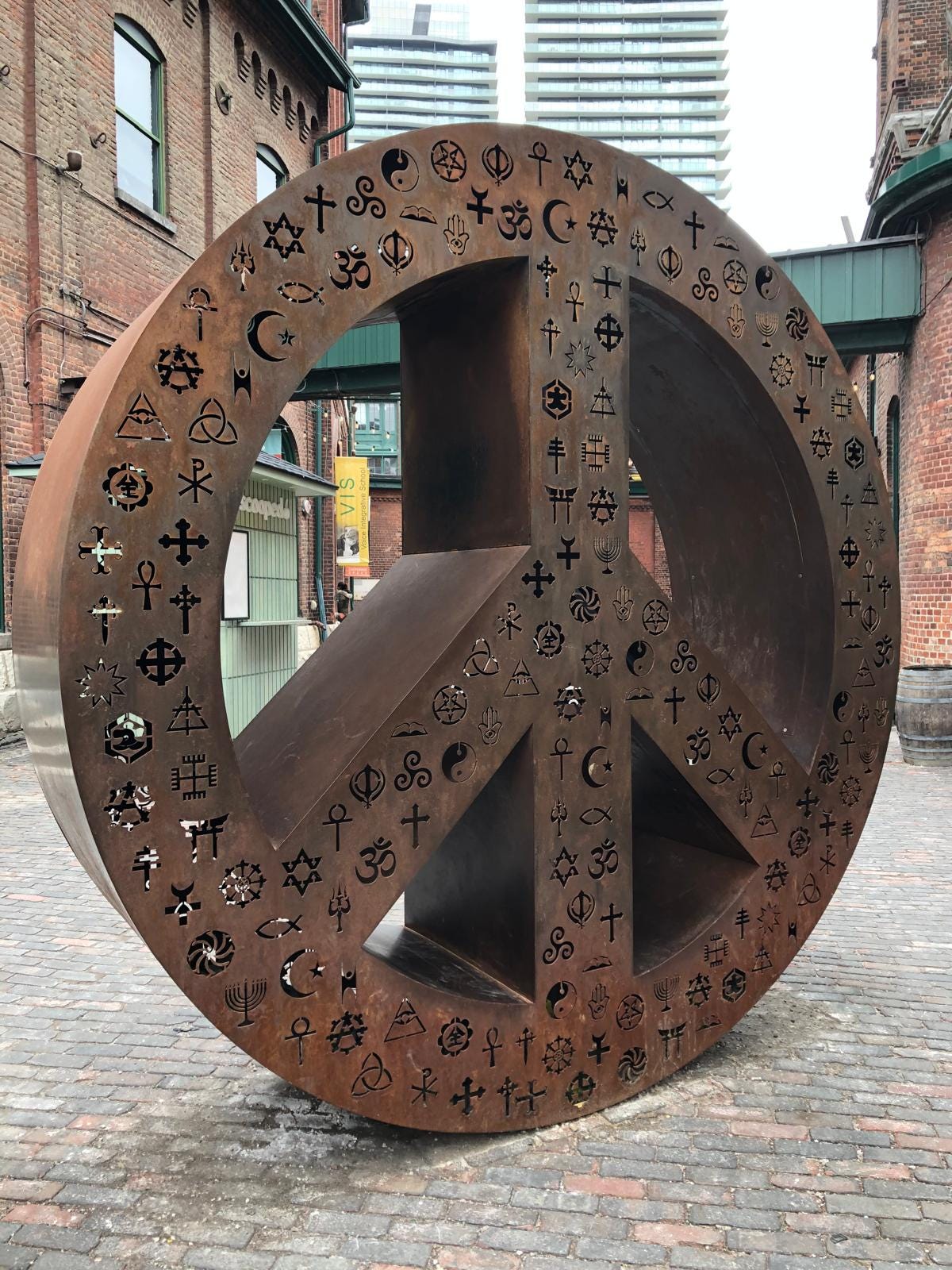
The Peace Wheel in Toronto’s Distillery District (test your ability identify all the different symbols, It`s fun..). A massive steel circle pierced with every sacred symbol: the crescent, the cross, om, khanda, yin-yang — and yes, the Star of David. Matthew Rosenblatt’s intention was to offer a physical reminder that identity need not be competitive: meaning expands, rather than diminishes, when symbols coexist.
In fact, both of our most freighted symbols- the Star of David and the Nazi swastika - were born not in Europe but in South Asia — not in the ghettos of Prague or the streets of Munich, but in the temples and tantric diagrams of the subcontinent.
In the end, symbols don’t make us who we are.
They can inspire, unite, confuse, divide, or be twisted beyond recognition — but they are never the essence.
What matters is not the sign we wear, but the values we carry.
When identity becomes a logo, it shrinks.
When it becomes a story, a practice, a generosity, a moral stance — it expands.
When it become “us”, and not “you”, “ours” or “wrong” - we should shrink from them.
And the moment a symbol begins to exclude, to draw borders rather than bridges, it stops being a symbol and becomes branding.
Branding is loud. Symbols are quiet.
Identity is quieter still.
We live in a world hungry for stickers, slogans, and easy signals of belonging, or excluding.
But the wiser path — the one you’re pointing toward — is this:
Hold ideas, not icons.
Hold people, not shapes.
Hold meanings that include rather than exclude.
Because the real work of identity is not wearing a star or rejecting a swastika;
it’s refusing to let any shape, any logo, any banner be the entire truth about who we are.
The hexagram survived precisely because it meant many things in many cultures.
The swastika was destroyed because its meaning was forced into one narrow, violent idea.
Plural forms survive.
Rigid ones break.
In that sense, the balcony star in Germany was doing something wise without knowing it:
it treated a symbol lightly, unpossessively, without fear — as a Christmas decoration, not a declaration.
Maybe that’s the lesson:
Use symbols freely.
Do not let them use you.
And never let a shape be more important than the human being standing next to it.
A challah kitchen in Berlin, where symbols soften back into bread. And from the balcony in Germany to a kitchen in Berlin — the Star changes meaning with every hand that shapes it.(Credit The Challah Prince Studio)
✨ All posts are free; paid subscriptions are optional, and your support is deeply appreciated.
💬 Share your story in the comments, or pass this essay along.
📖 To support more work uncovering Jewish food in unexpected corners of the world, consider subscribing to Beyond Babylon.
This is very interesting story of the Star of David. The Menorah actually had been the main symbol of judaism over the centuries. But the Star of David is easier to wear around your neck.
By the way, I do not wear the Magen David around my neck to remind me of who I am. It is there to let others know who I am. Especially in these days.
Thank you for such a prompt response! I should have posted last month as I've been seeing this for awhile:).