
What Is Kahi?
When borrowed food becomes a tradition

Certain foods become attached to particular festivals. Some are created by the event itself, shaped directly by its rules or its story, like matza for Passover.
Others are drawn from the everyday kitchen and given a new role, taking on meaning over time. Kahi belongs to this category.
This pattern is not unique to Jewish life. In many cultures, festival foods begin as ordinary dishes that are later fixed to a date.
Roast turkey in North America was not invented for Thanksgiving; it became associated with it. Sweet breads and spiced cakes across Europe were not created for Christmas; they were part of the winter kitchen before becoming seasonal markers.
In the Jewish Baghdadi kitchen, kahi has become synonymous with the feast of Shavuot.
Shavuot is celebrated fifty days after Passover and marks the giving of the law at Mount Sinai. It is also tied to the early summer harvest.
Among the laws introduced at Sinai are dietary rules separating meat and milk. One explanation for the custom of eating dairy on Shavuot is practical: having just received these laws, meat could not yet be prepared accordingly, and dairy became the immediate alternative.
The association itself appears relatively late. It is not prominent in early sources, and becomes visible in medieval Europe, where it is already practised but not yet explained.
More likely, it developed through layering: seasonal abundance of milk, existing food habits, and later symbolic interpretation.
What begins as availability becomes tradition.
And so on Shavuot, the table fills with dairy. Cheesecake, sambousak, sweet pastries. It looks fixed, almost inevitable - as if these dishes were created for the day. They weren’t.
Once dairy became part of the festival, communities expressed it in their own way.
In much of Europe and North America, that expression settled into cheesecake and other cheese-based dishes, which now feel inseparable from the festival. You only have to google Jewish cooking websites to find endless variations on cheesecake.
Elsewhere in the world, the same idea took multiple forms. Among Baghdadi Jews, dairy did not settle into a single canonical dish but into a small constellation of foods drawn from the everyday kitchen and reinterpreted for the occasion.
And then there is kahi.
What is kahi?
Kahi belonged to the city before it belonged to any one community or tradition.
It was so closely associated with the festival that Shavuot was remembered in Judeo-Arabic as Eid al-Kahi- the festival of kahi - across Baghdadi communities in Asia.
In Arabic, kahi (كاهي) refers to a flaky pastry made from stretched and folded dough, cooked until crisp at the edges and soft within, then finished with syrup and cream. The word does not translate neatly, because it names not an idea but a form: a layered pastry defined less by meaning than by structure, where technique - stretching, folding, cooking - produces indulgence.
In Baghdad, it is most famously eaten as kahi w qei’mar, a morning dish bought fresh from bakeries or specialist shops, eaten hot, and associated with pleasure rather than necessity. It belongs not to the routine of the household, but to the rhythm of the street.
Although it shares a technical resemblance to foods such as Moroccan mufletta, Yemenite mellawach, and Indian paratha, all of which rely on repeated folding and layering of dough, the similarity ends with the method.
What feels like intuition in the kitchen is often system. Within that shared system, however, purpose diverges. Mufletta, mellawach, and paratha are typically eaten with something else, functioning as part of a meal. Kahi is not. It is the point of the meal: a pastry built for richness, completed with syrup and cream, and eaten as a whole.
This becomes clearer when kahi is placed within its original setting. It was eaten by Muslims, Jews, and Christians alike, a breakfast pastry bought fresh, served hot, and enjoyed as a moment of indulgence. It belonged to the city before it belonged to any one group, and it is precisely this shared origin that allowed it to move across identities without losing its form.
Baghdadi Jews knew it, ate it, and carried it with them to India. They belonged to a much older continuity, rooted in Babylonia since antiquity. Baghdad, founded centuries later, became one of the great urban centres of that tradition, before it, too, became a point of departure.
This is the space I think of as “beyond Babylon”- not a place, but a search for what remains of a cuisine once it leaves the world that formed it.
Qei’mar: The Essential Pairing
Kahi without qei’mar is incomplete in Baghdad, because qei’mar - also called g’aymar or geymar - is not simply an accompaniment but part of the structure of the dish: the thick, creamy layer that forms on top of slowly heated milk, traditionally from water buffalo, producing a richness and texture that cow’s milk cannot fully replicate.
It belongs to the wider family of clotted creams found across Iraq, Iran, Turkey, and the Levant, yet it differs fundamentally from mascarpone, which is a cultured cream cheese. Qei’mar is a formed cream, dependent on patience, heat, and the behaviour of milk itself, and therefore both delicate and difficult to reproduce.
In Baghdad, qei’mar was not merely bought but sought out, and it belonged to the morning in a way that defined the experience of eating kahi. Before fixed shops became common, it moved through the streets in the hands of women carrying large trays balanced on their heads, calling out as they passed from neighbourhood to neighbourhood, cutting portions with a knife or even a pin, and sometimes pouring a little milk over it as part of the sale.
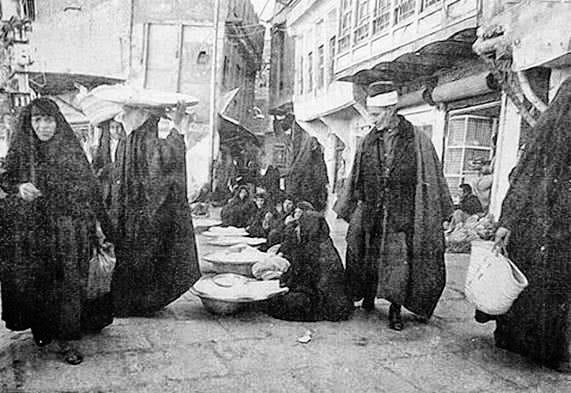
Women selling fresh dairy in the streets of Baghdad at the turn of the century, where foods like qei’mar moved through the city as part of daily life.
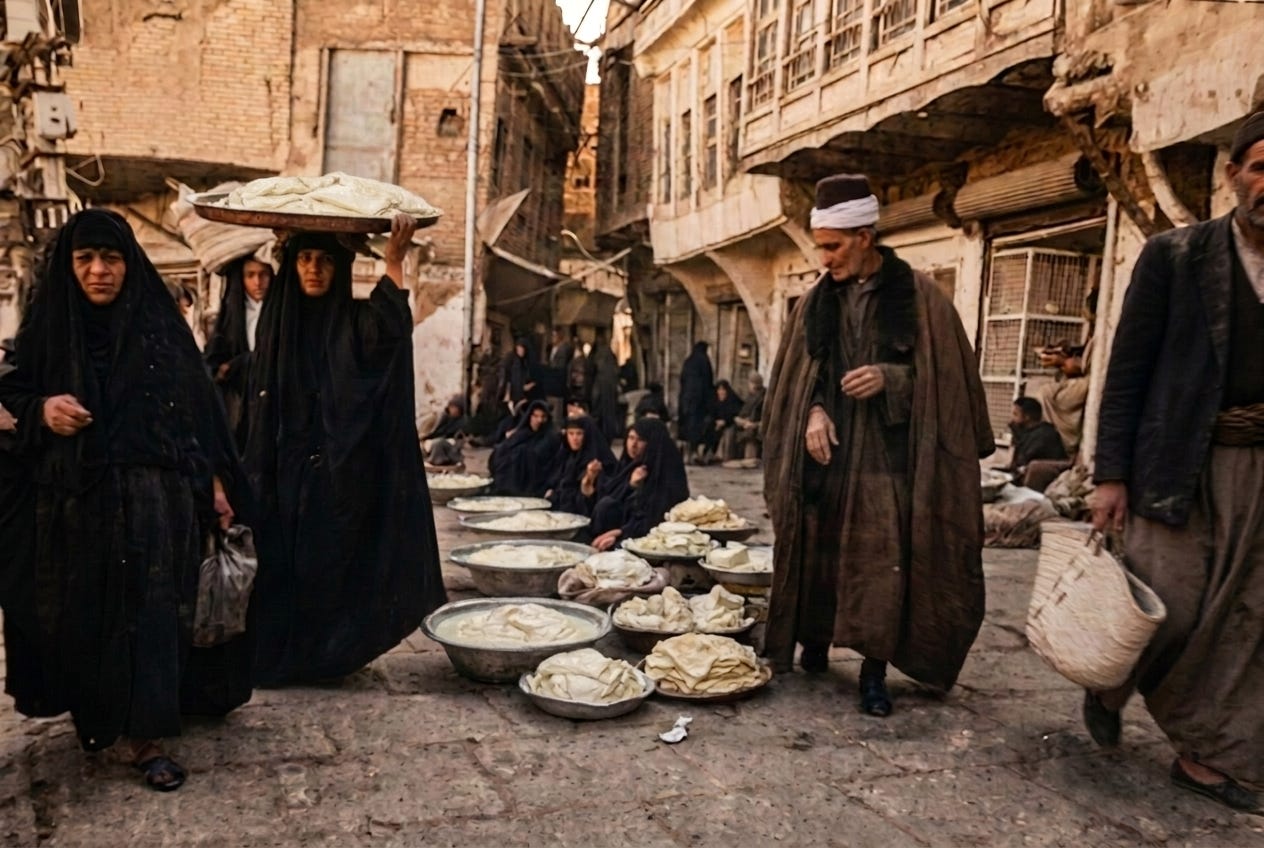
The original image was rare and grainy, so I reimagined it to bring the memory back to life, trying to stay faithful to the original.
What appears today as a dish was once inseparable from a setting made up of street, time, labour, and habit.
Kahi, in that setting, was not simply a pastry but an indulgence: layers of flaky dough soaked in syrup and finished with qei’mar, eaten hot in the morning and associated with pleasure rather than necessity.
Israel has a large Baghdadi community. Older people who still remember speak often about qei’mar - the version made from water buffalo milk - with a kind of quiet longing. It was not just its richness that mattered, but its specificity: a product tied to place, to animal, and to a way of producing milk that does not translate easily outside its original environment.
That difficulty is not accidental. It begins in the marsh itself.
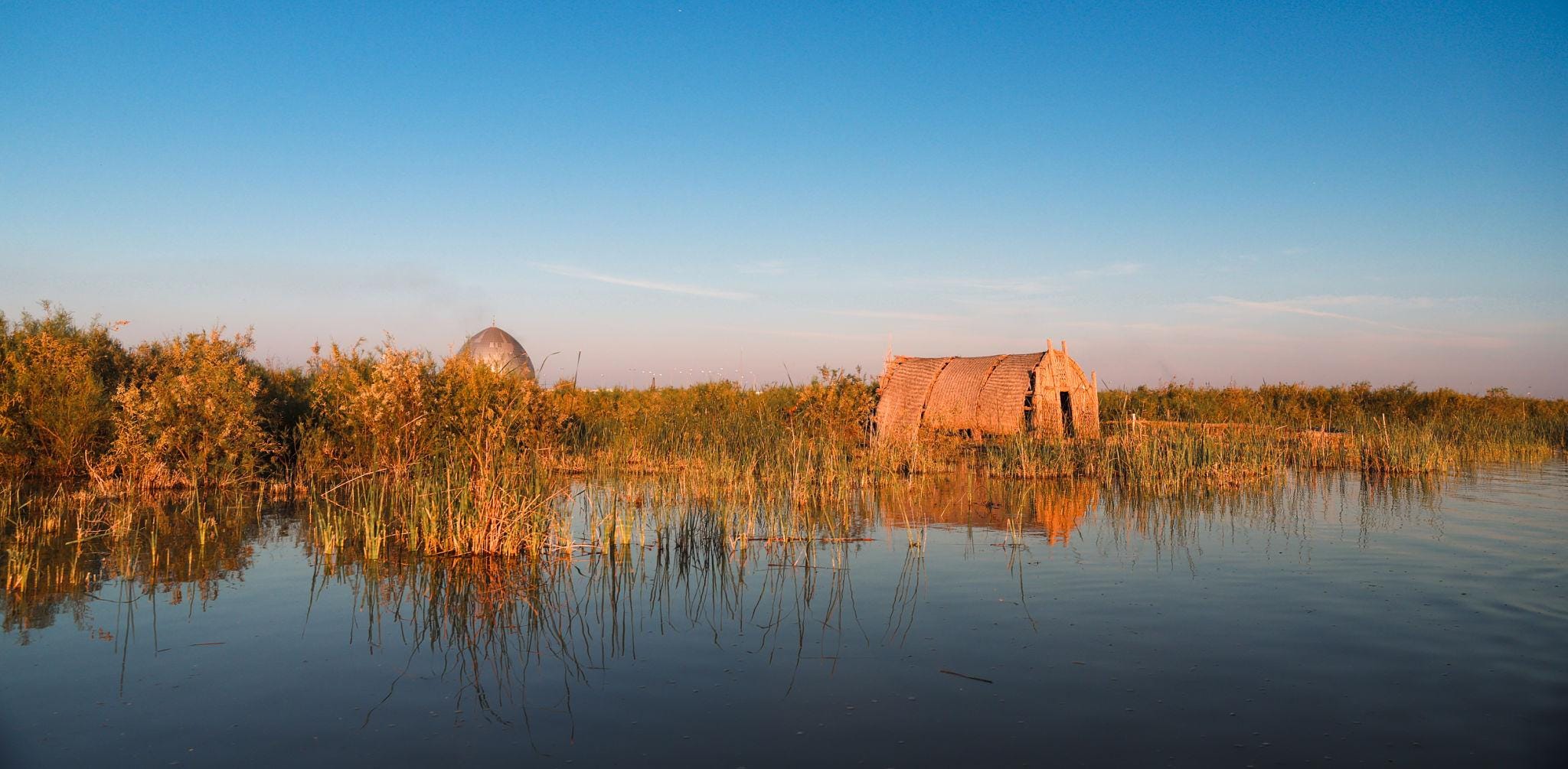
The marsh is not a backdrop. It is a system: water, reeds, and habitation held in balance. (Courtesy UNESCO).
Qei’mar is as much part of Baghdad’s landscape as it is part of kahi.
The Mesopotamian Ahwar marshes form one of the largest inland wetland systems in the world. More than a landscape, they are part of a long-standing human–environment structure in which life developed in direct response to water.
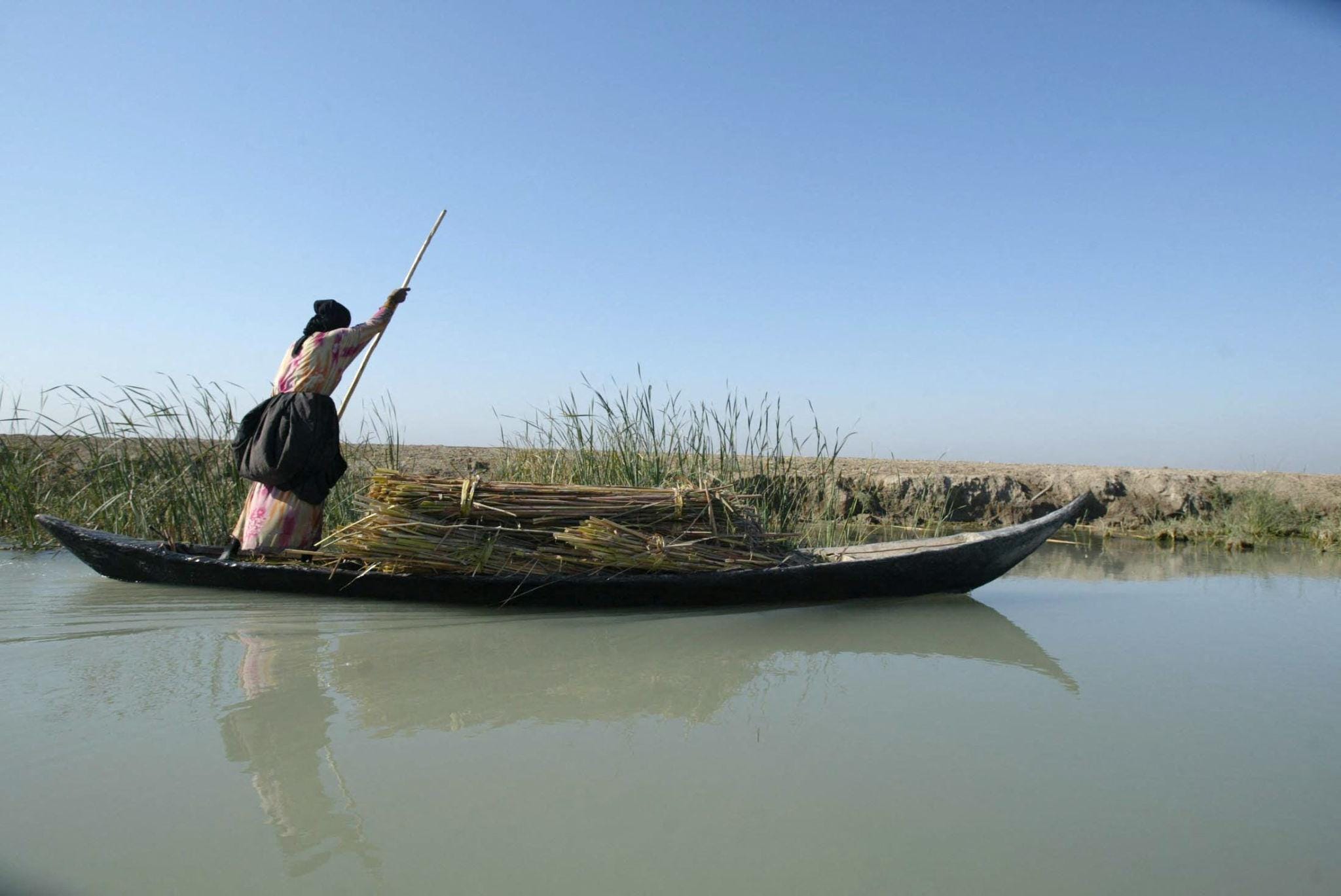
Life here does not stand beside the water. It moves through it.(Courtesy UNESCO).
It is within this system that qei’mar takes its original form. Made from the milk of water buffalo raised in the marshes, it depends on a particular set of conditions: rich milk, slow heating, and time. The thick layer that forms on the surface is not simply a product of technique, but of place.
That place is now under strain. The draining of the marshes, followed by years of drought and instability, has sharply reduced buffalo herds and milk production. Qei’mar still exists, but increasingly in altered forms. What is disappearing is the version rooted in the marsh itself.
Qei’mar is not just an accompaniment to kahi. It is the product of a system that does not travel.
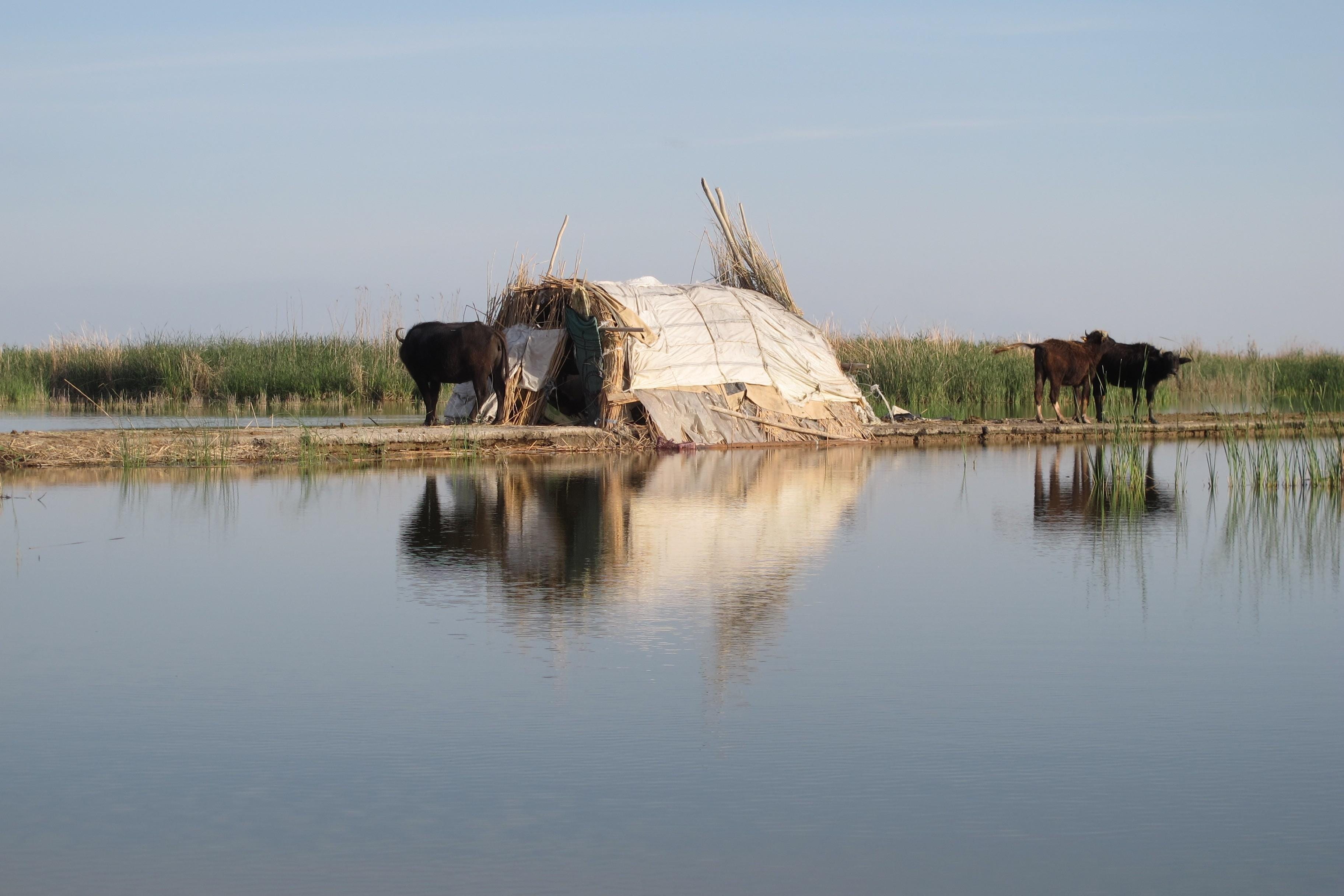
The Ahwar of Southern Iraq: Refuge of Biodiversity and the Relict Landscape of the Mesopotamian Cities: Buffalo grazing in the marshes. (Courtesy UNESCO).
The draining of the marshes in the late twentieth century severed that chain. Water receded, ecosystems collapsed, and the communities that depended on them were displaced. Although parts of the marshes have since been restored and recognised as a UNESCO World Heritage Site, the system remains fragile, subject to water scarcity and environmental pressure.

When the water leaves, the system does not adapt. It breaks. (Courtesy UNESCO).
What appears today as a difficulty of reproduction is, in fact, the residue of that disruption.
But even beyond that history, water buffalo milk does not lend itself easily to large-scale production. It requires time, care, and conditions that are not easily replicated, which is why qei’mar, in its original form, is difficult to find in most places.
In diaspora, the dish adjusted and morphed. Cow’s milk substitutes are used, or the cream is replaced altogether. In cities with established Baghdadi communities, qei’mar can still sometimes be found, and related creams such as Iranian sarshir or Turkish kaymak may appear as approximations, though the texture and flavour are not quite the same.
What remains is the structure of the dish, even as one of its central components becomes harder to sustain.
What Changed in India
When Baghdadi Jews migrated to India, kahi travelled with them, but not everything that sustained it could travel as well. In India, including in my own family, the dish changed. The kahi remembered in Calcutta was less like the syrup-soaked, cream-covered pastry of Baghdad and more like a flaky flatbread, fried in oil and served with sugar or semolina hulwa. The idea of the dish remained, even as its form shifted.
The syrup and cream that once defined the pastry were omitted. At the same time, the dough itself became more substantial, moving closer to a paratha or mellawach than to the lighter, syrup-soaked pastry of Baghdad.
In this new setting, the dish became domestic. It moved from the bakery and the morning street into the home and the holiday table. What remained was a layered dough, fried and eaten sweet. It was still recognisable as kahi, but no longer anchored in the full system that had once defined it.
The name survived. The memory survived. But the Baghdad setting did not.
Kahi Shortcuts - My Mother’s and other Versions
In my family, Kahi survived in fragments.
It was something my grandmother would always make, and my mother would make occasionally, using shortcuts, usually when my father was feeling nostalgic.
It was just too much work to make once a year. So it virtually disappeared from our household.
Working from memory rather than instruction, my mother developed a practical solution. She would take frozen Yemenite mellawach, fry it, slice it horizontally into thinner layers, and then fry it again. The result did not reproduce the original pastry exactly, but it moved toward it, recreating something of its crispness and layering.
And here is another shortcut, this time using store-bought frozen puff pastry.
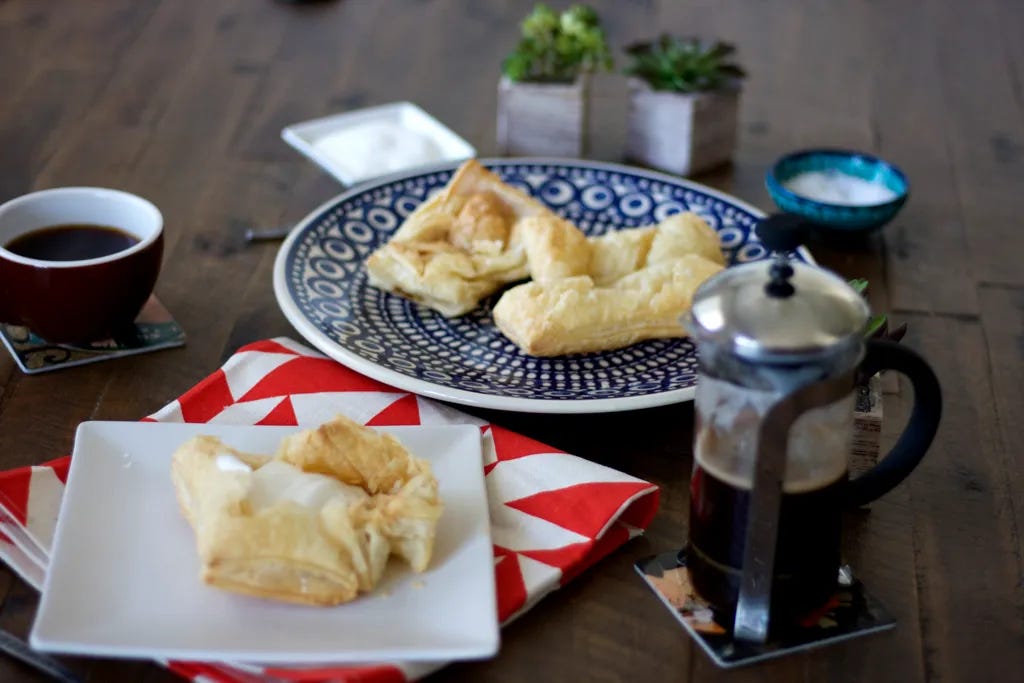
Quick Kahi & Qei’mar
serves 4
Ingredients:
4 squares puff pastry, about 10 cm / 4” each, thawed if frozen
1 cup sugar
1 cup water
8 tablespoons Qei’mar (or sarshir, or kaymak)
Directions:
Preheat the oven to 190°C / 375°F.
Make a simple syrup by bringing the sugar and water to a boil, stirring until dissolved, then reducing to a gentle simmer for about 10 minutes. Set aside to cool.
Lay the puff pastry squares on a baking sheet, leaving space between them, and bake for 15–20 minutes, until puffed and golden.
While still warm, pour the syrup evenly over the pastry, allowing it to soak in.
Top generously with qei’mar and serve immediately, ideally with Iraqi tea.
This is not the original kahi, and it does not attempt to be. Like my mother’s version, it works with what is available - puff pastry instead of hand-rolled layers, a simple syrup instead of a bakery soak - but it restores enough of the structure to make the dish legible again: layers, sweetness, and cream.
This kind of reconstruction can also move in another direction - not only toward the Indian memory of kahi as a layered flatbread, but back toward its earlier Baghdad form. If the mellawach method leans toward structure, a simplified pastry-and-syrup version can recover something of the sweetness and composition of the original.
This is how diaspora cooking often works. Not by preserving a dish in its original form, but by adapting it through available materials in a way that carries enough of its structure to remain recognisable.
Kahi: The pakka (real) Recipe
To write this essay, I went through a number of recipes collected from different sources. What becomes clear across them is that the dough itself changes very little. Flour, water, salt, and fat remain constant, sometimes with the addition of a small amount of vinegar or lemon juice to relax the dough. What shifts is not the ingredient list but the handling: how thinly the dough is rolled, how often it is folded, and how much fat is used to create the layers.
Among Calcutta’s Baghdadi Jews, there is a word for something that feels right in this deeper sense: pakka (पक्का).
The word comes from Hindi, where it originally means solid, finished, or fully formed, as opposed to something temporary or incomplete (kaccha, कच्चा). In everyday speech, it came to mean reliable, genuine, or certain.
In the Baghdadi Jewish context, it takes on a more precise meaning: not simply correct, but the real thing - true to form.
Among the many versions I have collected during researching kahi, I prefer one, not because it is fundamentally different than the others, because it preserves the proportions and handling that define the dish.
Chef David Karmi is a chef of Baghdadi heritage, who records it in a new cookbook of the traditional Jewish Babylonian kitchen (a Baghdadi Indian recipe of my own appears there).
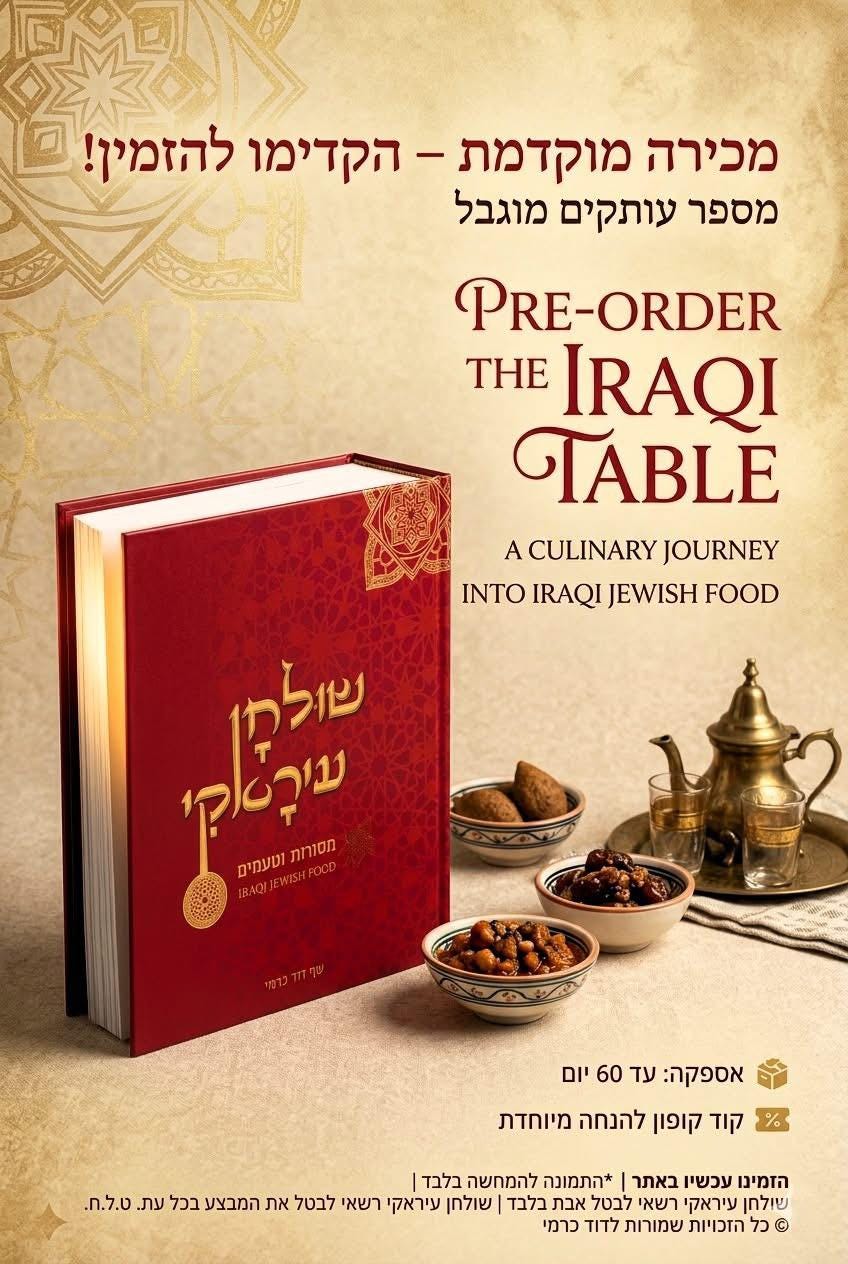
David’s recipe has that pakka quality to it. It preserves a sense of proportion and control that feels close to the original logic of the dish. The dough is soft and elastic, the layering deliberate rather than excessive, and the result sits between delicacy and practicality - exactly where kahi belongs when it moves from the bakery into the kitchen.
In that sense, this version does not replace the others. It clarifies them.
Kahi
Layered Pastry with Syrup and Cream
after Chef David Karmi
Ingredients
Dough
2 cups all-purpose flour
½ teaspoon salt
1 tablespoon white vinegar or lemon juice
½ cup warm water (plus 1–2 tablespoons if needed)
2–3 tablespoons neutral oil
For layering
60–80 g butter or ghee, softened
For serving
Sugar syrup, date syrup (silan), or honey
Qei’mar (clotted cream), or a substitute such as kaymak, labneh, or thick Greek yogurt
Method
In a bowl, combine the flour and salt. Add the oil, vinegar, and most of the water, mixing to form a soft dough. Add more water if needed. Knead until smooth and elastic, then cover and let rest for 45–60 minutes.
Divide the dough into 12–16 small balls. Lightly oil them, cover, and let them rest for a further 15–20 minutes.
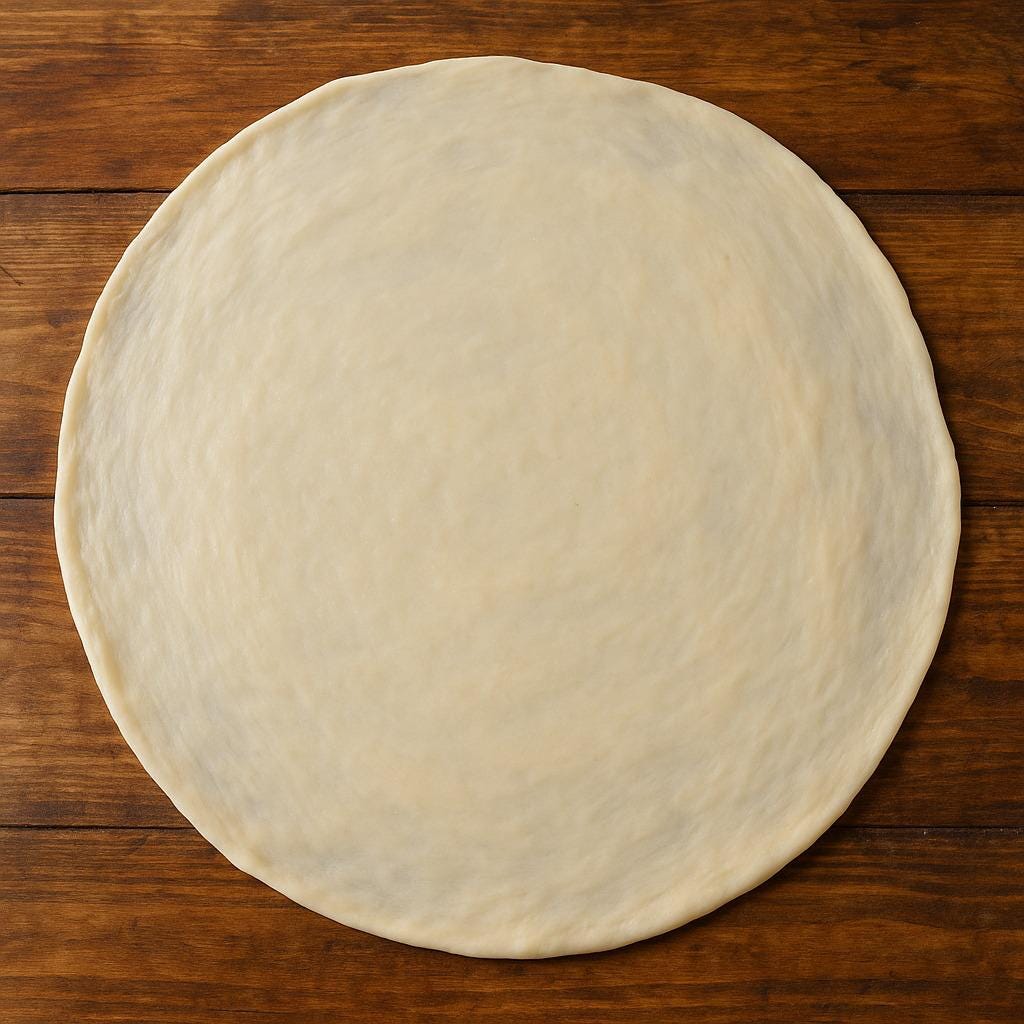
Working one piece at a time, roll each ball into a very thin sheet. Spread a thin layer of butter or ghee over the surface, then fold into a square or envelope shape to create layers. Repeat once more if a more pronounced lamination is desired.
Let the folded pieces rest briefly, then gently roll each into a flat round, taking care not to press out the layers.
Heat a pan over medium heat. Cook each piece until golden on both sides, turning once, until the pastry is crisp at the edges and soft within.
Serve immediately, while still hot, with syrup and cream.
Qei’mar (Geymar)
Clotted Cream from Slowly Heated Milk
adapted from Nawal Nasrallah, Delights from the Garden of Eden
Serves 4
Ingredients
2 cups heavy cream
2 cups whole milk (water buffalo milk, if available)
Method
In a heavy pot, gently combine the cream and milk. Place over very low heat and do not stir further.
Allow the mixture to heat slowly until it reaches a gentle rise, just below a boil. This should take approximately 30–40 minutes. Do not let it boil over or break.
Remove from the heat.
To prevent condensation from dripping back onto the surface, place a large upturned colander over the pot and cover it tightly with clean towels. Leave undisturbed at room temperature for at least 6 hours.
Remove the towels and colander, cover the pot with a lid, and refrigerate for 24 hours.
A thick, solid layer of cream will have formed on the surface. Carefully lift this layer off, folding it gently onto itself, and transfer to a plate. Spoon a small amount of the remaining milk over it before serving.
Notes
The key to Qei’mar is low, steady heat and complete stillness. Stirring or overheating will prevent the cream layer from forming properly.
The longer resting and chilling stages are not optional; they allow the fat to separate and set.
The yield will vary depending on the richness of the milk. Water buffalo milk produces a thicker, more stable cream than cow’s milk.
Kahi with Qei’mar, Berries, and Orange Oil
An adaptation, not an invention
In a previous essay, I argued that orange has no clear role in the Indian kitchen. It appears, but does not structure a dish.
In the following recipe, kahi remains the centre. Everything else is applied in proportion and in sequence so that the pastry is still the dominant element. This is not a berry dish with pastry; it is kahi, adjusted to enter the world of Ottolenghi.
Yield
Serves 4 (1 piece per person)
Ingredients
Base
4 pieces kahi, freshly cooked (see recipe above)
Qei’mar
Qei’mar (see recipe above), about 2–3 tbsp per piece
Orange oil
100 ml olive oil
Zest of 1 orange (in strips)
A few thyme sprigs
Berries
Small handful mixed berries (raspberries, blueberries, a few blackberries)
Berry dressing
2–3 tbsp crushed berries (from above)
1 tsp sugar
A few drops lemon or lime juice
Method
Prepare the orange oil
Heat the olive oil gently until just warm. Remove from the heat, add the orange zest and thyme, and leave to infuse for at least 30 minutes.Make the berry dressing
Lightly crush a small portion of the berries. Mix with the sugar and a few drops of lemon or lime juice. Set aside.Cook the kahi
Cook the kahi and keep it hot.Assemble
Place one piece of hot kahi on each plate.
Add a thick dollop of Qei’mar in the centre.
Spoon a small amount of berry dressing around and slightly onto the cream.
Add a few whole berries.
Drizzle lightly with orange oil.Serve immediately
👉 Get your printable PDF recipe for Kahi with Qei’mar, Berries, and Orange Oil here
Notes
The syrup replaces the usual sugar syrup and therefore performs a structural role.
The cream remains central; it should be rich, thick, and clearly present.
The fruit is intentionally limited. It provides contrast but does not redefine the dish.
The kahi must remain visible and texturally dominant.
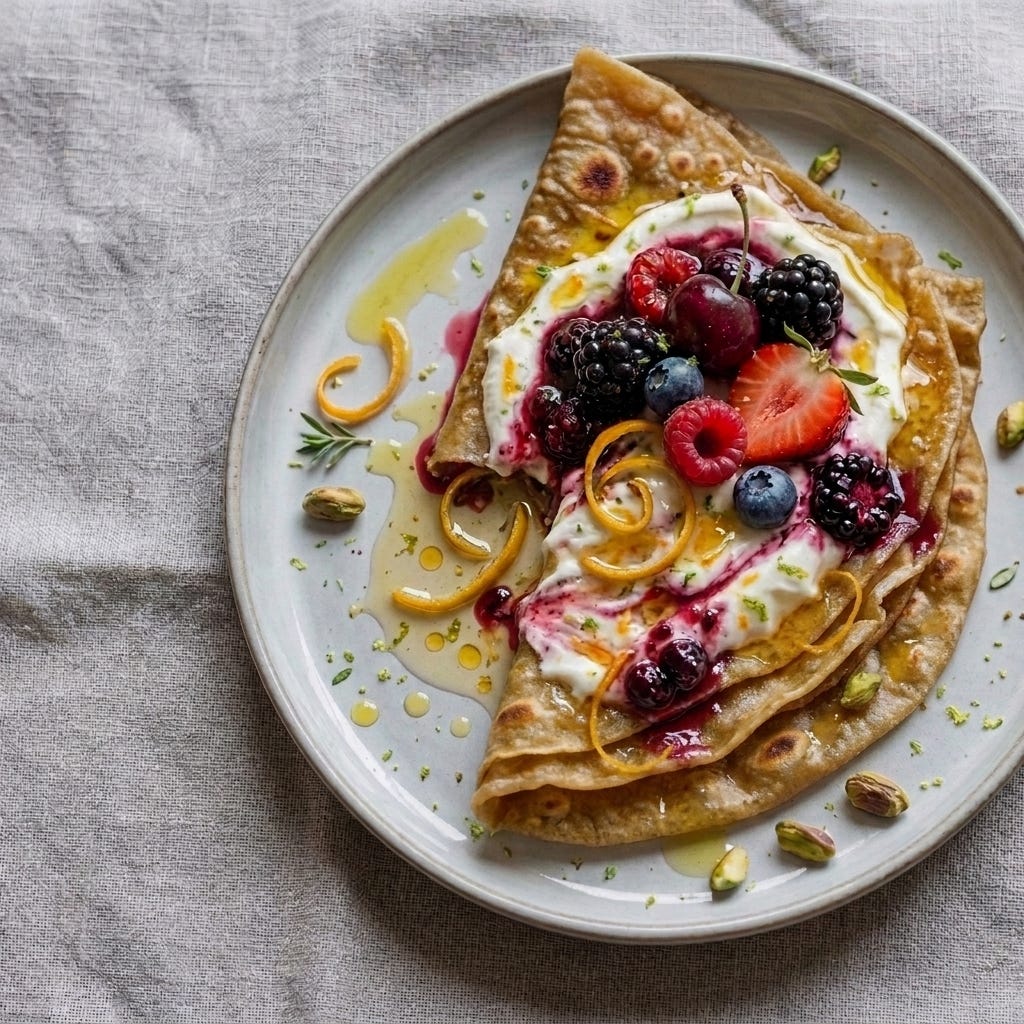
There are dishes that can absorb change without losing their structure. Kahi is one of them.
Once orange is given a role - as syrup, as balance within the cream - it stops being external to the dish. The result is not a new pastry, but a rebalanced one. It is still kahi.
If this essay resonated with you, I’m grateful you’ve read this far.
Beyond Babylon continues to trace Jewish life and food across unexpected geographies.
You’re welcome to subscribe or share the piece with someone who might enjoy it.
Fascinating
In The Islamic community we have a dessert called Malpua. I am wondering if they are cousins.
Another lovely informative post