
Under the table
when a a disapora fails to produce a kitchen

There is a tendency, when writing about diaspora, to focus on what survives.
The word diaspora itself carries an assumption.
From the Greek dia (across) and speirein (to scatter), it suggests a dispersal that nonetheless retains coherence - a scattering that still belongs to something.
But not all scattering produces a diaspora.
Seeds cast onto prepared ground take root.
Those cast onto stone do not.
What we call diaspora is often, in fact, the successful case:
a dispersal that achieved density, continuity, and recognition.
A diaspora that does not retain coherence ceases to be a diaspora. It becomes a field of scatterlings.
What remains less visible are the failed dispersals- movements of people that never acquired the conditions necessary to become communities.
We tell the stories of communities that built synagogues, established institutions, and left behind archives, recipes, and recognizable traditions. We point to Amsterdam, to Salonika, and later to the New World - to New Amsterdam (later New York) - places where Jewish life, though displaced, reorganized itself into something durable.
And in my writing, I not only place a pin on the map, but attach a recipe to it.
From these examples, a quiet assumption emerges: that diaspora, once set in motion, naturally produces community - and often, a menu unique to that community.
But this is not always the case.
Some communities did not fade.
They never fully formed.
And so this is an essay with a route - but no recipe.
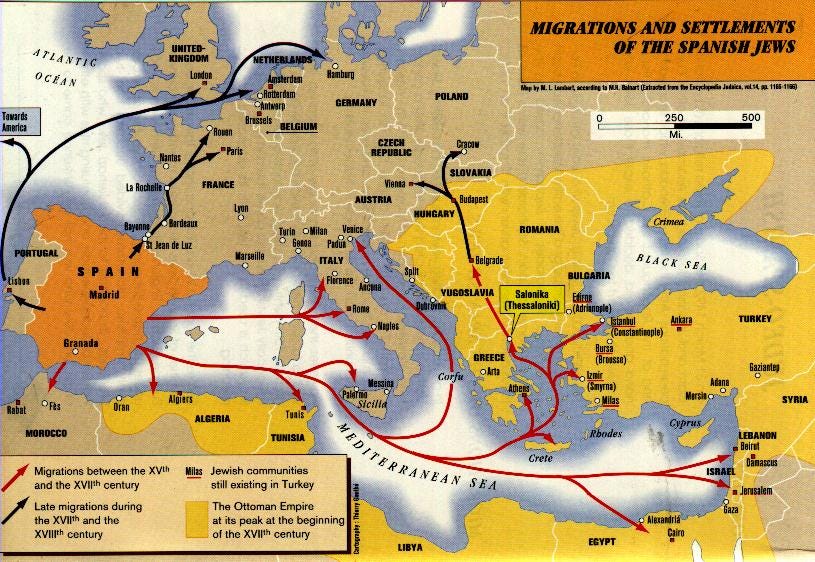
The routes are visible. The outcomes are not.
This map traces the dispersal of Spanish and Portuguese (Sephardic) Jews after 1492 - but it cannot show where communities formed, where they survived, and where they were prevented from emerging at all.
Its geography is telling: largely confined to Europe and North Africa, it reflects where Jews could be counted as Jews. Those who moved along maritime routes - often as conversos - disappear from view, recorded not as communities, but as fragments.
(Courtesy: Sephardic U)
The expulsions from Catholic Iberia in the fifteenth century coincided almost exactly with the opening of global maritime routes - to India under Vasco da Gama, and to the Americas under Columbus.
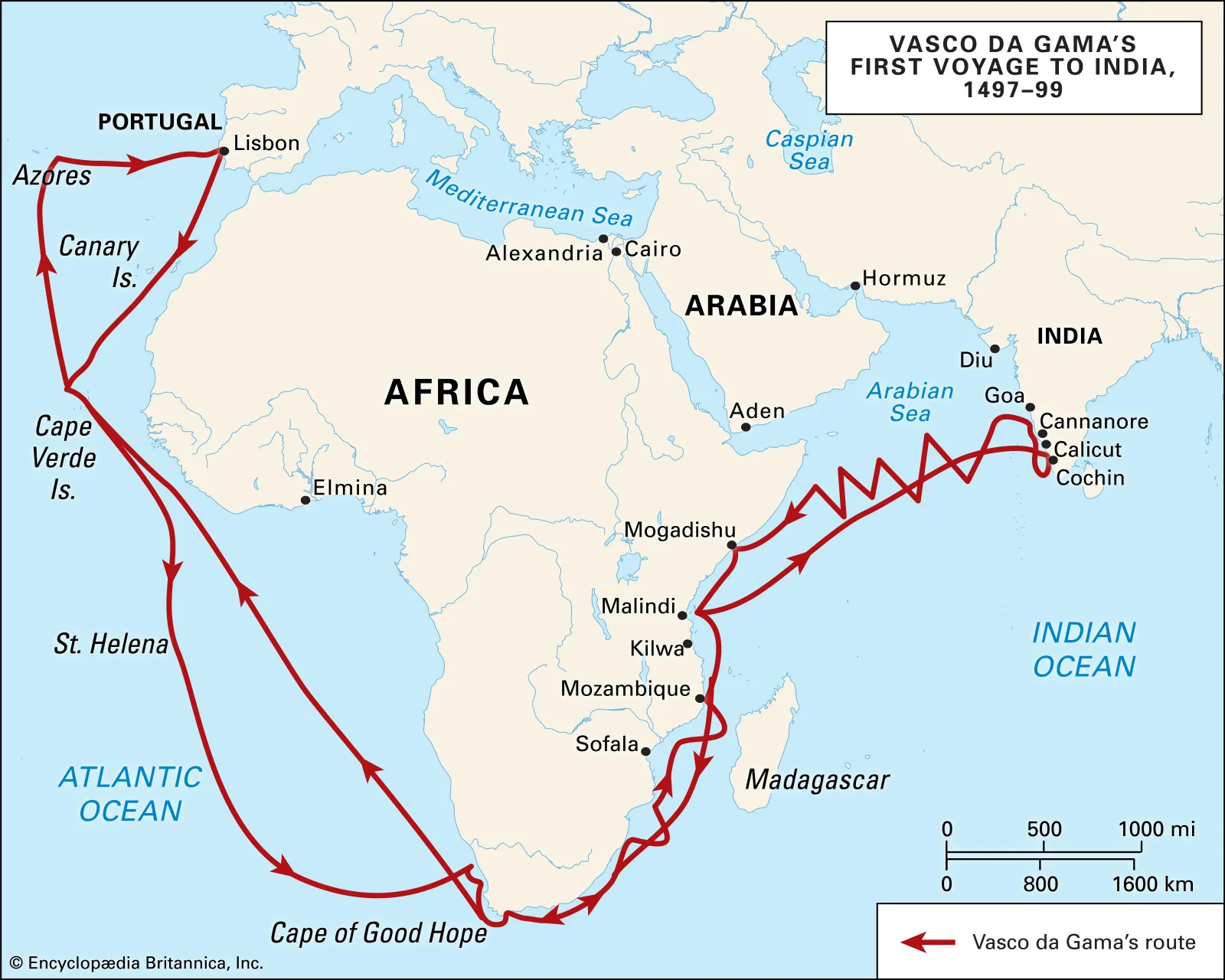
It is in Cochin that Vasco da Gama died in 1524 and was first buried, at St. Francis Church, before his remains were returned to Lisbon.
This shift was not inevitable.
Across the early modern Iberian and Portuguese worlds, Jewish life originating in Iberia was often forced into concealment from the outset. The expulsions and forced conversions of the late fifteenth century did not simply disperse Jews geographically -they fundamentally altered the conditions under which Jewish identity could be lived.
Most Iberian Jews who fled persecution found refuge in the Ottoman Empire, or in the more tolerant Protestant cities of northern Europe - Amsterdam, and later England after Cromwell’s readmission of Jews - where Jewish life could re-emerge openly. Some continued onward into the early Atlantic colonies, where commercial pragmatism often allowed a measure of religious flexibility.
Under Muslim rule in al-Andalus, Jews formed a visible - if legally subordinate - part of society, participating in intellectual, administrative, and commercial life. This position was not one of equality, and conditions varied over time, but it allowed for a degree of cultural and economic integration.
The transition to Christian rule did not occur all at once, but over time it transformed the conditions under which Jewish identity could be lived. Increasing pressure, periodic violence - especially from the late fourteenth century onward - and legal restrictions led many Jews to convert to Christianity. These converts, known as conversos or perjoratively Marranos (a derogatory term meaning “swines”), often remained under suspicion of maintaining Jewish practices in secret.
Subsequent to expulsion, the same ships that carried spices, silver, and empire also carried people - merchants, intermediaries, and, among them - conversos, moving outward along these newly connected routes.
The conversos who moved within the Portuguese Catholic empire - to Brazil, to West Africa, to India - did so under very harsh conditions.
In places like Goa, distance from Iberia did not mean safety.
Many who moved through these imperial networks did so not as openly Jewish communities, but as conversos - individuals and families legally defined as Christians, even when they retained fragments of Jewish memory or practice.
They could move, provided they were faithful to the church.
Yet they could not escape the machinery of suspicion: the inquisition.
A diaspora composed of individuals under constraint, living under assumed identities and carrying fragments of memory, is not the same as a diaspora composed of functioning communities taking root within tolerant societies.
A community requires structure.
It requires density: enough people who recognize themselves in one another. It requires institutions - formal or informal - that transmit knowledge. It requires repetition: of ritual, of language, of shared time. And above all, it requires connection - to other such communities, to sources of authority, to a wider world that reinforces and renews identity.
Where these conditions exist, Jewish life takes shape.
Where they do not, it struggles to begin, often disappearing without a trace.
Where Jews arrived in India later, under more tolerant regimes like the Dutch or English, they often arrived openly as Jews - or as former conversos who could now return to Judaism.
But what happens when these tolerant conditions are denied?
The answer can be seen by looking not at distance - but at structure.
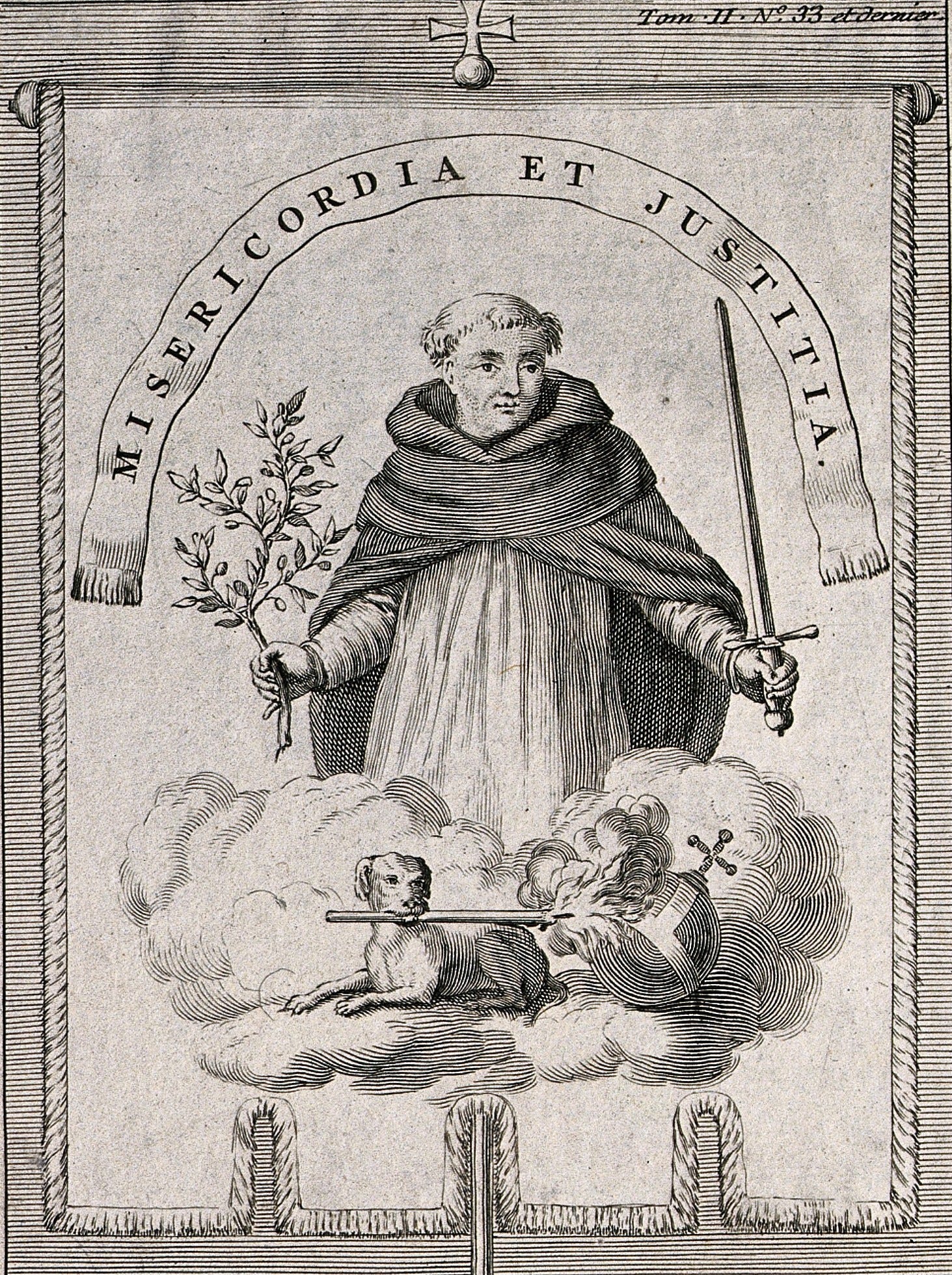
“Misericordia et Justitia.” Mercy and Justice.
An allegorical emblem of the Inquisition: a friar bearing the symbols of compassion and judgment, while below, the instruments of punishment are already at work. (Anonymous engraving, “Misericordia et Justitia” (18th century), associated with early modern European critiques of the Inquisition, including editions of Histoire de l’Inquisition).
The Goa Inquisition, established in 1560 and lasting - with interruptions - until 1812, endured for over two centuries as a sustained system of surveillance, denunciation, and punishment - nearly as long as its counterpart in Portugal itself (1536–1821).
It presented itself under the language of balance - misericordia et justitia, mercy and justice - but in practice claimed authority over belief, behaviour, and memory.
Very little mercy was exhibited.
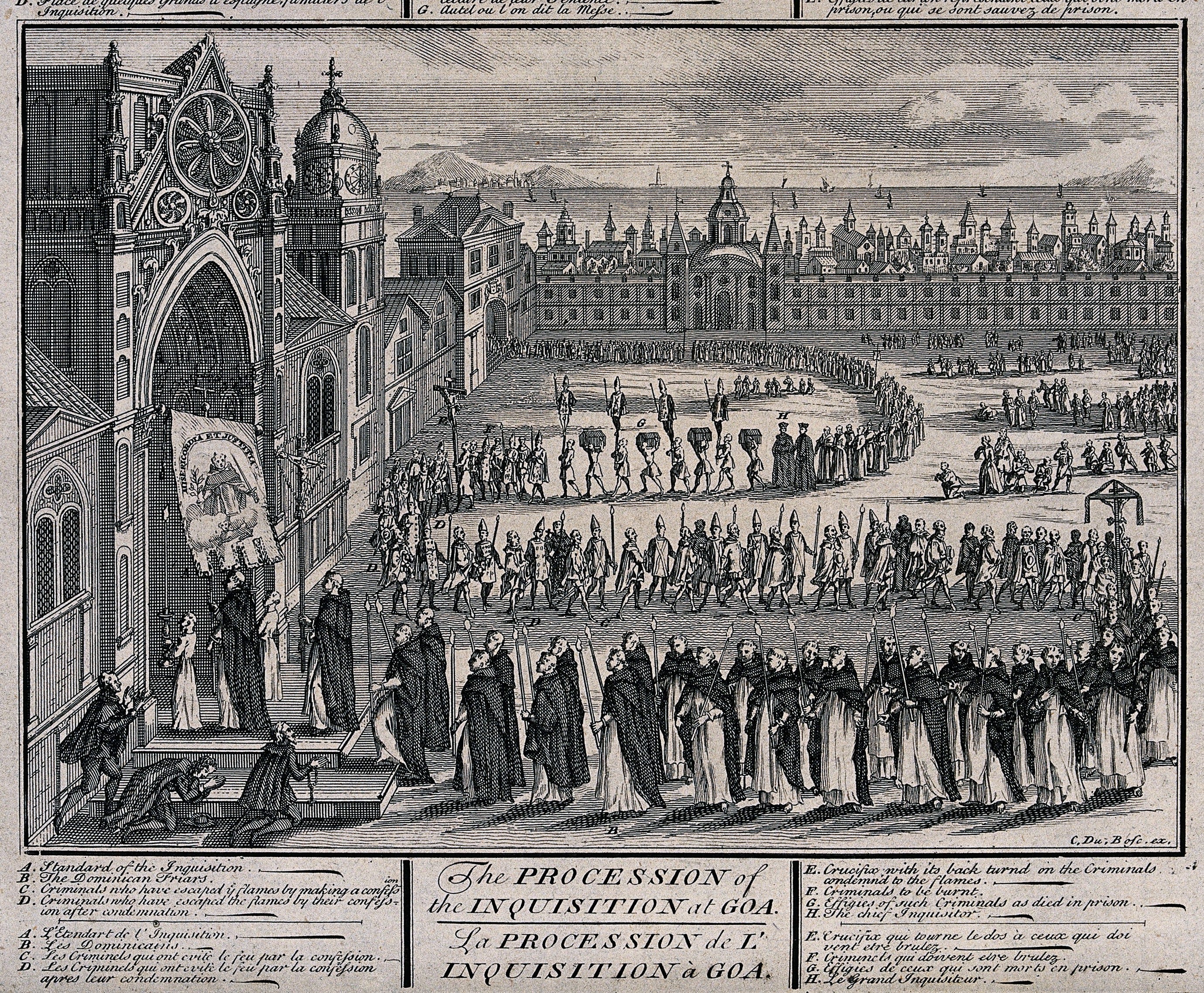
Anonymous engraving, “The Procession of the Inquisition at Goa,” 18th century. Wellcome Collection, London.
The system did not operate in secrecy alone.
It made itself visible - through accusation, procession, and public ritual - turning belief into something to be judged, displayed, and disciplined.
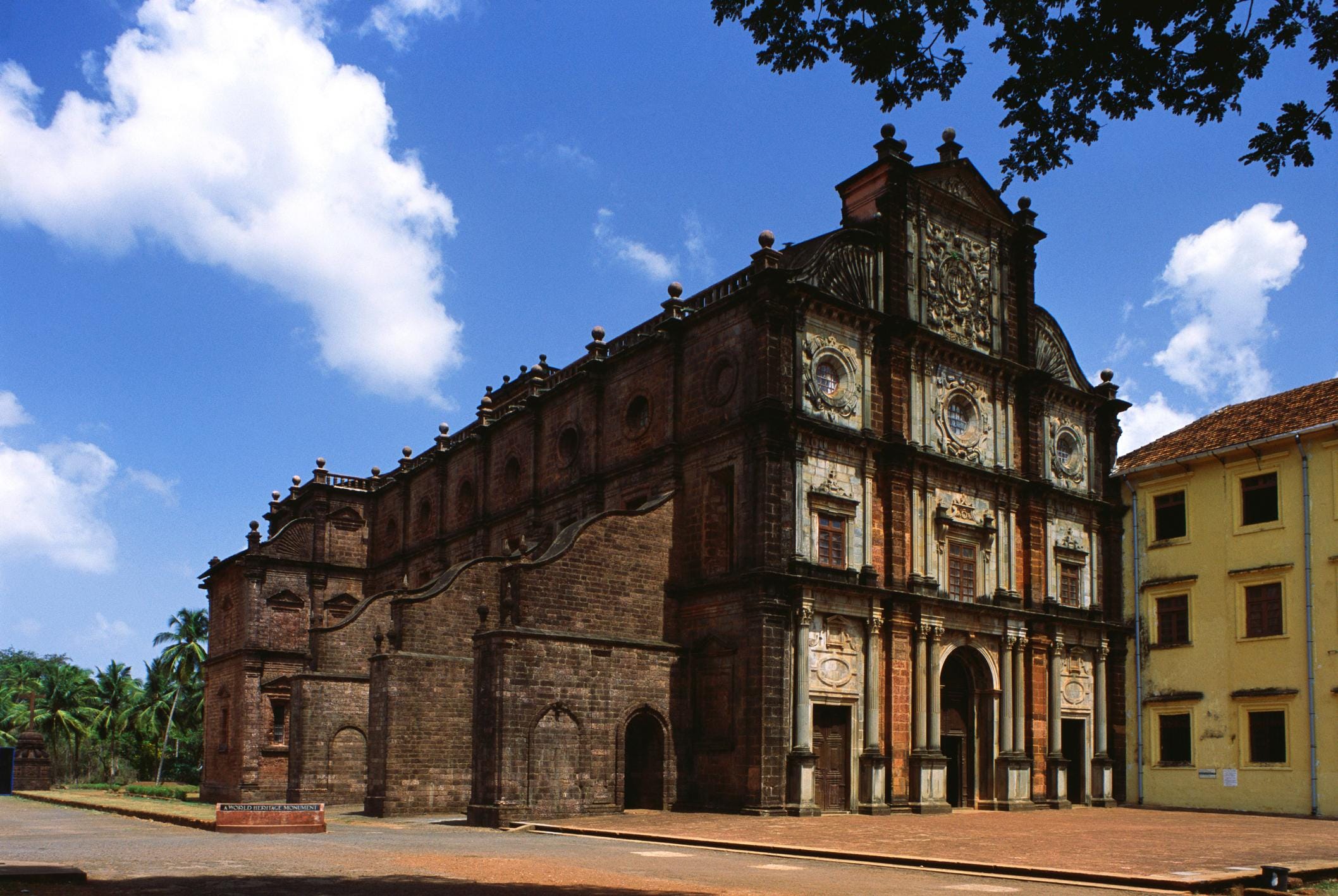
Old Goa: the remains of Portuguese ecclesiastical power in Asia.
From this landscape - of churches, convents, and tribunals - the Goa Inquisition operated for nearly two centuries (1560–1774; briefly reinstated until 1812), extending Iberian mechanisms of religious control into the Indian Ocean world. (Photograph: Wikimedia Commons)
In Goa, imperial architecture anchored this order.
Churches, tribunals, and administrative structures formed not just a religious landscape, but a system designed to regulate life itself.
Under such conditions, even the smallest deviation from orthodox Catholic life could carry real danger.
Two and a half centuries is not an episode.
It is a condition - long enough to ensure that what might have formed never had the chance to begin.
There may have been individuals of Jewish origin in Goa - merchants, intermediaries, officials - but they could not assemble openly as Jews.
The absence of visible Jewish life in parts of the Portuguese Indian Ocean world was not simply the result of migration or gradual assimilation.
It was shaped by design.
Within such a system, Jewish life did not simply disappear - it was prevented from organizing, forced into forms designed to leave little trace.
What could not be practiced openly could not easily be recorded, transmitted, or remembered.
In Goa, the Inquisition did not destroy synagogues.
It made sure none could ever be built.
No communal leadership emerged.
No visible markers of Jewish identity could survive scrutiny.
This is not a story of a community that declined.
It is a case of a community that was structurally prevented from forming.
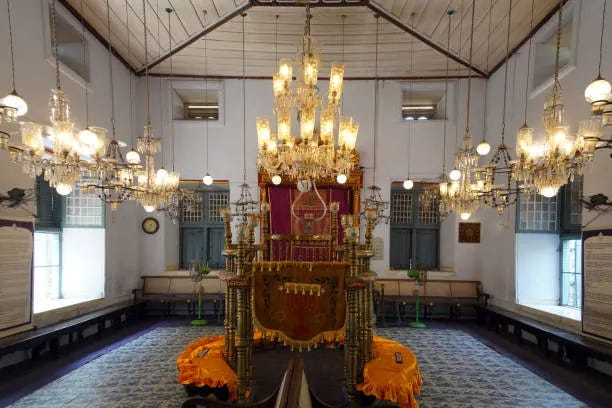
Interior of the Paradesi Synagogue, Matanchery, Cochin.
In contrast to regions where Jewish life was forced into concealment, this space reflects the conditions necessary for continuity: visibility, structure, and repetition. (photo: iStock).
The contrast is visible in Cochin.
Just down the coast, under a different political order, Jewish life unfolded differently.
In Cochin, Jewish communities existed openly for centuries. They built synagogues, maintained internal distinctions, and sustained links with wider Jewish networks. They lived under the protection of local rulers and were embedded in long-standing Indian Ocean trade networks.
The result was density, continuity, and transmission.
The Paradesi Synagogue, built in 1568 under Portuguese presence in Matanchery, could exist not because Portuguese policy permitted it, but because Portuguese authority on the Malabar Coast was never absolute. The local Rajah retained power, and Jewish communities - both pre-existing Malabari and Iberian Paradesi - were able to live openly within that framework under the protection of the Indian ruler.
When the Dutch displaced the Portuguese in 1663, this space widened further. What had been tolerated became more secure. The same empire that enforced religious conformity in Goa could not impose the same conditions in Cochin.
The difference was not geography alone. It was the structure of power.
From that continuity emerged something tangible: a cuisine.
Coconut, tamarind, curry leaf, and black pepper entered a recognizably Jewish framework of practice.
Food became a record - of survival and adaptation.
These communities did not remain unchanged. They adapted deeply to their surroundings - linguistically, culturally, even biologically - yet retained enough structure and tradition to remain legible as Jewish communities.
By comparison, the converso merchants of Macau appear in a different form.
They surface in trade networks linking Cochin, Malacca, Macau, and Manila, and in the records of the Inquisition that dismantled earlier communities in India. They become visible at the moment of accusation, taxation, or disruption - and then vanish again: some slipping onward along the routes, others ending in the tribunals and pyres of the Inquisition.
Here, movement continues.
Community does not.
As Dutch power displaced the Portuguese in parts of the Atlantic and the Indian Ocean, a different logic began to prevail - one driven less by religious uniformity than by trade.
In those spaces, Jewish life could once again become visible.
In the Atlantic world, this shift produced yet another outcome. Iberian Jews re-established visible communities in places such as Curaçao and the Caribbean, building synagogues and commercial networks.
But this visibility came within plantation economies shaped by slavery - the subject of a future essay.
Jewish life became visible again - yet within a system that carried its own moral entanglements.
The same routes led outward from Iberia.
What differed was the moment of arrival - and the empire that received them.
The route was the same.
The outcome was not.
Cuisine follows the same pattern.
Where Jewish communities were able to establish themselves openly, we find distinct culinary traditions. Food, like ritual, depends on repetition and transmission. It requires a community large enough to maintain practices, and stable enough to pass them on.
I was recently gifted Monsoon, a beautiful cookbook by Asma Khan, the Calcutta-born founder of Darjeeling Express in London.
I do not turn to Asma Khan here to tell her story, but because she articulates something essential about diaspora itself.

Like Khan, I too trained as a lawyer before turning to food - a trajectory she shares with others, such as Nisha Katona. One begins to wonder whether the discipline of law - with its concern for structure, order, and transmission - finds a different, more human expression in the kitchen. But for me, it is something else - something she expresses with a clarity I cannot improve upon, and so I bring her words here directly.
Khan speaks of food not as sustenance, but as something closer to memory itself. When she left Kolkata, she describes herself as stripped of her roots - like a tree pulled from the ground, its roots exposed.
And so she cooks.
“Food is my way home. Let me cook.”
For her, food is part of her DNA - her comfort, her anchor. Food and stories travel together. What is lost in place is rebuilt through repetition.
What she describes is not the kitchen of an individual home.
It is something larger.
A community kitchen.
Not a physical place, but a shared language: a set of techniques, tastes, and expectations that exist beyond any one household. A grammar of cooking that allows recognition - this is ours, this is how it is done.
Like language, it depends on continuity. It requires a critical mass of speakers.
A single family can preserve fragments. But without a wider community, the language begins to thin. Variations are no longer corrected. Meanings shift. Fluency gives way to approximation.
The food a community produces - Baghdadi cuisine repeating along the trade routes from Baghdad to Kobe - does not merely reflect identity. It produces and sustains it. Through repetition, it holds together people who are otherwise dispersed. In this sense, the kosher system functions as a structure of continuity, much like regional cuisines more broadly.
A community does not survive on belief alone. It survives on repetition - on what is cooked, shared, and remembered together.
Diaspora may begin as dispersal - dia, across; speirein, to scatter - sometimes under the pressure of exile, coercion, or historical force.
But for a people to remain a people, something must hold them together.
Not only belief. Not only memory.
A kitchen.
In diaspora, the kitchen is not peripheral. It is structural, essential for survival, for remaining distinct.
But a cuisine requires a table.
It requires people who gather, repeat, remember, and pass on.
Where there is no community, there is no cuisine.
Under pressure, identity behaves differently.
Where it can be expressed, it adapts.
Where it must be hidden, it fragments.
And where it is both hidden and isolated, it struggles to cohere at all.
This is precisely what was not possible in Goa.
Under the conditions of the Inquisition, what Khan describes - repetition, sharing, the rebuilding of memory through food - could not take place openly.
What could not be practiced could not be repeated.
What could not be repeated could not become tradition.
And what never became tradition left no cuisine behind.
This is why there is no Jewish vindaloo.
Because there was no table.
And no one left to gather around it.
If this essay resonated with you, I’m grateful you’ve read this far.
Beyond Babylon continues to trace Jewish life and food across unexpected geographies.
You’re welcome to subscribe or share the piece with someone who might enjoy it.