
Tickya
Plum fruit leather with salt and chili - Baghdad’s technique, Bengal’s palate.

When my aunt wrote that the little red plums were called kool, I doubt she meant by that temperature or swagger. She probably wanted to remind me of a recipe to write about.
Aunties do this without announcing it. They don’t say: I am now going to provide you with an archival coordinate. They say something seemingly ordinary – kool – and suddenly a door opens. The kitchen becomes a map. A winter market in Calcutta opens up behind the syllable. A boy with a paper cone of sour fruit reappears. A tray is carried into a patch of sun and placed out of reach. Someone warns someone else not to touch it. You smell salt before you remember the name.
My aunt’s message was short, almost casual, threaded with that particular kind of precise nostalgia older relatives use when they don’t quite trust you with their longing. She wrote about tickya the way people write about things that were once plentiful and are now precarious: tenderly, defensively, with a slight edge of instruction. She mentioned that it was “treated like gold.” She mentioned cleanliness. She mentioned exclusivity - made for someone, for him, for her, under supervision. And then, as if appetite were itself a form of evidence, she added that she was salivating even as she wrote.
The salivation tells us something: tickya is not just an object in a cookbook. It is a past sensation that has outlived the circumstances that produced it. It is memory with teeth.
And as if I would doubt her, she referred me to one of my usual go-to sources, Mavis Hyman`s Indian Jewish Cookbook, which documents one of the Jewish communities in India - the Baghdadi one, through the hands of one who actually knew about cooking.
You will find the recipe on page 38, she said. She was right, of course.
Tickya, for those who have not had it, is a kind of fruit leather - dark, concentrated, dense, leathery, sweet-sour, and unique in that it is spiced with salt and chili. In my head it exists in discs or ovals, small enough to be hidden in a pocket, substantial enough to feel like a possession. It is not jam, not chutney, not candy in the glossy sense. It is reduced essence: fruit boiled down to its secret and then dried until it can travel and be chewed on, but better sucked on so as not to stick to dental work.
Because here something important needs to be said.
Fruit leather is not uniquely Baghdadi. It is not uniquely Indian. It is not even uniquely Jewish.
Across Central and Eastern Europe, there exists what German calls Leder or Fruchtleder - literally “fruit leather.” In plum-growing regions of Germany, Austria, and Switzerland, cooks boiled down Zwetschgen or apples, spread the purée thin, and dried it until it became pliable and matte like hide. The name is purely descriptive. It looks like leather; it bends like leather; therefore it is - Leder. It was sometimes spiced lightly with cinnamon or clove, sometimes left pure, sometimes sweetened modestly. It was not hot. It did not carry chili. It lived inside a sweet register. But the preservation logic is identical: reduce, spread, dry, store.
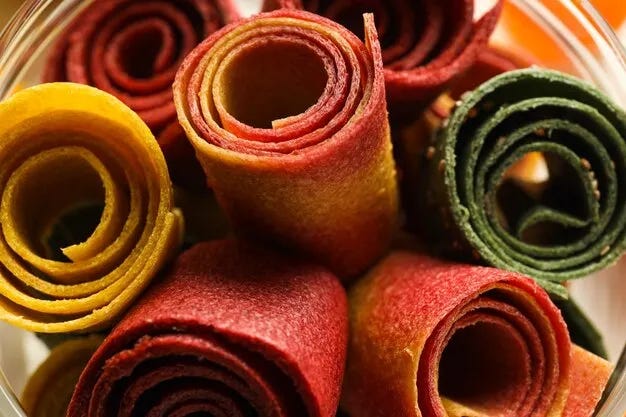
Not one cuisine. Not one climate.
Wherever fruit meets winter, someone flattens it into survival. (credit Freepik.com)
So tickya is not an isolated invention. It belongs to a much older preservation technology that appears wherever fruit meets winter. Persia has lavashak. Georgia has tklapi. Iraq has qamar al-din (aka cumradin). Central Europe has Leder. Different fruits, different climates, different spice grammars - but the same structural solution: concentrate the season into a sheet that can survive.
But what we seem to be looking at here is not simply a universal technique. It is a culinary migration into a different flavour world.
The technology of fruit leather - cooking fruit into a thick purée, spreading it thin, and drying it for preservation - was already established in the Levant and Persia, where apricot qamar al-din and sour plum traditions formed part of market life long before refrigeration. When Baghdadi Jews moved east along Indian Ocean trade routes to Bombay and Calcutta, they carried that preservation method with them, but India reshaped it.
Rosewater and perfume notes - so common in the Levantine sweet register - had little place in the Indian flavour profile. In their place came chili, salt, and sharper sourness. Apricots - the prestige fruit of the Middle Eastern version - gave way to what the Indian market actually offered: the small winter kool plums, tart enough to make your mouth flood before you’ve even swallowed.
Kool - also known as Indian jujube (Ziziphus mauritiana) - is a small, winter fruit common in eastern Indian markets, crisp when fresh and sharply tart beneath its thin skin. Though often called a “plum” in English, it is botanically unrelated to European plums, and its bright acidity and firm flesh make it ideal for reduction into tickya.
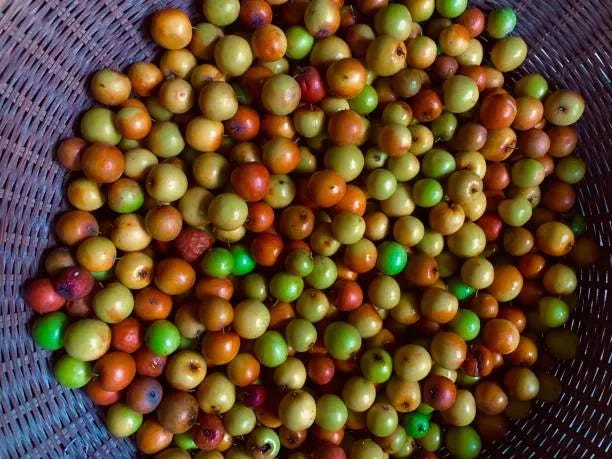
Kool (Indian jujube), winter fruit of eastern India.
Before it became tickya, it was this: tart, small, unassuming - a market fruit waiting to be reduced into memory. (Credit Shutterstock).
The sheet remained; the palate changed.
The name changed too.
In Iraq and the Levant, apricot leather carries the name qamar al-din - “moon of the faith” - or cumradin- a name heavy with Ramadan associations and golden apricot light. It belongs to the Levantine register: perfumed, amber, faintly floral.
But in Calcutta, the product was no longer called cumradin. It was called tickya.
That shift is not cosmetic.
In Hindi and Urdu, ṭikiyā means a small pressed disc, a patty, something flattened and formed by hand. It is a word for shape and describes what the thing looks like, not what it once symbolized.
As apricot gave way to kool plum, as rosewater gave way to chili and salt, the Arabic name fell away and an Indian one took its place.
The technique remained Baghdadi.
The fruit became Indian.
The palate became Indian.
And the word became Indian too.
This is not corruption. It is linguistic naturalization.
Tickya is what happens when a migrant method stops needing translation.
And this is where Leder becomes useful - not as an ancestor, but as contrast.
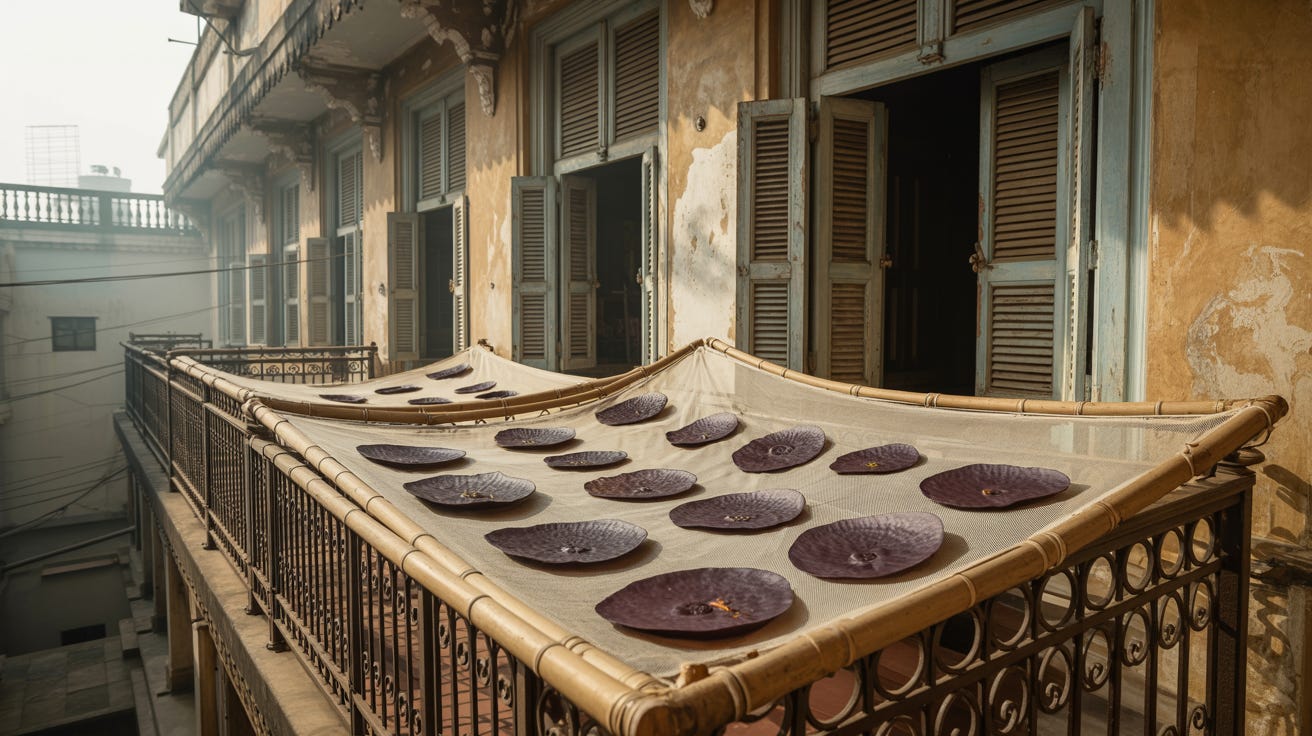
Calcutta balcony, winter light.
Iraqi technique. Indian fruit. Jewish hands.
Kool plums reduced, salted, spiced, and left to dry on muslin until they could outlast the season.
European Leder stayed within a sweet-spice register. It remained dessert-adjacent. It did not lean into heat. It did not invite the sting of chili. Its identity was shaped by a Central European palate.
Tickya did something else entirely.
It absorbed India.
cumradin was apricot pulp cooked down, strained, spread thin, and dried into sheets. It could be rehydrated into a drink, cut into strips, eaten as a chew. In Jewish households the technique was equally familiar, part of the shared culinary intelligence of the region.
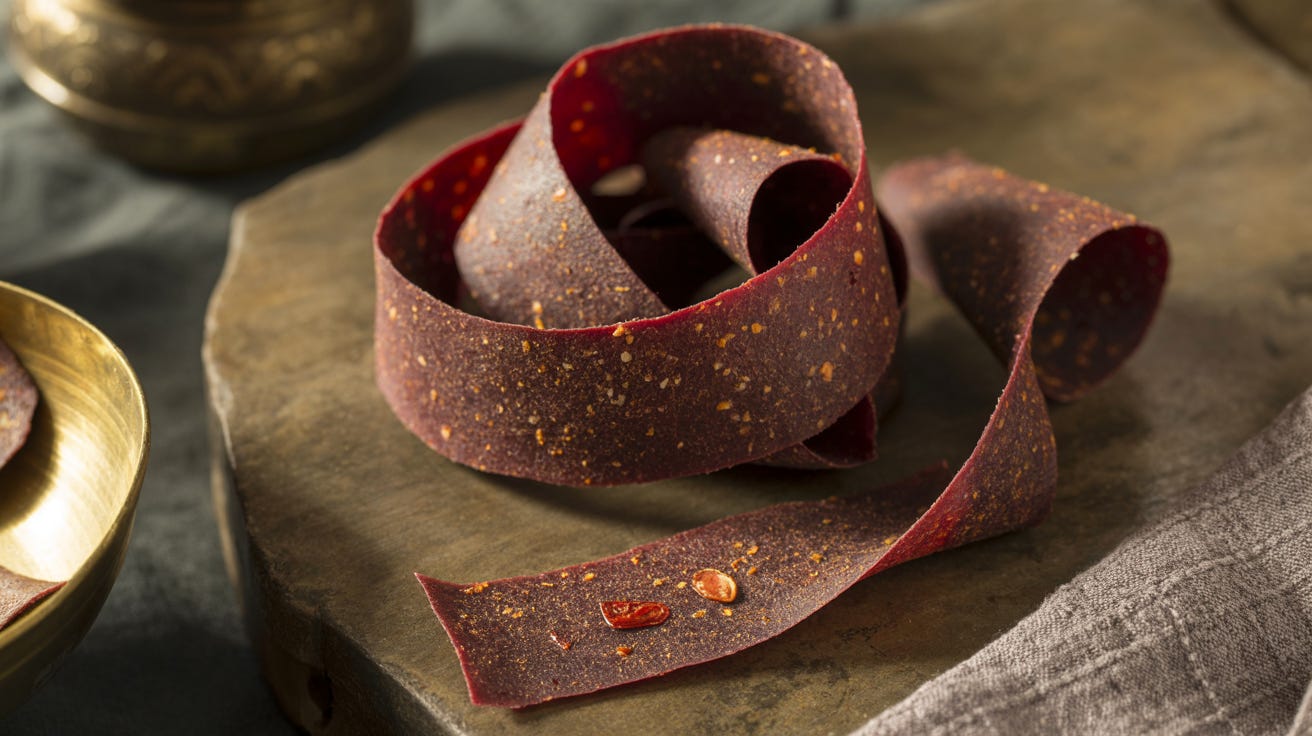
Tickya.
Plum reduced until it forgets it was fruit.
Salt and chili folded into memory.
An Iraqi preservation method, Indianised on a Calcutta balcony.
Dried to outlast the season - and the city.
It is not a “sweet” in the modern, decorative sense. It is preservation technology.
Preservation is foresight you can chew - abundance compressed against the possibility of disappearance.
So these are not “recipes” in the narrow sense. They are forms of expertise. They live in hands more than in books.
Baghdadi Jews who left Iraq in the eighteenth and nineteenth centuries carried these kinds of expertise with them. They moved along commercial corridors, settling in Bombay, Calcutta, Rangoon, Singapore - port cities shaped by British trade. They carried Arabic liturgy, Baghdadi synagogue rites, family names that became institutions, and a cuisine shaped by the Tigris and Euphrates.
What they did not carry were apricots in abundance.
Here the corridor becomes visible: Baghdad’s method meets Calcutta’s fruit.
Tickya follows the classic preservation logic:
Boil the fruit.
Reduce to pulp.
Strain.
Return to heat.
Sweeten modestly.
Add salt and chili.
Dry in discs.
It is the chili that tells us the story has moved again.
Because chili is not Baghdad. Chili is India.
Because in India, preserved fruit rarely stands alone in sweetness. It is pulled into the sweet-sour-salt-heat triangle that defines the snack palate. Salt sharpens. Chili awakens. The Bengal air demands patience.
Humidity demands assistance in preservation. The Baghdadi technique remains intact, but the Indian environment speaks back. And when the name shifts from cumradin to tickya - from a poetic Arabic title to a Hindi word meaning flattened disc - the seasoning follows the language. The sheet stays the same. The flavour declares allegiance to place.
It is a Baghdadi preservation method naturalized in India.
It shifted from perfumed Levantine sweetness to Indian sweet-sour-heat. It moved from apricot gold to dark plum density. It moved from rosewater to red chili.
And in that migration, it reveals something about diaspora that is both ordinary and profound: communities do not carry ingredients intact. They carry methods. They carry memory. They carry ways of doing things.
Then the market speaks back.
And sometimes, if the adaptation is successful enough, an aunt writes decades later that she is salivating even as she types.
That salivation is the proof.
Not of purity. Not of static tradition. But of survival.
Tickya preserved fruit, technique, and belonging.
(Note: If kool plums are unavailable, substitute small sour plums or damsons. Tickya depends on tart, firm fruit that will reduce to a dense paste. Adjust sugar and chili to balance the fruit’s natural acidity.).
✨ All posts are free; paid subscriptions are optional, and your support is deeply appreciated.
💬 Share your story in the comments, or pass this essay along.
📖 To support more work uncovering Jewish food in unexpected corners of the world, consider subscribing to Beyond Babylon.
I grew up eating qamar al-din. I never knew what the words meant or how it was spelled, so thank you for that. It was always apricot, the only flavor available in Middle Eastern stores then.
Those "plums" look suspiciously like Asian date jujubes I can get fresh in the markets here. They are not?
Elli, this is a good article abt a childhood delicacy. Indeed, the western part of India has aam paapad. My MIL used to make mango leather in summer when mangoes abound.