
The Salty Truth
What a supermarket expiry date taught me about how branding really works

I recently read this facebook post.
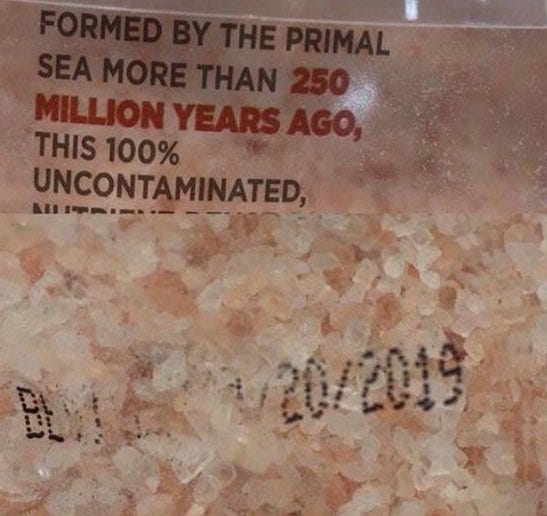
He was standing in a supermarket aisle looking at a bag of Himalayan pink salt. The packaging told him the salt was 250 million years old - formed from ancient seabeds, untouched by time, pure as the mountains it supposedly came from.
Then he noticed the expiry date.
His post then read: “Just my luck: 250 million year old salt, and it expires next year”.
In real terms, it seems this salt expired 6 years ago.
That small contradiction - primordial salt with a best-before date - is the whole story of how modern marketing works. And it sent me down a rabbit hole.
A confession before the chemistry:
I’ve always believed that if something is worth writing about, it’s worth researching properly. Old habit from my days as a criminal lawyer writing briefs. You don’t submit a half-argued case.
But I’ve also been hearing the same feedback repeatedly: too long.
And I recognise the tension. I don’t want readers skimming. I’d rather lose them at the door than have them drift away halfway through.
So I’m experimenting with a second format alongside the longform essays.
The longer pieces will remain what they are: layered migrations of food, memory, objects, and history across continents and generations.
But alongside them, I want to introduce something smaller: information capsules. Shorter than my usual essays, longer than notes, built around one clean idea taken seriously from beginning to end. No recipe at the end. No diaspora map stretching from Basra to Singapore. Just a single argument, properly researched, tightly structured, and fully executed.
If it works, I’ll alternate between the two forms.
So here is the first capsule.
“Himalayan” Salt Doesn’t Come From the Himalayas
When someone says “Himalayan salt,” your mind probably jumps to Tibetan monks, crisp mountain air, and pristine snowy peaks.

The reality is considerably less romantic.

The salt is mined from the Khewra Mine in Punjab, Pakistan - the second largest salt mine in the world, producing around 400,000 tons a year, located roughly 300 km south of the actual foot of the Himalayan range.
Three hundred miners work underground for eight hours at a time, blasting rock with gunpowder and hand drills, earning less than 1,500 rupees a day - not much more than the retail price of a single bag of the salt they extract.
Legend has it that Alexander the Great’s horses discovered the deposits in 326 BC by licking the rocks. What the legend never mentioned was the word “Himalayan.” That name came much later, courtesy of some very clever marketers.
They didn’t change the product. They changed the story around it.
So is there actually any difference?
Chemically, barely.
Pink Himalayan salt is 97–99% sodium chloride - essentially the same as ordinary table salt. The pink colour comes from trace iron oxide.
In plain terms: rust.
As for the “84 essential minerals” printed on the packaging - those minerals do exist, but in quantities so small that you’d need to consume dangerously large amounts of salt to get any meaningful nutritional benefit.
One peer-reviewed study found that to hit your recommended daily potassium from pink salt alone, you’d need to consume 3.7 pounds of it. At that point the sodium would kill you long before the potassium helped you.
There’s also a real downside worth knowing: unlike regular table salt, pink salt contains virtually no iodine. Iodine is essential for thyroid function and brain development, which is why over 120 countries fortify table salt with it. Switch exclusively to pink salt, and you may need to get iodine elsewhere.
A ton of raw salt sold from the mine to India went for roughly $40. The same salt, repackaged and relabelled, fetched hundreds of dollars in European retail markets. Pakistan banned salt exports to India in 2019. The miners’ salaries didn’t change.
Yet the industry generates nearly $2 billion a year.
Why?
Because the brain doesn’t buy chemistry. It buys stories.
Three psychological reflexes do most of the work.
The Halo Effect: “Himalayan” triggers associations of purity, nature, and remoteness, and those associations transfer onto the product itself.
The Naturalistic Fallacy: we instinctively assume something raw and unprocessed must be healthier than something industrial and refined, even when the chemistry says otherwise.
Price-Quality Bias: when we cannot easily evaluate something directly, we use price as a proxy. A salt that costs twenty times more must somehow be better.
Control the narrative around a product, and you control how people experience it.
In the end, every brand succeeds or fails on one question: what story are you telling, and what feeling does it create?
Everything else is just sodium chloride.
Sources: Business Insider documentary on the Khewra Mine; nutritional analysis via registered dietitian Rhiannon Lambert; Popular Mechanics; mineral content data from a 2010 peer-reviewed study published in the Journal of Sensory Studies.
If you enjoyed this essay, you might also like my previous dispatch on When the Jerusalem Bagel came to Switzerland
Beyond Babylon continues to trace Jewish life and food across unexpected geographies.
You’re welcome to subscribe or share the piece with someone who might enjoy it.
"kosher salt"... whatever that is (becuase kosher, it isn`t)
The expiry date is required by law in most countries - food labelling regulations mandate a best-before or use-by date on packaged food products, including salt.
The manufacturer probably has no choice but to print one.
The irony is exquisite.
The same regulatory framework that protects consumers from genuinely unsafe food forces the marketer of '250 million year old' salt to admit, in small print on the back of the packet, that it has a shelf life measurable in months.
Of course the salt itself doesn't "expire", whatever that means - sodium chloride is chemically stable essentially forever.
What the date technically refers to is the packaging integrity, or occasionally the iodine content in regular table salt which can degrade over time.
Pink Himalayan salt has no iodine to degrade, so the date is even more of a formality than usual.
In other words: the expiry date is a legal fiction required by the same modern regulatory state that the 'ancient and pure' branding is trying to make you forget exists.
The marketing says: timeless.
The label says: best before March 2026.
Both are printed by the same machine. Which probably also has an expiry date...