
The First Hebrew Juicer
A journey from the Mughal Kitchen to the Tel Aviv Kiosk

After my essay “The Orange Has No Job“ went out, fellow food blogger @khajazafarullah - a biochemist and IT executive, self-taught chef, and lifelong student of food history - sent me an email.
He had an old family recipe for Narangi Korma: a perfumed Mughal-style chicken curry layered with orange segments, kewra, browned onions, melon seeds, coconut, and khoya. Proof, if any were needed, that the orange had once found a role in the Indian kitchen - not a structural one, but a courtly one, built on fragrance and refinement rather than function.
“My grandmother used to make this dish,” he wrote. “Alas, it is lost in our family kitchens.”
That sentence stayed with me. Not the recipe itself- though he subsequently sent a facsimile, and it sounds extraordinary - but the elegance of the loss. The Narangi Korma did not disappear because it was forgotten. It disappeared because the world that gave it meaning - the Mughal court kitchen, the culture of refined fragrance, the idea that an orange belonged in a dish the way a perfume belonged on skin - had dissolved around it. The recipe survived long enough to reach one grandmother. Then it stopped.
In the kitchen I grew up in, this was simply inconceivable.
I grew up surrounded by orchards.
As a child I remember staring out the classroom window during mathematics lessons at the orange groves outside, the heavy sweet scent of blossom drifting through the air in spring, entire landscapes seemingly organized around citrus. The orange was not a luxury or a fragrance. It was infrastructure. It was breakfast, and the school run, and the kiosk on the corner, and the juice that appeared without ceremony every morning as though it had always been there and always would be.
Many of those orchards have since disappeared beneath apartment towers and new neighborhoods. But the scent survived, and so did the taste - in the daily kitchen, in the street stalls, in the machines still bolted to juice counters across Tel Aviv and Jerusalem, pulling juice from oranges and pomegranates with the same exposed mechanical force they used nearly a century ago.
My mother remembered her own childhood in Tel Aviv of the 1940s, when Arab boys would come from Jaffa selling oranges, calling out Burtuqal - the Arabic word for sweet orange, derived from Portugal, the fruit’s great early European distributor. In time, the Jaffa orange became one of the world’s most recognizable citrus brands. In winter I would buy krembo - the Israeli chocolate marshmallow puff - but I always loved the ones filled with orange cream most.
The orange, in other words, was not merely a fruit in Israel. It was a fact of life, pressing itself into every part of the daily world.
Which is why the machine that extracted it matters.
Yitzhak Zaksenberg was born in Warsaw in 1880 to a Polish Jewish family. Before immigrating to Palestine, he operated an iron foundry in the city, producing bells, metalwork, and industrial castings - heavy, sonorous objects built for churches and public spaces. When he arrived in Tel Aviv in 1924, he understood quickly that church bells would find no market in the new Jewish city rising from the coastal plain.
There is something worth pausing on in that transformation. A man who had spent his working life shaping metal into instruments of sound - objects that called communities to prayer, that marked hours, that rang across city squares - arriving in a society that needed instead the mechanics of extraction. Exile turning iron from bells into citrus machinery.
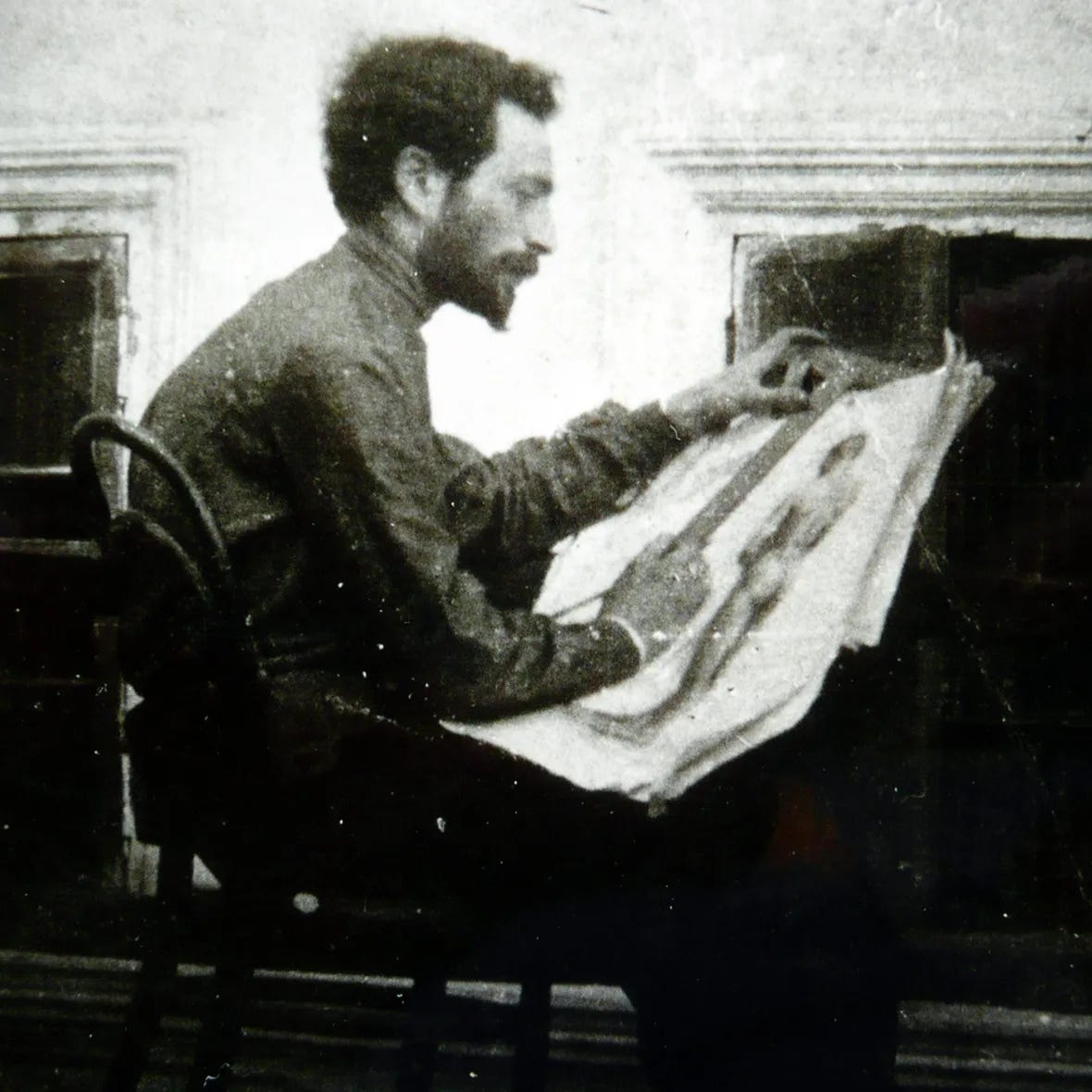
Zaksenberg in his studio: Yitzhak Zaksenberg, Warsaw. The foundry man was also an artist.
The family established one of the earliest iron foundries in Tel Aviv, first on Levinsky Street and later on Salame Road. The company letterhead, printed in Hebrew, Arabic, and English, described the business simply as an agency for all kinds of domestic machinery. Zaksenberg developed irrigation systems for the expanding agricultural settlements of Mandatory Palestine. During the riots of 1929, he manufactured armored protection for convoy vehicles traveling to besieged Jerusalem.
But the machine that survived him was the citrus press.
The first prototype appeared in 1926. Commercial production began in 1928, and a patent followed in 1931. Then, in 1939, a Tel Aviv court ordered a local imitator - a Jaffa manufacturer who had copied the design - to destroy all unauthorized versions of the press and compensate the Zaksenberg foundry. The machine had become valuable enough to forge.
I want to be precise about what Zaksenberg achieved, because the temptation is to make it tidier than it was.
By 1910, the United States Patent Office alone had registered more than two hundred citrus-press patents. The first cast-iron lemon squeezer had been patented in America in 1860. Lever-operated presses, hinged frames, integrated cutting blades - all of it was well-established industrial language long before Zaksenberg touched a lathe in Tel Aviv. His achievement was not invention from nothing.
It was localization.
He took that existing technology and gave it a specifically local destiny: the orange counter, the kiosk, the shuk, the street corner, the visible daily extraction of abundance in a society that had made the orange the center of its agricultural imagination. Contemporary sources describe the Zaksenberg as the first Hebrew juicer - a formulation that is more precise than it first appears. Not the first juicer. The first Hebrew juicer.
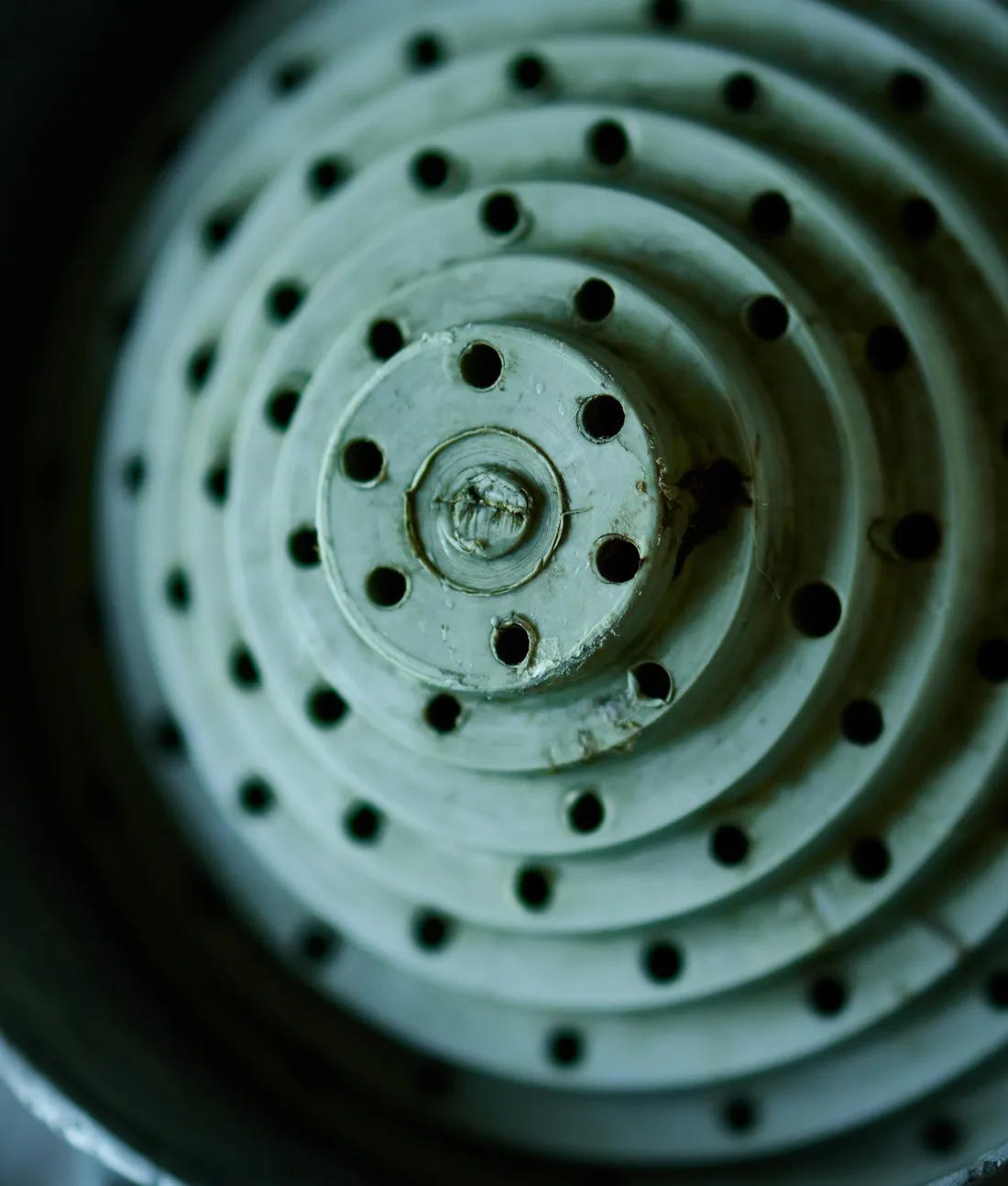
The reamer. The same design since 1928. (Courtesy Zaksenberg.com).
The distinction between those two claims is the whole story.
The 1939 court case sharpens this further. Zaksenberg’s patent was a Mandatory Palestine patent - territory-limited, operating within the layered legal world of Ottoman commercial law, British colonial patent administration, and emerging Jewish institutional infrastructure simultaneously. What the Tel Aviv court established in ordering the Jaffa imitator to pay damages was not that Zaksenberg had invented the citrus press. It was that within this particular territory, at this particular moment, this machine was his. The legal victory was real and precisely bounded. The myth it subsequently generated - first juicer, Hebrew industry, national innovation - was larger than the law had ever authorized.
That gap between what the court established and what history claimed is not surprising. It is, in fact, the same gap that opens whenever a society needs objects to carry more meaning than their patents allow.
The Shamouti - the iconic Jaffa orange, first cultivated commercially by Arab growers in Ottoman Palestine long before it became associated with Zionist agricultural modernity - had already become one of the great export symbols of the region. Citrus groves expanded dramatically during the 1920s as orange exports exploded across Europe. Arab farmers, Jewish agricultural settlers, German Templers, dock workers, exporters, kiosk owners, and metalworkers had all become entangled in the same citrus economy. The 1939 dispute - a Polish Jewish patent holder enforcing his rights against a Jaffa competitor before a British Mandate court - was itself a small legal crystallization of that entanglement: who owned what, which institutions had authority to adjudicate those claims, and whose version of the orange story would be told afterward.
The Zaksenberg press did not create that world. It mechanized it. And in doing so, it expressed something about the emerging Jewish society in Palestine that no other object quite captured: agricultural romanticism made legible through industry. The orange grove translated into cast iron, leverage, and the visible performance of freshness.
The press is not an elegant object in the Scandinavian countertop sense. It belongs to an older industrial language: heavy, exposed, almost sculptural, permanently sticky with citrus sugar, closer in spirit to the Land Rover than to anything designed to sit quietly on a shelf. The lines are coarser than the Bauhaus idiom contemporary with its moment. The cone diameter sits uneasily with the larger citrus varieties now dominant in the market. When the mounting plate went out of production, stability suffered. A European design critic of the period would have noted these things.
But Zaksenberg wasn’t designing for a European design critic. He was designing for a kiosk on Allenby Street, for the heat and the dust and the daily violence of commercial use, for a society that needed its abundance to be visible and its machinery to be honest. The coarseness wasn’t a failure of refinement. It was a refusal of it.
You still find them today in shuks and beach cafés and juice kiosks across Tel Aviv and Jerusalem, wedged between pyramids of oranges and split pomegranates. What has kept them there is not inertia. It is something more deliberate.
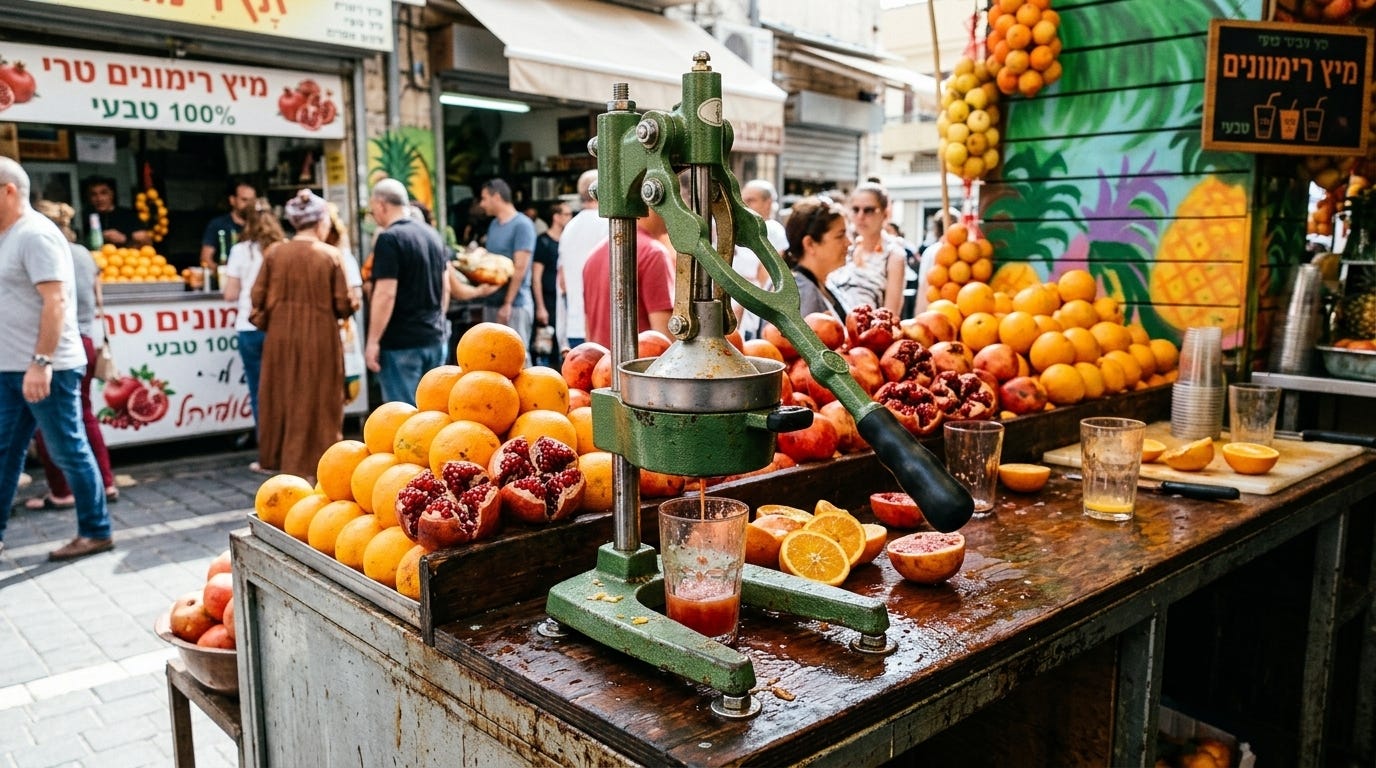
Carmel Market, Tel Aviv. The machine is still on the counter.
The Zaksenberg does not hide the act of extraction. It stages it. You watch the orange split, the lever descend, the juice emerge immediately into the glass. The fruit remains visible. The mechanics remain visible. Freshness itself becomes a performance rather than a claim - something witnessed rather than taken on faith. An electric juicer retreats into the background, but the Zaksenberg belongs to a Levantine world where preparation is part theater, part ritual, part public market choreography.
The machine also produces a materially different juice: less foam, less heat, less oxidation, a heavier and denser texture than most electric systems. But I suspect this is secondary. The press survives because the culture it belongs to - visible abundance, public extraction, the orange as shared daily spectacle - has not yet fully disappeared, even as the orchards that once supplied it have.
In Germany, stores like Manufactum now sell Zaksenberg presses as heirloom industrial objects: tools meant to be repaired rather than replaced, artifacts of a Mediterranean street culture that European design sensibility now regards with a kind of wistful admiration. What began as practical machinery for the orange kiosks of Mandatory Palestine has quietly entered the market for durable, emotionally weighted things. The machine that was once too heavy and too local for anywhere but a Tel Aviv shuk has become an object of desire in Hamburg and Munich precisely because it belongs so completely to a world those cities have never had.
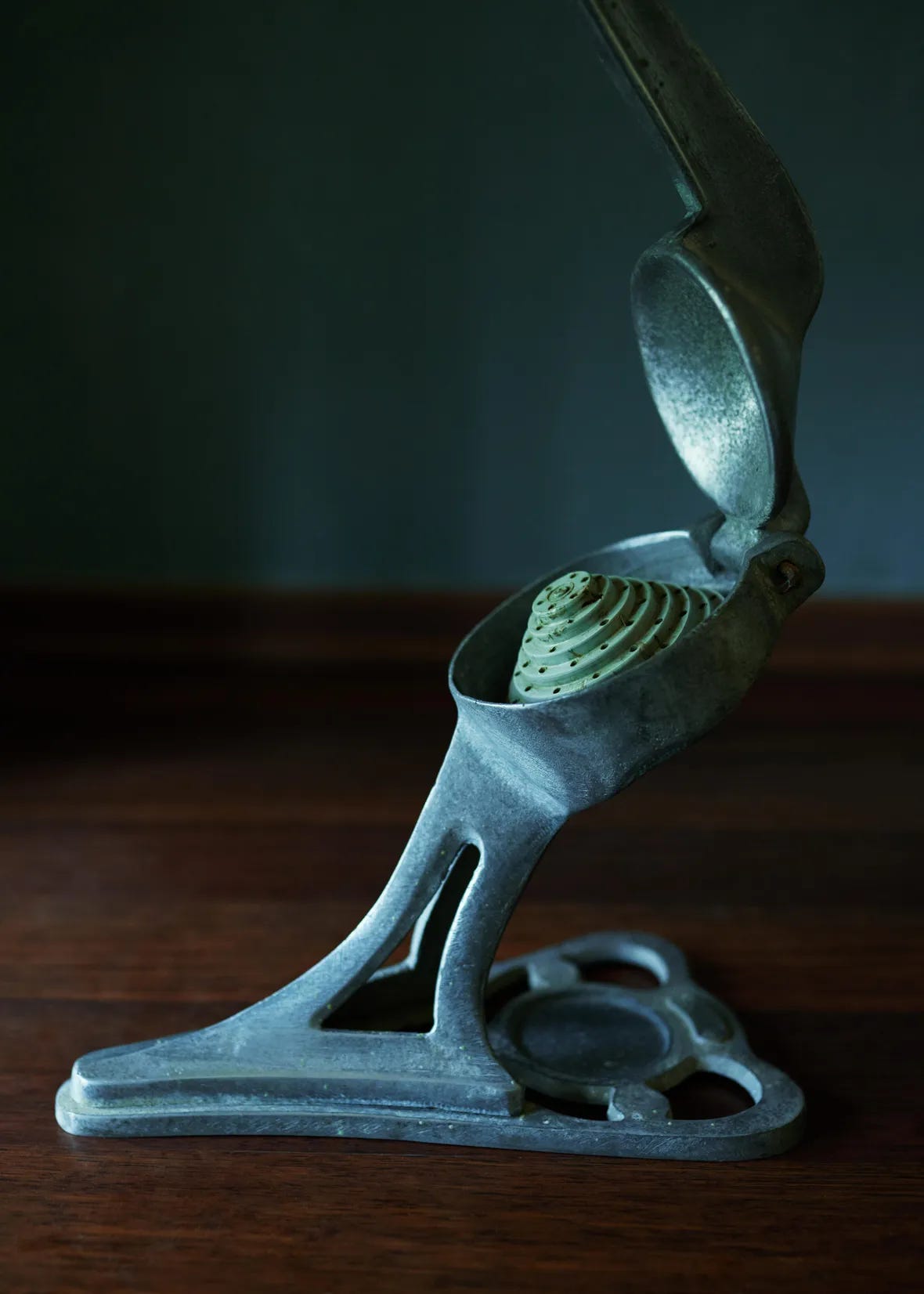
The original. Cast iron, Salame Road, Tel Aviv. (Courtesy Zaksenberg.com).
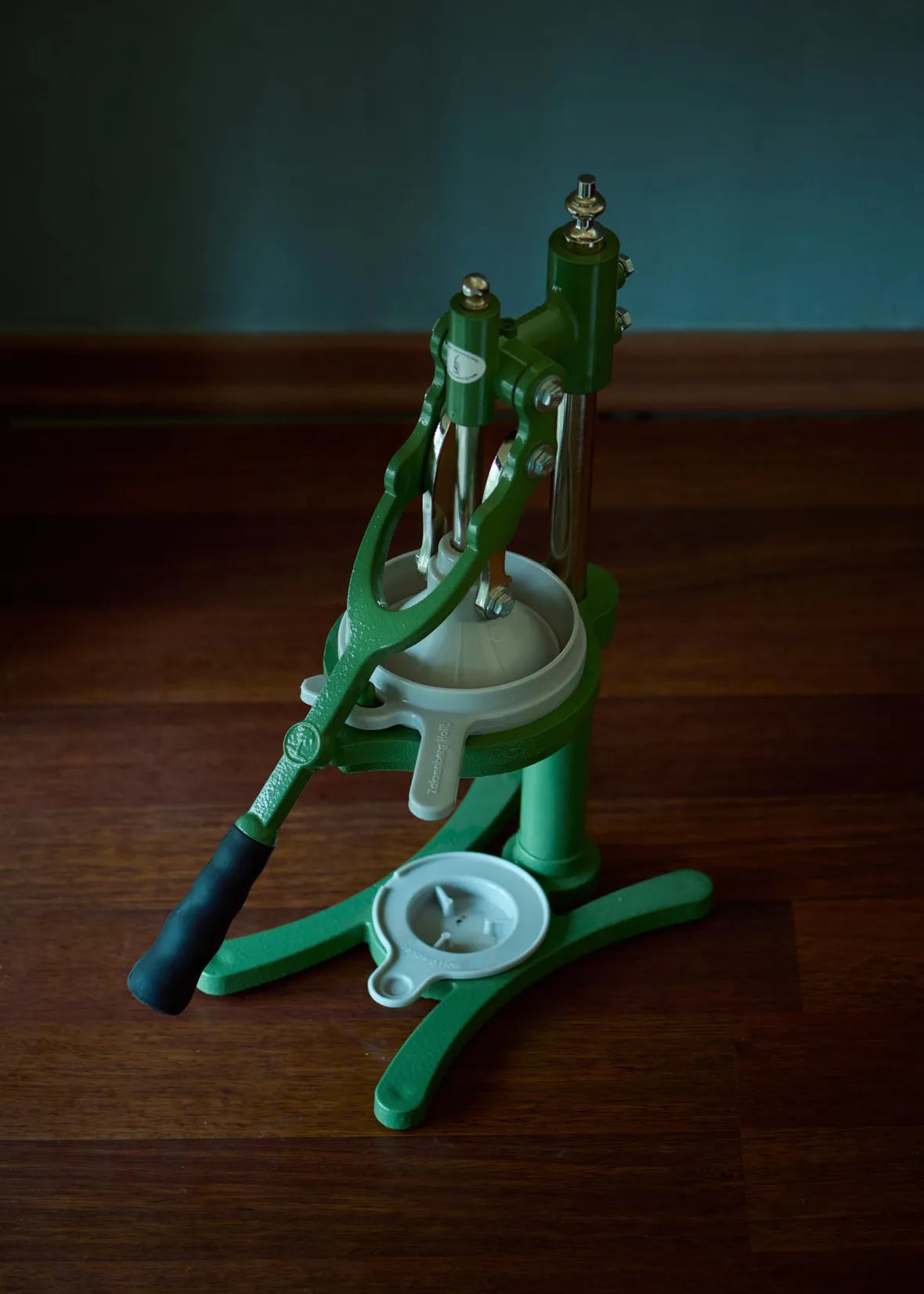
The same machine, a century later, sold as a design object in Germany (Courtesy Zaksenberg.com).
Return now to Khaja’s email, and to the Narangi Korma his grandmother once made.
The dish did not fail because it was less delicious than other things. It failed because it was sustained by a particular idea of what an orange was for - fragrance, refinement, the transformation of fruit into something closer to perfume than food - and that idea, once the structures supporting it dissolved, had nowhere to go. No kiosk culture. No daily extraction. No machine bolted to a counter to make the orange’s presence a public, repeatable, witnessed fact.
In the Zaksenberg press, you see the opposite logic entirely. The orange is not refined into fragrance. It is extracted into juice, immediately, publicly, with maximum mechanical transparency. Nothing is hidden. Nothing is elevated. The fruit is present, then it is pressed, then it is gone into the glass.
That difference - between the orange as courtly idea and the orange as daily infrastructure - is what separates the Narangi Korma from the kiosk counter. And the Zaksenberg press, bolted to that counter, pulling juice from the same fruit that once perfumed a Mughal kitchen, is the object that makes the difference visible.
The orchards I looked out at from my classroom window are largely gone. The orange civilization that built Tel Aviv has retreated beneath highways and towers and the ordinary expansion of a modern city.
Yet the presses remain.
In India, the orange survived as fragrance and memory.
In Israel, it became infrastructure.
The machine is still on the counter. The oranges are still there beside it.
The pressing continues.
For those who want to work with citrus rather than contemplate it, two recipes follow.
Kumquat Chicken with Citrus Glaze
Recipe by Limor Laniado Tiroche, chef, food writer, and author of the Friday food column in Ha’aretz. All photos in this section courtesy Limor Laniado Tiroche
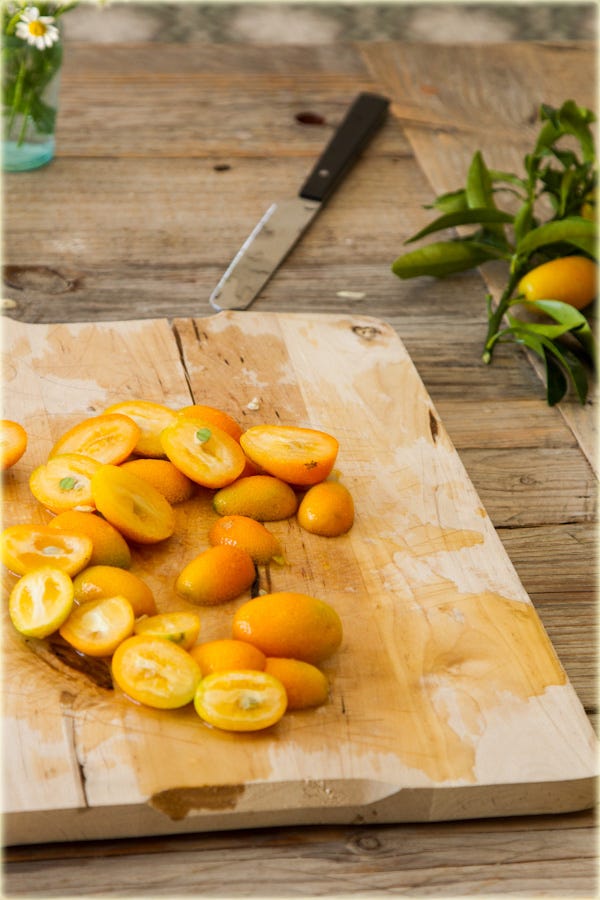
Eventually, the orange moved from the grove and the machine into the home kitchen itself.
In Israel, citrus was never merely a fruit. It became jam, candy, cake filling, children’s snacks - and sometimes dinner. This roasted chicken, glazed with kumquat marmalade, belongs to that world: Mediterranean, practical, slightly sweet, deeply citrus-driven. The marmalade melts into olive oil, garlic, honey, coriander, and white wine, forming a sticky lacquer that feels at once Levantine and unmistakably Israeli.
What fascinated me most was not only the flavour but the logic behind it. Through this dish I began to understand the culinary power of citrus preserves in savoury cooking. The bitterness of the peel, the concentrated sweetness, the acidity softened through heat - all of it creates a sauce far more complex than orange juice alone could manage.
Serve with a sharp green salad to cut through the richness, and spoon the sauce generously over everything.
Serves 4
Ingredients
1 whole chicken (about 1.5 kg), washed and patted dry
6 tbsp kumquat marmalade with syrup (about 300 g - see recipe next)
¼ cup olive oil
¼ cup white wine
2 tbsp honey
1½ tsp salt
1½ tsp black pepper
1½ tsp ground coriander seeds
5 cardamom pods
1 whole head garlic, separated into cloves
1 fennel bulb, trimmed and cut into wedges
5 medium potatoes, peeled and quartered
1 rosemary sprig
Method
In a small saucepan, combine the kumquat marmalade, olive oil, white wine, honey, spices, and the garlic cloves in their skins. Bring to a gentle boil, then lower the heat and simmer for 10 minutes. Remove from the heat and allow to cool slightly.
Heat the oven to 230°C. Lightly oil a roasting dish and place the chicken inside.
Rub the chicken thoroughly - including inside the cavity - with half the marmalade mixture.
Toss the potatoes and fennel with half of the remaining sauce and arrange them around the chicken. Add the rosemary sprig.
Cover and roast for 30 minutes.
Lower the temperature to 180°C and continue roasting for another 50 minutes, or until the chicken is deeply golden and cooked through.
Serve hot, spooning the citrus glaze and softened garlic over the chicken and potatoes.
Notes
Kumquats work particularly well here because their peel carries both bitterness and perfume - the same quality that made the orange so prized in Mughal cookery, redirected now into something faster, hotter, and entirely domestic. The garlic becomes soft enough to squeeze from the skins directly into the sauce. A lightly bitter salad of arugula or mixed leaves works beautifully alongside the sweetness of the glaze.
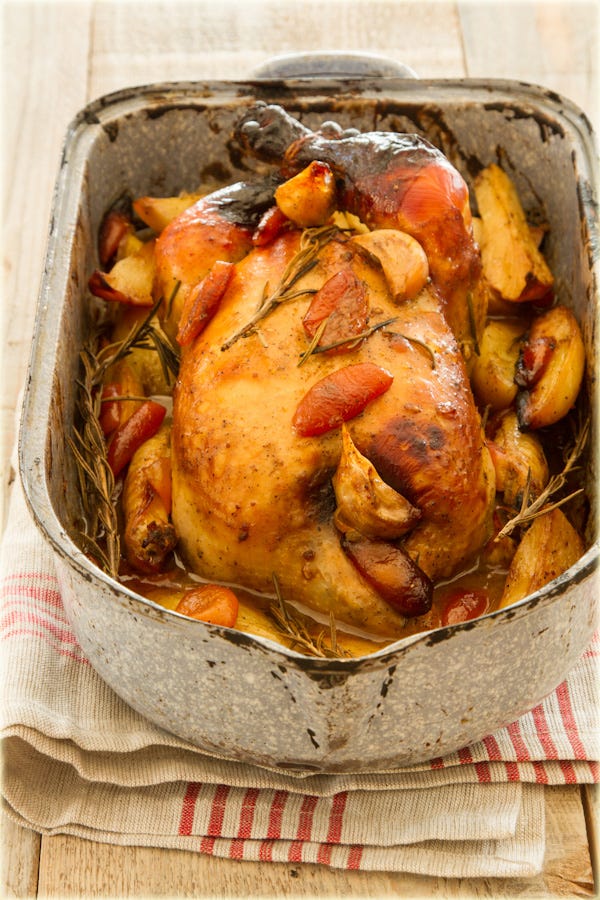
👉 Get your printable PDF recipe card for kumquat chicken with citrus glaze here.
Kumquat Marmalade
Limor Laniado Tiroche’s recipe: halved kumquats swimming in a clear, glossy syrup. Soft and tender in texture, sweet with a whisper of bitterness. Use it to enrich cakes, cookies, chicken marinades, or spooned warm over desserts.
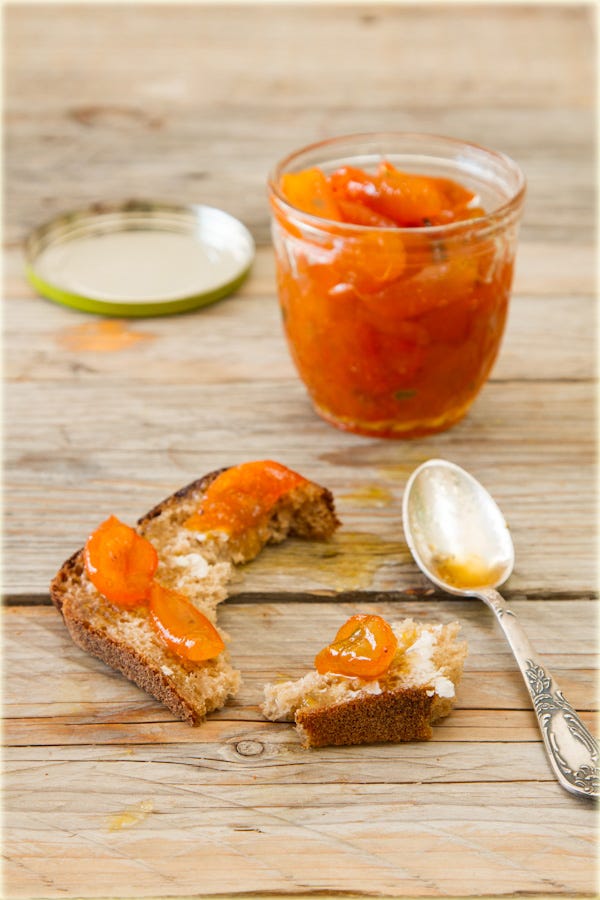
Servings
4
Ingredients
1000 grams kumquats
500 grams white sugar
0.5 cups orange juice
1 lemon, juiced and zested
1 small piece of fresh ginger
1 small sprig of rosemary
Steps
1
Wash the kumquats: Wash 1000 grams kumquats thoroughly with soap and plenty of water to remove any wax or spray residue from the skin. Halve them lengthwise.
2
Blanch three times: Transfer the halved kumquats to a medium saucepan. Cover generously with water, bring to a boil, then drain. Repeat this process two more times. This neutralizes the bitterness of the peel.
3
Cook the marmalade: Return the drained kumquats to the saucepan. Add 500 grams white sugar, 0.5 cups orange juice, the lemon juice and zest from 1 lemon, juiced and zested, 1 small piece of fresh ginger, and 1 small sprig of rosemary. Bring to a boil, then cook uncovered at a steady medium bubble for 30–35 minutes 35:00, until the syrup is clear and glossy.
4
Jar and store: Transfer to a sterilized jar. Store in the refrigerator.
Notes
Triple blanching is the key step - don’t skip it. Each round draws out more bitterness from the peel, leaving the kumquats tender and mellow without losing their character. The rosemary and ginger are subtle but present; remove them before jarring if you prefer a cleaner citrus flavor.
If this essay resonated with you, I’m grateful you’ve read this far.
If you enjoyed this, you might also like my previous dispatch on When the Jerusalem Bagel came to Switzerland
Beyond Babylon continues to trace Jewish life and food across unexpected geographies.
You’re welcome to subscribe or share the piece with someone who might enjoy it.
Brilliant fascinating article. A million thanks. 🙏
Wow , what an amazing history behind the juicer. I never knew how far the hand pressed juicers have travelled. Loved the research in this one, Elli. The recipe is a cherry on the top, I do want to give this a go.