
Teak
The Wood That Built Worlds

This essay is NOT about food.
It is also not about a recipe carried across the Indian Ocean in the pocket of a migrant, or a spice that changed its name as it crossed a border, or a dish that survived a diaspora by becoming indispensable to the city that absorbed it. There is no grandmother in this story, no kitchen, and no table set for the Sabbath.
You see, I started Beyond Babylon to trace Jewish foodways across the Indian Ocean world. Sometimes, though, the Indian Ocean hands you a story with no Jewish angle and no food in it. And yet, a story so well-constructed - so perfectly ballasted, so to speak (you will soon recognise the pun) - that to pass it by would be an act of wilful incuriosity.
The truth is, I really wanted to find a Jewish angle here. There wasn’t one, yet it is still a story worth telling.
This is the story of a wood. Teak.
Where it came from, where it went, and how it probably ended up in your parents’ living room. It did in mine.
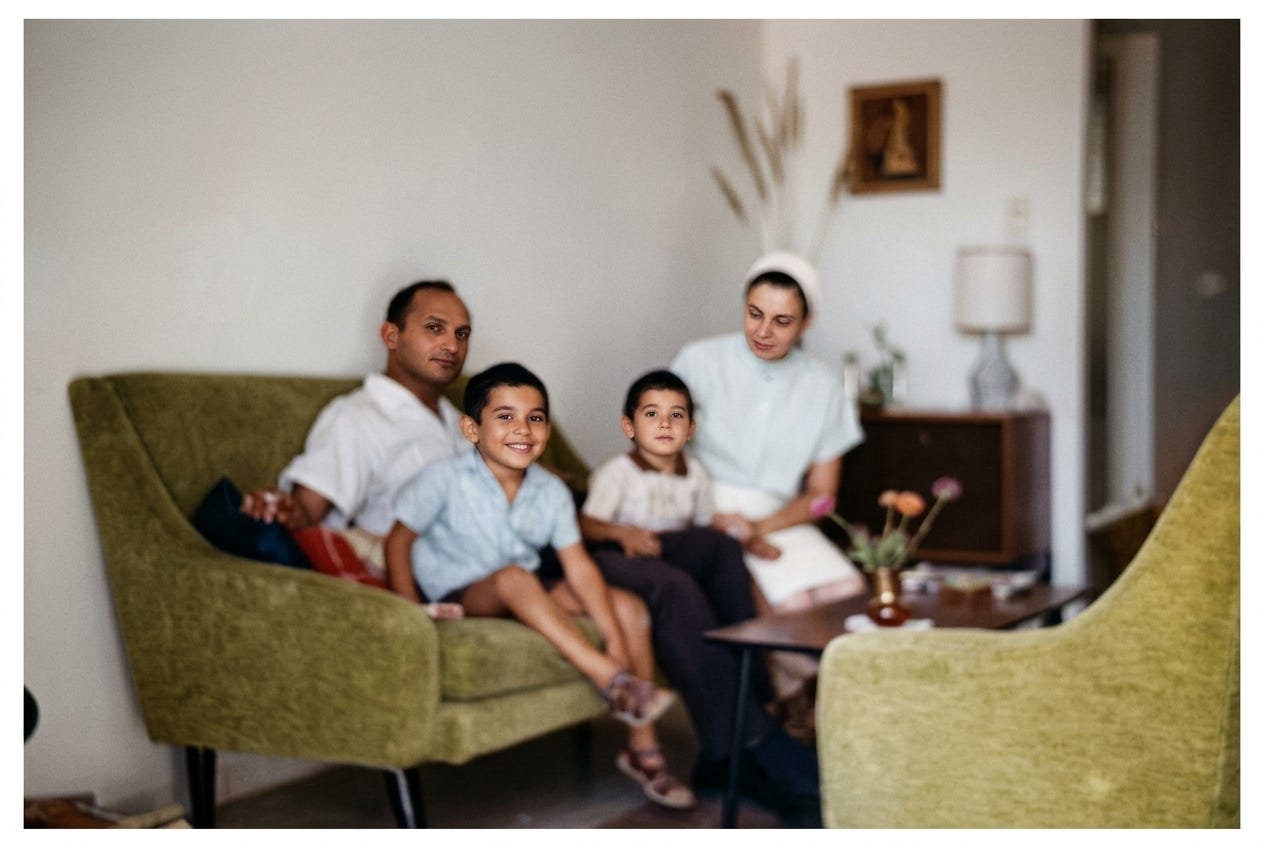
My family, circa 1966. At the time, the furniture in our living room was simply furniture. Only decades later did I learn that the wood all around us had travelled from the forests of the Indian Ocean.
In the first decade of the nineteenth century, the Bombay Dockyard was building ships that frightened the Thames builders of England.
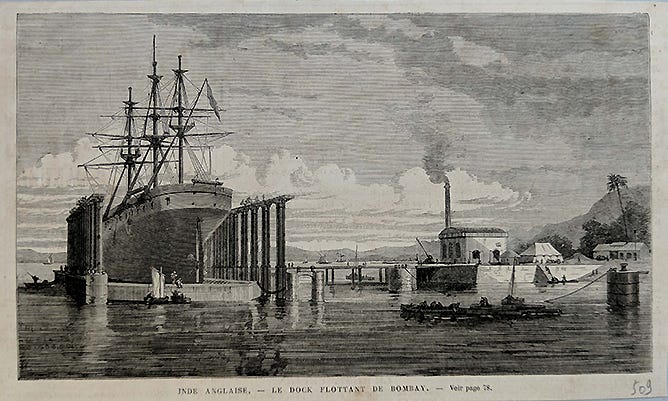
The Duncan Docks, Bombay. From here, the Minden was launched in 1810.
The ships were built from Malabar teak - Tectona grandis, native to the forests of India’s western coast - and they lasted twice as long as anything coming out of an English yard. British oak, the material of naval empire, was rotting within twelve years. An Indian teak ship could serve fifty to eighty. The wood contained natural resins that repelled the Teredo worm, a wood-boring mollusc that could riddle an oak hull in a single tropical season. The Admiralty knew this, which is why it had contracted the Wadia family of Bombay - nine generations of Parsi Zoroastrian master shipbuilders - to construct warships for the Royal Navy.
The ships they built were not colonial curiosities. They were the best ships in the world.
The most famous of them is HMS Minden, launched on 19 June 1810 from the Duncan Docks in Bombay: a 74-gun ship of the line, teak-hulled, Wadia-built, named after the Battle of Minden, where an allied British-led army defeated the French in Minden, Germany, in 1759.
The Minden was a Ganges-class ship. She was one of six ships of the line designed by Sir Edward Hunt in 1779. And she was the first British ship of the line ever built outside Britain.
The Bombay Courier at the time reported the launch in terms that still carry something of the occasion’s electricity: “Bombay is entitled to the distinguished praise of providing the first and only British ship of the line built out of the limits of the Mother Country; and in the opinion of very competent judges, the Minden, for beauty of construction and strength of frame, may stand in competition with any man-o-war that has come out of the most celebrated Dockyards of Great Britain.”
She sailed first for Java in 1811, where thirty-five of her men captured a Dutch fort at Marrack with a force the defenders outnumbered more than twelve to one. She bombarded Algiers in 1816. She served in the Tagus and Malta and the East Indies. In 1840, a dockyard fire at Devonport gutted the ship beside her and reached her hull; the teak held.
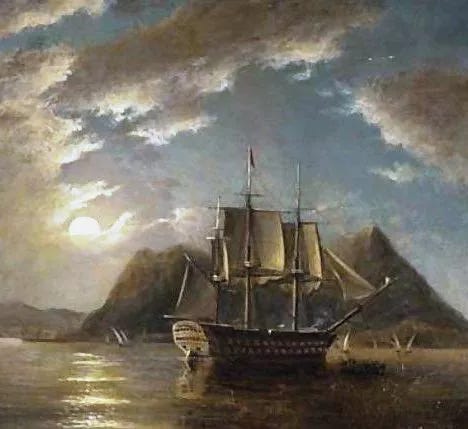
HMS Minden, 74 guns, off Gibraltar, moonlight. James Wilson Carmichael (1799–1868). Oil on canvas. Current location of painting unknown.
When a typhoon destroyed Hong Kong’s shore hospital in 1841, the Minden was recommissioned as a floating hospital and anchored in Hong Kong harbour, where she served the sick and dying of Britain’s new colony until 1846. She spent her final years as a stores ship and was sold for scrapping in 1861.
She was broken up in Hong Kong harbour - possibly the first vessel ever ship-broken there - in the same waters where she had tended the colonial sick twenty years before.
Two streets in Tsim Sha Tsui quarter of Hong Kong still bear her name: Minden Row and Minden Avenue.
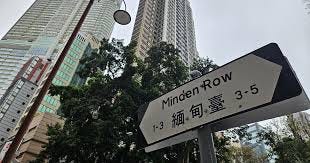
Minden Row, Tsim Sha Tsui, Hong Kong. Named in 1923. The ship it commemorates was broken up in this harbour sixty years earlier.
A teak warship built by Parsi craftsmen in Bombay, named after a Prussian battlefield, ending her days caring for the colonial sick in a harbour Britain had only just taken from China.
This is the kind of fact that the Indian Ocean produces regularly, yet
remains little known.
The Wadia dynasty had begun in 1736, when Lovji Nusserwanjee Wadia arrived in Bombay from Surat at the request of the British East India Company.
The name itself is occupational: wadia means shipwright in Gujarati. Lovji built Asia’s first dry dock in 1750. His son built the Minden.
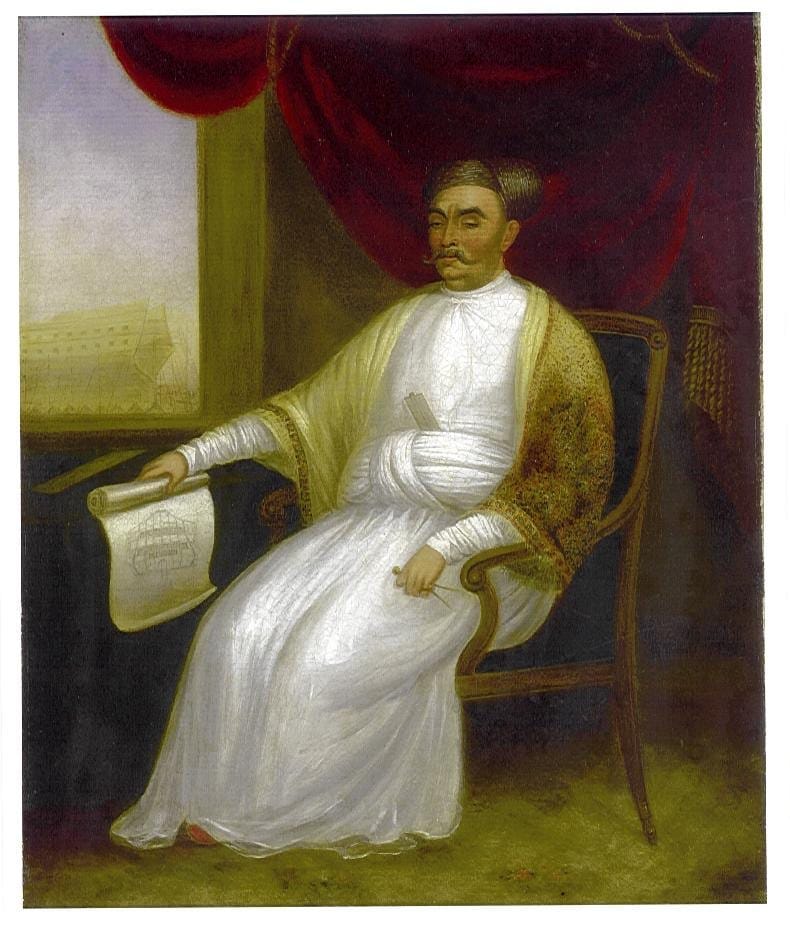
Lovji Nusserwanjee Wadia (1702–1774), founder of the Wadia shipbuilding dynasty. In 1736 he arrived in Bombay from Surat at the invitation of the East India Company and went on to establish Asia's first dry dock. The ship visible through the window reflects the profession from which the family took its name: wadia - shipwright in Gujarati.
His nephew built HMS Trincomalee in 1817 - a teak frigate sister ship to the Minden that still floats in Hartlepool, the oldest warship afloat in the world, kept intact by the natural oils of a wood harvested two centuries ago from the forests of Malabar.
By the time the dynasty ended in 1913, the Wadias had built over four hundred ships. The Napoleonic Wars alone generated a shipbuilding surge that consumed Malabar’s forests at a rate the land could not sustain. Between 1793 and 1815, Bombay shipbuilders constructed more than sixty ships from Nilambur teak alone - old-growth timber from the hills of Malabar, so dense and fine-grained that shipwrights considered it the best wood in the world.
Then the railways came, and what the wars had spared, the railways finished. Over thirty-five thousand trees were harvested in the Madras Presidency in the late nineteenth century for railway sleepers. Malabar, which had supplied the timber for the finest warships in the world, was running out of wood.
The British needed another source.
They found it by conquest.
In 1826, at the conclusion of the First Anglo-Burmese War, Britain acquired the Tenasserim region of lower Burma - and with it, forests of teak so vast and so dense that they made Malabar look like a kitchen garden. Burma possessed teak forests on a scale Malabar never had.
Extracting this resource was another matter. The trees were deep in jungle terrain accessible only by elephant. What developed over the following decades was one of the great logistical operations of the colonial era: over three thousand Asian elephants employed by a single corporation, hauling teak logs through jungle and floating them down rivers to the sea. The company was the Bombay Burmah Trading Corporation - BBTC - founded in 1863 by the Wallace Brothers of Scotland, operating out of Bombay, and so dominant in Burmese teak that when King Thibaw revoked its concessions in 1885 over allegations of illegal logging, the Indian viceroy sent an ultimatum to Mandalay. Britain used the dispute as a pretext to invade Upper Burma, depose the king, and annex his kingdom to British India.
A war was fought only so that the teak could continue flowing.
By the early twentieth century, BBTC was cutting Burmese teak at a rate that would have astonished Malabar’s foresters. Annual exports exceeded a hundred thousand logs. The corporation had become the largest teak operation in the world.
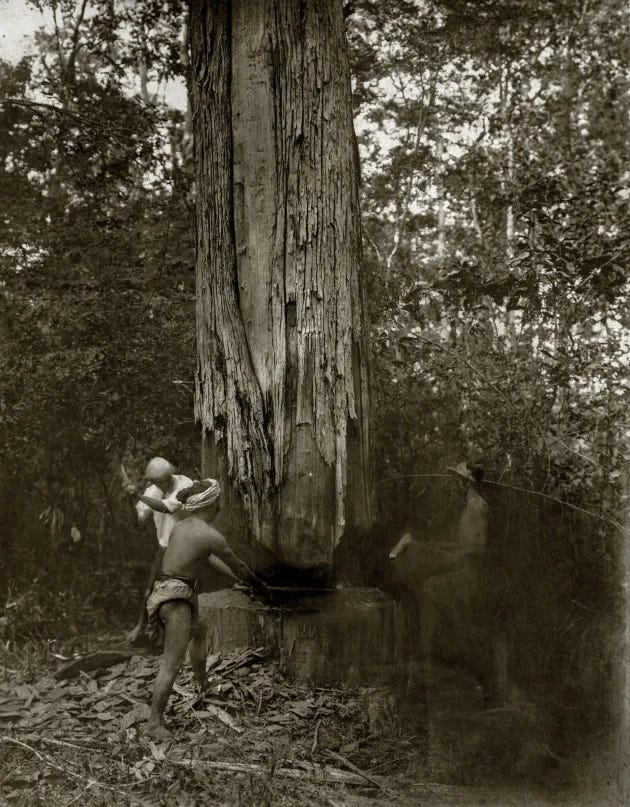
Burma, c.1918. A teak tree takes a century to mature. It takes an afternoon to fell.
All black and white Photographs attributed to Percival Marshall, BBTC; via Jonathan Saha, colonizinganimals.blog. (A reader has separately attributed an identical set of images to photographer Morinosuke Tanaka - so provenance unresolved).
In 1913, the Wadia family acquired it. Steam had displaced sail, steel was replacing timber, and the family whose fortunes had been made shaping teak recognised that the future lay in controlling the forests rather than the dockyard.
The British had spent decades ensuring it would end this way - discriminatory shipping legislation had systematically favoured British-built hulls, weakening the Bombay yards long before steam made the question moot.
And so the shipbuilding dynasty that had spent one hundred and seventy-seven years building the world’s finest ships from teak now owned the forests that supplied it.
The Wadias had built the warships. Now they owned the forests that would furnish the suburbs.
From crafting the wood to extracting the wood. The pivot is so clean it looks inevitable in retrospect - a family reading the material logic of empire and repositioning ahead of it.
Here is where the ballast enters.
You might recall the ice essay. Samuel Austin’s ships sailed from Boston to Calcutta with rocks in the hold - dead weight, worthless, carried only for stability on the outward voyage. In 1833, Frederic Tudor proposed replacing the rocks with ice cut from the freshwater lakes of New England, and the ice trade to India was born. The return voyage had always generated revenue. Now the outward voyage did too.
After the Second World War, a similar logic operated, but the trigger was not ingenuity. It was collapse.
The war ended. Britain decommissioned. The navy that had consumed Burmese teak for a century - that had fought a war in 1885 to keep the wood flowing, that had justified three thousand elephants and a continent of forest concessions - stopped ordering ships almost overnight.
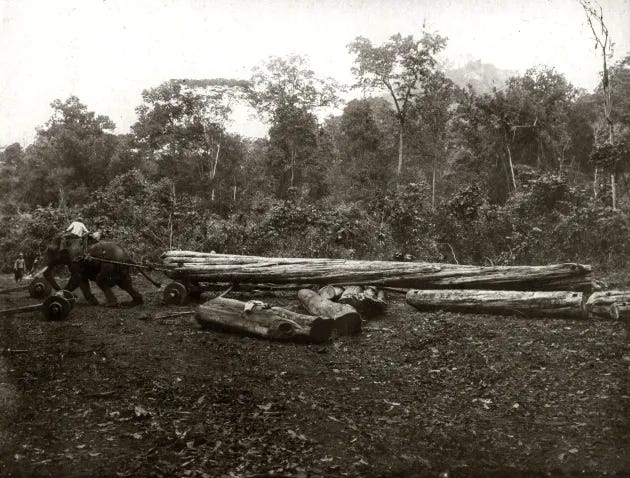
BBTC operations, Burma, c.1918. The corporation owned over three thousand elephants.
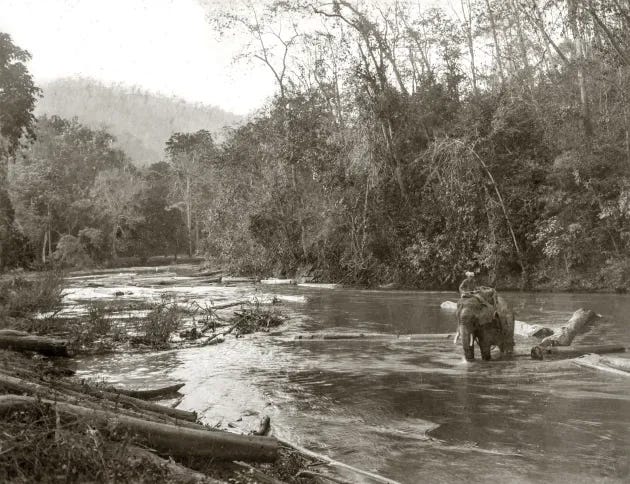
Logs floated downriver to the coast, then shipped west. The wood that built the navy was on its way to becoming the wood that furnished the suburbs.
The forests were still producing. The elephants were still working. The sawmills in Rangoon were still running. There was simply no buyer.
The wood had to go somewhere. It went into the returning holds of merchant vessels heading back to Europe - cheap, abundant, carried as ballast because an empty hold is a losing voyage. It arrived in northern European ports in volumes nobody had planned for and nobody had priced correctly.
Denmark was ready for it, and not by accident. Danish merchants had operated their own teak extraction concessions in Siam for decades, alongside BBTC. They understood the wood. Their ports received it. And the modernist Danish designers - Wegner, Finn Juhl, Arne Jacobsen, Arne Vodder - were already developing what would become known as Danish Modern: clean lines, organic forms, furniture built on the principle that beautiful things should be usable things.
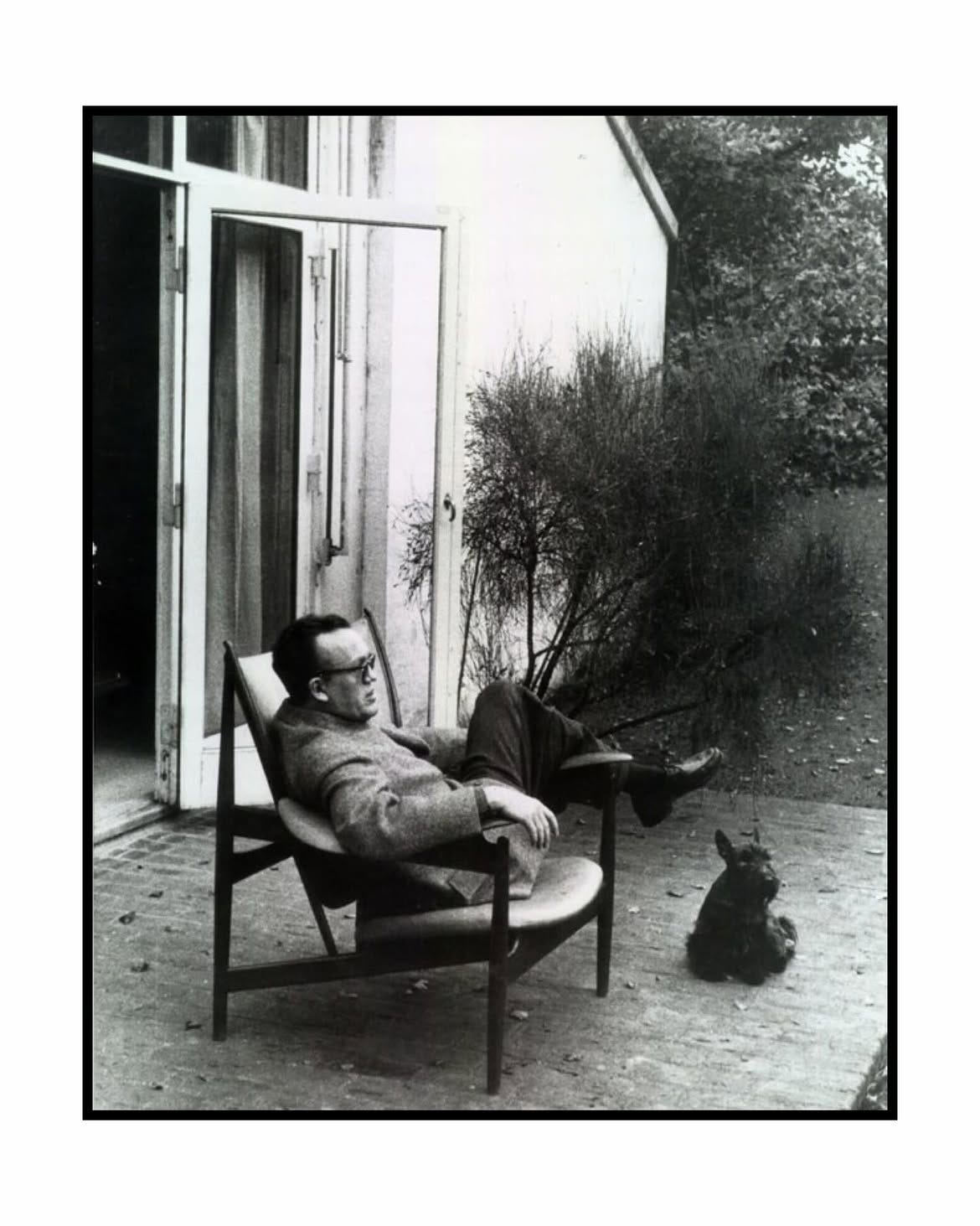
Finn Juhl, the Danish designer whose furniture defined the mid-century modern interior, in his own chair. Copenhagen, c.1950s.
The match between material and moment was exact. The wood was warm, workable, and suddenly cheap.
The surplus became a market. The market became a trend. The trend created its own demand - no longer the overflow of a collapsed naval industry but an active, accelerating appetite for old-growth Burmese timber. A second run on the same forests began, this time not for warships but for sideboards and coffee tables and dining chairs with elegant tapered legs.
The wood that built the Royal Navy’s finest warships ended up in the suburbs.
By the 1970s it was everywhere, and everywhere became a problem. A generation that had grown up with teak sideboards in every living room began to find them oppressive - too brown, too solid, too much the same.
Then the forests ran out, the environmental movement made tropical hardwood politically uncomfortable, and flatpack remade what furniture was supposed to cost and mean. The wood that had taken two centuries to travel from a Malabar forest to a Danish showroom disappeared from living rooms in roughly a decade.
Nobody noticed the connection because nobody was looking for it.
The G-Plan sideboard in the living room had no visible relationship to the ship that survived a Devonport fire because its hull was built from Malabar teak. The Danish coffee table bore no apparent connection to the Napoleonic Wars, or to the depletion of Malabar’s forests, or to the three thousand elephants working the Burmese jungle, or to a Parsi family from Surat who built Asia’s first dry dock in 1750 and owned the teak corporation in 1913.
As a child, I grew up running a hand along a teak sideboard I often wondered, vaguely, how the Danes had come to know this wood - the answer was the Indian Ocean. It had always been the Indian Ocean.
The wood was the same wood. Tectona grandis. The same species, the same natural oils, the same resistance to rot and worm and tropical water that had made it indispensable to empire. The tree did not know it had changed functions. It had gone from building the instruments of power to furnishing the homes of the people power had enriched. From warship to sideboard. From Bombay Dockyard to a furniture showroom in Wolverhampton.
This is what teak did across two centuries: it held an empire together, then decorated its living rooms.
The ice had done something similar - arriving in Calcutta as the demonstration that winter could be moved, becoming by the 1870s a domestic commodity available to anyone who could pay for it, democratised out of its original exclusivity. Cold had been power made visible. Then it became ordinary.
Teak was never ordinary. But it became ubiquitous, which is a different kind of forgetting. The rarity that had made it worth fighting a war over became the abundance that made it worth putting under a Danish lamp. Empire produces these surplus materials - the overflow, the ballast, the thing no one planned for - and the overflow changes everything downstream. Nobody planned the ice trade. Nobody planned the teak furniture trade. Both happened because ships needed to fill their holds on the way home.
The lakes of New England still freeze every winter. Nobody comes to cut them anymore. The teak forests of Burma are protected now, or claimed to be. The Danish Modern pieces sell at auction for thousands of pounds, described as old-growth Burmese, exceptional woodgrain, original condition.
The wood is older than the empire. The empire is gone. The wood remains.
The Indian Ocean did not only move recipes. It moved timber, ice, porcelain, cotton, ideas, people and empires.
Not every Indian Ocean story ends at the table. Some end in the living room.

A Wrighton Teak Sideboard featuring a mirror drinks/cocktail cabinet with a drop-down door in the center. courtesy vinterior
Beyond Babylon traces Jewish foodways across the Indian Ocean world. If this essay reached you, consider becoming a paid subscriber.
Eli - here's another twist... As you know I grew up in India and have an affinity for teak. I now spend much time in Ecuador. I found out on my last visit a few months ago from a businessman friend in Guayaquil that he comes across many Indian businessmen in Ecuador. When I asked him what are they importing or exporting here, he surprised me by saying that most of them that he has met come to buy really huge quantity of raw Teka ("teak") from Ecuador!
Well, it does make me sad that the rape of natural resources continues at the hands of man. When one area gets dried up, just move to another part of the world and continue. 😞
Some other trivia, and it gets closer to food: teak from Malabar and, later, Burma was also used to make opium chests. They sealed perfectly and kept the produce ‘fresh’. Parsi families would often put their monograms on them - Chor Bazaar, many decades later, in Bombay would sell them as Parsi chests. On the return journey, they would be used for carrying silks. And with opium and teak chests, the Sasoon family.