
Spilling The beans
Pythagoras's Fava Bean Taboo, and the Jewish Invitation to the Table

The bean that may have killed a philosopher was one of the Mediterranean’s most ordinary foods. So ordinary that but for the philosopher it might not have found mention in this essay.
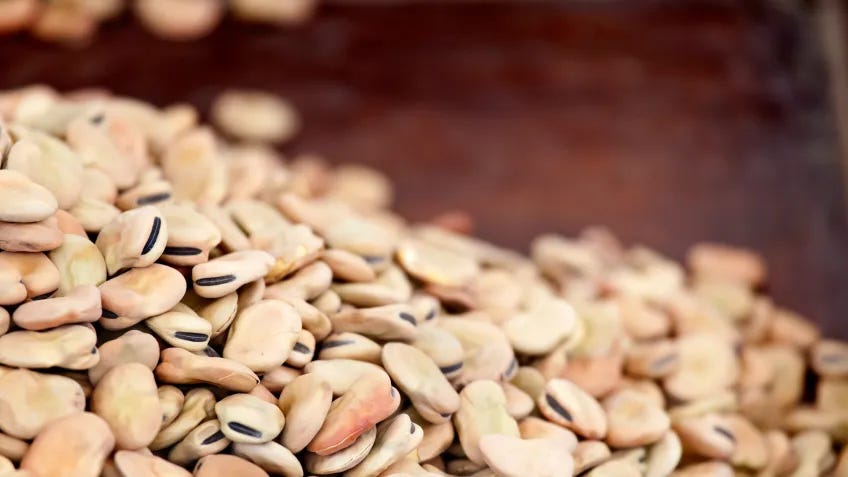
Broad beans (fava beans), the staple crop that fed the Mediterranean for millennia -and the ordinary food Pythagoras refused to eat. (Credit lacucinaitaliana.it)
Long before tomatoes, potatoes or New World beans reached Europe, the broad bean - the fava bean - was a staple. It fed farmers from Egypt to Iberia, appeared in stews, porridges and breads, restored nitrogen to exhausted fields, and provided protein where meat was scarce. If you had travelled through the Greek colonies of southern Italy in the sixth century BCE, you would have found fields full of them.
Few know that Falafel itself began as a fava bean dish. Ta’amiya, Cairo’s original falafel, is made from split white fava beans, not chickpeas - because the chickpea version only became dominant later, as the dish spread east through the Levant.
Even after the two pulses diverged into separate dishes, they still kept finding their way back onto the same plate.
In Jaffa, legend has it that a customer once asked for all three of a hummus stand’s dips served together - hummus with tahini, hummus with whole chickpeas, and hummus with stewed fava beans - and the combination became so popular the owners put it on the menu as a dish in its own right, a triangle of the three.
That’s the menu I grew up with.
Across Egypt and the Levant, hummus and ful - as fave is known here - are companions rather than rivals. In Jerusalem, a version called qudsiyeh - ful from the holy city - does much the same with a spicier ful.
In Acre, a dish called makhluta takes its name from the plaster of sand and lime that builders mix for construction, extended by analogy to the hearty, mixed breakfast that sustains builders through a working day (and feels very much like concrete in your stomach after you`ve had a portion): here the fava beans and chickpeas aren’t served side by side but mashed together into a single chunky paste.
Most people who eat hummus have never encountered fava beans as its topping rather than its rival. The two pulses have spent most of culinary history being treated as substitutes for one another.
And yet one of the region’s most famous residents refused to eat fava beans.
Pythagoras, the philosopher whose name every schoolchild learns through geometry, left his native Samos around 530 BCE and settled in Croton, in what is now Calabria.
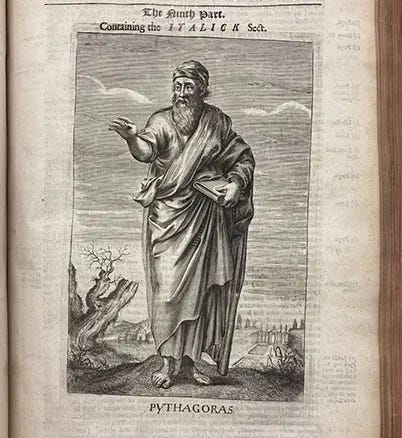
Pythagoras of Samos, imagined in a seventeenth-century engraving. The philosopher became almost as famous for refusing fava beans as for proving the shortest distance between two points. The History of Philosophy, by Thomas Stanley, 1687 (Linda Hall Library)
There he founded a community devoted to philosophy, mathematics, music, discipline and the purification of the soul. Among its many rules was one that has puzzled historians for more than two thousand years.
Do not eat fava beans.
Pythagoras chose to build his community in one of the great bean-growing regions of the ancient world. Southern Italy still celebrates the ingredient he rejected. In Puglia, fave e cicoria - a silky purée of dried fava beans served with bitter chicory - remains one of the region’s defining dishes, and is very evocative of orecchiette with cime di rapa, the region’s other great pairing of a humble pulse crop with a bitter green. Same structural move, different ingredients.
And if you had walked through Magna Graecia in the sixth century BCE, these were the fields you would have crossed.
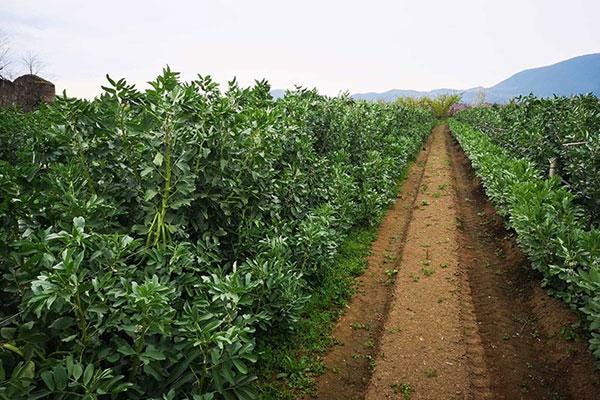
A field of broad beans in southern Italy. A straight line crosses it. These are the landscapes through which Pythagoras would have walked in Magna Graecia. (Credit italiafruit.it)
The broad bean was everywhere: food for the poor, fodder for animals, a gift to the soil - and, to one philosopher, something never to be eaten.
Centuries later and a sea away, Egyptian Jewish households would do almost the opposite: bury the same bean in the embers overnight and count it a blessing to eat it warm the next morning. We will get to that.
First, the rule itself, and the ways people have tried to explain it for two thousand years.

Broad bean flowers. Their black markings reminded some ancient writers of the gates of Hades, helping to fuel centuries of speculation about Pythagoras' taboo. Photograph: Pat Tuson/Alamy.
Ancient writers never agreed on the why. Some believed the beans held the souls of the dead, their dark-spotted flowers resembling the gates of Hades; others pointed to Aristotle’s more earthly theory, that beans were used as voting tokens in Greek assemblies, so refusing them meant refusing politics itself. Later writers thought a germinating bean looked too much like a human embryo for anyone who believed in reincarnation to risk eating one.
Perhaps every explanation captures part of the truth.
Food taboos rarely have a single origin. They accumulate meanings over centuries until the prohibition becomes more important than the reason behind it.
The most famous story about Pythagoras’ death illustrates exactly that.
Pursued by enemies (in ancient Greece your philosophical orientation was also your political bent), he reached a field of flowering fava beans.
Between Pythagoras and safety lay only the shortest route across the field. Rather than violate the rule by crossing it, he stopped. His pursuers caught him there and killed him.
The irony is almost unbearable. The philosopher whose name became synonymous with geometry, and reason - a discipline built on proof, demonstration and the certainty of the straight line - is remembered as abandoning the shortest path because of a belief that could not itself be proved. The man who taught generations to trust reason abandoned reason and died, if the legend is true, because of a bean taboo.
Whether the story is true hardly matters. Legends survive because they express something a culture wants us to remember. In this case, the lesson was simple: conviction is measured not when it is convenient, but when it becomes dangerous.
Modern medicine has offered another possibility. Around the Mediterranean, some people carry a genetic condition known as G6PD deficiency. For them, eating fava beans can trigger severe haemolytic anaemia, a condition known as favism. There is no evidence that Pythagoras himself suffered from it, and he could not have understood the biology. But if generations had observed that beans sometimes killed apparently healthy people, what later became a mystical prohibition may have begun as practical caution.
The paradox becomes even richer. Geometry was right. The shortest route to safety really was straight across the field, from point A to point B.
Yet the bean taboo may also have preserved a fragment of truth - not mathematical truth, but accumulated human experience. Science would not explain why until more than two thousand years later.
The philosopher thus became famous by refusing the very food that helped sustain the people around him.
If the ancient stories are to be believed, he would have walked the long way round rather than pass through a field of them. Yet the broad bean outlived the taboo. It fed Egyptians, Romans and North Africans. It found a place in Jewish kitchens wherever the Mediterranean climate allowed it to flourish, before yielding, in many places, to the beans that arrived from the Americas.
Archaeology leaves little doubt that broad beans were already ordinary food across the ancient Levant. Rabbinic literature mentions them matter-of-factly, alongside lentils, peas and chickpeas - not as sacred food or forbidden food, but simply as dinner.
Favism, the same haemolytic reaction that may have given Pythagoras’s caution a practical medicinal root, still occurs at unusually high frequency in several Mediterranean and Middle Eastern populations today, including some Jewish communities, especially Kurdish Jews - an intriguing modern echo, though no more than that.
Nothing suggests Jewish food customs developed in response to the condition, any more than Pythagoras’s prohibition can be traced to it with any certainty. The genetic story and the philosophical one simply sit near each other, without explaining one another.
There is, however, one Jewish dish worth lingering over.
Claudia Roden, the Egyptian-born Jewish food historian whose work transformed the way the world understands Middle Eastern and Jewish cooking, remembers a Sabbath dish her father called Tfadalou: whole eggs and fava beans left overnight in the fading heat of a communal bakery or bathhouse oven, ready to be eaten the next morning without further cooking.
Tfaddalū is Arabic for "please, help yourselves"-the invitation a host gives when calling everyone to the table. Whether that was the name used throughout Egypt's Jewish community or only within Roden's family is difficult to know, but it is too beautiful not to preserve.
What follows is not an attempt to recreate an ancient recipe. It is an invitation to continue the story.
Three Ways the Bean Survived
If Pythagoras refused the broad bean, history did not.
These three dishes show some of the forms it took as it travelled through Jewish and Middle Eastern kitchens.
A Sabbath Bean, Slow-Cooked
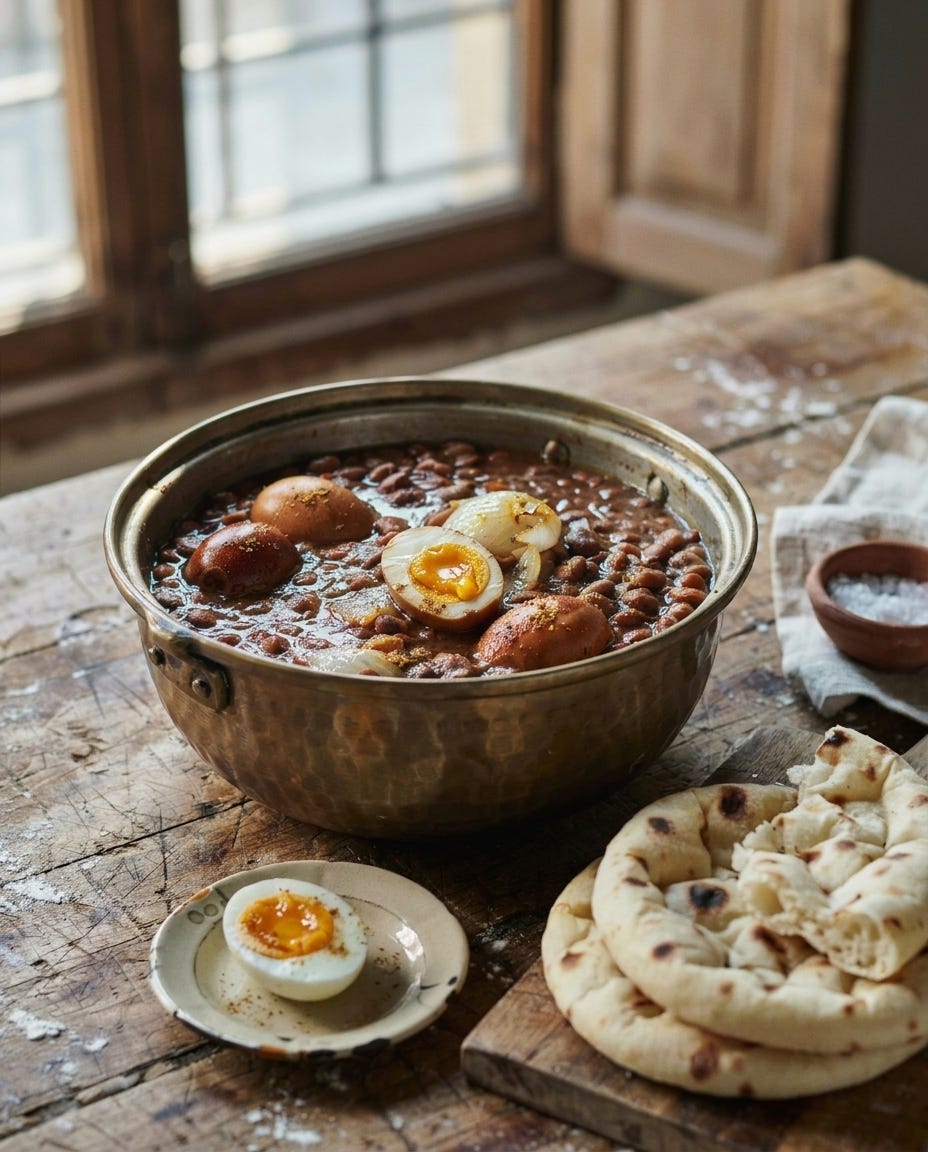
Tfadalou. Not a reconstruction of Claudia Roden's family recipe, but an attempt to honour its central idea: beans and eggs left overnight so that the Sabbath meal required no cooking once the day of rest had begun.
Serves 4
1½ cups dried whole fava beans, soaked overnight in plenty of water
6 eggs, in their shells, washed
1 small onion, halved but not peeled (the skin colours the dish)
2 tbsp olive oil
1 tsp cumin
Salt, to taste
Water to cover
Drain the soaked beans and place them in a heavy pot - a slow cooker or a very low oven both work well for this, standing in for the dying heat of a bakery oven. Add the eggs in their shells, the onion halves, olive oil, cumin, and salt, then cover everything generously with water.
Bring briefly to a boil, then reduce to the lowest possible heat, cover tightly, and leave it - on the stovetop overnight, or in a 200°F (95°C) oven, or in a slow cooker on its lowest setting. By morning, the eggs will have turned a deep, mottled brown, their whites gone custardy and their yolks creamy rather than firm, and the beans will have collapsed into a soft, dark stew around them.
Peel the eggs at the table. Serve the beans and eggs together, warm, with bread to mop up the liquid - a meal that asked nothing of anyone once the sun went down, because all the work was already done.
👉 Get your PDF recipe card for Tfadalou here
Ta’amiya at Home
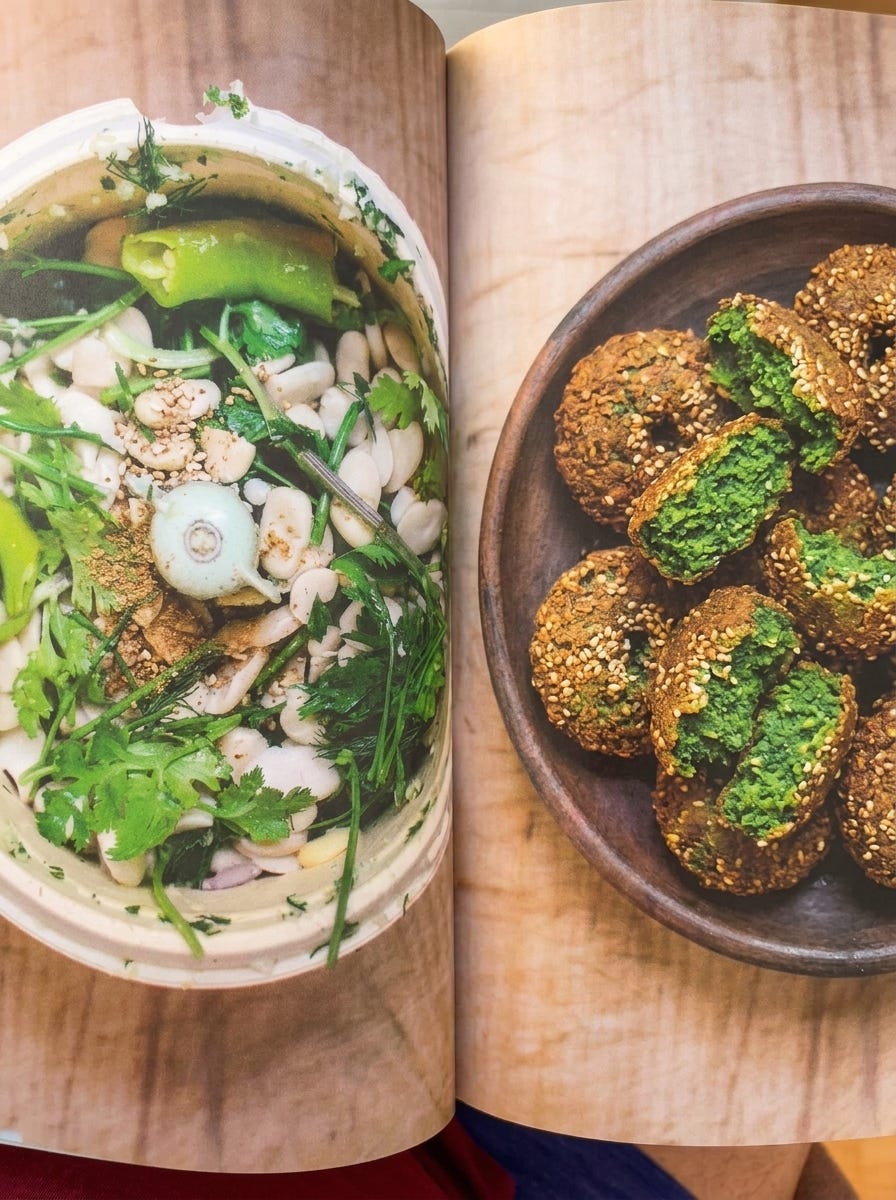
In the spirit of Cairo’s original falafel - a fava bean version, made from split white favas rather than chickpeas, in your own kitchen rather than anyone else’s recipe.
Left: Before the blades begin. Soaked split fava beans, coriander, parsley, dill, garlic and green chilli waiting in the processor. Egyptian ta'amiya gets its vivid green interior from herbs ground into the mixture before frying.
Right: Ta’amiya. The mixture, shaped and fried until crisp outside and vivid green within.
Makes about 20 small patties
2 cups dried split, skinned white fava beans (look for these labelled “split fava beans” or “ful mudammas, split and peeled” at Middle Eastern grocers)
1 small onion, roughly chopped
3 garlic cloves
A generous handful of fresh cilantro, and another of parsley
1 tsp cumin
½ tsp coriander
½ tsp baking powder
Salt and pepper
Sesame seeds, for coating (optional)
Oil, for frying
Soak the split fava beans in plenty of water for at least 12 hours - they will roughly double in size and soften considerably, but should still have some bite; they are not cooked at any point before frying.
Drain well. In a food processor, pulse the beans with the onion, garlic, and herbs until you have a rough, crumbly paste - not smooth, you want texture. Add the spices, baking powder, salt and pepper, and pulse a few seconds more, just to combine.
The mixture should hold together when pressed; if it feels too wet, let it sit in a sieve for ten minutes to drain further, rather than adding flour.
Using two spoons - one to scoop, the other to flatten the scoop (or an ice cream scoop) - into small, flattish patties, pressing a few sesame seeds onto each side if using. Fry in about an inch of hot oil, in batches, until deeply golden on both sides, two to three minutes per side. Drain on paper towels.
Serve warm, the way Cairo has served it for longer than anyone serves the chickpea version: in bread, with a tahini sauce and a sharply dressed salad, the tomato and cucumber cut small.
Fava Beans as Hummus Wants to Remember Them
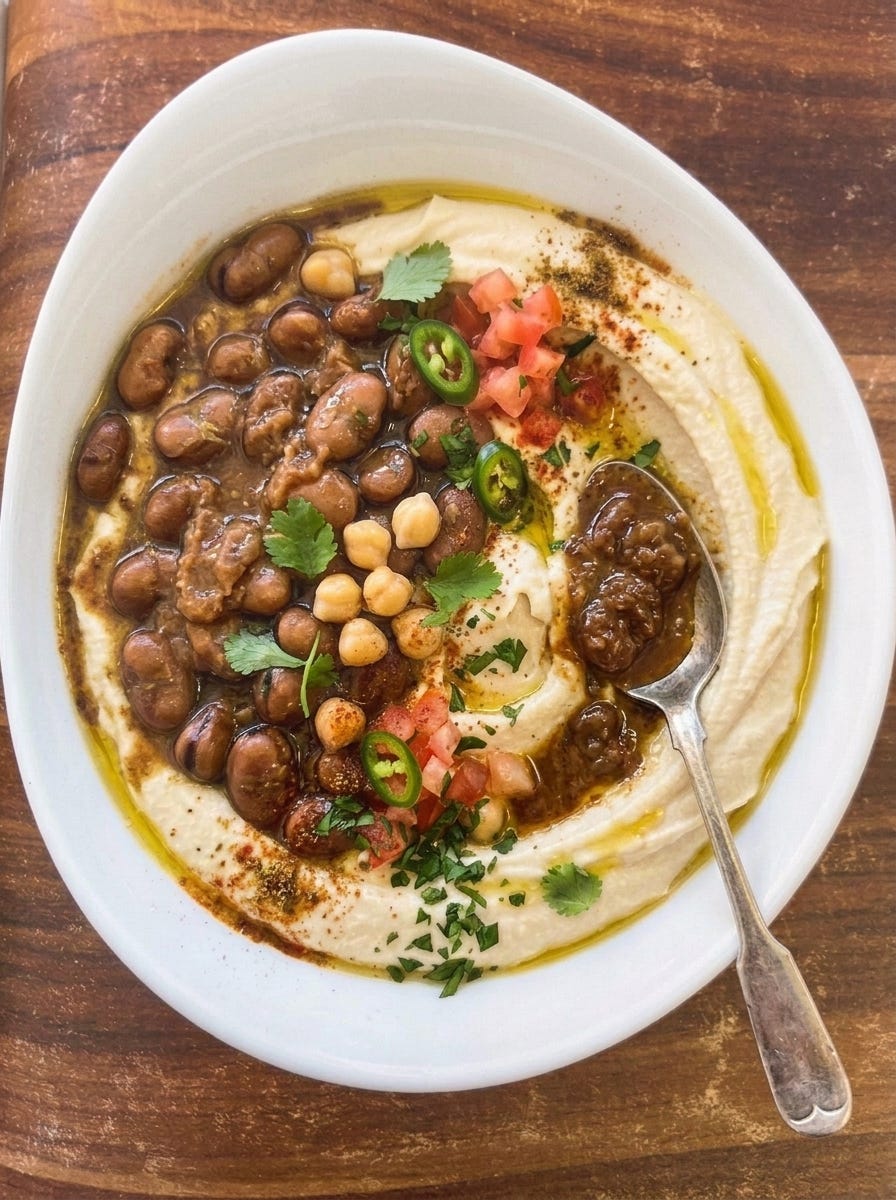
Hummus bi Ful. Chickpea hummus crowned with slow-cooked fava beans - a reminder that for most of their history these two legumes were companions rather than competitors.
Serves 4
For the fava topping:
1 cup dried split fava beans (or two 14-oz cans cooked fava beans/ful medames, drained)
2 tbsp olive oil
1 small onion, finely chopped
2 garlic cloves, crushed
1 small tomato, finely chopped
1 tsp ground cumin
Juice of ½ lemon
Salt and pepper to taste
A pinch of chilli flakes or fresh chopped chilli, if you like heat
To serve:
2 cups good hummus, store-bought or homemade
Olive oil, for drizzling
Chopped parsley
A few whole cooked chickpeas, for the top
If using dried beans, soak overnight, then simmer in fresh water for about an hour, until soft enough to mash easily. If using canned, skip straight to the pan.
Warm the olive oil and soften the onion until golden, about 8 minutes. Add the garlic, tomato and cumin, and cook a few minutes more until the tomato breaks down. Add the fava beans and a splash of their cooking liquid or water, and simmer, mashing roughly with a fork, until you have a thick, chunky, porridge-like mixture - you want texture here, not a purée. Finish with lemon juice, salt, pepper, and chilli if using.
Spread the hummus generously over a shallow plate. Spoon the warm fava mixture over the top rather than folding it in - the point is to taste each one distinctly, the way the eye moves between two colours before the fork ever mixes them. Scatter whole chickpeas over the top, drizzle with olive oil, and finish with parsley.
Pythagoras left us with a prohibition. Claudia Roden leaves us with an invitation.
If Pythagoras believed the bean carried the souls of the dead, I prefer to think it carries the food of the living: ordinary, sustaining and endlessly adaptable, changing each time it enters a new kitchen.
The philosopher stopped at the edge of the field because the bean meant: do not enter, do not touch, do not eat.
Centuries later, at an Egyptian Jewish Sabbath table, it meant something else entirely.
Tfadalou.
Please, help yourselves.
Postscript. Today the fava bean has acquired an unexpected second life. Its cooking liquor - now known as aquafaba, from the Latin for “bean water” - can be whipped into glossy meringues and mousses without a single egg. The name is modern, coined only in 2015, but it reminds us how little we had appreciated this ancient crop.
In Britain, where fava beans were a common protein source until the Industrial Revolution before falling out of fashion entirely, scientists at the University of Reading are now trying to smuggle them back into the national diet - developing a fava bean flour bread indistinguishable from ordinary white loaves, precisely because they’ve found people reject the bean the moment they know it’s there.
One researcher fed the same loaf to her own family on two different days: told it was a fava bean bread, they complained it tasted “too beany.” Served the identical bread the next day without being told, nobody noticed anything at all.
The bean that once stopped a philosopher in his tracks now foams meringues, thickens vegan desserts and quietly returns to European fields.
It has survived every explanation people ever invented for it.
Beyond Babylon traces the foodways of Jewish communities across the Indian Ocean world. If this essay reached you, consider becoming a paid subscriber.
A fair question to ask before the deed. It depends which bean you’re holding.
If it’s fresh - podded in spring - then yes: blanch it, slip off the waxy jacket, and there it is, the tiny green heart. Pythagoras believed the bean might house a soul, which is presumably why he never got this far.
If it’s dried and whole, the way the Sabbath pot takes it, leave the skin on. The long night in the oven needs it - it’s where the color and the slight bitterness come from.
And if it’s split and white, for ta’amiya, someone at the mill has already done the peeling. The green inside those fritters isn’t the bean’s heart at all - it’s the herbs.
So: the recipes in this essay never ask you to peel. Only spring does. And when it does - eat your heart out.
I've often wondered what was behind the Pythagorean ban on fava beans, and I think you are on to something with favism. Will need to look up entries on it in Chinese pharmacopeia! Fava was all over Yunnan last month when I was there--sometimes employed in dishes for its starchy, almost salted duck egg flavor (I had it in Dali with bitter melon). And it's traditionally the main ingredient in doubanjiang! I have often wondered whether it came to China with the Silk Road. Now a question, perhaps an unanswerable one, why do you think the chickpea (which the Chinese referred in ancient times as the 'Muslim bean') became dominant? Ease of growth?