
Saloona
The ancient fish recipe that left Baghdad and acquired an Indian accent.

If you like Moroccan chrayme, you will probably love fish saloona.
If you don’t - alas, but feel free to move on.
At first glance, the two dishes seem like cousins: white fish swimming in a thick red sauce of onions and tomatoes, both built on the old logic of fish softened into spice, oil, and acidity. Yet where chrayme feels distinctly Mediterranean - sharp, direct, aggressively fiery with paprika and cumin, fresh coriander - fish saloona tastes like a dish that has spent centuries travelling.
To be honest, I have always associated the word saloona less with the Tigris than with a four-door Austin Cambridge.
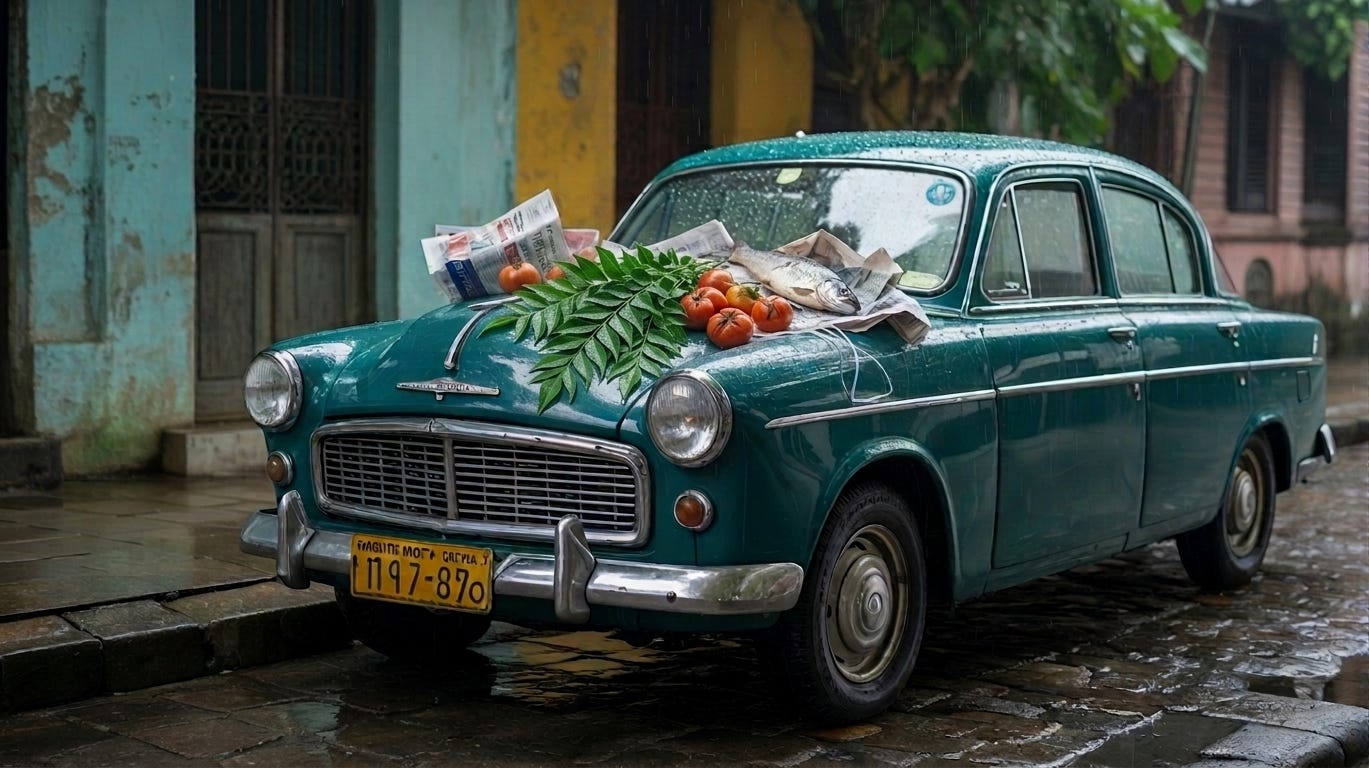
The Baghdadi “Fish Saloon”: A sturdy Mesopotamian culinary structure refitted for another climate and driven deep into the monsoon.
There is something about Mavis Hyman’s anglicised “Fish Saloon” in Indian-Jewish Cooking that sounds less like an ancient Mesopotamian fish stew than a sturdy British saloon car rebuilt for the monsoon. That instinct turns out not to be entirely wrong, because the Baghdadi “Fish Saloon” is, in many ways, exactly that: a Mesopotamian culinary structure refitted for another climate.
What fascinated me while researching the dish was that I eventually found not one recipe, but three, and each one revealed a different stage in the journey.
The first came from Claudia Roden’s The Book of Jewish Food, preserving what feels like the clearest Iraqi baseline: fish in a tart-sweet red sauce built around what Iraqi Jews call hamedh-helu - literally “sour-sweet” - the Near Eastern counterpart to the Indian khatta meetha instinct of balancing acidity against sweetness through lemon, tomato, tamarind, pomegranate molasses, sugar, or date syrup. Roden’s version belongs to that older Mesopotamian world of sweet-sour cookery inherited from Abbasid and Persian culinary traditions, where fish and meat stews alike were often pulled toward that characteristic tension between brightness and depth.
The second recipe came from Mavis Hyman’s Indian-Jewish Cooking, documenting the Baghdadi kitchens of Calcutta, where the same fish structure suddenly begins speaking in another accent. The underlying grammar remains recognisably Iraqi - fish, onions, tomatoes, a red braising sauce sharpened by acid - yet the aromatic centre of gravity has shifted eastward. Turmeric enters the sauce. Curry leaves perfume the oil. The sharp lemon-and-sugar architecture softens into something warmer, darker, more humid.
The third version came from Sandra of Sannie’s Kitchen, born in Tehran to Iraqi parents, whose recipe sits somewhere between all those worlds at once: unmistakably Baghdadi in structure, yet carrying traces of Persian Gulf migration routes and later Indian memory through turmeric and curry powder. Together, the three recipes reveal not merely a fish stew, but a migration timeline.
Roden preserves the Iraqi source grammar. Hyman records the Indian acclimatization. Sandra preserves what happens after migration itself begins migrating again.
And the distinction between curry powder and curry leaves turns out to matter enormously.
Curry powder travels easily. It can be packed into tins, carried across oceans, bought in diaspora groceries, folded into family memory long after a community has left the climate that produced the original dish. A Baghdadi-Iraqi family living in Tehran, London, Manchester, or Toronto could preserve traces of Indian cooking through portable spice blends carried through trade networks or family connections to Bombay and Calcutta.
But curry leaves belong to another category altogether.
Curry leaves are ecological. They are tied to climate, cultivation, and everyday domestic use. Unlike curry powder, fresh curry leaves did not historically travel easily through older diaspora systems. Their appearance implies proximity to the Indian kitchen itself: the markets, the gardens, the humidity, the daily rhythms of South Asian domestic cooking.
That is why the curry leaves in Hyman’s Fish Saloon matter so much historically. The curry powder in later diaspora versions may represent remembered India. The curry leaves in Hyman represent inhabited India.
They suggest that by the time Hyman records the Baghdadi kitchens of Calcutta, Indian flavours were no longer external influences layered onto an Iraqi dish from the outside. They had become part of the dish’s internal domestic logic. The Indian pantry was no longer surrounding the Baghdadi kitchen. It had become the kitchen itself.
This is also what separates fish saloona from the broader global family of fish stews in tomato sauces, many of which emerged through older maritime trade routes and imperial circulations of ingredients. Across the Mediterranean and Atlantic worlds one repeatedly encounters the same broad culinary architecture: fish simmered in onions, tomatoes, oil, acid, and spice. Moroccan chrayme, Provençal bouillabaisse, Spanish escabeche, Caribbean fish guisados, Goan fish curries, West African tomato stews - all belong, in different ways, to the long afterlife of tomatoes, peppers, citrus, vinegar, and maritime migration after the Columbian exchange.
But fish saloona occupies a particularly interesting position within that wider geography because it preserves something older beneath the tomato itself. Underneath the curry leaves and turmeric still lies the older hamedh-helu instinct of Mesopotamian sweet-sour cookery, itself connected to medieval Persian and Abbasid culinary traditions in which vinegar stews, tamarind broths, and fruit-acid balances structured the logic of the dish long before tomatoes arrived from the Americas.
The tomato changed the colour of the sauce.
Migration changed its accent.
The underlying grammar survived.
Long before tomatoes arrived from the Americas, kitchens across the Abbasid and Persian worlds were already building fish and meat stews around the tension between sourness and sweetness: vinegar against honey, tamarind against dates, citrus against sugar. In many ways, fish saloona belongs to that older sikbaj world of sweet-sour cookery more than to the later tomato stews that now surround it. The tomato altered the surface of the dish. The deeper structure was already there.
This is why fish saloona does not really belong to the modern category of “fusion cooking.” Fusion implies novelty, experimentation, chefs consciously combining worlds together. Fish saloona is something older and quieter than that. It is a diaspora dish: a recipe carried through migration until adaptation itself hardens into inheritance.
The curry leaf is therefore not garnish. It is the interpretive key.
In Hyman’s version, curry leaves are not presented as decorative flourish or exotic embellishment. They are described simply as “the traditional way of preparation.” That small phrase matters enormously because it tells us that by the time these recipes were being written down in the Baghdadi Jewish kitchens of India, the Indian pantry no longer felt foreign to the dish. It had become part of its instinctive vocabulary.
The Indian note was no longer garnish. It had become inheritance.
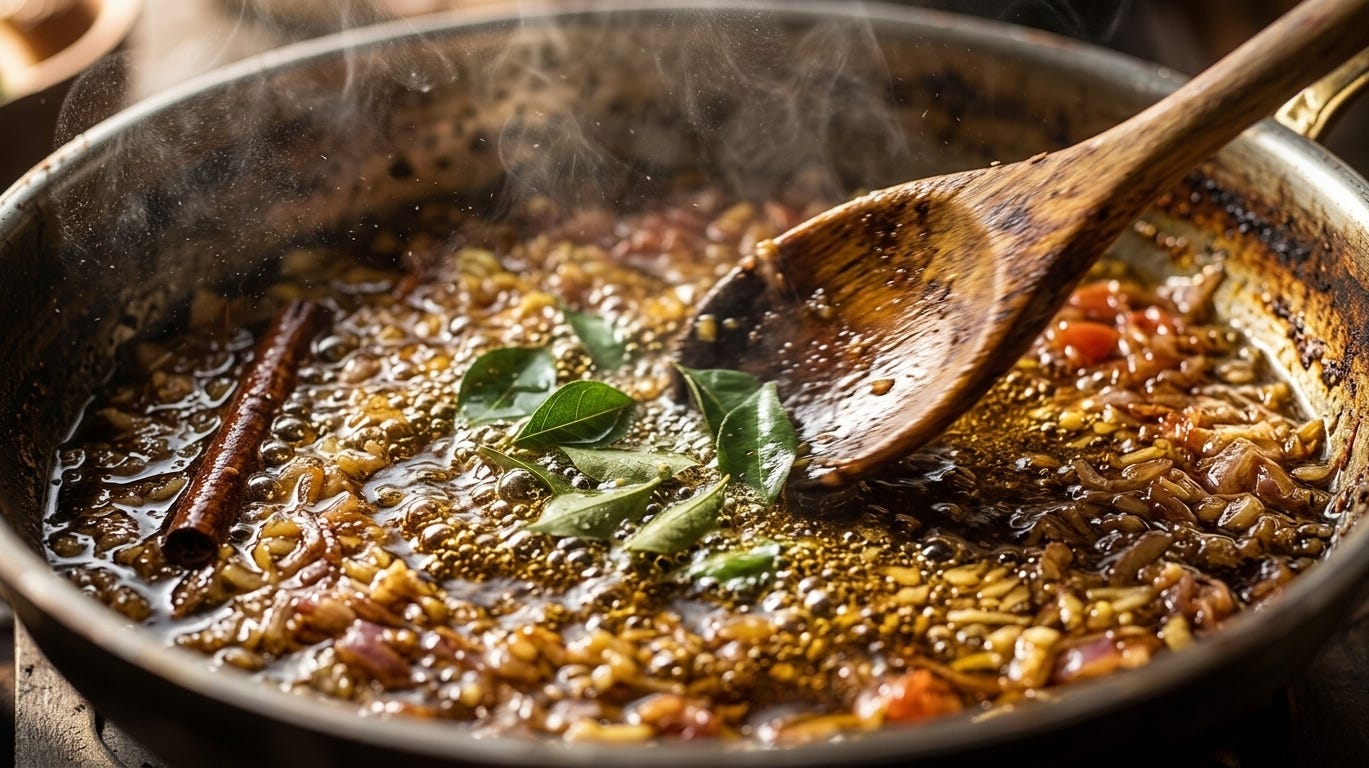
Sizzling in another climate: The precise second an inherited Baghdadi fish grammar acquires its permanent, vibrant Indian accent.
A family can migrate across oceans yet still carry the rhythm of an older language inside newer words. Kitchens behave similarly. The fish remains recognisably Baghdadi, but turmeric changes the colour, warmth, and emotional register of the dish. The curry leaves alter its perfume. The dish begins speaking in another climate.
That concept fascinates me because it reveals something larger about diaspora cooking itself. We often speak about “authenticity” as though traditions survive by remaining untouched. But most enduring food traditions survive precisely because they learn how to absorb the world around them without losing their structural memory.
Fish saloona is a perfect example of that paradox. The Baghdadi Jews who settled in India in the late eighteenth and nineteenth centuries did not simply preserve Iraqi food in amber. They adapted to Indian ingredients, Indian markets, Indian climate, and Indian domestic taste. Over generations, those adaptations stopped feeling imported.
They became instinctive.
By the time onions are browning in oil and curry leaves hit the pan, you are no longer watching an outside influence enter the kitchen. You are watching a migrant form become local without forgetting where it came from.
That may be the real story of the Baghdadi-Indian kitchen altogether. Not a cuisine trapped between two worlds, but one that learned how to carry memory forward while allowing the pantry around it to change the accent of the sentence.
Fish Saloona / Fish Saloon
A Baghdadi fish braise refracted through Iraq, India, and the wider diaspora
This version draws structurally from Claudia Roden’s Iraqi saluna, Mavis Hyman’s Baghdadi-Indian Fish Saloon, and Sandra’s Tehran-Iraqi family version. The result preserves the older tart-sweet hamedh-helu logic while allowing turmeric and curry leaves to enter naturally into the sauce.
Serves 6–8
Fish
1.5 kg firm white fish (cod, sea bass, halibut, or tilapia), cut into portions
100 g flour
1 tsp salt
½ tsp black pepper
1 tsp turmeric
oil, for frying
Onion Base
300 g onions, finely sliced
3 garlic cloves, minced
1 mild green chili or bell pepper, sliced
8–10 fresh curry leaves
1 tsp turmeric
4 tbsp olive oil
Sauce
500 ml tomato passata
2 tbsp tomato paste
Juice of 2 lemons
1 tbsp pomegranate molasses
1–2 tbsp silan (date syrup), to taste
1 tsp salt
½ tsp black pepper
½ tsp chili flakes (optional)
To Finish
2 tomatoes, sliced
Extra curry leaves (optional)
Method
1. Prepare the fish
Mix the flour with salt, pepper, and turmeric.
Lightly coat the fish pieces.
Heat olive oil in a frying pan and fry the fish briefly - about 2–3 minutes per side - until lightly golden but not fully cooked. Remove carefully and set aside.
2. Build the onion base
Heat 4 tbsp oil in a heavy pan.
Add the curry leaves first and allow them to perfume the oil for several seconds.
Add the onions and cook slowly until soft and deeply golden.
Stir in the garlic, sliced pepper, and turmeric. Cook another 2–3 minutes until fragrant.
This moment - curry leaves entering hot oil before the onions fully collapse - is where the dish begins turning toward India.
3. Make the sauce
In a saucepan combine:
tomato passata
tomato paste
lemon juice
pomegranate molasses
silan
salt
pepper
chili flakes
Simmer gently for 5–10 minutes until slightly thickened.
Taste carefully.
The sauce should balance brightness, sweetness, and acidity without becoming cloying.
4. Assemble
Preheat oven to 180°C.
Arrange the fried fish in a baking dish.
Spread the onion mixture over the fish.
Pour the sauce evenly across the dish.
Top with sliced tomatoes.
If desired, scatter a few extra curry leaves over the top.
5. Bake
Bake uncovered for about 40 - 45 minutes until the sauce darkens slightly and the fish is fully tender.
Serve warm with plain rice or yellow Baghdadi pilau, or sop up with some bread (I use an amazing loaf, called baslerbrot, common in this neck of the woods).
The following day it is often even better.
👉 Get your printable recipe card for Fish Saloona here
If this essay resonated with you, I’m grateful you’ve read this far.
This piece was inspired by a series of conversations about the ‘unseen’ heritage of the Baghdadi Jews. If you enjoyed this, you might also like my previous dispatch on What is Kahi.
Beyond Babylon continues to trace Jewish life and food across unexpected geographies.
You’re welcome to subscribe or share the piece with someone who might enjoy it.
Thanks, friend.
This is very serious, compared with how my mother made it. Since she was a Chinese immigrant who shopped in Chinatown, she picked up a can of sweet-and-sour sauce, and she sliced up red and green peppers along with the onions. 🫑 She baked the dish in the oven. As a kid, I loved this dish because it was sweet, with lots of textures. And she called it Saloona, which it unquestionably was not. It strikes me that her version was real timesaver. Maybe that was what was important to a mother with two small kids.