
Plum garumba
Rebuilding a Lost Calcutta Jam

People sometimes ask me how I find recipes for Beyond Babylon.
The answer is - everywhere and anywhere.
When you’re a Jewish recipe hunter, it’s wherever there is prey. And pray.
Sometimes it’s easy. A printed cookbook. A written source. A grandmother who still remembers - more or less - exact quantities. “Two teaspoons. Or whatever it takes.”
And sometimes it isn’t.
Sometimes it begins with a sentence.
“We had a jam in Calcutta,” my aunt wrote. “Plum gorumba.”
That was it.
No measurements. No dates. No written record. Just a memory of a cook - “the head honcho” she called him - who boiled small red fruit with jaggery until it turned sticky and sweet.
Plum gorumba.
I’d never heard of it.
Now go find the recipe.
That’s when the rabbit hole opens.
You start with language. Gur. Amba.
I know amba is mango. But this wasn’t mango. It was plum. Or something like a plum. Seed left in. Thickish compote.
You chase spellings. Gudamba. Gulamba. Gurumba. You find mango versions in Maharashtra. Diaspora versions in Guyana. Sweet pickles in Bengal that look suspiciously similar but go by different names.
And then, weeks later, you’re standing at a dusty bus station in Fort Galle, Srilanka, staring at a pile of small red gooseberries on a wooden cart, and something in your body says: this!
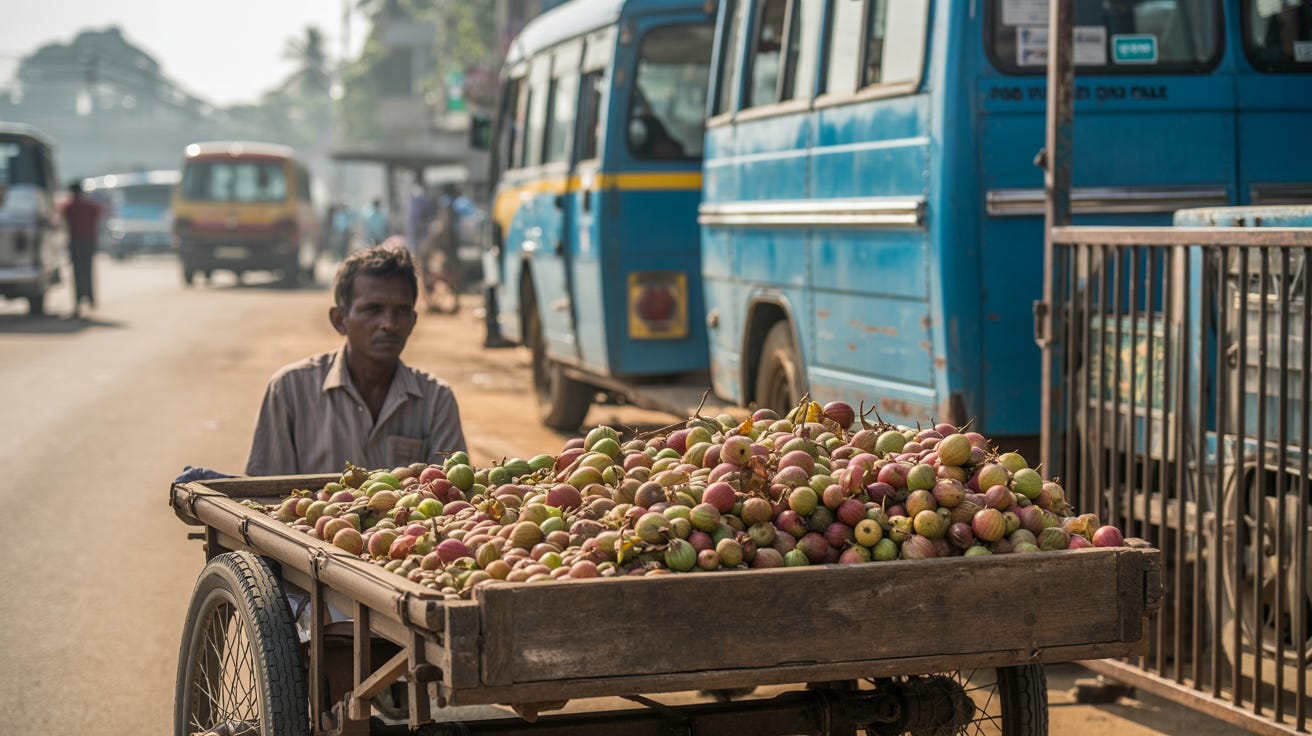
Fort Galle, Srilanka. Central bus station.
Gooseberries waiting for someone to notice.
The vendor was annoyed that I photograph his fruit without buying any. Perhaps he was right. Perhaps I was wrong.
Still, I walked away with the image - and the confirmation.
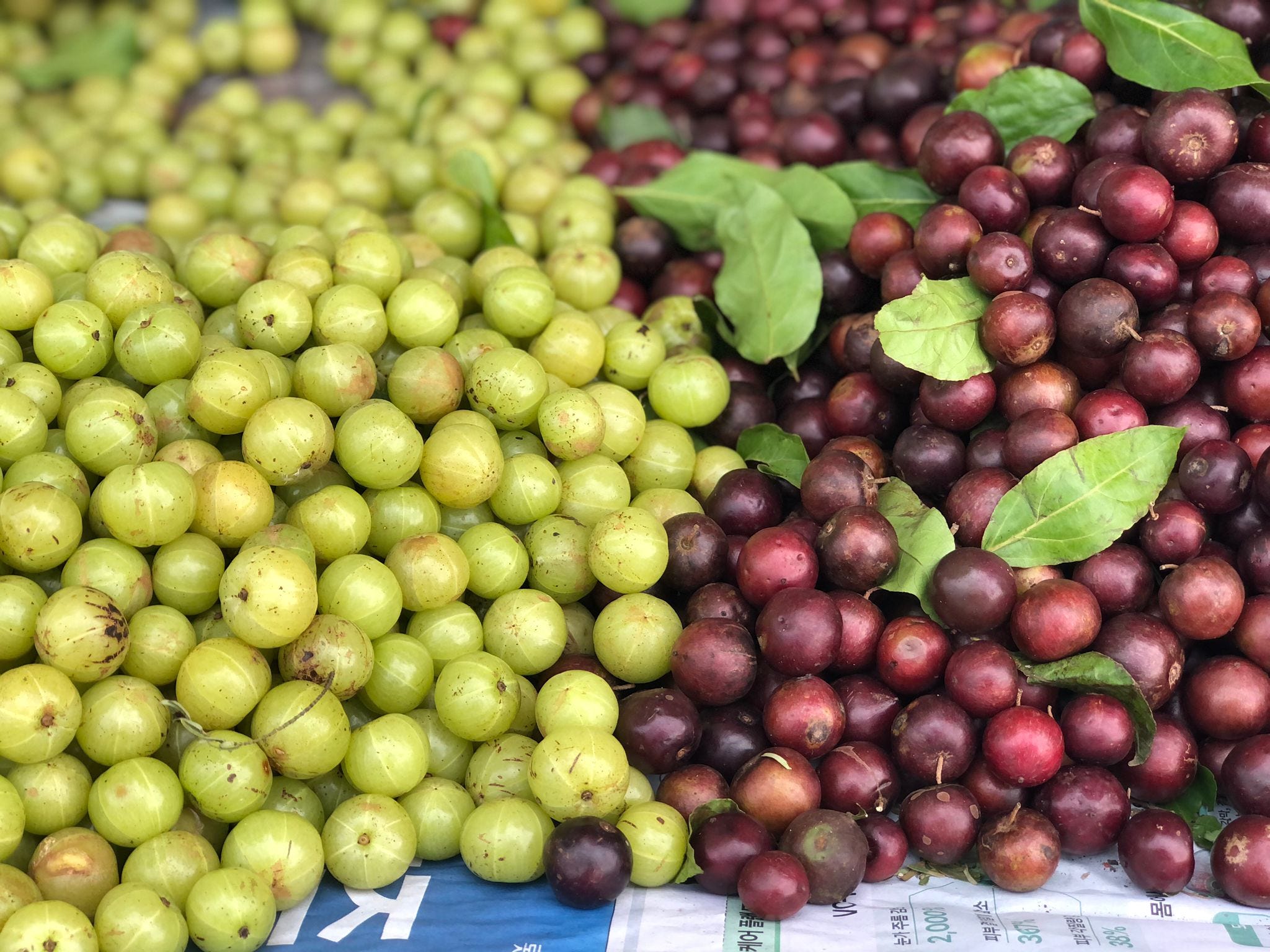
This is how recipes are found.
Not downloaded.
Not sourced.
Chased.
Across languages. Across ports. Across memory.
Sometimes you don’t find the recipe.
Sometimes you rebuild it from fragments.
And sometimes the fragment is the inheritance.
In Punjab and Maharashtra, guramba (sometimes gudamba, sometimes gulamba, but the point is always a word that combines sugar and the fruit) is a jaggery-mango preserve. Sweet. Sticky. Somewhere between pickle and jam. The logic is simple: fruit plus gur, cooked down until it glosses.
And then there’s murabba - that old instinct of preserving abundance. Mango. Gooseberry. Plum. Cooked slowly in sugar or jaggery until durable. Spoonable. Meant to last.
So perhaps my aunt’s plum gorumba wasn’t invented at all.
Perhaps it was borrowed.
Perhaps it was simply translation.
In Calcutta, kitchens were never pure. Baghdadi Jews borrowed from Bengali cooks. Anglo-Indians borrowed from local fruit trees, preserved using a method that had already traveled across regions. Servants moved between households, carrying techniques like invisible luggage.
Jaggery instead of refined sugar changes everything. It darkens the fruit. Deepens it. Gives it that caramel edge that white sugar never quite achieves.
And the fruit?
When colonial memoirs describe “marble-sized red plums” in winter Bengal, I begin to suspect something else.
Maybe it was ber.
Maybe kul.
Maybe what the British called “Indian plum.”
Oral memory has no orthography.
Which would mean plum gorumba was not European at all.
Mango gudamba clearly exists - documented, reproducible, Googleable. And then you feel the asymmetry.
Mango gudamba survived in many Indian kitchens.
The plum version did not.
Plum gorumba simply did not survive the Jewish exodus from India.
It was never packed.

Calcutta, departure era. Some things boarded. Some did not.
But absence is not extinction.
It is invitation.
Then I thought of Harshita Saxena from Epicurean. Harshita recently wrote about kitchens that didn’t call themselves sustainable because they didn’t need to. Preservation began when fruit was abundant, not when it was about to rot. Mangoes became murabba. Gooseberries were cooked down with jaggery. Heat was never wasted. Nothing was accidental.
That logic - not nostalgia, but instinct - is what plum gorumba belongs to.
Before declaring it lost, I consulted Harshita Saxena about traditional jaggery preserves. When I asked Harshita Saxena how she would read this fragment, she described the full murabba discipline - fruit pricked, soaked in choona to hold its shape, then coaxed slowly into jaggery syrup over days of resting and reheating. Preservation as patience, not panic.
Her family’s amla murabba follows that older North Indian rhythm - fruit, gur, slow heat, gloss - and you can read her full method here.
Plum gorumba, I suspect, stopped earlier on that arc. Before crystallising. Before candy. At the point where fruit turns dark and spoonable.
So this is how I would rebuild it.
If plums are unavailable - or not sharp enough - I would use gooseberries.
Not sweet ones. Tart ones.
Small. Firm. Slightly stubborn.
No cookbook required.
Just a cook who knew what to do when fruit was in season.
You are not looking for jam-set.
You are looking for gloss.
And you use Panch phoron - Bengal’s five-spice mix of fennel, nigella, cumin, fenugreek, and mustard - added whole, allowed to crackle in hot oil so the sweetness, bitterness, and heat begin speaking before the fruit does.
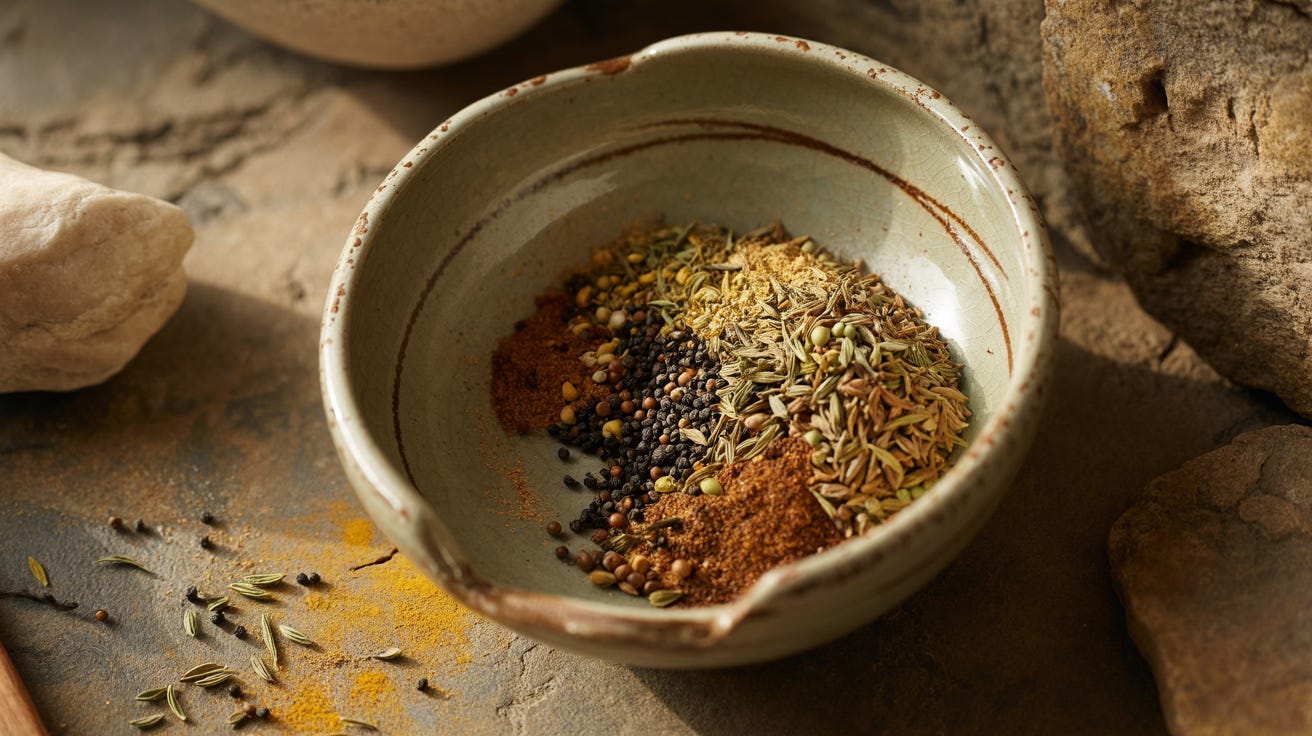
Panch phoron. Five whole seeds that begin speaking in hot oil.
The spices should hum in the background - fennel sweet, nigella slightly bitter, mustard sharp.
Cook until thick but spoonable.
Let it cool. It will deepen as it rests.
Sweet enough to spread.
Sharp enough to wake rice and dal.
Call it plum gorumba.
Or call it what kitchens have always done -
fruit, preserved for later.
That`s it. Short and sweet.
✨ All posts are free; paid subscriptions are optional, and your support is deeply appreciated.
💬 Share your story in the comments, or pass this essay along.
📖 To support more work uncovering Jewish food in unexpected corners of the world, consider subscribing to Beyond Babylon.
So interesting...was her plum guramba made from surplus unripe plums or ripened varieties? and this (I was introduced to a museum ambassador in NY) might interest https://foodish.anumuseum.org.il/en/event/family-food-stories-indian-kitchen/?event_index=0
That is absolutely true. You never know what inspires you to write. I am sure your travels have bought you even more this time.
I amazing how we keep finding similarities in our cusines. You have intrigued me to try make a Plum Guramba. It may not be as good as your aunts "Head Huncho". But, I may come close.