
Pass the Ketchup
How Heinz's ketchup became the world`s leading tomato condiment

I made myself lunch today, and almost instinctively reached for that Heinz ketchup bottle in the fridge. As I held it, I wondered what it is about vinegar, sugar and tomato that makes food taste better, and why it was ketchup that became the world’s favourite combination of the three.
I also pondered what the word ketchup was ever supposed to mean. Turns out that in the Hokkien ports of southern China, the ancestor of the word named the brine of pickled fish.¹ Not sweet. Not red. Not thick. No tomato. The bottle in the refrigerator is not the original. So why is it that the Heinz version became so famous that the very idea of ketchup is now synonymous with it?
Lunch led to research. The research led here: how ketchup got famous is a story about trade routes, chemistry, industry and a good deal of luck.
This is a food historian’s account rather than a food technologist’s. The question here is not chiefly how ketchup works, but how it came to be the particular thing it is, and why this one version conquered the world when so many rival sauces, several of them arguably better, did not.
In the beginning there was kê-chiap
The word ketchup is the first clue, because it survived when nearly everything else about it was replaced.
Ketchup descends from Hokkien, a language of China’s southeastern coast - Fujian province, facing Taiwan - whose traders carried it across every port in Southeast Asia. In the old dialect of Amoy, the region’s great trading harbour (now Xiamen), a fermented sauce of fish brine and spices was called kôe-chiap or kê-chiap.¹
So when you think about it, the ketchup we know and love as a tomato sauce began life as fish sauce…
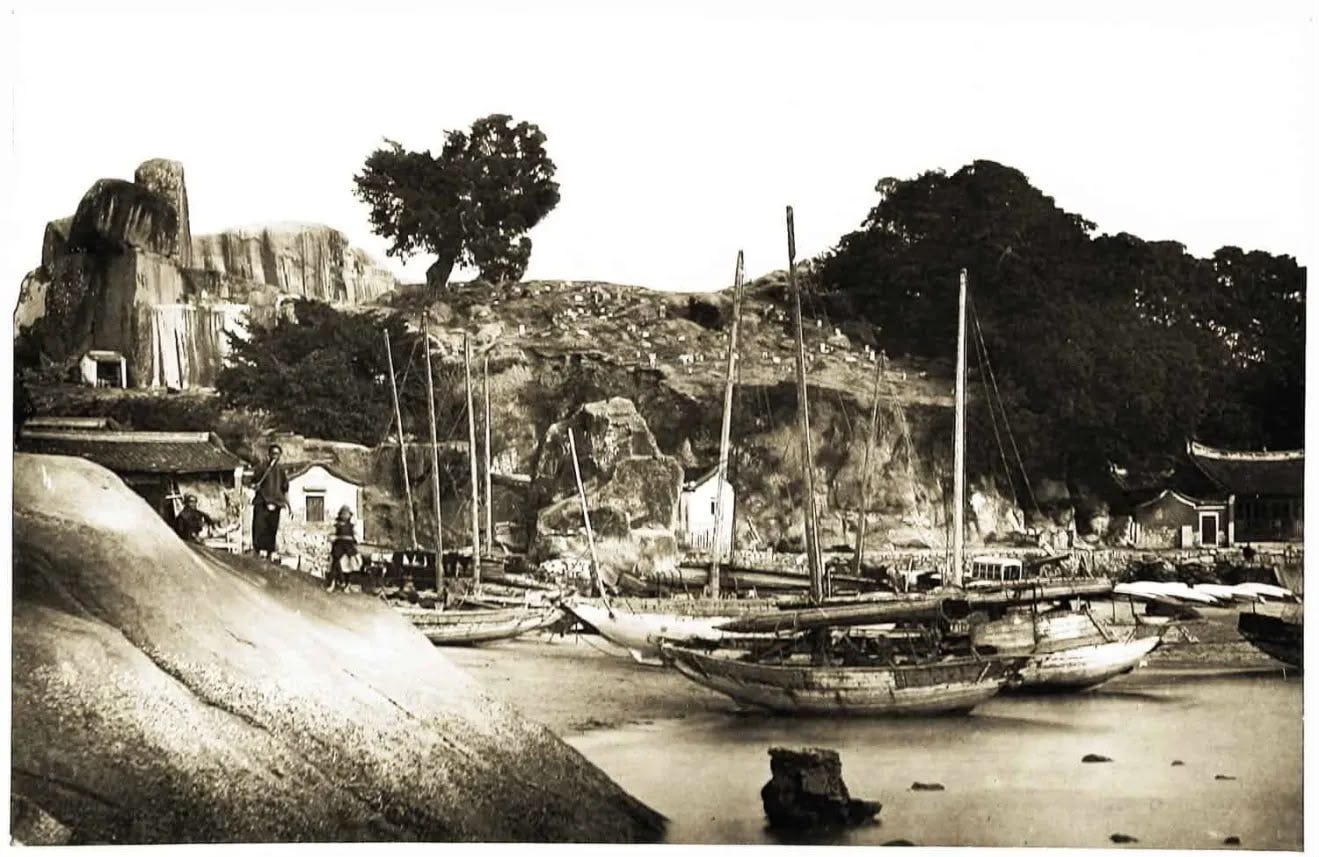
The birthplace of ketchup? Photograph: John Thomson, Amoy harbour, c. 1870. Published in Treasure Spots of the World (Ward, Lock & Tyler, 1875). Public domain.
There is no single birthplace to point to, yet the word travelled with the sauce from Fujian through the contact zones of maritime Southeast Asia, and as it moved through Malay it became kecap, the ordinary word for soy sauce in Malay and Indonesian, surviving today in kecap manis, the sweet soy sauce that shares ketchup’s name - and, distantly, its function as a dark, savoury seasoning - but little of its substance.²
The earliest English evidence fits that pattern. A dictionary of slang published around 1698, B.E.’s A New Dictionary of the Terms Ancient and Modern of the Canting Crew, defined “catchup” as “a high East-India sauce”. Englishmen already understood it as an import from Asia, not something made at home.³
“I’d rather die than say it.” - Jerry Stiller as Arthur Spooner, refusing to say “ketchup” and preferring the more “erudite” catsup. The King of Queens, “Trash Talker” (S6E18, 2004).
In 1711, the merchant Charles Lockyer, in An Account of the Trade in India, advised that “the best Ketchup” came from Tonqueen, in what is now northern Vietnam, while noting that good versions were also made and sold cheaply in China.⁴
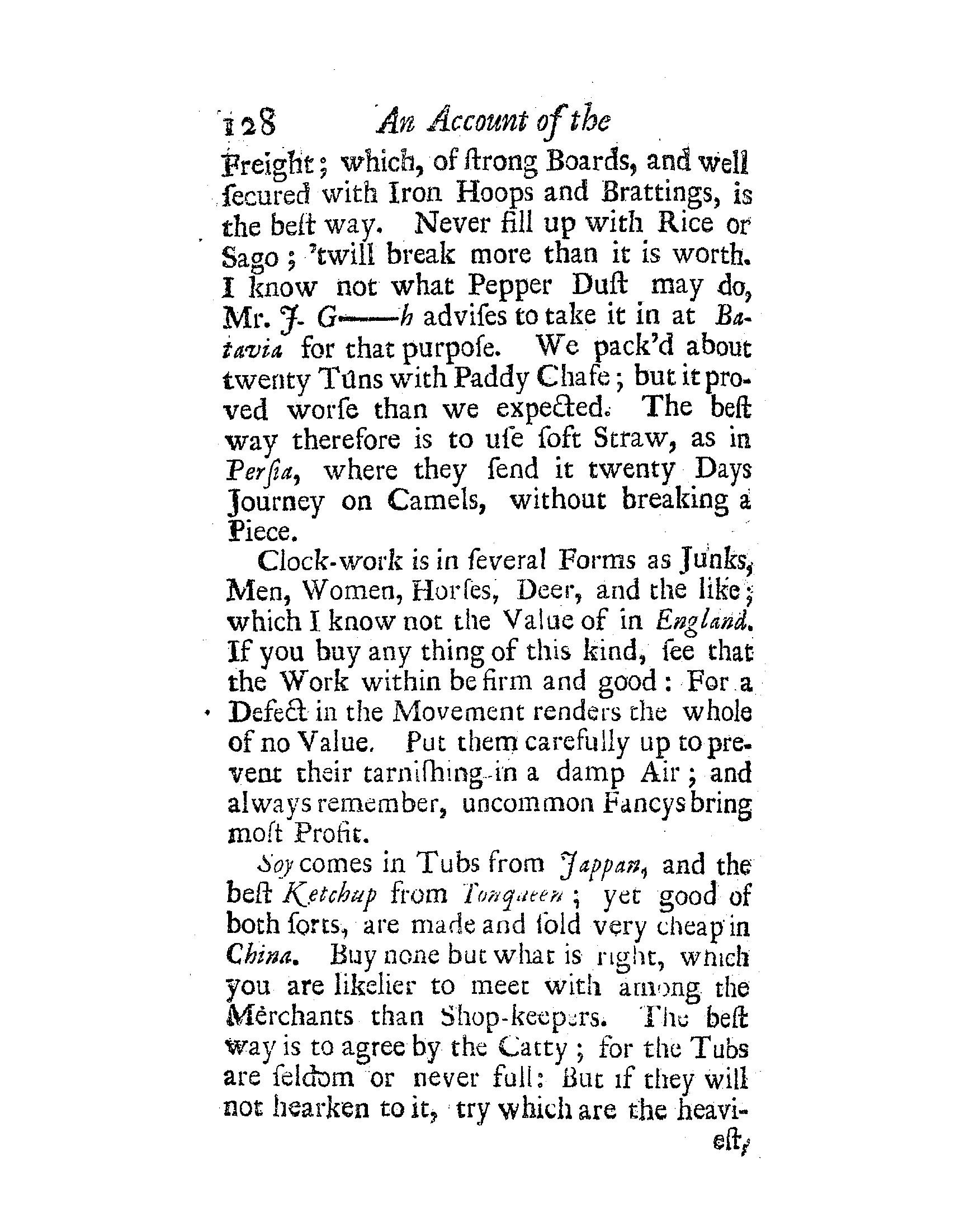
Charles Lockyer, An Account of the Trade in India (London: printed for the author, 1711), p. 128. Internet Archive, public domain.
What the British encountered was not a fixed recipe but a sauce already in motion, and what they carried westward was as much a concept as a formula.
Chasing the perfect savoury sauce
To see why a single word could survive such total changes of content, it helps to name what people actually wanted from the sauce. Part of what they wanted was what we now call umami: that deep, savoury, mouth-filling taste that food science attributes chiefly to glutamate. They had no word for it, but they knew the sensation, and they would follow it across the world and across ingredients.
Fermented fish sauce is an umami concentrate almost by design: fermentation breaks fish protein into peptides and free amino acids, among them free glutamate, the compound at the heart of savoury taste.⁵ The original Asian ketchup was powerful not merely because it was salty but because fermentation had unlocked deep savouriness and made it keep.
Once that is clear, the sauce’s later career makes sense. When British cooks remade the sauce at home, they reached, knowingly or not, for other glutamate-rich ingredients.
Dried mushrooms and anchovies are rich in it; and tomatoes, as they ripen, accumulate free glutamate until it becomes the dominant amino acid in the fruit.⁵ The long march from fish sauce to mushroom ketchup to tomato ketchup is therefore not a series of unrelated condiments that happened to share a name. It is a succession of umami technologies. The ingredients changed; the function held. People were never loyal to the fish, or the mushroom, or the tomato. They were loyal to portable, stable savouriness, and they became attached to the word that promised it.
Britain makes its own version
The British brought home the name and the taste expectation, but not the ingredients.
Working without tropical fermented fish, they improvised, and by the early eighteenth century English cookbooks were full of ketchups made from mushrooms, walnuts, oysters and anchovies, none containing tomatoes, none resembling the red sauce we mean today.⁶
What they shared was the underlying logic: a concentrated, long-cooked or fermented liquid that delivered depth and survived a voyage.
It is worth remembering how various this category once was. There was no single ketchup; there were ketchups, a whole shelf of savoury brown liquids, and the survivors of that older diversity are still with us. The British brown sauces carry tomato now as body rather than identity, their character built instead on malt vinegar, tamarind, dates and spice; HP Sauce and A.1. are the surviving commercial heirs of that older, un-red tradition. Worcestershire is the true holdout, fermented anchovy and tamarind, no tomato at all, the closest thing on the modern table to what English ketchup was before the tomato conquered it.
Worcestershire is not ketchup’s ancestor. It was launched only in 1837, a quarter-century after Mease’s tomato ketchup, but it is a surviving relative of that older family of fermented, anchovy-based sauces.⁷
The tomato arrives on the scene
The tomato came last. The first known published recipe for tomato ketchup was written by James Mease, a Philadelphia scientist and horticulturalist, in 1812; his version had tomato pulp, brandy and spices, but no vinegar and no sugar, which left it highly perishable.⁸
For most of the nineteenth century commercial tomato ketchup was an unreliable and often revolting product, bulked out with pumpkin rind or apple pomace, dyed a brighter red, preserved with borax or worse, and sold in dark bottles that hid whatever was inside.⁹ But ketchup was only one instance of a larger problem: industrial food was increasingly being made by strangers, shipped long distances and sold to consumers who had no way of knowing what was inside.
This was the age of the “poison squad,” when Harvey Wiley, chief chemist at the U.S. Department of Agriculture, was feeding volunteers measured doses of borax, salicylic acid and formaldehyde to test their effects on human health as part of his campaign against adulterated food.¹⁰
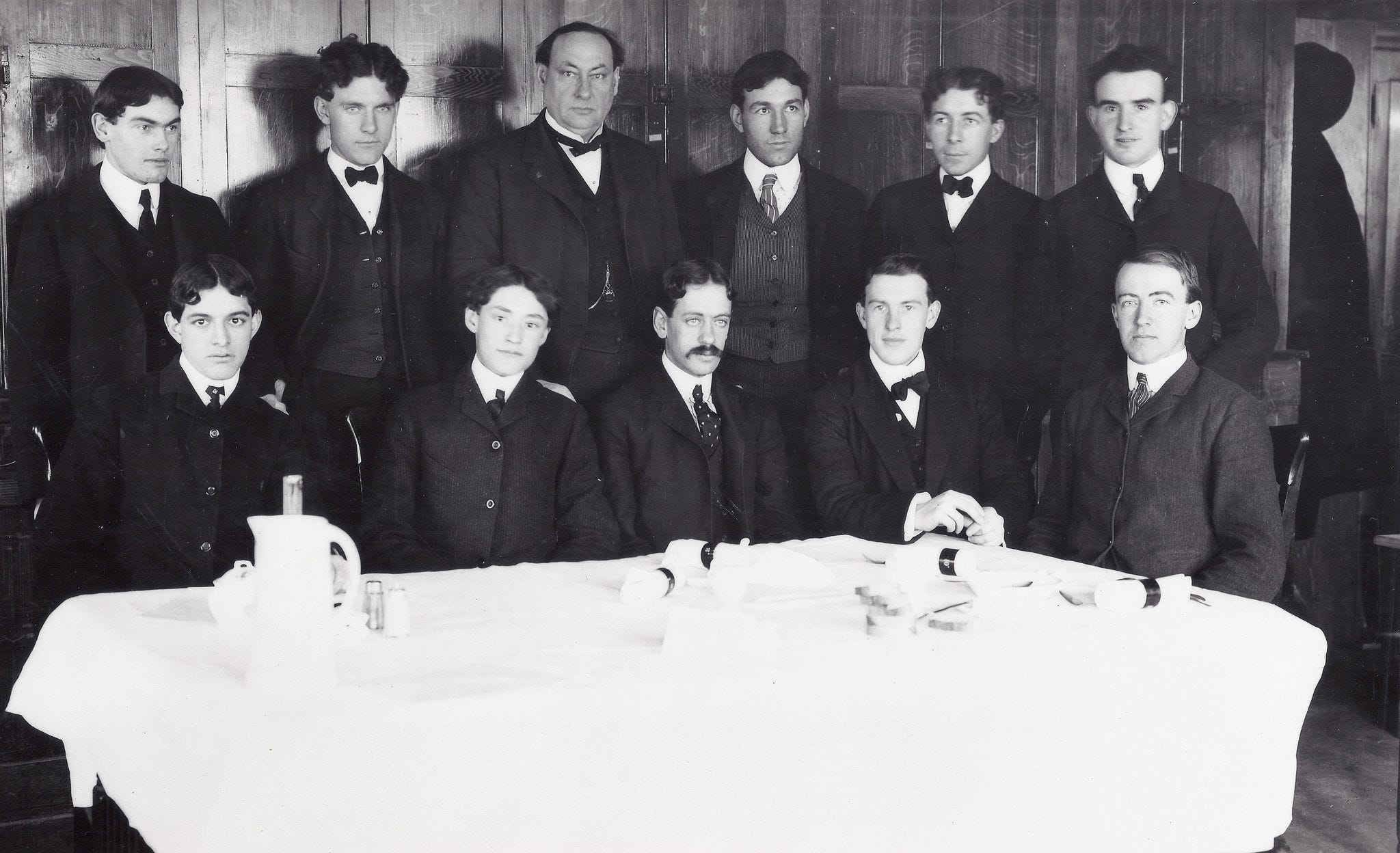
Members of Harvey Wiley’s “Poison Squad,” c. 1902, volunteers in the U.S. government’s experiments on food preservatives. FDA, public domain.
Heinz standardizes ketchup
Henry J. Heinz did not invent tomato ketchup, the clear bottle, or the campaign for pure food. What he did was sequence these things with uncommon shrewdness, and in doing so he answered a genuinely new problem: how to make a stranger trust food he could not watch being made.
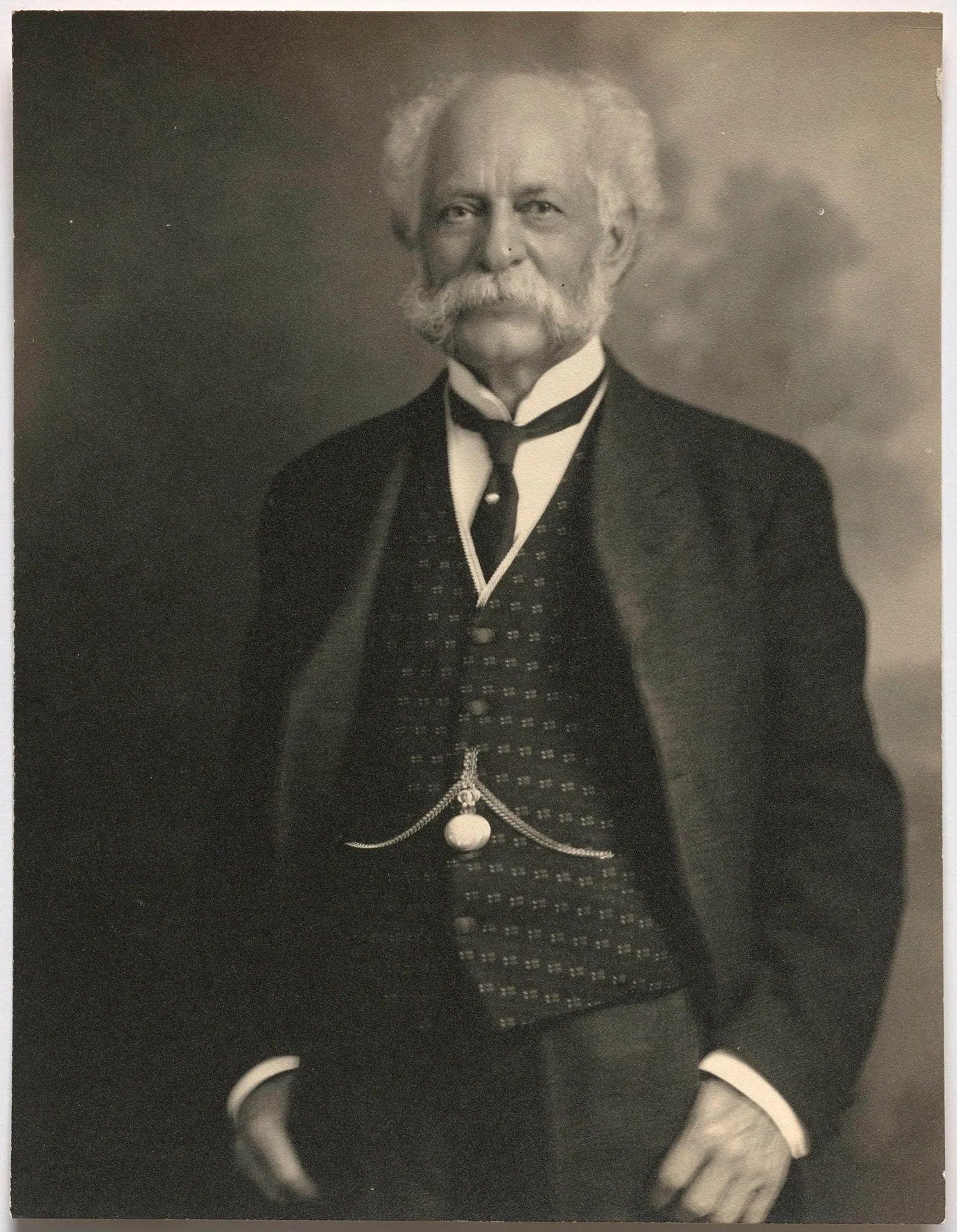
Henry J. Heinz (1844-1919), c. 1914. He did not invent tomato ketchup; he turned it into a standardized product the world learned to trust. Photograph by Pach Brothers Studio. National Portrait Gallery, Smithsonian Institution. CC0/public domain.
Heinz used chemical preservatives in his ketchup, as his competitors did, as late as 1904.¹¹ The turn came when his chemists worked out a reliable preservative-free recipe that relied on higher acidity and careful cooking for shelf stability; the tomato’s own pectin supplied body rather than preservation.¹²
But “pure” did not mean healthy. The reformulation was itself a recipe change, and one we still taste: the ketchup that replaced the benzoate versions carried roughly twice the salt, sugar and vinegar of its competitors, built on fully ripe, carefully cooked tomatoes.¹³ The sweetness we now think of as quintessentially American began as a preservation strategy, more sugar to balance the added acid, and acid enough to keep the sauce without benzoate.
Then Heinz threw himself, loudly, behind the growing push for federal pure-food legislation, but only once he had a preservative-free product ready to sell and knew a campaign for purity would favour it.¹⁴ His advocacy was sincere and self-interested at once; his own biographer put it as "idealism and noble purpose compounded with pragmatic, self-interest."¹⁵ When the Pure Food and Drug Act passed in 1906, Heinz was ready with labels reading, prominently, free from benzoate of soda; his competitors were not, and within a few years he was outspending the rest of the industry on advertising and had become the largest tomato-ketchup producer in the world.¹⁶
This is the moment ketchup became more than a sauce. Before industrial food, you trusted a condiment because you knew the cook, or the market stall, or the recipe. Heinz’s ketchup was made by strangers hundreds of miles away, and it had to earn trust another way: through the clear bottle you could see into, the standardization that made every bottle identical to the last, the purity claim, and finally the law standing behind the label. Ketchup became one place where food learned to be trusted by people who would never meet its maker.
So consistency was itself the product. A cook who bought ketchup in 1880 did not know what she was getting; a cook who bought Heinz in 1910 did, and would again next year, and in another city. Fordism before Henry Ford, though the analogy holds only for the process, since Ford's assembly line drove prices down and Heinz's standardization pushed his prices up.
What Heinz was selling was not cheapness but predictability, and predictability is what lets a stranger trust a sealed bottle. It is also, incidentally, what lets a sauce travel: a condiment that tastes the same in Pittsburgh, Manila and Lagos can be bought sight unseen by someone who has never tasted it before.
I learned this cooking in Switzerland. It does not matter if the food is boring, so long as it is the same boring every time, and that is what people come to trust, and trust is what brings them back.
Trust made ketchup safe to buy. It did not, by itself, make ketchup the default condiment of the planet. That took three more things, and it is worth being precise about them, because none of them is “it tasted best.”
The first was branding, at which Heinz was a genius before the word was common. He gave ketchup an identity you could recognize across a room. In 1896, riding an elevated train in New York, he saw a shoe advertisement boasting “21 styles” and decided his company needed its own memorable number. He settled on “57 Varieties” and stamped it across everything.¹⁷
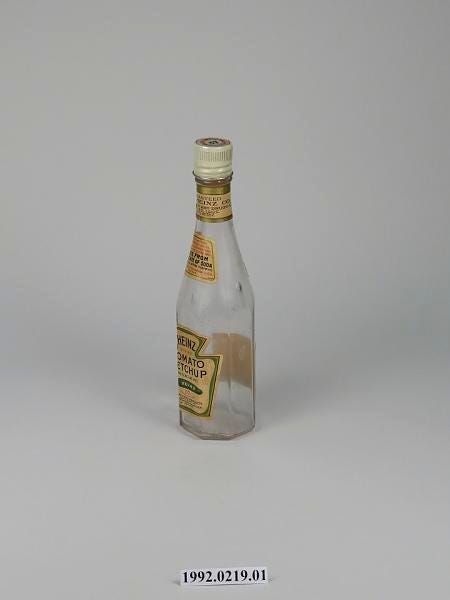
Heinz Tomato Catsup bottle, with the “57 Varieties” and “Pure Food Products” labels. National Museum of American History, Smithsonian Institution.
The number was pure invention: Heinz was already selling well over sixty products at the time, so 57 was not a count but a slogan, chosen because he liked how it looked and sounded, five being his lucky number and seven his wife’s.¹⁸ It did not matter that it was false. It mattered that it stuck. Alongside the number came the object itself: the clear glass, the narrow neck, the keystone label, a silhouette so consistent that when Heinz ran an advertising campaign asking people around the world to draw ketchup, they overwhelmingly drew the Heinz bottle.¹⁹ Ketchup came in an icon.
The second was distribution. The chemistry of savoury depth was available to everyone, the tomato’s glutamate is not a Heinz patent, and the world was already full of tomato condiments that used it.
Yet ketchup, and not the others, hitched itself to the twentieth century’s most exported meal. It is hard to prove a counterfactual, but the pattern is suggestive: the hamburger and the fries seem to have carried ketchup to every continent much as an earlier empire’s navy had carried Worcestershire around the world as a cook’s seasoning. The condiment did not spread on its merits alone. It spread, I think, bolted to a winning delivery system.
And the third, quietly, was the sauce itself. Here honesty requires a concession that cuts against the marketing story: ketchup may also have won because of what it is.
Malcolm Gladwell, “The Ketchup Conundrum,” The New Yorker, September 6, 2004 (collected in What the Dog Saw, 2009), famously argued the opposite: that Heinz won because it is, in sensory terms, perfect. A tasting panel at Kansas State found in it what the analysts call amplitude: every flavour blended and balanced, nothing protruding, the same quality they find in Coca-Cola.
The tasting Gladwell reports was conducted by Edgar Chambers IV’s sensory-analysis centre at Kansas State University; “amplitude” is the sensory analysts’ term for flavours that are well blended and balanced, in which no single element stands out, and Gladwell’s exemplars of it are Coca-Cola and Pepsi. His question is why ketchup, unlike mustard, never diversified into varieties; his historical section, which draws on Andrew F. Smith, covers the benzoate battle and the Heinz reformulation.
The finding is real, and I do not dispute it.
I dispute what it is taken to prove. Chambers’s panel showed that Heinz is remarkably balanced: vinegar, salt, tomato, sweetness and bitterness are blended so that no single note protrudes. That may help explain why Heinz beat other ketchups. It does not explain why ketchup beat other condiments. Those are different questions.
The fact is, world is full of tomato condiments that are arguably better: matbucha, the slow-cooked tomato-and-pepper relish of North African Jewish kitchens; tomato kasundi, the fierce Bengali mustard relish; and a dozen others that never left home. Several surpass ketchup for flavour.
But each of those other tomato “ketchups” is assertive: matbucha tastes emphatically of peppers, garlic and heat; tomato kasundi bites with mustard sharp enough to clear the sinuses. They ask something of the eater. Ketchup asks nothing. It is sweet, smooth, mild; umami enough to satisfy the craving for savoury depth, and neutral enough to offend no palate anywhere. A fierce sauce is specific, and specificity limits a market. Ketchup was sanded down, partly by that sugar-heavy reformulation, to a lowest common denominator almost anyone, anywhere, could accept at first taste. It did not win the argument of the palate.
Heinz ketchup won by declining to have the argument at all.
Occupation, it turns out, was a delivery system too. In the ruins of a defeated Germany, ketchup arrived the way it arrived almost everywhere in that decade, with the American military, and passed to civilians through the barter economy of the occupation, traded from soldiers along with the cigarettes and cognac that served as currency in a broken city.²⁰
According to the conventional Berlin account, in 1949 a cook named Herta Heuwer combined ketchup, or an ersatz of it made from tomato paste and Worcestershire, with curry powder obtained from British soldiers, poured the sauce over sliced sausage, and created currywurst, now eaten by the hundreds of millions every year in Germany.²¹
Berlin is where the last two arguments meet: ketchup arrived on a delivery system, and it took hold by being curried back into something particular. Heuwer did not replace the sauce; she added to it, and it accepted the addition, which is the answer to anyone who calls the Heinz formula perfect. You cannot improve on a finished thing. The neutrality that let it travel was also what let a place make it its own.
The bottle itself: Tapping the 57
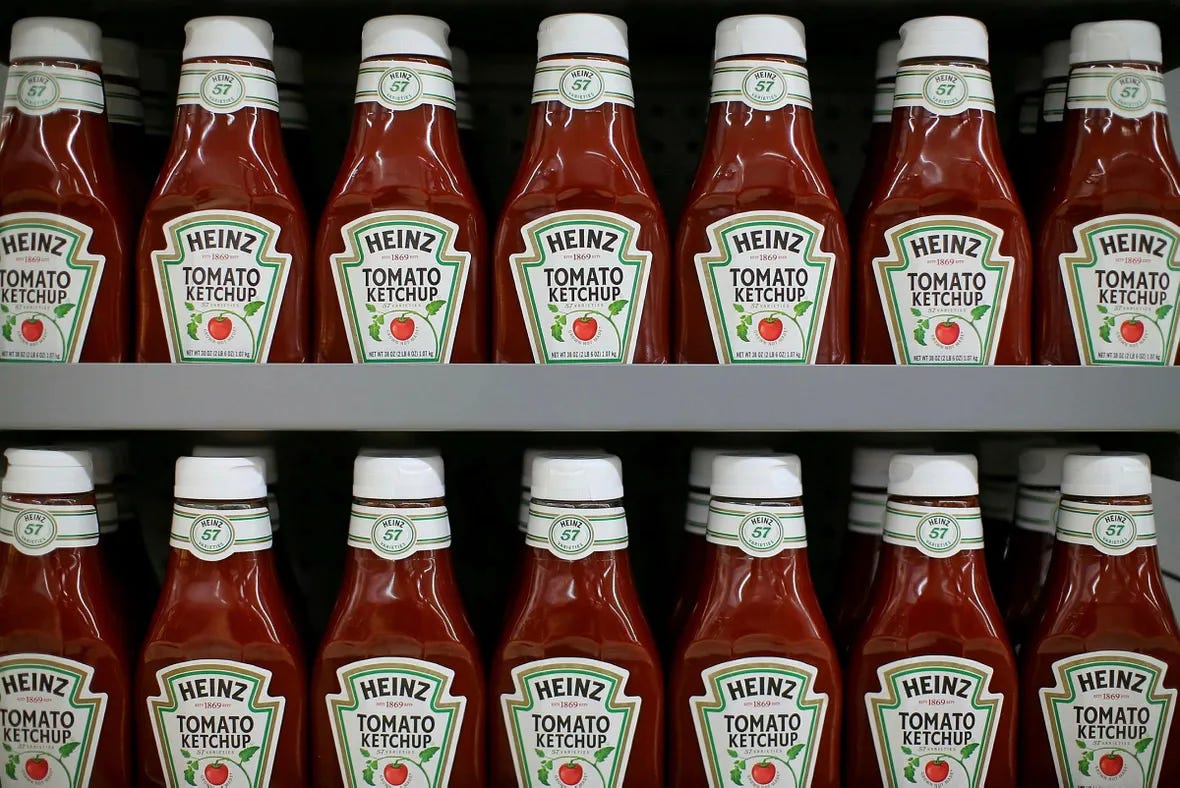
Heinz Tomato Ketchup. Photograph by Mike Blake/Reuters
The object all this produced is, incidentally, a small marvel of physics - and the physics is bound up with the branding, because the famous “57” embossed on the neck turns out to be the practical point at which to strike the glass bottle to make it pour.²² Ketchup is a non-Newtonian fluid, shear-thinning in the jargon. At rest, tomato solids and pectin form a loose gel that holds the sauce almost motionless, which is why it clings to the bottle and refuses to come out; apply enough sudden force and the structure collapses, the viscosity drops, and the ketchup arrives all at once. It waits, and then it comes in a rush, creeping from a tilted bottle, when it finally moves, at something close to a stately fraction of a mile per hour.²² The connoisseur’s trick is not to pound the base but to tap the 57. The squeeze bottle, later, engineered the whole difficulty away.
Ketchup goes bananas
What changed most across this whole history is the map. Ketchup began somewhere in the fermented-fish world of maritime Southeast Asia, travelled to Britain, took on tomatoes in America, and was standardized, branded and bottled in Pittsburgh. Then it went out again, everywhere, carried by commerce and the universal appetite for sweet, sour, salt and savoury in a single mouthful. Pittsburgh did not invent the condiment’s grammar. It turned one late version of it into the global default.
And then the wheel came full circle, in a place the word had already passed through on its way west. Tomato ketchup reached the Philippines under American rule after 1898, familiar enough that homesick American soldiers wanted it and Filipinos acquired the taste, but tomatoes grew poorly in the islands and the imported sauce stayed expensive.²³ In the 1930s the Filipino food technologist Maria Orosa, trained in chemistry in the United States and devoted to building her country’s food self-sufficiency, applied the same logic of substitution: use what you have.²⁴ She developed a banana-based ketchup from local ingredients: saba bananas in place of the tomatoes, with vinegar, sugar and spices, tinted red to look familiar. Magdalo V. Francisco Sr. began commercially mass-producing banana ketchup in 1942, under the Mafran brand, helping make it the national staple it remains.²⁵
That is not a comic footnote to the real history of ketchup. It is the history of ketchup made visible. Orosa did exactly what British cooks did in the 1700s and what Mease did in 1812: she translated an idea into what was at hand. A fermented fish sauce became mushroom and walnut ketchup in Britain, tomato ketchup in America, a curried sauce on a Berlin sausage, and banana ketchup in Manila, not because ketchup was ever one sacred recipe, but because it was never only a recipe. It was a method: a repeatable way of organizing acid, sweetness, salt and savoury depth out of whatever a place could grow, ferment or afford. Its very blandness was the precondition: a sauce with strong opinions of its own, a matbucha or a kasundi, is less easily a substrate for someone else’s idea; ketchup, asking nothing, could be rewritten by every place it reached.
The bottle in the refrigerator is the version that got famous. What travelled all the way around the world was not a sauce. It was the idea of a sauce, and a word that refused to let go.
Banana Ketchup
Makes about 600 ml
This is my own version, cooked in my kitchen, not an attempt to reproduce Maria Orosa’s recipe. It works from the same logic she did: use what you have, and let the vinegar, sugar and spice do what the tomato would have done.
Ingredients
500 g peeled ripe but still firm bananas
1 tablespoon neutral oil
1 medium onion, finely chopped
4 garlic cloves, finely chopped
20 g fresh ginger, finely grated
1 teaspoon ground annatto
1 teaspoon sweet paprika
¼ teaspoon cayenne pepper, or more to taste
¼ teaspoon ground allspice
A small pinch of ground cloves
120 ml cane, coconut or apple-cider vinegar
180 ml water, plus more as needed
60 g dark brown sugar
1 tablespoon light soy sauce
1 teaspoon fine salt
Freshly ground black pepper
Method
Cut the bananas into thick slices.
Heat the oil in a saucepan over medium-low heat. Add the onion and cook for 7–8 minutes, until soft and beginning to colour.
Add the garlic and ginger and cook for one minute. Add the annatto, paprika, cayenne, allspice and cloves and stir for another 30 seconds.
Add the bananas and cook for 4–5 minutes, turning occasionally, until their edges begin to caramelise.
Add the vinegar, water, sugar, soy sauce, salt and several grindings of black pepper. Bring to a gentle simmer and cook uncovered for about 20 minutes, stirring frequently, until the bananas have collapsed and the sharp smell of raw vinegar has disappeared.
Blend until completely smooth. For an especially fine ketchup, pass it through a sieve.
Return the ketchup to the saucepan. Add enough water to give it the consistency of bottled ketchup and simmer for another 5 minutes. Taste while it is still warm. Add a little more vinegar if it seems too sweet, sugar if it is too sharp, or salt if the flavour seems flat.
Spoon into a clean jar and allow to cool before refrigerating. The ketchup will thicken as it cools.
This banana ketchup is naturally amber-red rather than the brilliant red of commercial versions. It contains no tomato or artificial colouring.
Keep refrigerated and use within three weeks. It can also be frozen for up to three months.
👉 Get your recipe for Banana ketchup here
Elli Benaiah spent thirty years as a trial lawyer, then cooked professionally and managed restaurants in Switzerland and Germany before turning to food history. He is at work on a history of the Jewish food of the Indian Ocean.
Sources
The Hokkien (Amoy dialect) forms kôe-chiap / kê-chiap, denoting a fermented fish sauce, are the generally accepted root of the word. See Dan Jurafsky, The Language of Food: A Linguist Reads the Menu (New York: W. W. Norton, 2014), and Jurafsky’s blog The Language of Food; cf. NPR, “Ketchup: The All-American Condiment That Comes From Asia” (Dec. 2, 2013).
On Malay kecap and Indonesian kecap manis as cognates carried through Southeast Asian trade, see Jurafsky, The Language of Food; and Charles Payson Gurley Scott, “The Malayan Words in English” (1897).
B.E., A New Dictionary of the Terms Ancient and Modern of the Canting Crew (London, c. 1698; a second edition appeared in 1699), s.v. “Catchup, a high East-India sauce.” The work is conventionally dated c. 1698 in the bibliographic record; some popular sources give 1690, which is inaccurate.
Charles Lockyer, An Account of the Trade in India (London, 1711): “Soy comes in Tubbs from Jappan, and the best Ketchup from Tonquin; yet good of both sorts are made and sold very cheap in China.”
On glutamate as the basis of umami and its concentration in fermented fish sauce, dried mushrooms and ripe tomatoes, see Shizuko Yamaguchi and Kumiko Ninomiya, “Umami and Food Palatability,” Journal of Nutrition 130, no. 4 (2000): 921S–926S; and John D. Fernstrom, “Glutamate: from discovery as a food flavor to role as a basic taste (umami),” American Journal of Clinical Nutrition 90 (2009), which records free glutamate in ripe tomatoes at roughly 140 mg/100 g and notes that levels rise sharply with ripening. On the parallel role of 5’-guanylate in dried shiitake and 5’-inosinate in dried fish, see the same sources; and the Umami Information Center’s comparative food data.
On eighteenth-century British mushroom, walnut, oyster and anchovy ketchups, see Andrew F. Smith, Pure Ketchup: A History of America’s National Condiment (Columbia: University of South Carolina Press, 1996); and Eliza Smith, The Compleat Housewife (London, 1727 and later eds.).
Lea & Perrins Worcestershire sauce was first made on 28 August 1837 and sold from 1838; see Lea & Perrins company history and Wikipedia, “Lea & Perrins.” It therefore postdates James Mease’s 1812 tomato ketchup by roughly a quarter-century and cannot be ketchup’s ancestor, though it descends from the same family of fermented, anchovy-and-tamarind sauces.
James Mease’s 1812 recipe, titled “Love Apple Ketchup,” published in his Archives of Useful Knowledge, is generally credited as the first published tomato ketchup recipe. Mease (1771–1846) was a Philadelphia physician (M.D., University of Pennsylvania, 1792), scientist and horticulturist. See Andrew F. Smith, Pure Ketchup; and the biographical entry for James Mease.
On nineteenth-century adulteration of commercial ketchup, fillers such as pumpkin rind and apple pomace, coal-tar dyes, borax and other preservatives, and dark bottles that concealed spoilage; see Andrew F. Smith, Pure Ketchup, 59–65; and Deborah Blum, The Poison Squad: One Chemist’s Single-Minded Crusade for Food Safety at the Turn of the Twentieth Century (New York: Penguin, 2018).
On Harvey Wiley and the “Poison Squad” experiments, see Blum, The Poison Squad.
“Heinz ketchup had artificial preservatives as late as 1904.” Timothy P. Carney, “Heinz and Buffett: Big Government for Thick Ketchup,” American Enterprise Institute / Washington Examiner (2013), drawing on Quentin Skrabec, H. J. Heinz: A Biography (Jefferson, NC: McFarland, 2009).
On the preservative-free reformulation: the shelf stability came from higher acidity (vinegar) together with careful cooking and sanitation, not from pectin, which supplies body and consistency rather than microbial preservation. Cf. USDA tomato-products inspection guidance; and Andrew F. Smith, Pure Ketchup.
On the preservative-free reformulation and its altered proportions, the 1906 recipe carrying roughly twice the salt, sugar and vinegar of competing commercial ketchups; see Andrew F. Smith, Pure Ketchup: A History of America’s National Condiment (Columbia: University of South Carolina Press, 1996), 84–87; quoted in Atlas Obscura, “When Every Ketchup But One Went Extinct” (Aug. 16, 2022).
On Heinz’s support for the Pure Food and Drug Act of 1906 timed to his possession of a benzoate-free product: Smith, Pure Ketchup; Carney/Skrabec (n. 11); Blum, The Poison Squad.
Robert C. Alberts, The Good Provider: H. J. Heinz and His 57 Varieties (Boston: Houghton Mifflin, 1973), 172: “Like so much of Henry Heinz’s philosophy, the stand on pure food legislation was idealism and noble purpose compounded with pragmatic, self-interest.” (Note that the shortened form of this quotation in circulation omits the word “pragmatic.”)
On the “free from benzoate of soda” label, the post-1906 production surge, and Heinz’s rise to the largest tomato-ketchup producer: Smith, Pure Ketchup; Atlas Obscura (n. 13); National Geographic, “How Henry Heinz Used Ketchup to Improve Food Safety” (2021).
On the origin of “57 Varieties” (the 1896 New York elevated-train shoe advertisement for “21 styles”): Heinz History Center (Smithsonian affiliate); CNN, “Why Heinz Ketchup Bottles Still Say ‘57 Varieties’” (Feb. 19, 2022); E. D. McCafferty’s early biography of Heinz, quoted in CulinaryLore.
At the time the slogan was coined in 1896, Heinz was already selling more than sixty products; 57 was chosen for its sound and appearance (five his lucky number, seven his wife’s), not as a literal count. Snopes, “Heinz 57 Varieties”; Wikipedia, “Heinz 57”; and CNN, “Why Heinz Ketchup Bottles Still Say ‘57 Varieties’” (Feb. 19, 2022).
“Heinz Draw Ketchup,” a 2021 Heinz campaign by the Canadian agency Rethink, anonymously asked participants across eighteen countries to draw ketchup; the company reported that 97 per cent drew a recognisably Heinz bottle, and the drawings were then used as limited-edition labels and advertising. See Rethink, “Heinz Draw Ketchup” (rethinkideas.com); D&AD Awards Archive, “Draw Ketchup”; and Kraft Heinz Canada’s campaign materials. It was a branded marketing exercise rather than independent research, and is cited here as such.
On American military food (including ketchup) reaching German civilians through the black market and barter economy of the occupation, in which cigarettes and spirits functioned as currency, rather than through official food relief, which was initially restricted: see general histories of food in occupied Germany (e.g. Wikipedia, “Food in occupied Germany”), and the account of the occupation barter economy in the currywurst origin sources below.
On the origin of currywurst, conventionally attributed to Herta Heuwer in the British sector of Berlin in September 1949, who obtained ketchup (or, by several accounts, tomato paste and Worcestershire sauce) and curry powder via Allied soldiers, and later patented her “Chillup” sauce in 1959, see Deutsches Currywurst Museum; Wikipedia, “Currywurst” and “Herta Heuwer.” The origin is disputed, with rival claims from Hamburg and the Ruhr and earlier datings; this account follows the most common version. The figure of roughly 800 million currywursts eaten annually in Germany is the Currywurst Museum’s estimate.
On ketchup as a non-Newtonian, shear-thinning (pseudoplastic) fluid with a definite yield stress, see A. Koocheki, A. Ghandi, S. M. A. Razavi, S. A. Mortazavi and T. Vasiljevic, “The rheological properties of ketchup as a function of different hydrocolloids and temperature,” International Journal of Food Science & Technology 44, no. 3 (2009): 596–602; and “Rheological Properties of Tomato Products,” in Tomato Chemistry, Industrial Processing and Product Development (London: Royal Society of Chemistry, 2019), which gives a power-law flow behaviour index of about 0.2 for ketchup and tomato paste. On the “57” as the practical tap-point, and the often-cited pour rate of roughly 0.028 miles per hour, see CNN, “Why Heinz Ketchup Bottles Still Say ‘57 Varieties’” (Feb. 19, 2022).
On tomato ketchup’s arrival in the Philippines after 1898, its expense, and poor local cultivation: U.S. National Park Service, “Maria Ylagan Orosa”; Esquire Philippines, “The History Behind the Invention of Banana Ketchup” (2019).
On Maria Ylagan Orosa (1892/93–1945), her U.S. chemistry training and her work at the Philippine Bureau of Plant Industry, and her creation of a banana-based ketchup in the 1930s: U.S. National Park Service, “Maria Ylagan Orosa”; New York Times, “Overlooked No More: Maria Orosa, Inventor of Banana Ketchup” (Sept. 29, 2022). Orosa is widely credited with the recipe; recent scholarship (e.g. Alyssa Paredes in Gastronomica) cautions against reducing the history to a single heroic inventor.
Magdalo V. Francisco Sr. developed his own banana-ketchup method and began commercial mass production in 1942 under the Mafran brand; see Wikipedia, “UFC (food brand)”; and Esquire Philippines, “The History Behind the Invention of Banana Ketchup” (2019). On the saba-banana base and red coloring, see also the National Historical Commission of the Philippines.
Thank you for 'catching us up' with the journey of the ketchup.
Enjoyed this immensely 🙏