
Part One: The Fizz
On seltzer, spa towns, and the intergenerational passing of the effervescence

My father loved soda water.
Not sparkling mineral water, not Perrier, not anything that came in a branded bottle with a label promising Alpine sources or volcanic filtration. Plain soda water, from the tap. Pressurized, immediate, slightly harsh - the kind that hits the back of the throat with a small useful violence
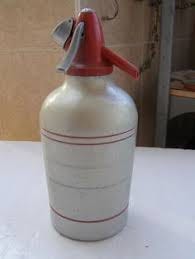
He had a Sipholux.
If you grew up in Israel in the second half of the twentieth century, you know what this means. A heavy metal bottle with a metal siphon head, charged with small CO2 capsules that you screwed in one at a time, each one producing that precise hiss of carbonation that meant the thing was ready. You tilted the sipholux, pressed the lever and the water came out hard and fast into the glass.
He drank it with his food. Specifically with the curry dishes he felt most at home with - the rich, spiced, fatty cooking of a cuisine that demands something sharp and cold to cut through it. The soda water was not a luxury or an affectation. It was a digestive tool, as practical as a knife.
My father loved soda water, and he loved his Sipholux. And he apparently loved me - because when he passed away, he left it to me.
It was more sentimental than it sounds.
Knowing how my dad loved his sipholux, I consider it to be the intergenerational passing of the effervescence.
I eventually moved on to a SodaStream. I was even tempted, briefly, by the syrups - the cola flavours and the fruit concentrates that promised to turn plain water into something more interesting. I tried them and rejected them. Plain soda water was the only thing I actually wanted. The fizz without the sweetness. The effect without the disguise.
I did not know, at the time, that this preference placed me in a very long tradition.
The word seltzer is German by birth and Jewish by adoption.
It begins in a spring. Specifically in Niederselters, a small town in the Taunus hills of Hesse, where naturally carbonated mineral water has been documented since the year 815.
By the eighteenth century, Selterser Wasser - water from Selters, a German town known for its natural mineral water - was being exported across Europe in stoneware bottles, prized by royalty and physicians alike for its curative properties. Goethe, who lived nearby, was an admirer. The water was medicinal, aristocratic, and distinctly German.

There was nothing Jewish about it.
What happened next is a story about thirst, migration, and the way objects follow people across the world and change their meaning in transit.
The water had to travel a long way before it became Jewish.
In 1767, Joseph Priestley moved next door to a brewery in Leeds. He suspended a bowl of water above the fermenting liquor and found that it quickly developed a pleasant, acidic taste not unlike that of Seltzer mineral water.
He called what he had made “artificial Pyrmont water” - named after a spa town, because that was still the only frame of reference anyone had for water that tasted like that. In 1772 he published his method.
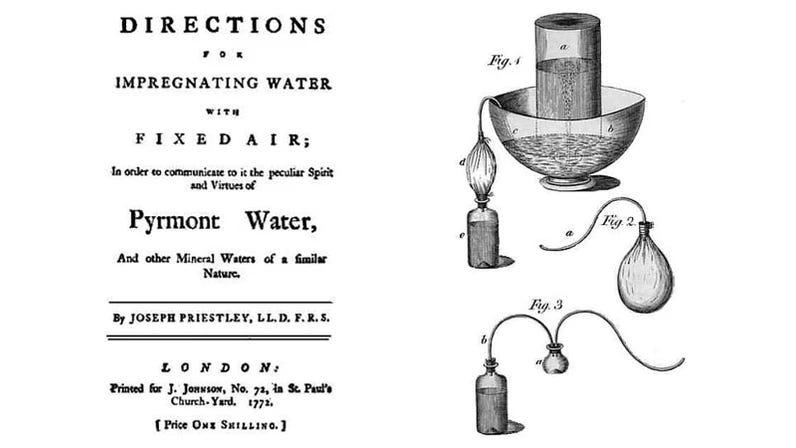
In 1772 (five years after his original discovery), Priestley wrote a much-admired paphlet about his carbonation process called ‘Directions for Impregnating Water with Fixed Air’.
A Swiss watchmaker named Johann Jacob Schweppe read it, improved on it, and founded a company in Geneva in 1783 to produce and sell carbonated water at scale. Schweppe moved his operation to London, where soda water became a fashionable drink among the English elite - eventually receiving a Royal Warrant as an official supplier to the British Royal Family.
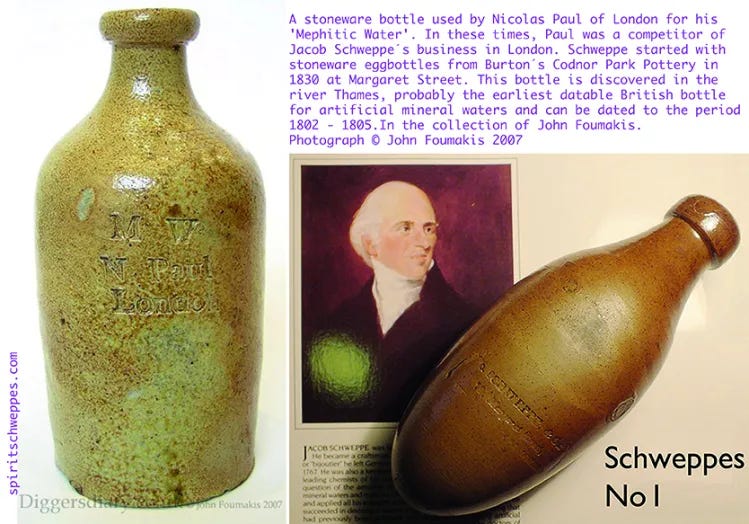
A stoneware bottle used by Nicolas Paul, Schweppe's London competitor, c.1802–1805. Schweppe himself began with stoneware before moving to glass. The bottle was found in the Thames.
The water from a brewery in Leeds had, in the space of two generations, become the drink of kings. But before it reached kings it reached sailors. Priestley was asked to accompany Captain Cook on his second Pacific voyage - only his religious views put the Admiral off at the last minute. The equipment went anyway. The crews of the Resolution and the Adventure became the first regular makers and drinkers of carbonated water in the world, somewhere in the Pacific Ocean, in the service of an empire that would eventually carry the fizz to India, Argentina, and everywhere else.
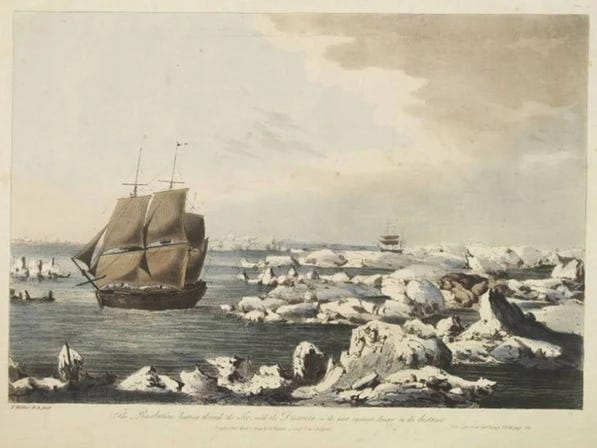
HMS Resolution in the ice, Cook's second Pacific voyage, 1772–75. The crews of the Resolution and the Adventure were the first regular drinkers of artificially carbonated water.
But before it democratized, it performed. The great spa towns of Europe - Baden-Baden, Karlovy Vary, Spa, Vichy, Wiesbaden - had been doing this work for centuries, bottling the idea that carbonated water was medicine, that the right spring could cure gout, restore digestion, repair what urban life had broken.
I was in Baden-Baden recently. The Romans called it Aquae - simply The Waters - which is about as direct as a civilization can be about what a place is for.

The Steinbrunnen fountain in Baden-Baden’s Lichtentaler Allee, built in 1871 from mineral deposits left by the city’s thermal waters. Across nineteenth-century Europe, spa towns and naturally sparkling mineral springs helped create the culture from which modern soda water eventually emerged.
These places moved from being the domain of elite aristocrats in the eighteenth century to being popular with the bourgeoisie in the nineteenth, aided by the coming of the railway. The railway democratized the spa just as Schweppe had democratized the spring: suddenly you didn’t need to be Goethe to take the waters. You just needed a train ticket.
The springs that drew Roman legions off the Rhine frontier in the first century are the same springs that drew Goethe, that drew the nineteenth century bourgeoisie off the newly built railways, that the spa physicians bottled and the pharmacists sold and the seltzerman delivered up the tenement stairs for two cents plain.
The need never changed. Only the price of admission did.
What happened next was the crucial move. Once artificial carbonation made the spa unnecessary - once the water could be manufactured in a factory and delivered to your door - the whole social apparatus that had surrounded it began to collapse, and the drink fell downward through the class system. Soda water spread to pharmacies across Europe and North America. The pharmacist replaced the spa physician. The siphon bottle replaced the pump room. And in the cities of Central and Eastern Europe - Warsaw, Odessa, Budapest, Vienna - a delivery infrastructure emerged, modest and practical, that brought carbonated water to the tenements and the market stalls and the kitchen tables of people who had never been to a spa and never would.
This was the seltzer that emigrated. Not the aristocratic version, not the medicinal version, not the mixer served in London drawing rooms alongside gin. The version that crossed the Atlantic in the 1880s was already a working-class drink, a street drink, a drink that belonged to the daily life of people who drank it because they were thirsty and it was there and it cost almost nothing. As Central and Eastern European immigrants poured into New York, they brought with them a taste for seltzer. For many, it wasn’t just a drink; it was a connection to home.
Eastern European Jews arriving in New York in the 1880s found a city with a water supply that was, in the tenements at least, scarce, polluted, or simply undrinkable. Seltzer, by then artificially produced and cheap, filled the gap. It became, in the formulation of food historian James Edward Malin, an ad hoc water infrastructure - the drink of people who had no reliable alternative. Jewish immigrants who had owned seltzer carts in Poland and Russia entered the soda manufacturing trade as early as the 1880s.
By the turn of the century, the entire Lower East Side was, in Harry Golden’s words, “addicted to seltzer.” Golden - the Jewish-American writer and humorist who chronicled immigrant Jewish life in America - later used the phrase Two Cents Plain as the title of one of his most famous books. The expression referred to the cheapest drink in the city: a plain glass of seltzer sold for two cents. But it eventually came to describe something larger - an entire immigrant way of life.
Once Jews assimilated and moved out of the tenements, they no longer needed seltzer for hydration. But by then it had become something else: identity. Memory. The Jewish dichotomy, as Malin puts it, of remembering historical strife whilst celebrating abundance. The Three Stooges, who grew up in a Jewish household, made the seltzer bottle a weapon of comedy. Mel Brooks still talks about it. Brooklyn Seltzer Boys, the last seltzer factory in New York, now runs a museum.
Brooklyn Seltzer Boys. The wooden crate, the door-to-door route, the granddaughter who gets a spritz alongside her milkshake. The seltzerman is still delivering. The tradition is still being passed down.
Ashkenazi food tends toward density. Schmaltz, chopped liver, pickled herring, fatty brisket, dense rye bread. It is the cuisine of cold climates and scarce resources, built for survival and flavored with necessity. Alfred Kazin called seltzer “the poor Jew’s dinner wine” - the beverage that accompanied the meal that accompanied the life.
When carbonated water meets the acids and rough surfaces of a loaded stomach, dissolved CO2 is released as gas. You belch. The pressure drops. The discomfort eases. CO2 does not significantly alter gastric acid. It does not cure anything. What it does is provide relief - transient, immediate, physical. It is nucleation physics - the same thing that happens when you drop a Mentos into a bottle of Diet Coke.
EepyBird's original Diet Coke and Mentos experiment, 2005. The same physics that makes this happen is what makes seltzer work in a loaded stomach.
Alka-Seltzer, invented in 1931, simply added aspirin and a chemical acid-neutralizer to the same effervescence - making it the pharmaceutical version of what the seltzerman was already delivering door to door for two cents plain. The fizz was always the medicine. The bottle was always the delivery system.
My father drank his Sipholux alongside his curry. He was not following a tradition. He was following a logic. A universal logic.
The bottle took longer to figure out.
The siphon arrived in 1829, patented by two Parisian jewelers, Deleuze and Dutillet, who devised a hollow corkscrew and valve that could dispense carbonated water under its own pressure without losing the fizz in the remaining liquid. Not just a container - a pressurized system, a small piece of controlled engineering that sat on a table and performed on demand.
The problem it solved was simple: carbonation escapes. Every closure system in the history of the soda bottle was an attempt to solve this problem more elegantly than the last.
The earliest soda bottles were stoppered with cork - unreliable, prone to leaking, allowing the carbonation to bleed away slowly. The bottles themselves were hand-blown, thick-walled, heavy - the aqua and green tints that make old bottles beautiful were not design choices but accidents of chemistry, the natural result of iron impurities in the glass. Colour was a byproduct of imperfection.
The colours your eye is drawn to in a collection of antique bottles are the colors of a technology that didn’t know how to make things transparent yet.
The closures evolved in rapid succession, each one a small piece of engineering genius followed quickly by its own obsolescence. Hiram Codd, a British engineer, patented a bottle with a marble sealed inside a pinched neck - the carbonation itself held the marble in place, creating an airtight seal you opened by pushing the marble down with your thumb. Elegant, simple, entirely self-sufficient. The Codd bottle still survives in Japan, where it is used for a children’s soda called Ramune, and in India, where street vendors sell a drink called Banta from the same design, unchanged.
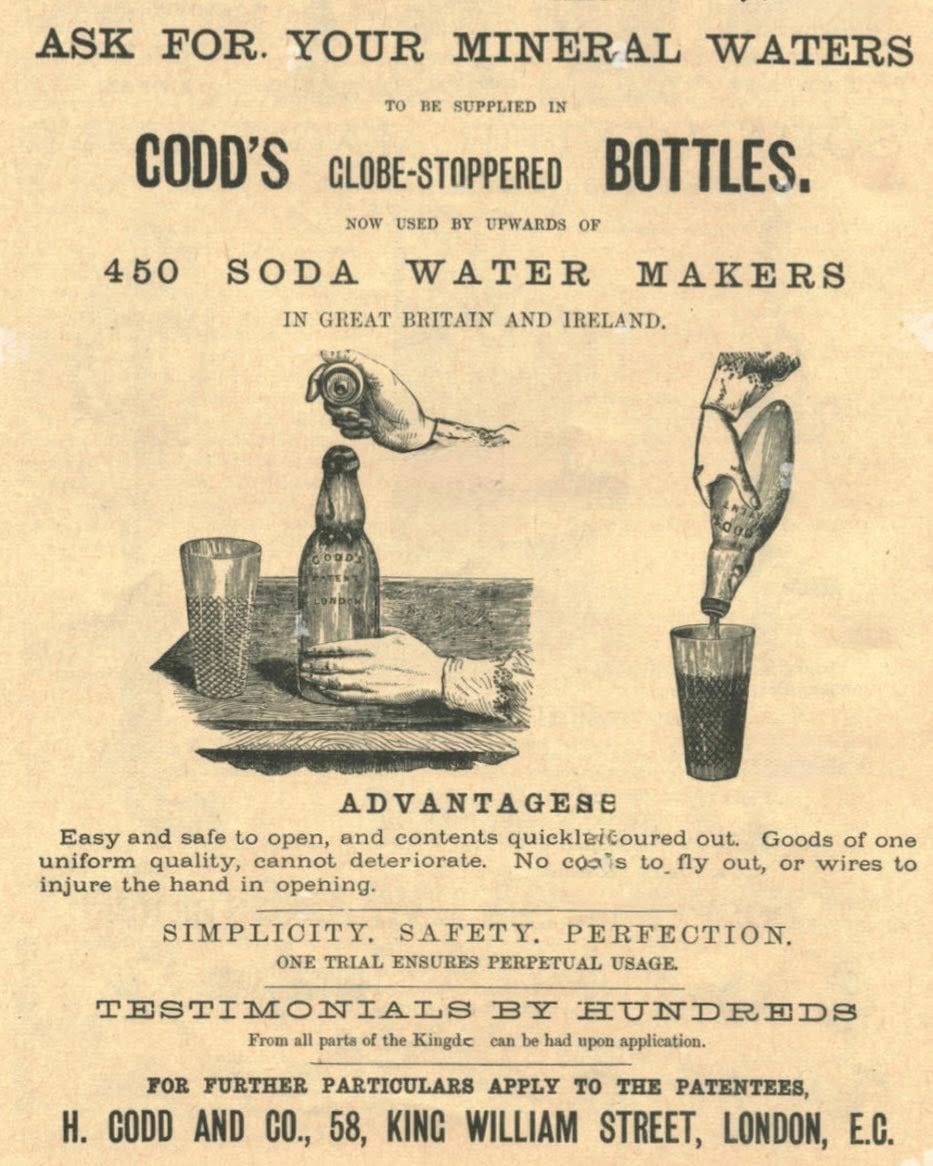
Hiram Codd’s globe-stoppered bottle, patented in 1872, used pressure itself to seal carbonation inside the bottle.
Charles Hutchinson’s spring stopper - a wire-and-rubber mechanism seated inside a bulging blob of glass - dominated American soda production until the crown cap arrived. Nearly all Hutchinson bottles were hand-tooled, which means they can be dated precisely: the blob finish, the mold seam stopping below the lip, the particular weight of the glass. They are the most American object in the soda bottle story - pragmatic, slightly inelegant, immediately recognizable.
In Germany and Central Europe, a different solution prevailed: the flip-top ceramic stopper, a porcelain plug on a hinged wire bail that allowed resealing - something neither the Hutchinson nor the Codd permitted. You still find it on Grolsch beer.
William Painter’s crown cap - a simple crimped metal disc pressed onto a standardized bottle mouth - was cheaper than everything that came before it, faster to apply, and impossible to reseal. By the 1920s it dominated Europe. The cork, the marble, the wire spring, the ceramic swing-top - all retired within a generation. The crown cap won because it was mass-producible, and mass production was what the twentieth century wanted.
The soda siphon watched all of this from the side and declined to participate.
The siphon bottle - heavy glass, internal dispensing tube, pressurized by an external CO2 charge - was not trying to solve the same problem as the crown cap. It was not a single-use container. It was a device. You charged it, you used it, you charged it again. The siphon was the bottle that refused to become disposable, and this refusal is what gave it its character and eventually its cult.
In the 1920s and 1930s - the same decades when the crown cap was consolidating its dominance - soda siphons were at the height of their popularity. The European bottles of this period are the most beautiful objects in the whole story: thick-walled glass in aqua, green, cobalt, and clear, often faceted to catch the light, wrapped in wire mesh that was both protective and decorative.
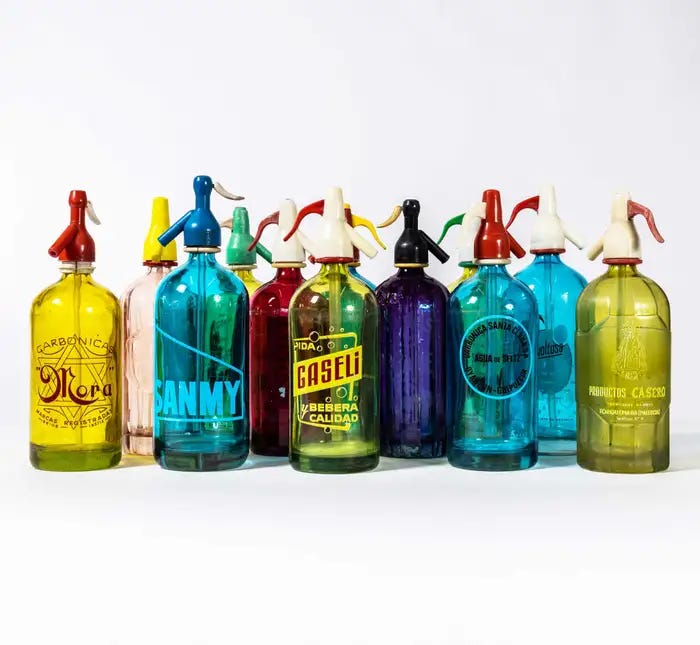
The mesh was functional - siphon bottles were under significant internal pressure, and a cracked bottle could be dangerous - but it was also beautiful in the way that industrial objects are beautiful when their form follows their engineering without apology.
The siphon heads - the metal mechanisms that controlled the dispensing lever, the valve, the tube - were made separately, in small precision workshops. Vienna was a centre of this manufacture. The Austrian company Heimo produced siphon heads and licensed their mechanism to manufacturers across Europe. ISI - Innovationsgeist Siphon Industries - was also Viennese, and is still operating today, which makes it one of the few surviving links to that pre-war manufacturing tradition. But many of the smaller workshops that supplied alongside them did not survive. The Jewish metalworking districts of Central and Eastern Europe - Vienna, Budapest, Prague, Warsaw - were centres of precision small-scale manufacturing: watchmakers, instrument makers, siphon head makers. When the Nazis came, those workshops closed. The families did not merely emigrate; in many cases they did not survive.
The Holocaust did not only kill people. It killed industries - and the contraction of the siphon trade in the years after 1945 is partly traceable to the destruction of the workshops that had supplied it.
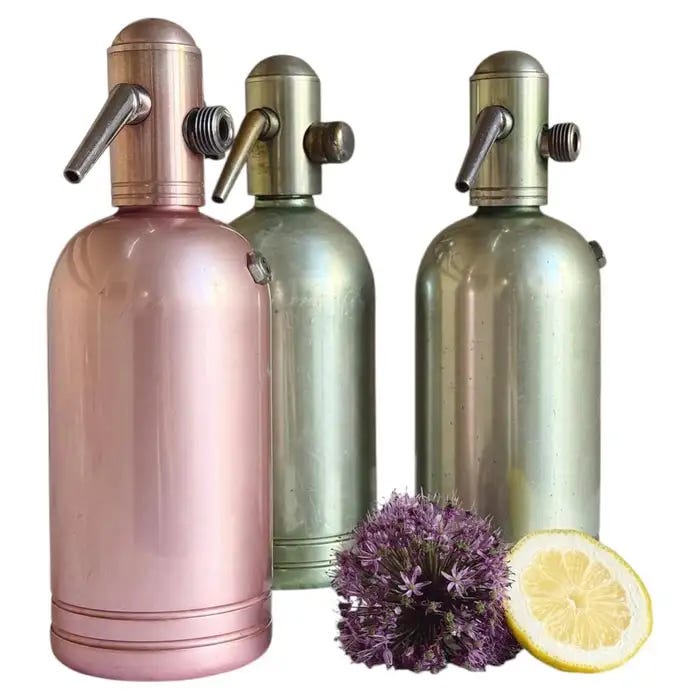
Italian siphons from the late reusable era: by the twentieth century, the soda siphon had evolved from industrial pressure vessel into a familiar object of domestic design.
The American soda siphon told a different story. The seltzerman’s bottle - made to be carried in wooden crates on horse-drawn wagons through Brooklyn and the Bronx, filled and refilled at the plant, delivered door to door - was a working object rather than a beautiful one.
Many siphon heads were stamped “Property Of,” because the bottle belonged not to the customer but to the circulation system itself - washed, refilled, and sent out again.
Cleaner lines, less ornamentation, stamped with the names of bottlers rather than craftsmen. The embossing on an American seltzer bottle reads like a business card: the company name, the city, sometimes a patent date. These bottles were not meant to be admired. They were meant to be filled, delivered, empties collected, refilled. The seltzerman’s route was a logistics operation, not a design statement.
Looking at the collection one last time - shelf after shelf of European siphon heads - I noticed the names stamped into the trigger mechanisms. Names I didn’t recognise. Names that appear in no current manufacturer’s catalogue. Some of them sounded Jewish. Names that stopped.
The Argentine bottles occupy a world between the European and the American. Brought to Buenos Aires and Rosario by the immigrant soda trade - much of it built by Eastern European Jews who carried their seltzer habit from Warsaw and Odessa — the Argentine siphon bottles developed their own distinctive character over the first half of the twentieth century. Heavy colored glass in deep red, emerald green, cobalt blue, occasionally amber or clear, often with a slight surface texture from the mold, each one carrying the name of its maker etched into the glass in Spanish: Soda Siffredi, Soda Lourdes, Soda Belgrano.
The colored glass was not accidental - by this period the technology for clear glass was well established. The Argentine bottlers chose colour deliberately, as identity. A red bottle meant one company, a green bottle another. The colour was the brand before branding existed as a discipline.
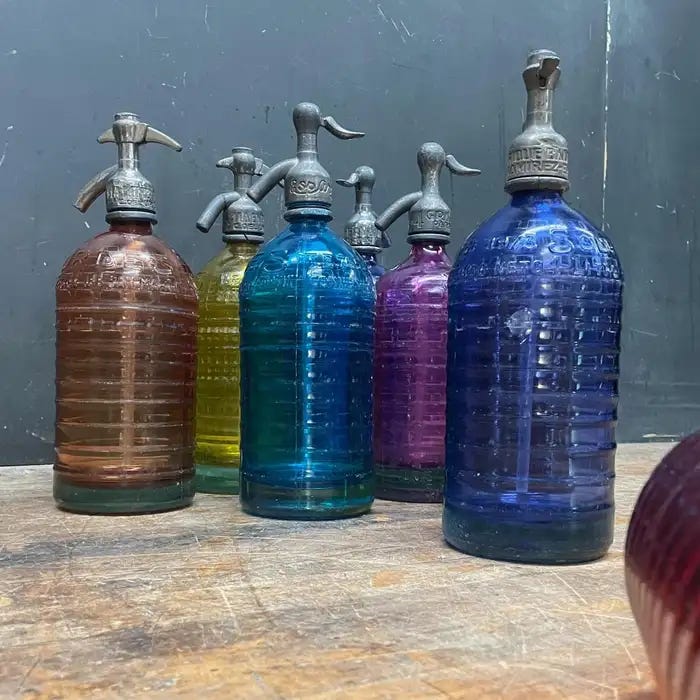
These bottles are now sold at the San Telmo market on Sunday mornings, wrapped in newspaper by vendors who know their customers will carry them home in their luggage to Hamburg and Stockholm and New York. They appear on 1stDibs for several hundred euros. They are displayed in design shops and restaurant interiors across Europe as artifacts of a street culture that feels simultaneously foreign and deeply familiar - the warm pavement, the pyramid of fruit, the bottle on the counter doing its quiet mechanical work.
The Israeli bottles were the same European tradition replanted in a new climate and stripped of ornament. The Sipholux - heavy glass and later metal body, functional plastic siphon head, charged with small CO2 capsules - was designed for the Israeli kitchen: for the heat, for the dust, for the daily requirement of a table where the food was serious and the equipment was expected to work without ceremony. It was not beautiful in the Argentine sense. It was honest in the way that tools are honest. You could identify it by its weight in your hand and the specific hiss of the CO2 capsule engaging. It was a working object that happened to have been designed by people who understood that working objects have their own dignity.
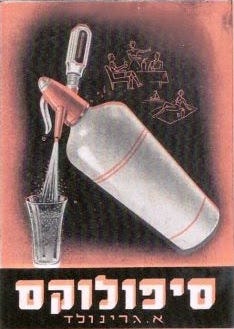
The early Israeli soda companies - Jafora, founded in 1933, and Tabori in 1936 - began with siphon bottles and fountain apparatus before transitioning in the 1950s to crown-capped glass following the international standard. By the 1970s Tabori was advertising plastic caps on glass bottles. The Sipholux existed in parallel with this industrialization, on kitchen tables rather than in commercial distribution - a domestic object, a family object, the thing your father had.
What the entire history of the soda bottle demonstrates, from Codd’s marble to the Sipholux’s CO2 capsule, is that the problem of carbonation was never really solved by any single design. It was negotiated, repeatedly, by different cultures with different priorities. The British wanted elegance and a marble. The Americans wanted speed and a crimped metal disc. The Germans wanted to reseal their bottle. The Argentines wanted colour and identity. The Israelis wanted something that worked on the kitchen table every evening without fuss.
Each solution produced a different object. Each object became, in time, a different kind of heirloom.
The SodaStream was not an Israeli invention, though Israel eventually claimed it. It was created in 1903 by a British gin manufacturer named Guy Hugh Gilbey, who wanted carbonated water for his guests. The first affordable home machine appeared in 1955. It passed through various owners - including Cadbury Schweppes - before being acquired in 1998 by an Israeli company called Soda-Club, founded by Peter Wiseburgh, who had been Israel’s exclusive SodaStream distributor since 1978. Under Israeli ownership the brand was relaunched globally, went public on the Nasdaq in 2010, and was sold to PepsiCo in 2018 for $3.2 billion.
It is the logical endpoint of the seltzer tradition and also its negation. The SodaStream does what the Sipholux did - carbonate water at home, on demand - but it does so without weight, without glass, without the small ceremony of screwing in a CO2 capsule and hearing the hiss. The bottle is plastic, glass is an exception. The machine is designed to disappear into the kitchen. Nothing is etched into the surface. No maker’s name, no town, no date.
The fizz is the same. The object is gone.
My former partner collected seltzer bottles for years. Whenever we saw one at a market or an antique fair, we bought it. Friends who wanted to give a birthday gift knew to look for a bottle. The collection grew shelf by shelf until it lived above the bookshelves - greens and blues and aquas catching the light, each one carrying its handmade metal top, each top a small piece of Viennese or Central European craft that had survived by accident while the people who made it had not.
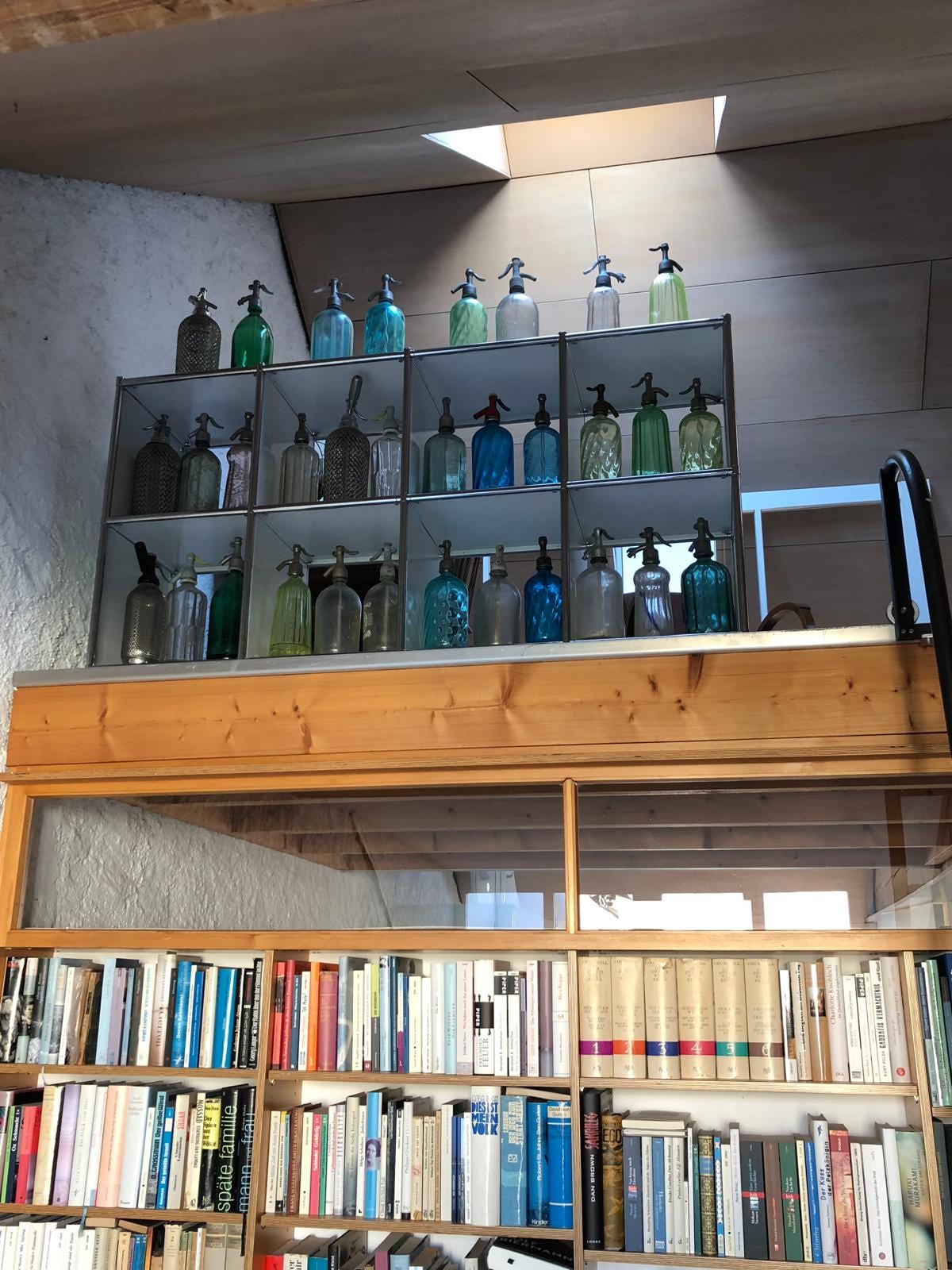
The collection. Notice the mesh-covered bottles.
I no longer have my dad’s Sipholux.
It was not beautiful in the Argentine sense. It was honest in the way that tools are honest.
The collection belongs to someone else now.
In Germany, non-carbonated water is called stilles Wasser - still water. Strongly carbonated water is sometimes jokingly described as laut - loud.
My father preferred it loud.
Old seltzer men used to say that good seltzer should hurt a little.
My father would have agreed.
If this essay resonated with you, I’m grateful you’ve read this far.
If you enjoyed this, you might also like my previous dispatch on When the Jerusalem Bagel came to Switzerland
Beyond Babylon continues to trace Jewish life and food across unexpected geographies.
You’re welcome to subscribe or share the piece with someone who might enjoy it.
Fascinating essay, Elli! Your paragraph about Eastern European Jewish immigrants in New York struck a chord with me. Here in Michigan, after the Flint water crisis in 2014, many people still feel uneasy about tap water. It’s fascinating—and sobering—how something as ordinary as drinking water can carry so much history, memory, and distrust across time.
Fabulous documentation