
My Sweet Luzeena
a diamond in the rough

By Elli Benaiah | Beyond Babylon
Pomelo Luzeena — a Southeast Asian reimagining
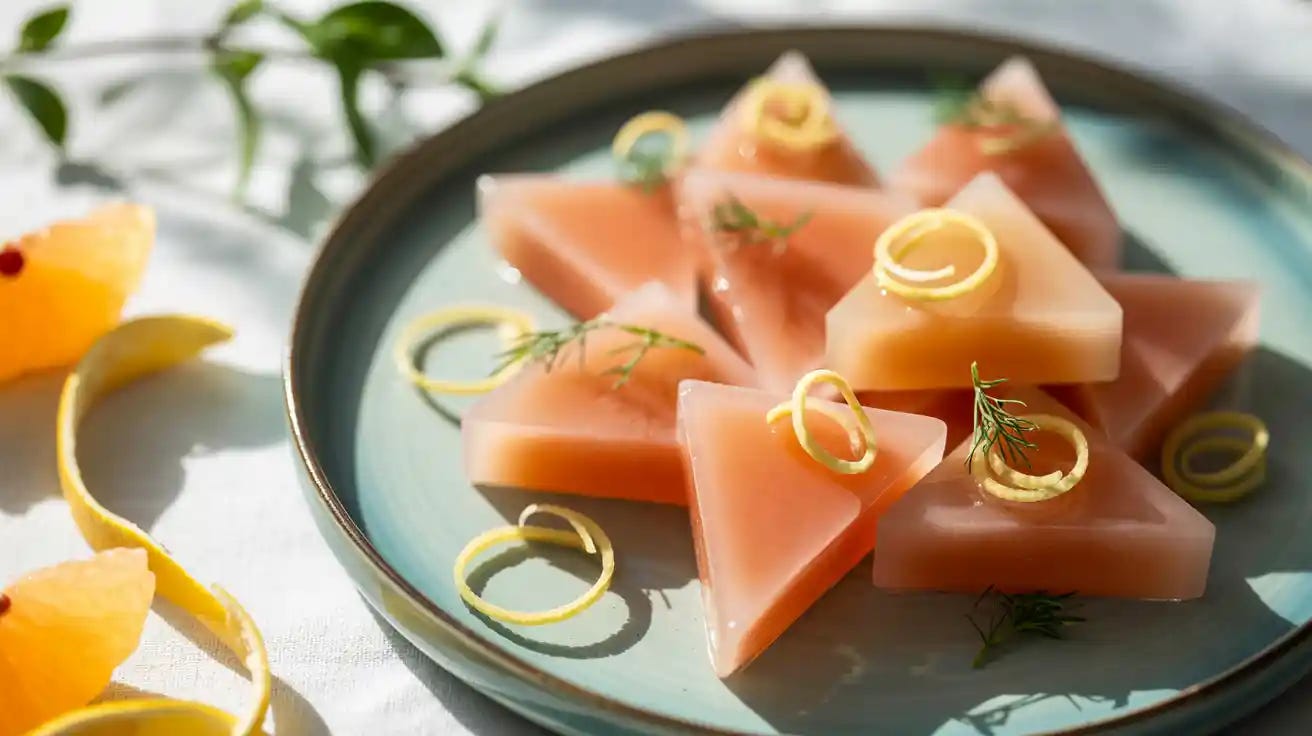
(here I use triangles to distinguish from the original diamonds)
It began, as these things sometimes do, with someone else’s memory.
On her Insta, Samantha Ellis, author of the wonderful memoir Chopping Onions on My Heart: On Losing and Preserving Culture — stirred quince into a glowing crimson paste while the Basie band played “Quince” in the background, the notes rising like the fruit’s transformation.
“Quince lowzina!” she wrote. “I love it even more than the orange version… this one didn’t make it into my book.
Samantha Ellis cooking up luzeena on her Instagram
The little video fascinated me. I’m always drawn to anyone who can tell me about the origins of a food I know only in its Indian incarnation.
Samantha’s cooking and food narrative always feels like a conversation with the past — a companion to the diasporic questions I’m asking in my own work.
Luzeena. The original.
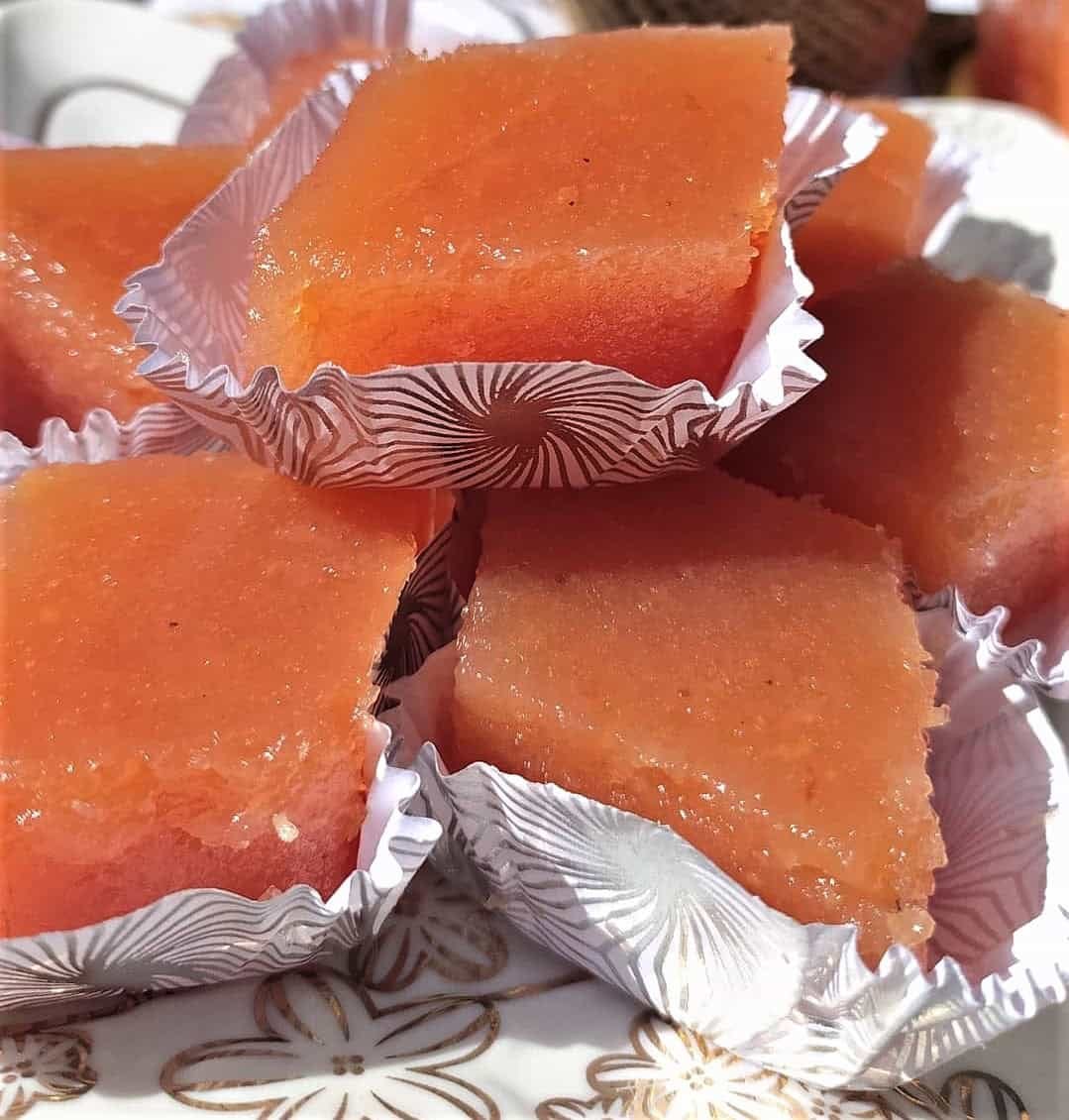
The difference is that Samantha’s family went directly from Baghdad to England, and her memories carry the flavour of that route — but they lack the layer I grew up with. Mine is the Baghdadi memory refracted through India: bent, stretched, sweetened, sometimes distorted.
So her quince paste felt like an invitation.
A rare chance to peel back the Indian layer and see what lay behind it.
I remembered something called luzeena — but not the quince version.
Quince I would have remembered.
In India, where my family had lived for generations, luzeena was… different.
And honestly, quite forgettable.
To me at least. The orange luzeena of Calcutta sat in the repertoire but rarely on the plate.
But Samantha’s ruby paste opened a door backwards — not into India, but into Baghdad, where the sweet was born.
And before Baghdad, into the much older world of quince.
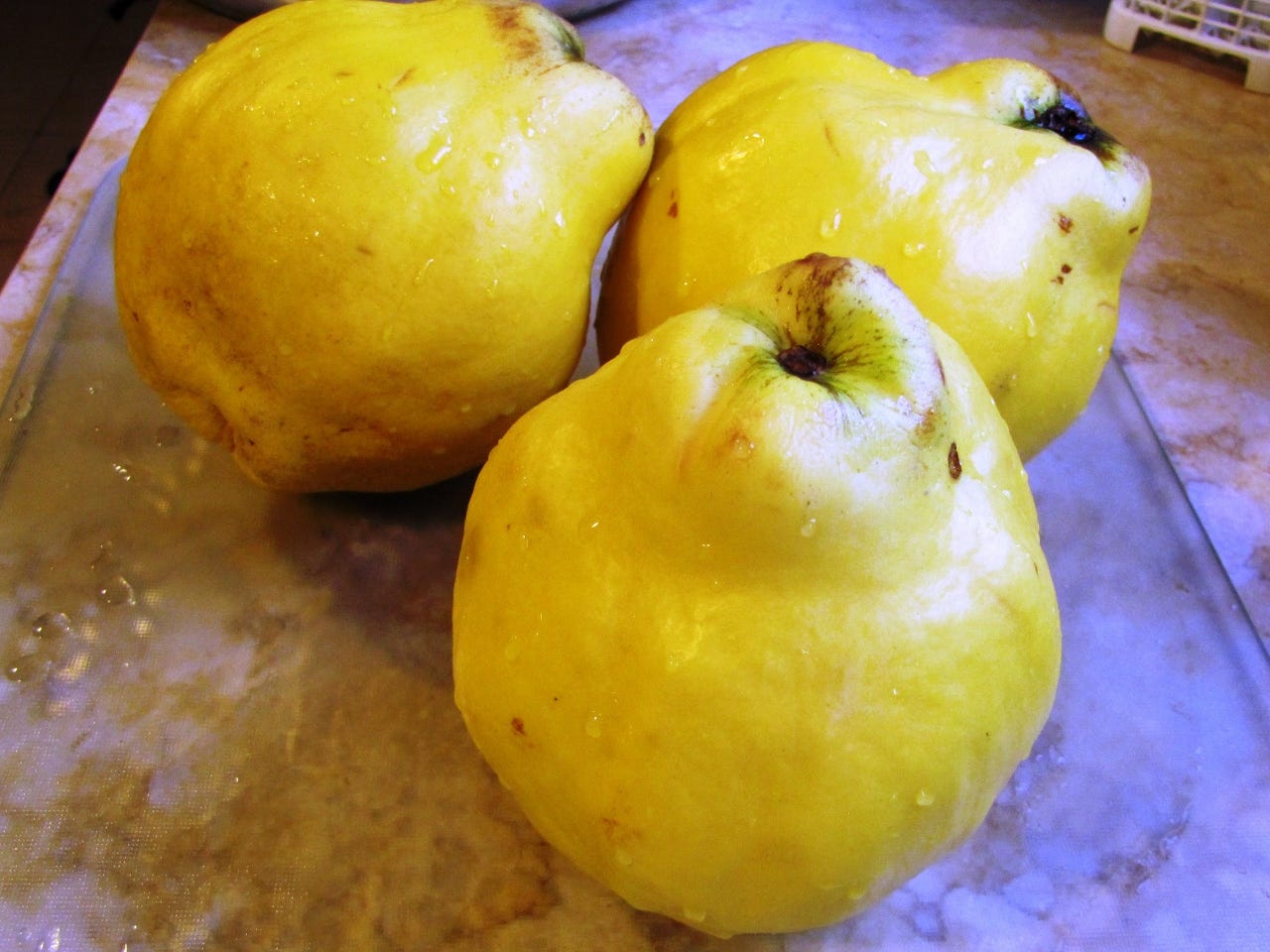
Fresh quince, the ancient fruit at the heart of Baghdad’s original luzeena — knobbly, fragrant, and stubbornly old-world.
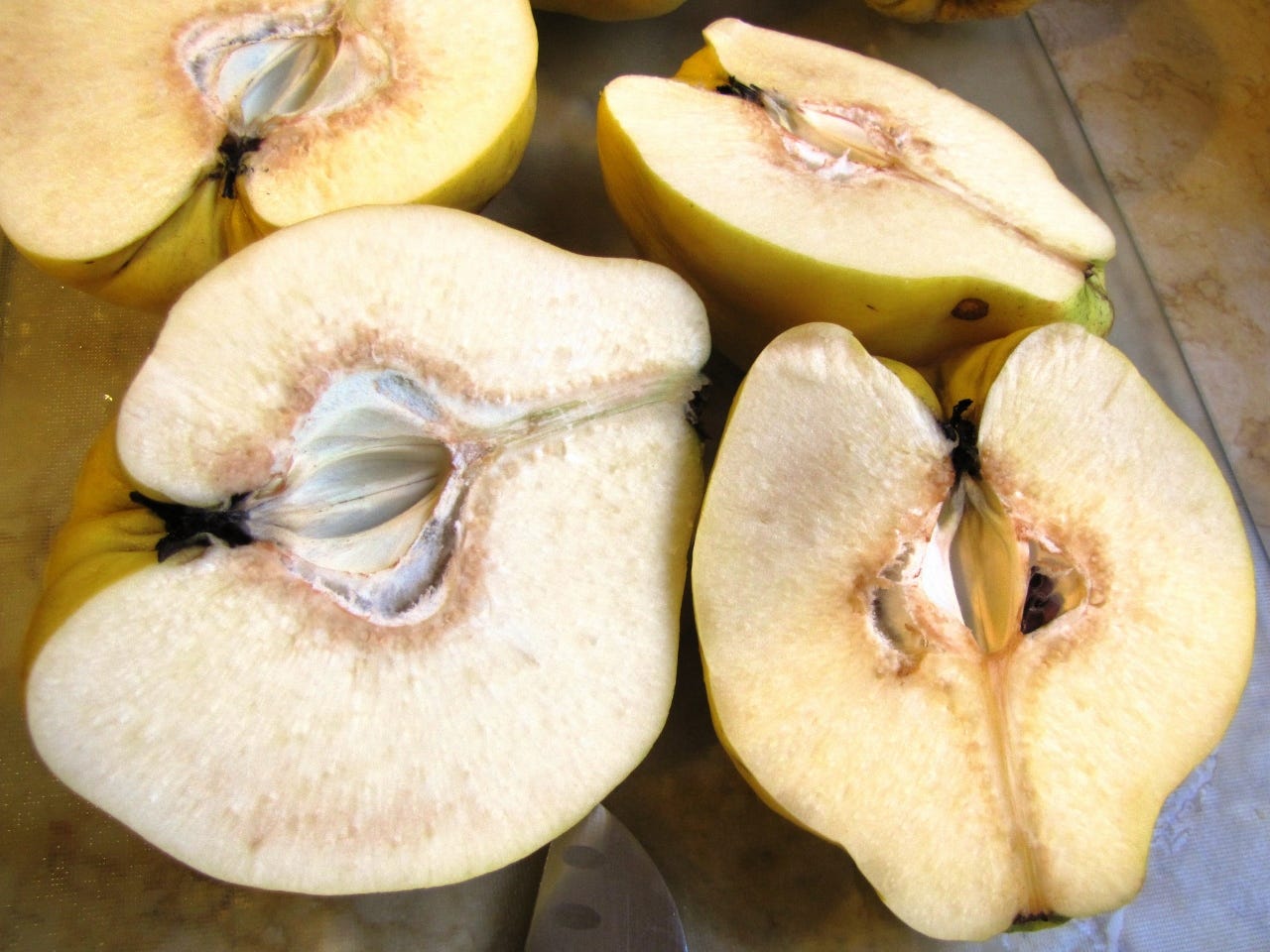
Raw quince reveals its pale, stony flesh. Inedible when fresh, it transforms into ruby sweetness — the alchemy behind quince luzeena.
Fresh quince — the ancient fruit behind Baghdad’s luzeena
Quince is one of humanity’s oldest fruits — ancient, wild, stubborn, fragrant.
It grew across the Caucasus, Persia, Anatolia, Mesopotamia.
It perfumed Greek weddings, Roman tables, Persian stews, Ottoman desserts.
Wherever quince travelled, it became a preserve — something to set, to slice, to store.
A linguistic trail pointing back to the eastern Mediterranean — the world that made Baghdad’s original luzeena possible.
Persian cooks used beh (quince) in khoresh-e beh, morabba-ye beh, beh polo.
Ottoman cooks adored ayva tatlısı and stuffed quince.
The ancient Greek kydonion became the Latin cydonia, which morphed into the French coing.
Across Europe, quince paste took on new names as it travelled westward: marmelada (Portugal), dulce de membrillo (Spain), pâte de coing (France), cotognata (Italy), birsalmasajt (Hungary).
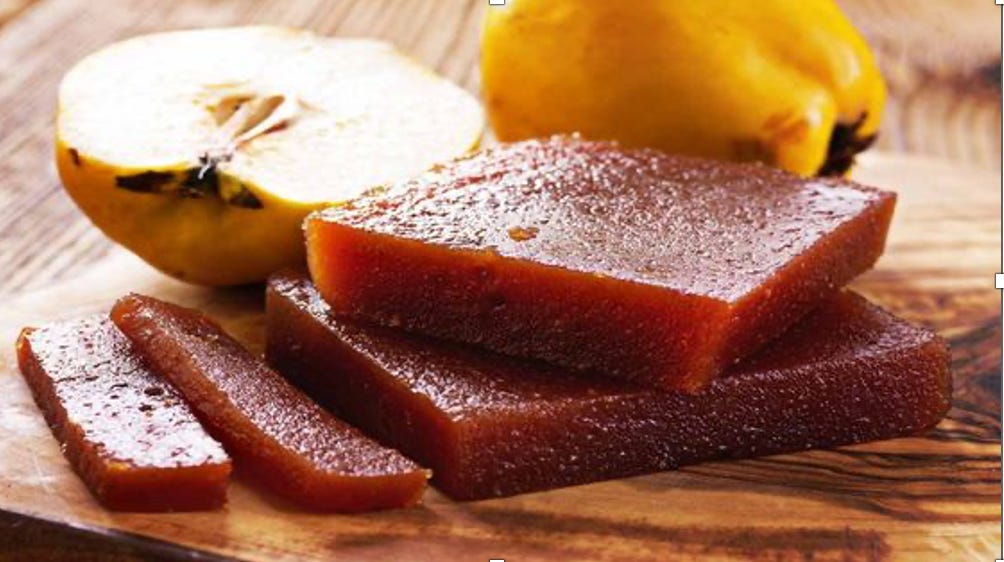
Italian Cotognato. (Credit lucianopignataro.it)
Portugal’s marmelada matters most, because England borrowed the word and turned it into marmalade, which was once quince jam.
Over time, as quince fell out of favour in the 19th century, English marmalade shifted from quince to Seville oranges — but the linguistic ancestry remained.
And then the story takes an unexpectedly British turn.
Orange marmalade — once Portuguese quince paste — became so quintessentially British that it ended up in the paws of Paddington Bear.
Paddington Bear’s beloved orange marmalade sandwich is a direct descendant of quince paste.
A culinary migration hiding in plain sight. (Credit: YouTube)
Luzeena travels east
Among Baghdadi Jews, luzeena (lowzina / luzeena / luzina / loozina) was a festive sweet: quince or orange boiled into ruby paste, flavoured with cardamom or rose water, poured, set, cut into diamonds, and served at weddings and Purim.
Then came migration.
Baghdadi Jews moved east — to Bombay, Calcutta, Rangoon, Singapore.
They carried their recipes… but the fruit itself did not follow.
And this fruit — abundant across the Near East — stumbled when it reached India.
It survived in Mughal Kashmir and the Himalayan belt — Persian quince culture carried south — but it never reached the coastal markets of Bombay or Calcutta.
So Baghdadi luzeena had to adapt.
A quiet sense of loss — as if we were waiting for a fruit that never reached our shores.
As Mavis Hyman notes (Jewish Indian Cooking):
“Orange Loozena was part of the repertoire of Baghdadi cooking… This was not continued in India as oranges grown in the Middle East were not available there.”
Indian “orange” was really santra — a fragrant tangerine.
Delicious, but structurally unreliable for sweets.
So in India, quince luzeena disappeared.
Orange luzeena struggled.
New forms emerged — closer to Indian sweets: coconut-cardamom fudge.
Indian in flavour, Baghdadi in method.
With quince absent and citrus unpredictable, luzeena expanded into pistachio, pumpkin, coconut, mixed-fruit versions.
And truthfully, had my ancestors consulted me, luzeena would have taken yet another shape — perhaps a Singaporean calamansi–pandan version, or even pomelo, fruits carrying the scent of Southeast Asia in every drop.
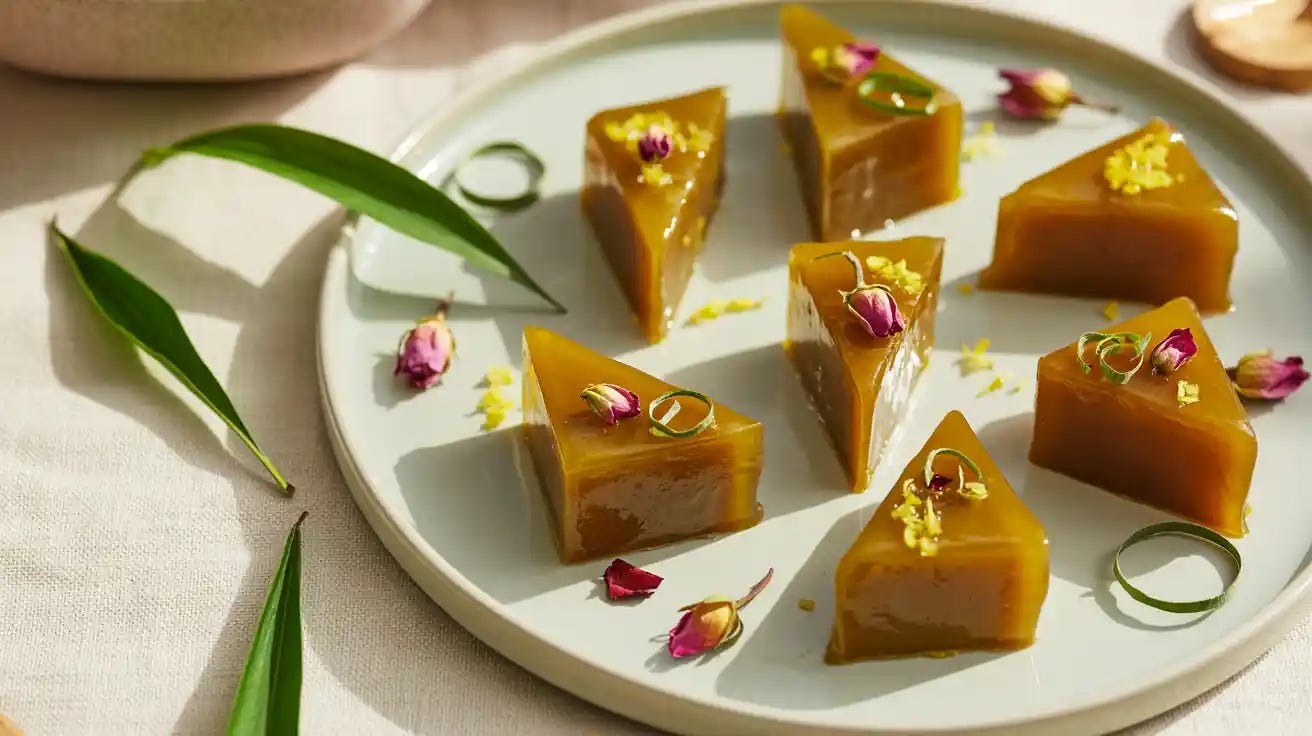
Calamansi–Pandan Luzeena, scattered with rose petals
Mavis Hyman (Jewish Indian Cooking) gives us pumpkin luzeena.
Copeland Marks (The Varied Kitchens of India) gives us Indian spice logic.
Together, they form a recipe that feels like diaspora:
recognisable, adaptive, alive.
⭐ Pumpkin Luzeena (Mavis + Copeland Marks Fusion)

Pumpkin luzeena - A diaspora recipe in motion
⭐ Pumpkin Luzeena
(Mavis + Copeland Marks Fusion)
Pumpkin luzeena — a diaspora recipe in motion
Yield: 12–16 diamonds
Ingredients
500 g pumpkin, grated
1 cup sugar
½ cup water
¼ tsp cardamom
1 tsp ghee or neutral oil
pinch saffron
1 tbsp rosewater
chopped pistachios
Method
Cook the pumpkin with the sugar and water until soft and glossy.
Add cardamom, saffron, and ghee. Cook down until thick and pulling away from the pot.
Stir in rosewater.
Spread into a greased tray and cool completely.
Cut into diamonds, garnish with pistachios.
These little Baghdadi sweets really do “shine bright like a diamond.”
Diaspora sugarwork, centuries old, still glinting under today’s kitchen light.
A Baghdadi technique.
An Indian ingredient.
A Jewish story.
👉 Get your recipe card here
The Sweet That Survived Us
Luzeena isn’t a recipe — it’s a pattern.
A method our people carried from Babylon to Bengal, reshaping it each time geography reshaped the fruit.
It survived because we survived.
And we survived because we kept making it — even in places where quince and Middle Eastern oranges were nowhere to be found.
A diamond-shaped metaphor for everything we brought with us —
and everything we had to invent simply to adapt and go on.
✨ All posts are free; paid subscriptions are optional, and your support is deeply appreciated.
💬 Share your story in the comments, or pass this essay along.
📖 To support more work uncovering Jewish food in unexpected corners of the world, consider subscribing to Beyond Babylon
My Dad used to rave about many of his childhood Calcutta Jewish foods when we were growing up in London, and though he never cooked more than a Spanish omelet or a Welsh Rarebit, one day he decided to have a go at making Quince Luzeena after waxing lyrical about it and realising that Mum was not going to try it. It was a disaster that left Mum with a pile of washing up, and us with the funny, foreign-sounding word "Luzeena" firmly embedded in our - well you might say "culinary consciences!" Thanks for the interesting tour de force! Some shops in Jerusalem have broad flat cans of "dulce de membrillo," which is presumably very close, and I suppose could be sprinkled with cardamom and flaked or ground almonds at a pinch...
This was a very interesting read. I can only remember having quince once, and many years ago.