
Morwarchi
The Porous Jewish Kitchens of the Indian Ocean

I think I finally began to understand the real shape of this project through a single chicken dish - and through a single sentence that nobody had bothered to explain.
I had been leafing through Mavis Hyman’s Indian-Jewish Cooking, long considered one of the foundational texts of the Baghdadi Jewish kitchen of Calcutta. Beneath a recipe for a dish called Morwarchi - a fiery tomato-and-chili chicken braise - Hyman had written one word of attribution: Cochin.
And then moved on.
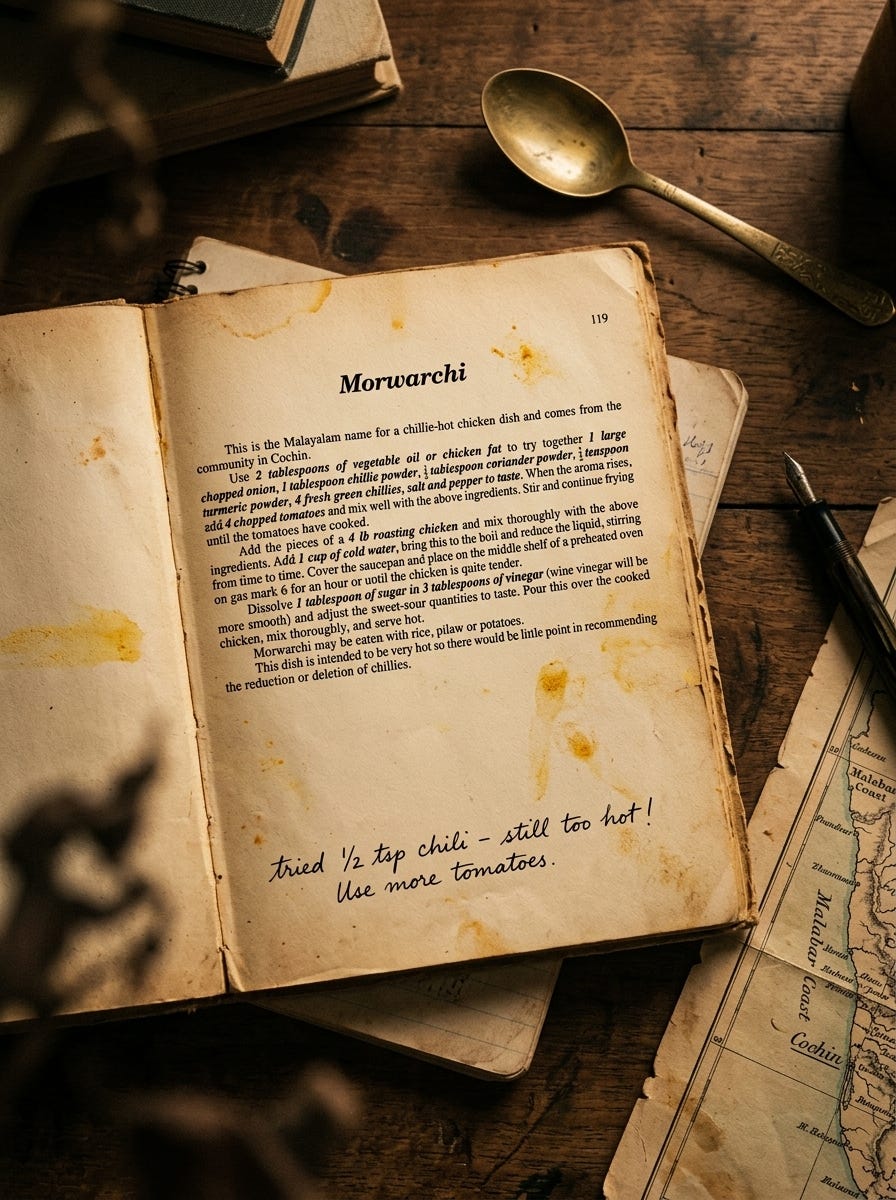
A single unexplained line in Mavis Hyman’s Indian-Jewish Cooking: “comes from the community in Cochin.” The dish travelled on. The explanation did not.
No explanation of how the dish had travelled four hundred miles from the kitchens of Kerala to the Baghdadi homes of Calcutta. No account of what had happened to it along the way. Just the attribution, sitting there quietly, as though it required none.
That small unresolved detail became the beginning of a much larger investigation.
I started asking questions.
Through conversations with Ilanit Menachem, who documents Malabari Cochini Jewish food traditions, and later through exchanges with Thoufeek Zakriyah, the Muslim chef who researches and cooks dishes connected to Cochin’s Jewish past, I began uncovering other versions of the same dish - versions that felt older, closer to something original.
Then a typed Paradesi community recipe surfaced.
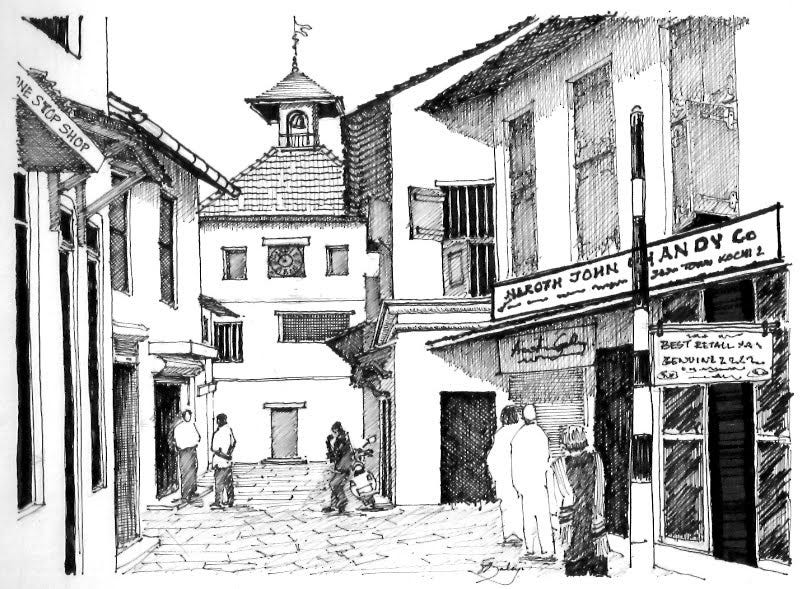
Jew Town, Mattancherry, Cochin, India.
The narrow lane beside the Paradesi Synagogue, where spice merchants, Jewish traders, Malayalam-speaking neighbours, and Arabic-speaking Baghdadis once moved through the same humid air. Even the clocktower seems suspended between worlds: Kerala beneath it, Babylon behind it, and the Indian Ocean just beyond the street.
Suddenly there was not one Morwarchi, but several.
What fascinated me was that all the versions clearly belonged to the same family, sharing essentially the same name, while each one reflected in a different way the nature of the community that had carried it. Yes, the recipes were evidently related, but not identical. And the differences, once seen, became impossible to ignore.
Ilanit’s Malabari version felt deeply rooted in Kerala village life - and her memories explain why.
For her, Friday mornings before Shabbat began with appam, the lacy fermented rice pancakes of Kerala, slowly baking in a ‘miracle pot’ while the red chicken simmered beside it, children tearing pieces of bread directly into the sauce before dinner had even begun.
Today few people even remember the ‘miracle pot,’ the stovetop baking vessel once used before modern ovens became common.
Chicken itself was largely reserved for weekends, because kosher slaughter in Cochin was only periodically available in the villages. Morwarchi for Ilanit was associated with Shabbat, because it was the one time during the week where meat was available.
Even the older name carried this weight. Mullvo Erchi - literally “bones meat” in the local Malayalam - reflects a practical domestic kitchen built around cheaper cuts, long simmering, and flavour extracted from bone rather than abundance. Tamarind, curry leaves, tomatoes, potatoes. A dish inseparable from the ecology and the calendar of village Jewish life.
Thoufeek’s Paradesi version - preserved in a yellowing typewritten recipe handed down to him by older women he grew up with in Mattanchery - already felt different. More urban. More mercantile. More hybridized. English culinary vocabulary had entered. Capsicum appeared. Ginger-garlic paste became standardized. The dish felt shaped by the cosmopolitan trading world of Cochin’s Paradesi Jews, who moved simultaneously through Arabic, Indian, colonial, and Jewish spheres.
And then finally the Hyman’s Calcutta version that started this story: codified, literary, already functioning as diaspora memory. By the time the dish reached the Baghdadi kitchens of Calcutta, it no longer belonged entirely to Kerala - yet it remained recognizably Morwarchi. The structure survived. The heat survived. The broad emotional architecture of the dish survived.
But something else had quietly shifted.
The capsicum had vanished.
In the Paradesi version, its presence makes sense: capsicum was already becoming associated with colonial port-city cooking, with club cuisine and railway refreshment rooms, with a cosmopolitan Cochini kitchen moving through mercantile and Anglo-Indian worlds simultaneously. Its appearance signals a particular moment in the dish’s migration.
Its disappearance in the Calcutta version is equally revealing. It raises the possibility that Morwarchi entered Baghdadi kitchens not through elite Paradesi transmission alone, but through older Malabari domestic cooking networks - networks less shaped by Anglo-Indian urban taste, closer to the village kitchen where the dish had begun.
Absence (of capsicum), in other words, can be evidence of origin.
The disappearance of the capsicum is a telltale sign, but the smoking gun of this forensic trail is found at the very end of the cooking process: the sudden, calculated addition of wine vinegar and sugar to a heavy Indian onion-and-chili paste.
To a conventional food writer, this is dismissed as a superficial ‘Anglo-Indian flourish.’ But through the lens of a comparative history, it is something much older and deeper. It is the activation of the hamedh-helu—the ancient Mesopotamian sweet-sour grammar inherited from Abbasid and Persian traditions.
When the Baghdadi Jews arrived in the tropical heat of India, they didn’t just cook local curries. They used local ingredients to refit their original structural engine. By dumping an acid-sugar correction into a searing Kerala reduction, they were manually replicating the lost, tart-sweet balance of the Tigris.
My grandmother, Granny Ruby, would look at a table loaded with these adapted dishes and offer a single Judeo-Arabic blessing: Awafi.
To anyone else, it’s a casual phrase for ‘bon appetit.’ But Awafi literally translates to ‘abundant healths’ - a plural invocation of physical resilience. It was the verbal reflex of a diaspora that knew their survival depended entirely on their ability to feed their ancient structures to a new soil.
I have decided to weaponize that word. From this dispatch forward, the technical scripts at the base of my essays will be anchored as The Awafi Archive. We are tracking the why behind the what, ensuring the underlying grammar outlives the modern maps trying to contain it.
One of the most revealing moments in the entire trail appears not in any of the community recipes, but in a footnote buried inside Claudia Roden’s The Book of Jewish Food, a foundational classic of global Jewish cuisine.
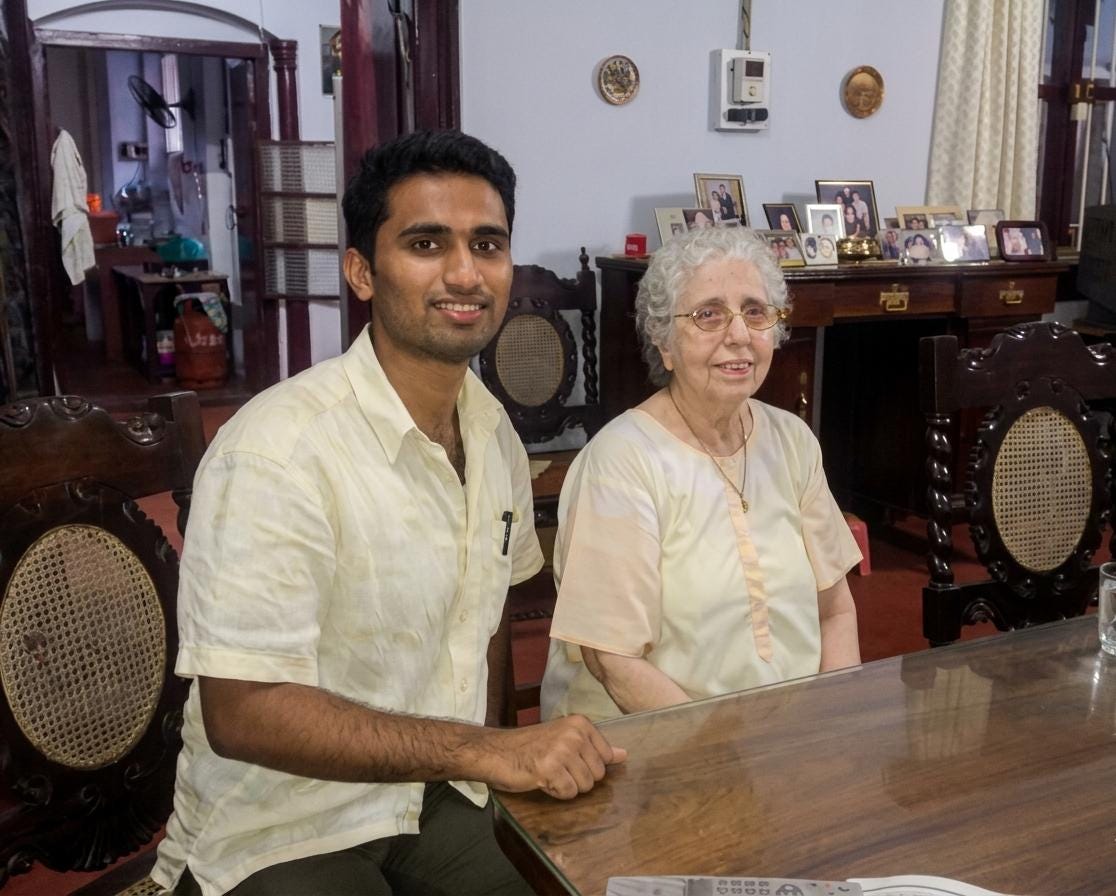
Chef Thoufeek Zakriyah beside Queenie Hallegua in Cochin - where recipes survived not only through books, but through the people who continued cooking them.
Roden publishes a Cochin recipe (p. 313) for Capsicum Chicken attributed to Queenie Hallegua, a member of the Paradesi Jewish mercantile community.
Structurally the dish still resembles a slow braise: chicken simmered in a thick onion sauce, sharpened with sourness, reduced until the oil rises. But the sensory world has already shifted decisively toward Kerala. Curry leaves crackle in oil. Tamarind replaces the sharper lemon logic of Iraq. Turmeric stains the sauce gold.
Then comes the footnote.
Queenie Hallegua’s original quantities called for five to eight fresh green chilies and a full tablespoon of chili powder. Roden admits she reduced them because the dish was, in her words, much too hot for her.
That small admission quietly exposes several centuries of culinary migration.
A kitchen comfortable with that level of chili heat is already deeply acclimatized to Kerala’s spice ecology. Chili tolerance is not merely a preference. It is historical evidence - a record of how long a community has lived inside a particular climate, absorbed its ingredients, calibrated its palate to its heat.
And yet the recipe arrives through a Paradesi household: one of Cochin’s English-speaking communities, the ones who produced most of the written documentation later accessible to authors like Roden. Which raises a deeper question.
Whose kitchen is actually preserved inside the dish?
Roden`s Cochini recipe arrives through a Paradesi family while carrying techniques, tolerances, and flavour structures that emerged from far wider layers of Malabar society. The dish is not merely a recipe. It is a compressed archive of port-city exchange.
From the outside, writers often described the Jews of Cochin as a single community. But the Paradesi and Malabari Jews frequently experienced themselves as socially distinct worlds, with different histories, hierarchies, and degrees of integration into colonial society.
In The Book of Jewish Food (p. 365), in a section entitled The Three Jewish Communities of India, Claudia Roden identifies the Baghdadi Jews, the Cochin Jews, and the Bene Israel. But even the category “Cochin Jews” conceals important internal distinctions.
Roden explains that Cochini Jews - particularly cooks and domestic workers escaping difficult social conditions in Kerala - came to work inside the homes of the Baghdadi Jews of Bombay and Calcutta. Alongside Muslim cooks, Hindu cooks, and later refugees from Rangoon, they helped shape what Roden describes as a hybrid Baghdadi cuisine marrying Middle Eastern, Bengali, Maharashtrian, and Cochini styles.
And almost in passing, Roden provides the missing bridge - the explanation Hyman never gave for why a Cochini dish would appear so naturally inside a Baghdadi kitchen.
Suddenly Morwarchi no longer looked mysterious in Hyman’s book.
The dish had not travelled abstractly between communities, through recipes passed in synagogue whispers or preserved in cookbooks. It had travelled through actual kitchens, carried by the people cooking inside them.
The transmission did not happen through recipes.
It happened through labour.
Once seen through that lens, even the name begins to behave like a map.
Thoufeek explained to me that the original Malayalam name was almost certainly Mulagirachi: mulag meaning chili, irachi meaning meat. Somewhere between Kerala, Cochin, Calcutta, English transcription, and Baghdadi pronunciation, that name appears to have slowly bent and softened into Morwarchi.
The dish was migrating not only through kitchens, but through language itself.
What emerges from comparing the three versions is not simply culinary variation, but three intertwined systems of transmission.
The Malabari version preserves the rhythms of Kerala village life and Shabbat preparation - bones, tamarind, appam, the travelling kosher slaughterer. The Paradesi version reflects the cosmopolitan mercantile world of Cochin’s trading communities - capsicum, typed English instructions, ginger-garlic paste. Hyman’s Calcutta version already reads like diaspora memory refracted through Anglo-Indian urban life.
What remained constant is equally revealing: the hot-sour logic, the tomato, the tamarind, the chili heat, the broad emotional structure. These were not negotiable. They were the memory the dish refused to surrender, even as everything around them changed.
Most writers before had approached these kitchens separately. One preserved Baghdadi recipes. Another documented Cochini memory. Even Roden, who collated hundreds of Jewish recipes worldwide, kept the communities in their own chapters, the recipes categorized by origin, as though the culinary boundaries had remained intact.
The communities themselves often remained formally separate - praying separately, marrying separately, maintaining different hierarchies and moving through different social worlds. Yet the kitchens continuously leaked into one another, through cooks, servants, markets, trade routes, ingredients, and daily repetition.
The Jewish culinary world in Asia was simultaneously segregated and porous.
That, finally, is what Morwarchi reveals - not as an isolated Cochini recipe sitting oddly in a Baghdadi cookbook, but as evidence of a much larger system. Parallel diasporas, carrying older structures forward while absorbing the climates, ingredients, and rhythms of the worlds around them.
Each migration rewrote the dish in the image of the community that carried it.
Recipe 1: Ilanit’s Malabari “Red Chicken”
This version from Chipappam feels agricultural, village-based, domestic, oral, Shabbat-centered, tied to scarcity and rhythm. Bones matter. Appam matters. The travelling kosher slaughterer matters. The recipe lives inside memory and repetition rather than formal codification. Tamarind, curry leaves, and slow cooking tie it deeply to Kerala ecology.
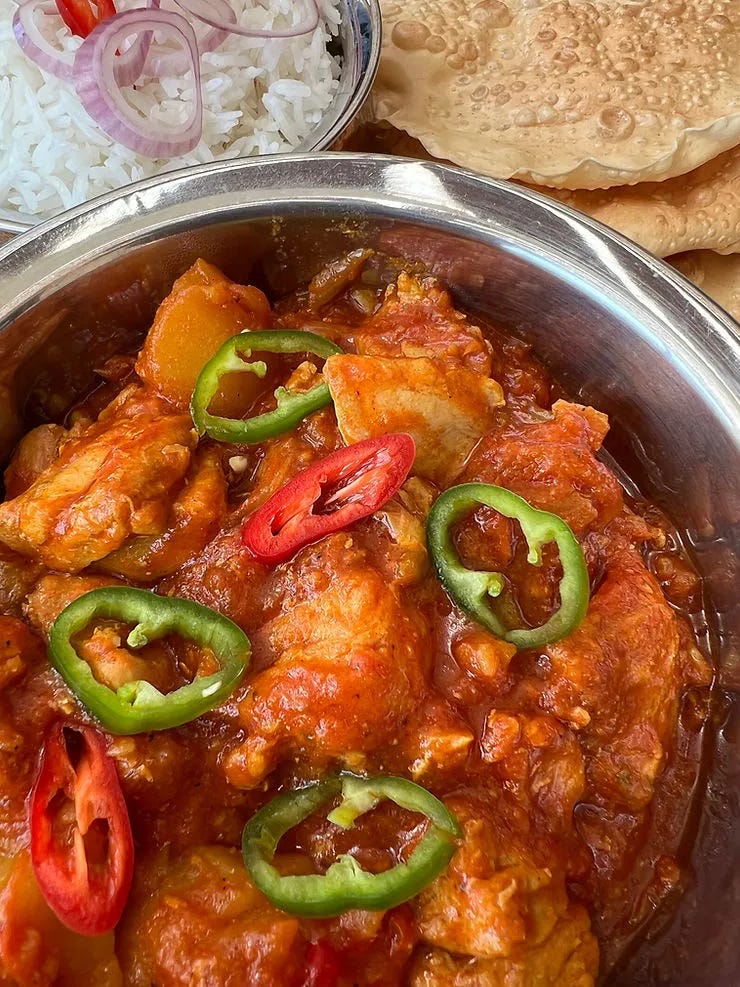
It is important to cut the chicken into small pieces so that each part absorbs the flavours. You can make the red chicken not only from parts with bones—pullets or any cut will work. But bones give the dish its special aroma and depth.
Ilanit’s tip: Mix all ingredients in a pan, cover with baking paper and foil, and bake at 200°C for an hour and a half. Uncover and bake for another half hour, stirring occasionally.
Ingredients
1 whole chicken, cut into small pieces
2 onions, sliced
4 cloves garlic, sliced
1 green chilli, cut into strips
5–6 tomatoes, finely chopped
2 tablespoons tomato paste
1 heaping tablespoon tamarind (optional)
3 potatoes, cubed
5–6 tablespoons sunflower or frying oil
1 tablespoon vinegar (optional)
½ teaspoon black pepper
½ teaspoon hot paprika
½ teaspoon ginger
½ teaspoon turmeric
1 teaspoon ground coriander (preferably from toasted seeds, ground fresh)
Salt to taste
Method
Heat the oil in a wide pot. Add the onion and fry until lightly golden.
Add the garlic and fry lightly.
Add the chicken pieces and cook on low heat until the chicken turns white.
Add the chillie and vinegar; mix well.
Add the tomatoes and tamarind. Bring to a boil, then lower the heat.
Add the potatoes.
Add all the spices and tomato paste. Cook on low heat for 45 minutes to an hour.
The potatoes can be fried first, then added to the stew - tastier, but optional.
👉 Get your PDF printabke recipe for red chicken here
Recipe 2: Mavis Hyman’s Morwarchi
From Indian-Jewish Cooking by Mavis Hyman
🏺 The Awafi Archive: Operational Kitchen Scripts
A recipe tells you the what. It doesn’t tell you the why. Below is the technical data needed to execute the structural memory of the dish.
The Hyman/Calcutta Baghdadi baseline: “This is the Malayalam name for a chillie-hot chicken dish and comes from the community in Cochin.” By the time the dish entered Mavis Hyman’s Calcutta repertoire, the older Malabari–Paradesi distinctions had largely collapsed into a broader, singular Cochini inheritance.
By the time the dish entered Mavis Hyman’s Calcutta repertoire, the older Malabari–Paradesi distinctions had largely collapsed into a broader Cochini inheritance.
Ingredients
2 tablespoons vegetable oil or chicken fat
1 large onion, chopped
1 tablespoon chillie powder
1 tablespoon coriander powder
½ teaspoon turmeric powder
4 fresh green chillies
Salt and pepper to taste
4 chopped tomatoes
1 chicken (about 4 lb / 1.8 kg), cut into pieces
1 cup cold water
1 tablespoon sugar
3 tablespoons vinegar (wine vinegar preferred)
Method
The Foundation: Heat the oil or chicken fat in a heavy saucepan. Fry the chopped onion, chillie powder, coriander powder, turmeric powder, and fresh green chillies together with the salt and pepper.
The Reduction: When the spice aroma rises, add the chopped tomatoes. Continue frying over medium heat until the tomatoes have completely broken down into a thick paste.
The Sear: Add the chicken pieces and mix thoroughly, ensuring the meat is completely coated with the spice foundation.
The Oven Retrofit: Pour in the cold water and bring to a boil. Cover the saucepan tightly and transfer it to the middle shelf of a preheated oven at 200°C (Gas Mark 6) for approximately 1 hour, or until the chicken is tender.
The Sweet-Sour Correction: Dissolve the sugar in the vinegar, adjusting the ratio to hit a precise hamedh-helu balance. Pour this solution directly over the cooked chicken, mix thoroughly, and serve hot.
🔍 Forensic System Notes:
The Heat Parameter: This dish is structurally intended to be very hot. There is little historical point in reducing the chilies; the dual use of dried powder and raw green chilies provides the primary aromatic engine.
The Oven Hinge: The transfer from stovetop to oven is unusual for ancestral Indian village cooking, signaling a practical, mid-century adaptation to British-Indian urban kitchen infrastructures.
The Acid Shift: The final vinegar-and-sugar addition acts as a mechanical layer. It cuts through the sulfurous heat of the chilies while preserving the old Mesopotamian memory of an acid-sweet finish.
This dish would pair beautifully with basmati rice to temper the heat, or as suggested, with a fragrant pilaf that could complement the complex spice profile. The oven finish suggests adaptation to a different kitchen environment while preserving the dish’s essential structure.
Recipe 3: Capsicum Chicken (Mulagirachi)
Paradesi Cochin community recipe preserved in typewritten form, handed down to and archived by Chef Thoufeek Zakriyah.
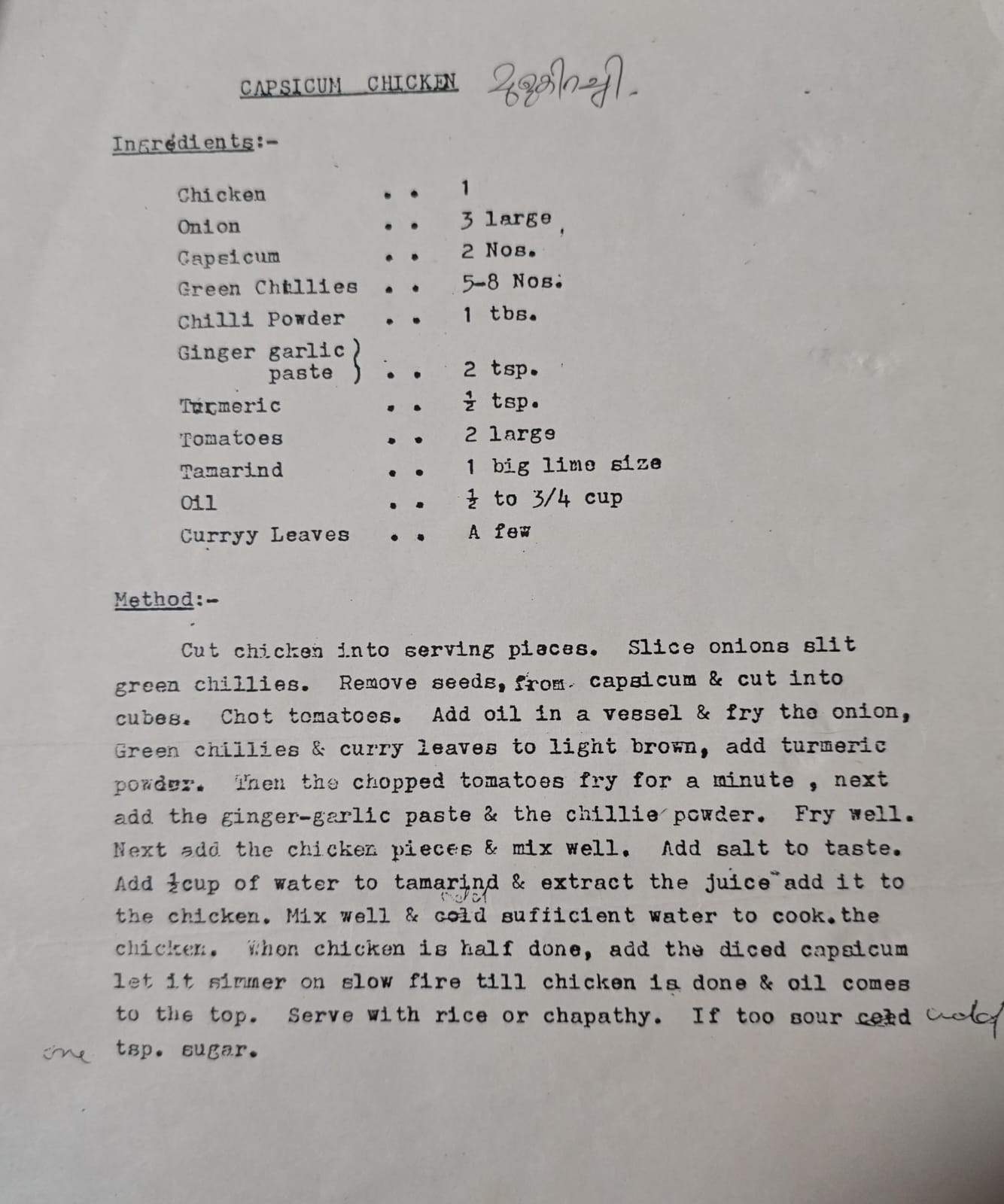
This transitional version of Mulagirachi already reflects a more urbanized and mercantile Cochini-Paradesi kitchen. Yet the recipe retains unmistakably Kerala elements—curry leaves, tamarind, green chillies—while also showing increasing Anglo-Indian influence through standardized measurements, typed English instructions, and the prominent use of capsicum.
The handwritten Malayalam annotation beside the recipe appears to identify the dish as Mulagirachi or Mulaku Irachi:
Mulagu / Mulaku = chillie
Irachi = meat
But the dish is no longer merely “Mulagirachi.” It acquires an English-facing identity: “Capsicum Chicken.”
That means the dish is beginning to present itself through ingredients recognizable to an English-speaking or Anglo-Indian environment.
Over time, somewhere between Cochin, Calcutta, English transcription, and oral repetition, the name appears to have drifted toward the Baghdadi-Calcutta form: Morwarchi.
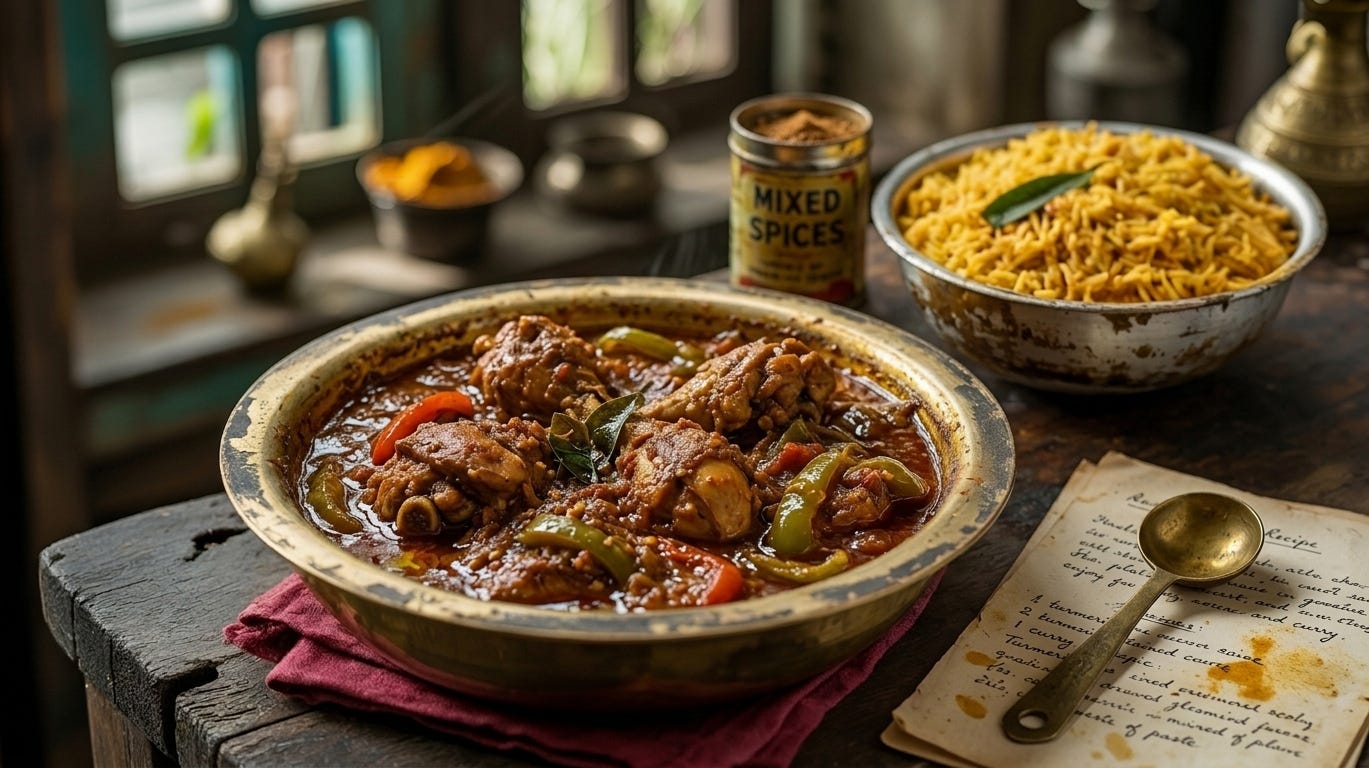
Capsicum Chicken (Mulagirachi), from the intertwined Jewish kitchens of Cochin and Calcutta.
Yield: Serves 6–8
Ingredients
1 whole chicken, cut into serving pieces
3 large onions, sliced
2 capsicums (bell peppers), seeded and diced
5–8 green chillies, slit
1 tablespoon chillie powder
2 teaspoons ginger-garlic paste
½ teaspoon turmeric powder
2 large tomatoes, chopped
Tamarind, about the size of a large lime
½–¾ cup oil
A few curry leaves
Salt, to taste
1 teaspoon sugar (optional, if too sour)
Method
Cut the chicken into serving pieces. Slice the onions and slit the green chillies. Remove the seeds from the capsicum and cut into cubes. Chop the tomatoes.
Heat the oil in a large vessel or heavy pot. Fry the onions, green chillies, and curry leaves until lightly browned.
Add the turmeric powder and chopped tomatoes and fry briefly for about a minute.
Add the ginger-garlic paste and chillie powder and fry well until aromatic.
Add the chicken pieces and mix thoroughly with the masala. Season with salt.
Soak the tamarind in 1 cup of water and extract the juice. Add the tamarind liquid to the chicken and mix well. Add sufficient water to cook the chicken.
When the chicken is about half done, add the diced capsicum. Continue simmering gently over a slow fire until the chicken is fully cooked and the oil rises to the top.
Serve with rice or chapathi.
If the dish is too sour, add 1 teaspoon sugar to balance the flavour.
What emerges from comparing the recipes is not simply culinary variation, but three intertwined systems of transmission: language drifting across migration routes, ritual structures shaping the physical logic of cooking itself, and domestic labour carrying recipes across otherwise segregated communities.
If this essay resonated with you, I’m grateful you’ve read this far.
This piece was inspired by a series of conversations about the ‘unseen’ heritage of the Baghdadi Jews. If you enjoyed this, you might also like my previous dispatch on What is Kahi.
Beyond Babylon continues to trace Jewish life and food across unexpected geographies.
You’re welcome to subscribe or share the piece with someone who might enjoy it.
Lovely. Your words layer the storytelling like only a chef can. The joy of diaspora cooking is that you can keep guessing. The immigrant adapts quickly. The cooking learns faster than the spoken word. While Paradesi literally means “foreign” or “foreigner,” this recipe is home-grown. It belongs to all those who made it before—and to all those who will keep adapting it. Also, chicken frankly should only be cooked on the bone.