
Kasundi vs. Matbucha
Caught in the Crossfire, finished with Strawberries

Being caught in the crossfire of ballistic missiles from Iran makes you feel like a stationary target. Not poetic. Not dramatic. Just a daily slog—you never know when it’s safe to come up for air, or where to go when the app says take cover.
It reminds me of childhood hide and seek. If you stayed too close to base, you were called chicken. But what do you call it now, when staying close to shelter is the only way to stay alive?
So I do what I can. I cook, I write, I dissect flavour—not for comfort, but for control.
Today it’s Kasundi: sharp, fermented, unapologetically bold. A good match for a moment shaped by fire.
Many know what Matbucha is. Few know what Kasundi is.
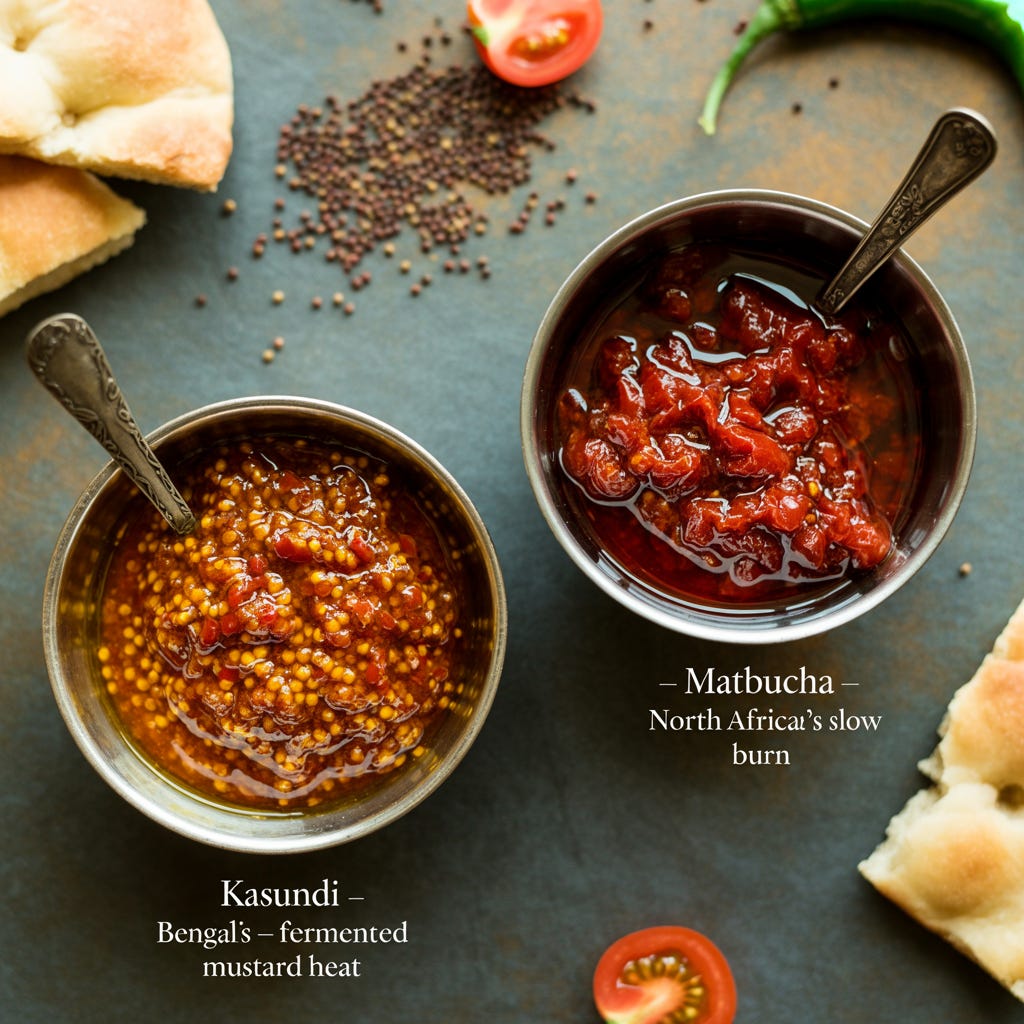
Matbucha (Arabic: مطبوخة, maṭbūkhah; French: salade cuite) is a North African condiment or cooked salad consisting of simmered tomatoes and roasted bell peppers, seasoned with garlic and chili pepper, and slow-cooked for hours until silky and deep.
Even in the Munich restaurant I managed, Matbucha was on the menu — and Münchners loved it with their beer. The beer complemented the fire, and cooled it down.
Kasundi, by contrast, is a traditional Bengali condiment. That explains its link to Calcutta’s Baghdadi Jews — and why I’m writing about it here.
On the surface, Kasundi and Matbucha seem like cousins who never met. One is Bengali. The other, North African. One ferments mustard seeds. The other slow-cooks peppers and tomatoes into velvet. But line them up on the same plate, and the contrast becomes a conversation. This isn’t fusion. It’s parallel evolution — two condiments born from heat, spice, and the logic of preservation.
Kasundi: The Acid Tongue of Bengal
Kasundi is a Bengali mustard relish — fermented, fiery, unapologetically sharp. Traditionally made from black mustard seeds, green chilies, water, and salt, it was never meant to be sweet or polite. It’s punchy. It hits the back of the throat.
And it works because mustard, like horseradish or wasabi, isn’t just heat — it’s clarity.
Later versions, especially Anglo-Indian or commercial ones, soften the blow.
They add vinegar. Tomatoes. Apples. Brown sugar.
These are not betrayals. They’re adaptations.
Another comparison? Perhaps Mostarda, the Italian fruit-and-mustard preserve.
While both use mustard as a backbone, Kasundi is a fermented firebomb — sharp, aggressive, earthy — while Mostarda is elegant and baroque, sweet first with a mustardy kicker.
Real Kasundi is an acid bomb. A live culture in a jar.
Matbucha: The Low Flame of the Maghreb
Matbucha — from the Arabic for “cooked” — takes the opposite approach. It’s slow. Tomatoes, bell peppers, garlic, and chilies simmer in oil until the water evaporates and you’re left with a glossy, concentrated paste. The flavors are deep, roasted, smoky. The sweetness is natural — from time, not sugar.
Matbucha is about layering. You taste the tomato, then the garlic, then the subtle sting of chili. There’s no fermentation. No vinegar. But there is preservation: olive oil and patience.
As a lawyer, I would often have court appearances in Be'er Sheva. The city has a large North African Jewish population, and Tuesday was Couscous Day in every local restaurant. I’m a condiment aficionado, and loved eating my couscous with a generous helping of Matbucha. But now, I introduce something as good — and far lesser known.
What They Share
Both are condiments born from necessity. No fridge? No problem. Preserve your bounty with acid (Kasundi) or oil and time (Matbucha).
Both ride the balance between heat and complexity. They’re not just spicy — they’re nuanced.
Both are used as punctuation. A spoon on the side of rice. A swipe on bread. A blast in a sandwich. These aren’t main dishes. They’re force multipliers.
And What They Don’t
Texture: Kasundi is often a paste or sauce; Matbucha is chunky, with visible strands of pepper and tomato.
Technique: Kasundi begins raw and ferments. Matbucha cooks low and slow.
Base Flavor: Mustard and vinegar define Kasundi. Tomato and garlic define Matbucha.
The Strawberry Twist
I decided to make things interesting.
It’s strawberry season right now in Munich, where I usually live.
So — let’s imagine from the bomb shelter:
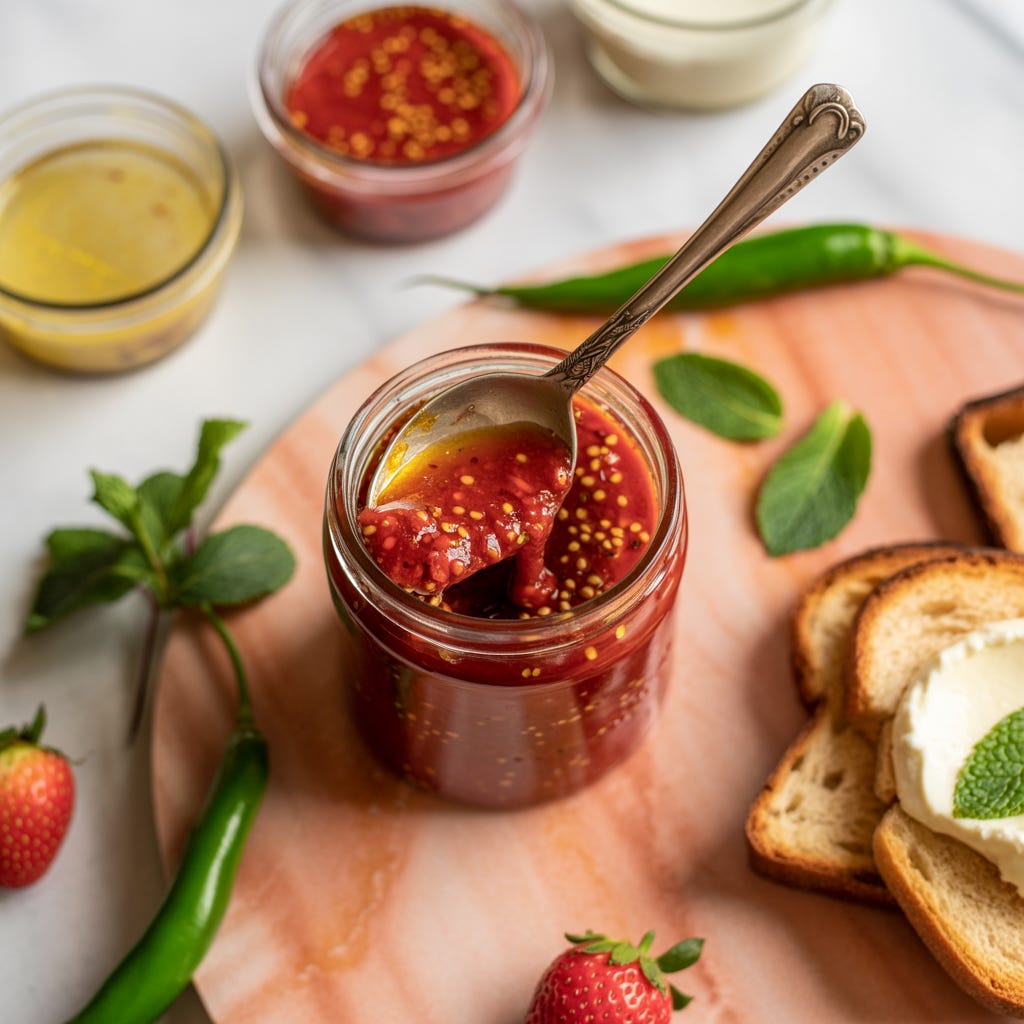
A Strawberry Kasundi — inspired by once colleague and always friend Susan Freiman and her modern takes on chutneys — slides into the Matbucha camp without meaning to. It’s cooked down. Sweet. Glossy. Still spiced, but the edge is rounded. A hybrid of technique, not tradition.
If Matbucha and Kasundi had a culinary child with a fondness for Western fruit, it might look like this.
Bottom Line
Kasundi slaps. Matbucha seduces. One shouts; the other murmurs.
But both are proof that across continents, people reached for the same basic goal:
Take what’s fresh. Make it last. Make it sing — especially with your favorite piece of bread.
🍓 Recipe: Strawberry Kasundi
Yield: About 1 liter (2 x 500 ml sterilized Mason jars)
Storage: Keeps up to 1 year sealed; refrigerate after opening.
🧾 Ingredients
15 cloves garlic, minced
½ cup chopped fresh ginger, minced
340 g strawberries, hulled and chopped
360 ml (1½ cups) apple cider vinegar
25 g (2½ tbsp) black mustard seeds
2 tbsp neutral oil, or mustard oil if available
5 tbsp ground cumin
1 tbsp turmeric powder
2½ tbsp nigella seeds (kalonji)
½ tsp whole cloves
1 tsp red chili powder (adjust to taste)
220 g (1 packed cup) dark brown sugar
10 fresh green chilies (e.g., serrano), slit and deseeded
Salt to taste (start with 1 tsp)
🔪 Method
Steep the mustard seeds:
Warm the vinegar slightly. Pour over the mustard seeds in a bowl or jar. Cover and let steep for at least 15 minutes, or overnight for deeper flavor.Fry the spices:
Heat the oil in a large heavy-bottomed pot. Briefly remove from heat to avoid scorching, then stir in cumin, turmeric, nigella, cloves, and chili powder. Fry for about 20 seconds until aromatic.Add garlic, ginger, and strawberries:
Return pot to medium heat. Sauté the garlic, ginger, and strawberries for 5–7 minutes until softened.Simmer the chutney:
Stir in the steeped mustard-vinegar mixture and dark brown sugar. Bring to a gentle simmer. Cook uncovered for 2.5–3 hours, stirring occasionally. Add a splash of water if mixture thickens too quickly.Adjust and finish:
Taste and adjust salt, chili, or sugar to your liking. Mash gently or blend with an immersion blender for a smoother texture.Bottle it up:
Ladle into sterilized jars while hot. Seal and store in a cool, dark place. Refrigerate after opening.
Want to make it yourself? This is how
I grew up with kasundi, and have never been able to find it as an adult. It was almost black, from a bottle by an Indian purveyor. A colorful label, as I recall. My mother slathered it on my sandwich bread and inserted slices of boiled egg. It stank, like many Third Culture kids' school lunches, but I adored it. Thank you for writing about it.
I'm trying to picture in my mind (and mouth) the flavor profile of Kasundi, but the closest I can come to is spicy brown mustard. Obviously, Kasundi has a more complex taste. This condiment would be an interesting addition to any table! Stay safe! 🙏