
Indian Spring
Passover, Nowruz, and the Shared Table of Renewal

In a recent Substack post, Nancy Harmon Jenkins writes of Nowruz with a kind of quiet relief - as if, for a moment, one could look at Iran and see something older and more peaceful than politics: a civilization aligned not with ideology, but with spring.
I think that is still possible.
But I want to approach Persia from a different direction entirely.
Not from Tehran, but from India - closer to my heart, and to my heritage.
A spring not only of season, but of shared life.
We begin with Zubin Mehta, who conducted the Israel Philharmonic Orchestra for many years.
Mehta is Parsi - that is to say, Persian Indian.
Here he stands before the orchestra, conducting Vivaldi’s Spring.
A Parsi Indian conductor.
A Jewish musical tradition.
An Israeli orchestra.
All playing a European composition of renewal.
Not as an exception - but as something already familiar to the histories that brought them there.
Spring
In the lands stretching from Mesopotamia to the Iranian plateau, spring was never just a season.
It marked the beginning of the year - and, with it, the ordering of time.
It is no coincidence that two ancient calendars - Jewish and Persian, both emerging from the same broader Mesopotamian–Iranian world - turn toward that same moment.
The Hebrew month of Nisan and the Persian month of Farvardin, both anchored in the same seasonal threshold, do not merely coincide.
They arise from the same civilizational soil.
This is not an essay about two holidays - Passover and Nowruz.
It is about a shared system that precedes them both, and reflects a common logic of time.
Nowruz - new day - begins at the vernal equinox, when day and night stand in balance.
Time here is not declared.
It is observed - and sanctified.
Passover is generally associated with the Exodus from Egypt.
But in the Bible, it is also anchored in the month of Aviv - spring.
Aviv names not an idea, but a condition: the stage of ripening grain, when the first barley is ready in the fields.
This is not symbolic language.
It is agricultural precision.
Passover belongs to a cycle of pilgrimage festivals - moments in the year when the land itself determines time, and when offerings are brought to the Temple in Jerusalem.
The Exodus overlays this system with memory.
But beneath it lies something older:
a calendar set by time, marked by the state of the fields.
Nowruz rests on the same ground.
It predates Islam, emerging from a world shaped by land before doctrine.
Floodplains governed by rivers.
Plateaus defined by returning light.
Fields dependent on the arrival of spring.
Calendars here were not abstractions.
They were survival.
Long before Nowruz - or Passover - this turning was already marked in Mesopotamian festivals such as the Babylonian Akitu, where renewal meant the reordering of the world.
As the biblical text puts it:
“This month shall be for you the beginning of months.” (Exodus 12:2)
If Nowruz marks the renewal of the world,
the Jewish month of Aviv - or Nisan, in its Babylonian name - gives that renewal a dual meaning: renewal of nature, renewal of a people.
Two Diasporas: Movement and Proximity
These ancient calendars did not remain in place.
They travelled.
With Jews from Mesopotamia to Cochin and Calcutta.
With Persians into Parsi communities in Bombay and Calcutta.
And there, in India, they met again—under entirely different conditions.
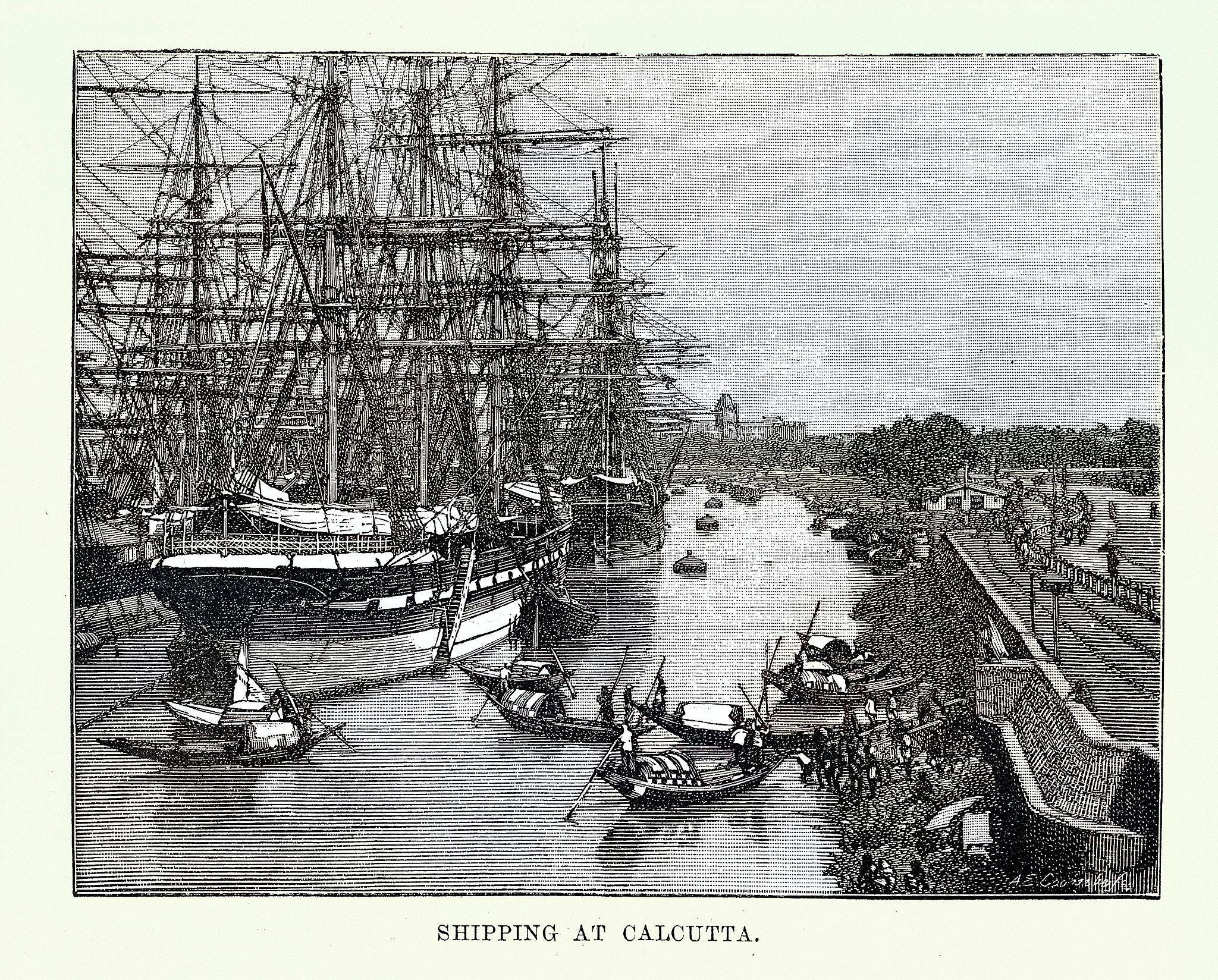
Sailing ships in the port at Calcutta, India, Victorian, Vintage illustration, 19th Century 1880s
Renewal
They Parsis arrived in India not as passive carriers of culture, but as a community choosing continuity
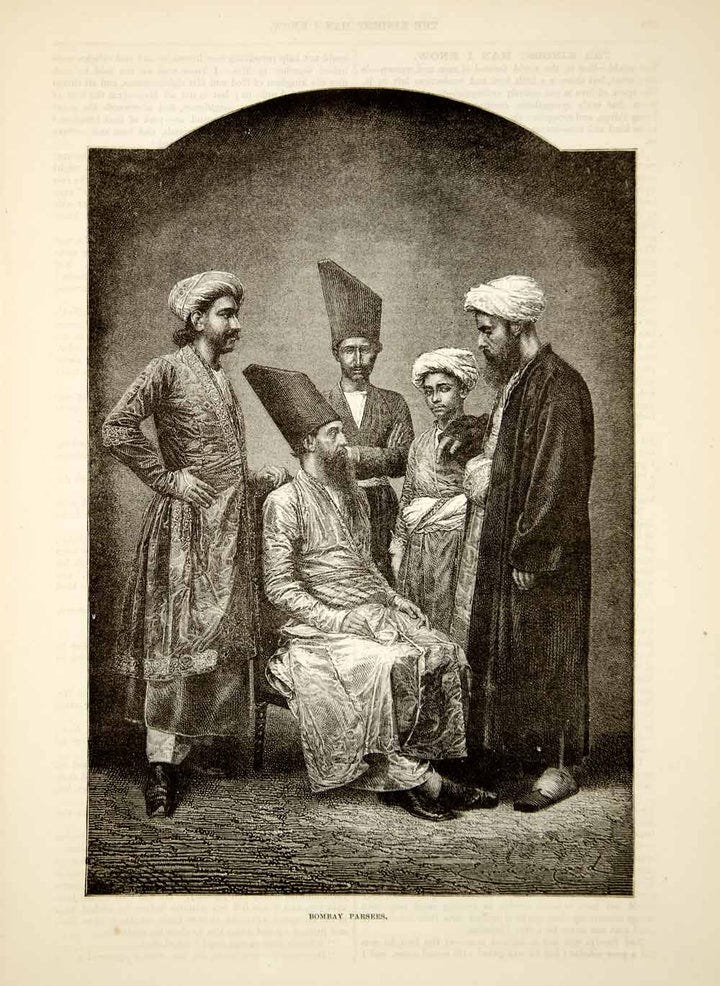
“Bombay Parsees” An original 1876 black and white in-text wood engraving of Parsi (or Parsee) men, part of the Zoroastrian community in Bombay, India. (Periodpaper.com)
Between the seventh and tenth centuries, after the Muslim conquest of Persia, the Zoroastrian world - once the imperial faith of the Sasanian Empire - began to contract.
Some remained.
Some adapted.
And some left.
The Parsis belong to that last category - not as a people in flight, but as a community making a decision: to preserve continuity by relocating it.
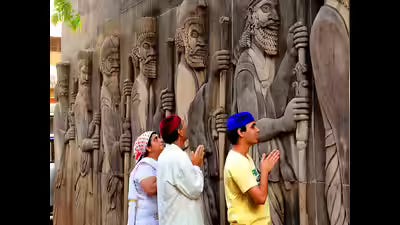
Worshippers at the fire temple relief in Mumbai, at Navroz. (Credit Times of India).
They moved to the western edge of the old Persian world, to India, where they could remain themselves and yet become something new.
They did not rebuild Persia.
They continued it - differently.
Parsi culture in India is not a relic frozen in time.
It is resistance carried into language, into food, into ritual.
If Nowruz marks renewal, then for the Parsis - Navroz - it marks something more:
Not only the return of spring,
but the survival of a world that refused to disappear.
From the beginning, Parsi history in India is a history of translation.
Persian memory carried into Gujarati speech, Indian ingredients, and later a colonial world shaped by English education and global trade.
In Parsi idiom, they sweetened the milk with sugar.
Not Persian.
Not Indian.
Not British.
All three at once.
By the time David Sassoon arrived in Bombay in the 1830s, the Parsis had already been in India for nearly seven centuries.
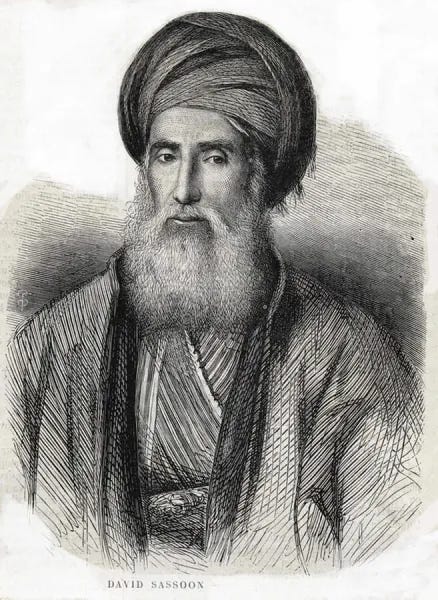
19th Century Portrait of David Sassoon Print. Art Prints, Posters & Puzzles from Fine Art Finder
The Jews did not encounter a frontier.
They entered a system.
And within that system, the Parsis were already central.
Figures such as Jamsetjee Jeejeebhoy had built vast commercial networks linking Bombay to China.
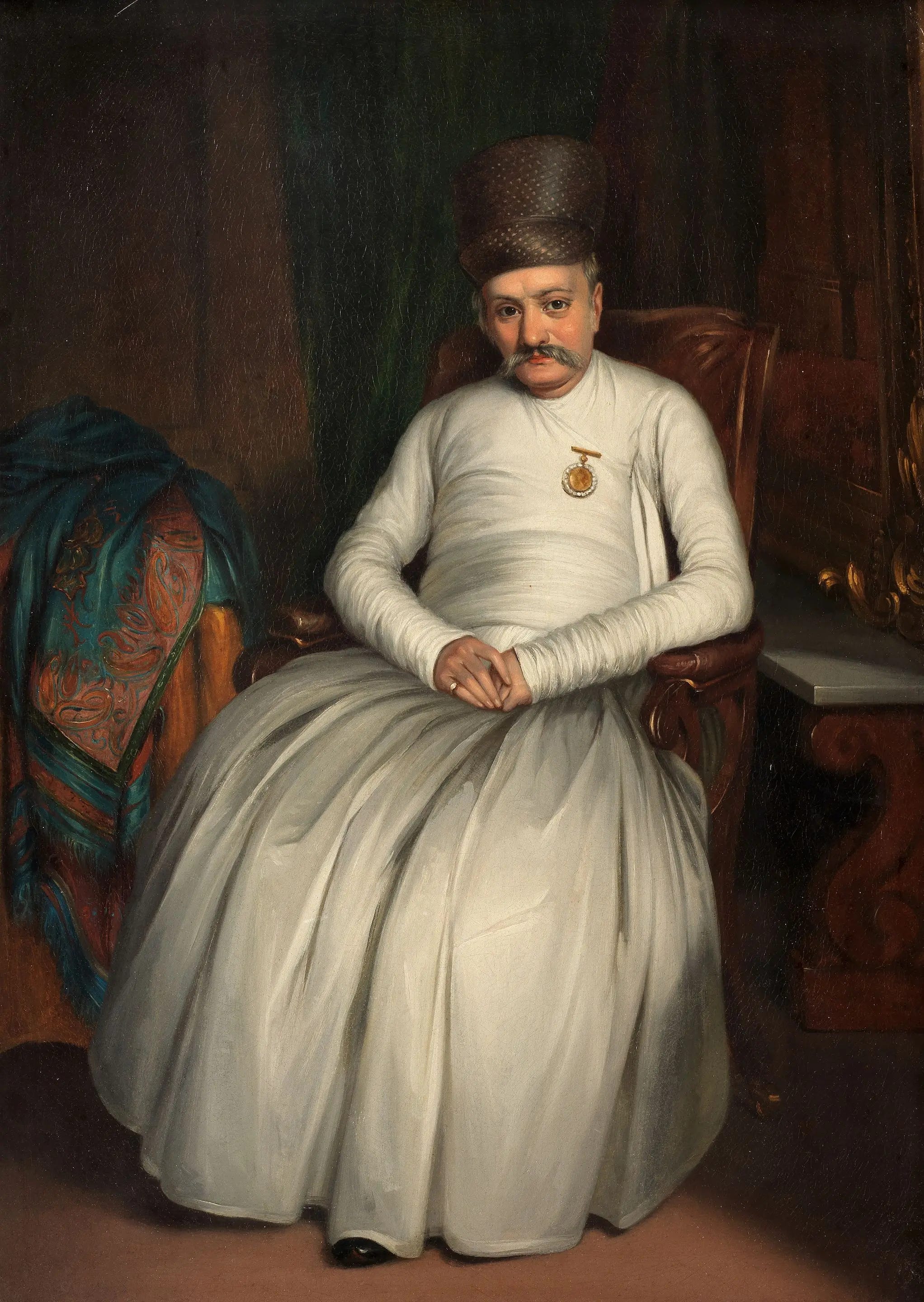
Bonhams : Attributed to Lamqua (act. 1820-1860) Portrait of Sir Jamsetjee Jeejeebhoy, 1st Bt. (1783-1859), circa 1844
The Sassoons would follow - sometimes alongside, sometimes in competition.
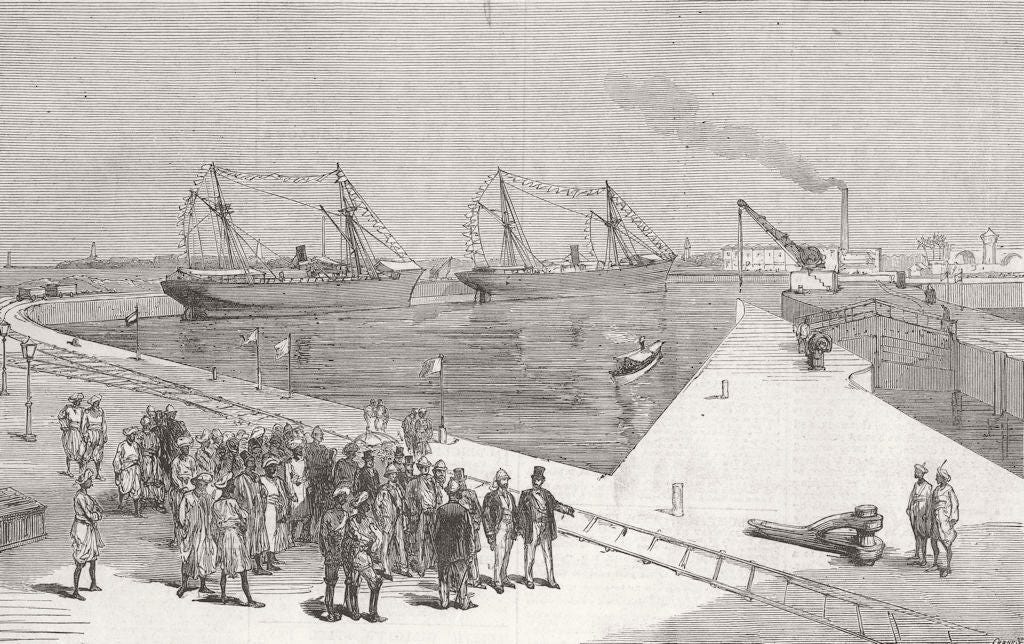
Sassoon Dock, Bombay, 19th century, 1875 old antique vintage print picture. (Antiquemapsandprints.com).
What Professor Joseph Sassoon traces in The Global Merchants are the trade routes of empire.
What they reveal here is something else:
That those same routes continue in another form -
in food, carried not in ships, but in memory and taste.
Parsis and Baghdadi Jews did not merely coexist.
They operated within the same system.
Sometimes they collaborated.
Sometimes they competed.
Always, they intersected.
They did not merely share a city.
They shaped it.
And this is how Parsi dhansak and Jewish hameen end up in the same city.
Allegro: The Table of Spring
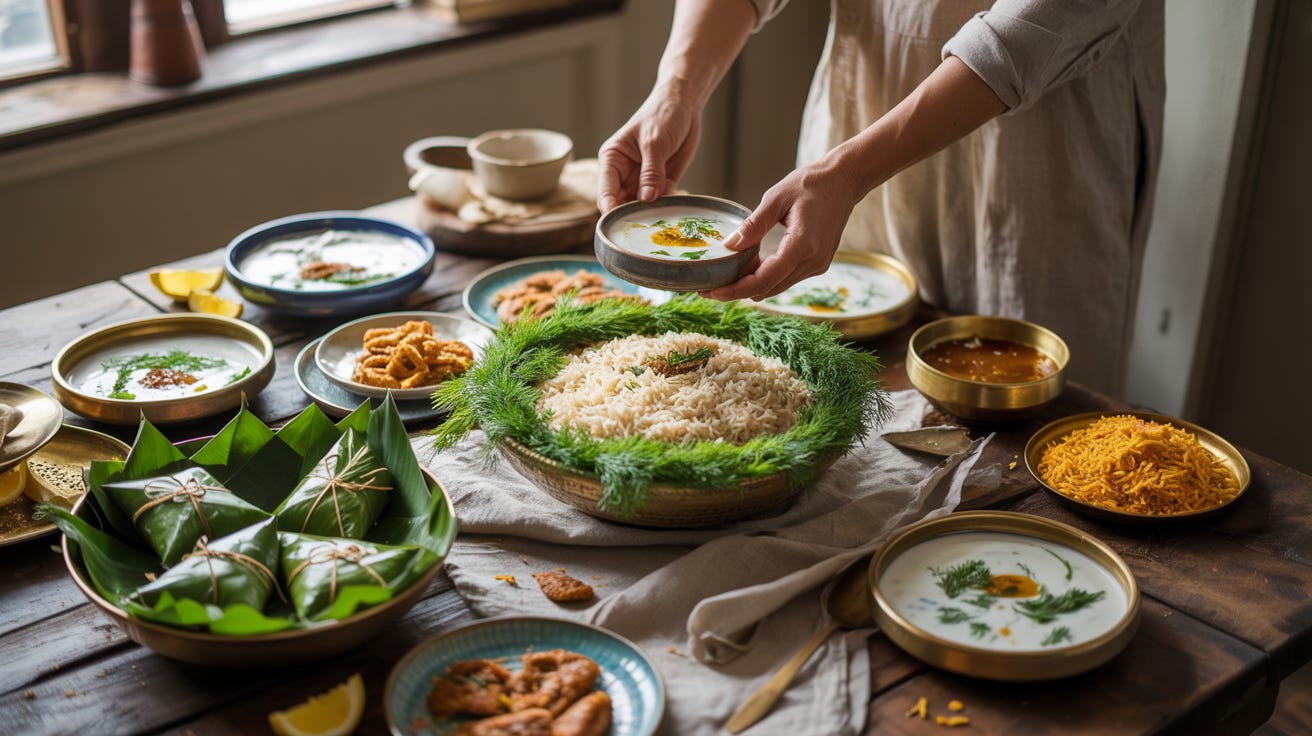
In Parsi homes, Navroz is not only marked in the calendar.
It is laid out.
The table does not represent renewal.
It enacts it.
Not as a collection of dishes, but as an order - a sequence through which the new year is entered, tasted, and given form.
What begins in the sky, at the moment of the equinox,
is carried into the home as arrangement:
sweetness before substance,
light before weight,
beginning before continuation.
This is not unlike the logic of the Seder, where time is structured through food, and memory is made edible.
But here, in the Parsi table, that structure carries another layer:
the long translation of Persia into India.
In the Navroz table presented by chefs such as Anahita Dhondy, this logic appears not as concept, but as sequence.
Sweetness first -sev, ravo, yogurt.
A beginning that is not symbolic, but tasted.
Then structure -rice, fish, meat.
The meal settles into form.
A dish like shehenshahi pulao carries an older memory of Persian rice: saffron, dried fruit, the balance between richness and restraint.
But it is no longer Persian.
It has been translated - made sweeter, more opulent, unmistakably Parsi.
Alongside it, dishes such as patra ni machhi bring the season forward: green chutney, sharp with coriander and mint, wrapped and steamed.
Not preserved forms, but living ones.
And then, in the everyday kitchen, something else appears.
Bheeda par eeda - okra with eggs.
Simple. Immediate. Cooked in a single pan.
Here, the distance between communities narrows.
Because this is where the Parsi kitchen begins to echo others.
In dishes like this, one can hear akuri.
One can taste the Jewish Calcutta mahmoosa I have written about.
Not borrowed.
Not identical.
But shaped in the same shared space - markets, ingredients, habits of cooking.
If the festive table preserves structure,
it is the everyday pan that reveals proximity.
Bheeda par eeda - okra with eggs. The recipe.
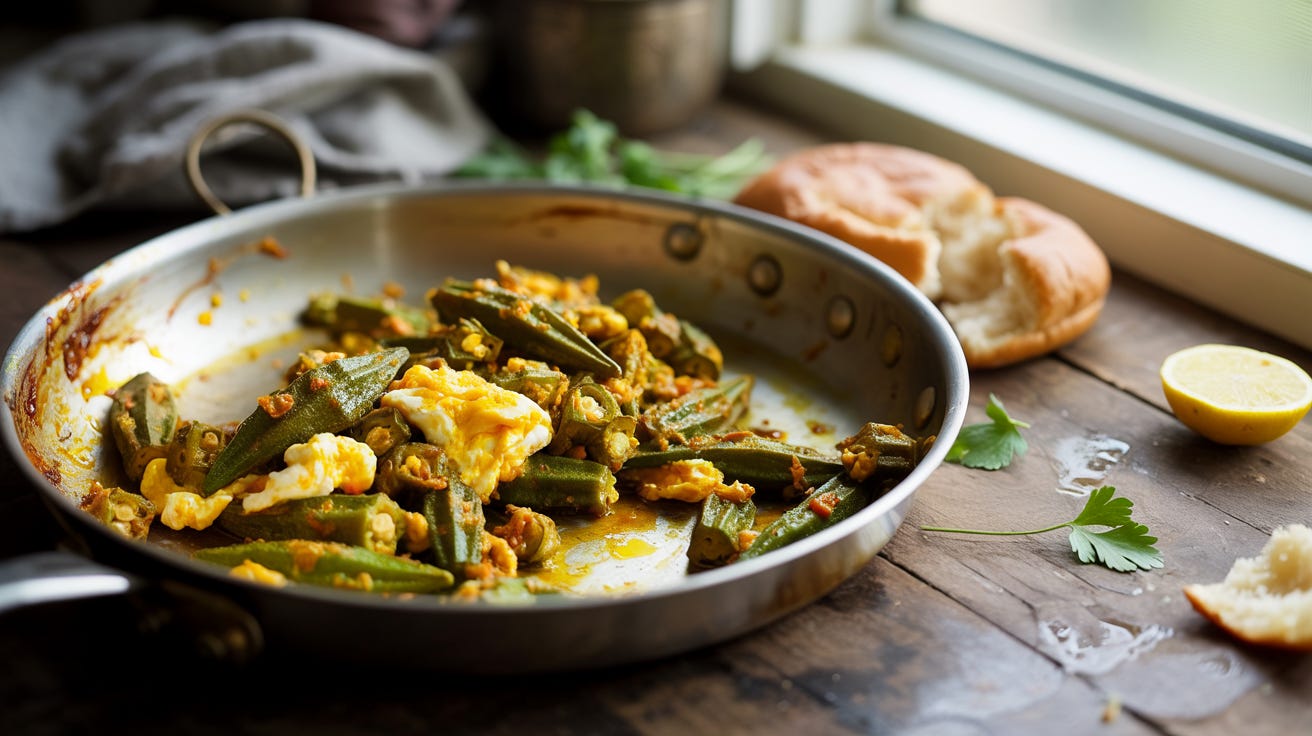
Bheeda par Eeda - Okra with Eggs
The everyday pan
A classic Parsi dish where spiced okra is topped with eggs and cooked until just set.
Yield: Serves 2–3
There is more than one way to make bheeda par eeda.
In some kitchens, the eggs are stirred into the okra - soft, integrated, closer to a scramble.
In others, they are cracked on top and allowed to set - distinct, structured, each element holding its place.
The difference is small.
But it reveals something larger.
Even within a single dish, one can see the same pattern:
sometimes blending,
sometimes layering,
always sharing the same ground.
Ingredients
250g okra (bhindi), chopped
3–4 eggs
1 onion, finely sliced
2 tomatoes, chopped
1–2 green chillies, slit
1 tsp cumin seeds
½ tsp turmeric powder
1 tsp coriander-cumin powder
Salt to taste
Fresh coriander for garnish
2–3 tbsp oil
Method
Prep the okra
Wash and dry thoroughly (moisture causes sliminess). Chop into pieces.Sauté the base
Heat oil in a wide pan. Add cumin seeds, then onions. Cook until golden.Add aromatics
Add green chillies and tomatoes. Cook until softened and the oil separates.Spice it up
Add turmeric, coriander-cumin powder, and salt. Mix well.Cook the okra
Add okra and cook uncovered for 8–10 minutes until tender and no longer slimy.Add the eggs (two ways)
Layered version: Make wells and crack eggs on top. Cover and cook until set.
Blended version: Stir eggs into the okra for a soft scramble.
Finish
Garnish with fresh coriander and serve hot.
Serving
Best enjoyed with warm rotis or crusty bread (pav), as in Parsi homes.
💡 Tip:
Keeping the okra dry and avoiding excessive stirring prevents sliminess.
Bheeda par Eeda - Okra with Eggs. the layered version

👉 Get your PDF recipe card for Bheeda par eeda here
Closing: Spring, Heard Again
This movement is not only culinary.
It appears, in another register, in music.
Daniel Barenboim has often said that music does not resolve conflict - but it creates the possibility of listening.
I have always held on to that.
I have always admired Zubin Mehta, and was deeply moved to be present when he conducted one of his final concerts - decades after his first appearance with the Israel Philharmonic Orchestra.
Mehta - a Parsi from Bombay - stood before that orchestra not as a symbol,
but as continuity.
Spring has been heard before.
In birds.
In storms.
In returning light.
Here, it is heard differently -
in calendars,
in kitchens,
in repetition.
Nancy Harmon Jenkins allows us to see Iran not as a problem, but as a civilization.
And that creates a double vision:
The Iran of Nowruz - enduring.
And the Iran of conflict.
Both are real.
But not equal in depth.
Before we argued about nations,
we agreed on spring.
Navroz.
A new day -
not declared -
but returned to, again and again.
For ourselves,
and for each other.
If this essay resonated with you, I’m grateful you’ve read this far.
Beyond Babylon continues to trace Jewish life and food across unexpected geographies.
You’re welcome to subscribe or share the piece with someone who might enjoy it.