
In a soup
What Mulligatawny Misses About Indian Food


This article is the result of a cross-cultural dialogue between me, author of Beyond Babylon, and Harshita Saxena, author of Epicurean dispatch - My Spicy journal.
What began as a conversation about Mulligatawny evolved into a deeper exploration of how soup carries not just flavour, but function—how it reflects the body, the household, and the logic of care in both Jewish and Indian food cultures.
Together, we followed the paths of Aash-e-Sangsheer and Marag—two soups born from entirely different worlds, yet grounded in the same quiet grammar of restoration. One speaks from court kitchens and ritualised nourishment, the other from migration, memory, and the gentle repetition of the everyday.
This collaboration is less about contrast, and more about convergence. We didn’t aim to define soup, but to listen to what it tells us—about where we come from, what we carry, and how we feed those we love.
I. Whats Soup
Soup is one of those foods that seem self-evident—until you try to define it.
Is it liquid?
Is it a starter?
Is it something eaten with a spoon?
Is it nourishment, medicine, comfort—or all three?
Every culture has soup of some kind, yet no two cultures seem to mean the same thing by it. Similar, but not identical. This paradox is not accidental. Soup travels easily across borders precisely because it is not a fixed dish, but a method: boiling. What differs is not the technique, but what boiling is meant to yield—and where soup is meant to sit in the life of a meal.
Soup has always belonged to economies of scarcity, where nourishment had to be coaxed from limited fuel, uneven ingredients, and simple tools. A single pot over a steady fire could stretch bones, scraps, grains, and vegetables into something sustaining, feeding many with little waste.
A few litres of water added to the broth can increase the yield of a soup from feeding one—to many.
In such contexts, soup is not a prelude or refinement but the main act: a method that maximises calories, warmth, and nutrition per unit of effort. This is why soup appears so early and so widely, and why it persists in domestic, peasant, royal, and diasporic kitchens long after other techniques become available.
As wealth increases, meals fragment into courses. Surplus fuel, specialised labour, fixed kitchens, and leisure make it possible to separate techniques—boiling here, frying there, baking elsewhere—and to serve them sequentially.
Soup, once central, is lightened and pushed forward in the meal, becoming a starter or a gesture rather than sustenance.
You order soup, but expect another course.
You are served soup as a guest, but assume more will follow.
Courses, in this sense, are not a culinary necessity but an economic expression of largesse: a way of organising abundance and demonstrating culinary dexterity. Soup remains on the menu, but its role has changed—less about survival, more about structure—revealing that what a culture does with soup ultimately reflects what it can afford.
You eat soup alone when dieting, or economising. And Soup by itself becomes a demonstration of restraint—dietary or financial.
Cold soups are not contradictions. They are climatic adaptations. Gazpacho, ajo blanco, chilled çorbalar—these do not abandon soup’s purpose. They shift its thermodynamics. In heat, hydration replaces warmth; the function remains intact.
In hot climates, boiling was never only a cooking method — it was a way of purifying food and body at once, making nourishment safe before it became pleasurable.
Seinfeld’s Soup Nazi is funny because he turns the oldest democratic food into an authoritarian performance. That soup’s power lies in access is so deeply ingrained that its inversion — soup as something denied, conditional, policed — becomes instantly comic.
The mulligatawny scene in Dinner for One sits at almost the opposite pole of the Soup Nazi, yet it exposes the same fault line we are writing about.That soup’s original logic can disappear entirely is perhaps best captured in the ritualised mulligatawny of Dinner for One — a dish born of colonial encounter, reduced to a first course performed without hunger, meaning, or eaters.
Soup in a Land of Dal
Ask most people in Europe what “Indian soup” looks like, and one name surfaces almost immediately: mulligatawny.
Peppered, yellow-brown, thickened with apple or rice, faintly spiced and usually served as a starter, it appears on menus as an introduction—something to be gotten through on the way to the main event. For many, it stands in for the quintessential Indian soup.
But mulligatawny carries baggage. The dish itself is not the problem. Mulligatawny has a history—colonial, adaptive, improvised. Its name derives from milagu-tanni, Tamil for “pepper water,” a simple rasam transformed in colonial kitchens into something recognisable to European dining rooms.
It is soup as translation.
Soup as accommodation.
Soup made legible to another table.
What Mulligatawny Misses
This is not an argument against mulligatawny, nor a claim that it is inauthentic. Mulligatawny is a legitimate, historically layered dish—shaped by translation, adaptation, and colonial encounter.
What it cannot do, however, is carry the full grammar of Indian soup culture. Framed as a starter rather than a bodily stabiliser, and presented as a course rather than a condition, it reflects European dining logic more than the functional role soup plays in Indian homes. Yet in its own way it is certainly part of the Indian soup culture.
The distinction here is conceptual, not culinary.
Culturally speaking, mulligatawny belongs to the same world as Dinner for One: endlessly repeated, oddly comforting, and slightly detached from the logic that produced it.
Step into Indian homes, however, and the idea of a European soup begins to dissolve almost immediately.
Soup, Language, and Condition
To understand soup, we must delve into soup etymology. Across languages, this dissolution is already encoded.
In English, soup comes from the Old French soupe—bread soaked in broth. The name describes a preparation, which thickens liquid.
English preserves this logic in idioms that have little to do with eating. To be “in the soup” is to be in trouble—immersed in a situation one cannot easily escape. “Alphabet soup” describes bureaucratic confusion, where everything dissolves into an undifferentiated mass. Something “souped up” is intensified, saturated, pushed beyond its base state. In each case, soup names not a dish but a condition: something enveloping, pervasive, hard to separate back into parts. Even here, soup does not function as a course. It functions as an environment.
In European traditions often overlooked in discussions of soup-as-course, there is brodo: derived from brewing or boiling rather than serving. Historically, brodo was not decorative. It was restorative—given to the ill, the elderly, the fatigued. In this sense, brodo belongs far closer to marag, shorba, tāng, shiru, and guk than to plated starters.
Language preserves this older logic in unexpected ways.
In German, on a cold, wet day, one might ask:
„Hast du heute noch keine Suppe gegessen?“
Have you not had soup today?
This is not a culinary question. It means: Are you cold? Are you run down? Are you ungrounded?
Other German expressions reinforce this:
Das ist mir eine schöne Suppe — a mess, a sorry state
Alles eine Suppe — everything blurred together
Soup here names a condition, not a dish.
Yiddish, sitting between European and Jewish worlds, preserves soup as baseline care:
Hot er gehat a sup? — Did he at least have soup?
Asked of the sick, the poor, the exhausted. Soup is the minimum standard of being looked after.
In many Asian languages, soup never becomes metaphor at all—because it never lost its function.
In Chinese, tāng names both soup and medicinal decoction. In Japanese, shiru means liquid itself; miso soup stabilises a meal rather than beginning it. In Korean, guk is structural: a meal without it feels incomplete.
None of these words describe a course.
All of them describe a function.
Where soup becomes a course, it becomes metaphor.
Where soup remains functional, it remains literal.
Soup as Preparation
In many kitchens—across India, Iran, the Middle East, East Asia, and Jewish homes—soup is not defined by texture or sequence at all, but by function.
Soup is what prepares the body.
It appears before meals, before fasting, before recovery. It is not designed to excite appetite but to steady it. It does not shock the palate; it coats it. It is not plated for effect; it is offered with intent.
Calling soup a “starter” already misunderstands it. A starter belongs to a sequence—appetiser, main, dessert—a structure shaped by European dining rooms and menu logic. Soup, in older food cultures, often precedes sequence altogether. It answers a bodily question, not a culinary one.
Seen this way, soup is not a category but a condition: warmth, hydration, grounding, digestibility.
And it is within this understanding that Indian soup—properly read—comes into focus: not as a discrete course, but as integrated liquid nourishment.
It is within this grammar that the following two soups speak.
II. Aash-e-Sangsheer: A Soupy Mughal Memory in a Bowl
Some recipes are not written. They are remembered by how they feel in the body—steam on your face, ghee on the tongue, quiet warmth behind the ribs. This one lived unnamed in my father’s kitchen long before I found it in a cookbook.
A Name Steeped in Nourishment
In Persian, aash does not just mean soup—it means a slow, sustaining meal. Derived from āshīdan (“to eat”), it refers to bowls that are full-bodied, protein-rich, and meant to be eaten with bread, not a spoon alone.
Aash-e-Sangsheer is a specific version of this tradition. The name survives even when the recipe rarely does. Sang (stone or strength) and sheer (milk or nourishment) suggest something fortifying—a soup built to warm the body, not excite the palate.
Its core: lamb, chickpeas, rice, yogurt, almond paste, and greens. No tomato. No garam masala. Just depth, clarity, care.
From Steppe to Subcontinent
The idea of aash comes from Central Asia and Iran, travelling through Turco-Persian empires into India long before colonial kitchens coined the word “curry.” By the 16th century, it had found a home in Mughal courts—especially in Agra, Delhi, and Lucknow—where Persian chefs shaped what we now call Mughlai cuisine.
Aash was often served before meals, before recovery, before feasting—a bridge between states of the body.
A Soup of Memory, Not Menu
In our house, soup was never a performance. If my father pressure-cooked mutton or chicken, he would scoop out the broth, add a handful of masoor dal, maybe a clove or two, and make a thin, golden soup. No garnish. No name. Just preparation.
Years later, when I found Aash-e-Sangsheer in a heritage archive, I recognised it instantly—not in technique, but in logic.
The warmth before the meal.
The broth that coats, not shocks.
The restraint.
Recipe: Aash-e-Sangsheer
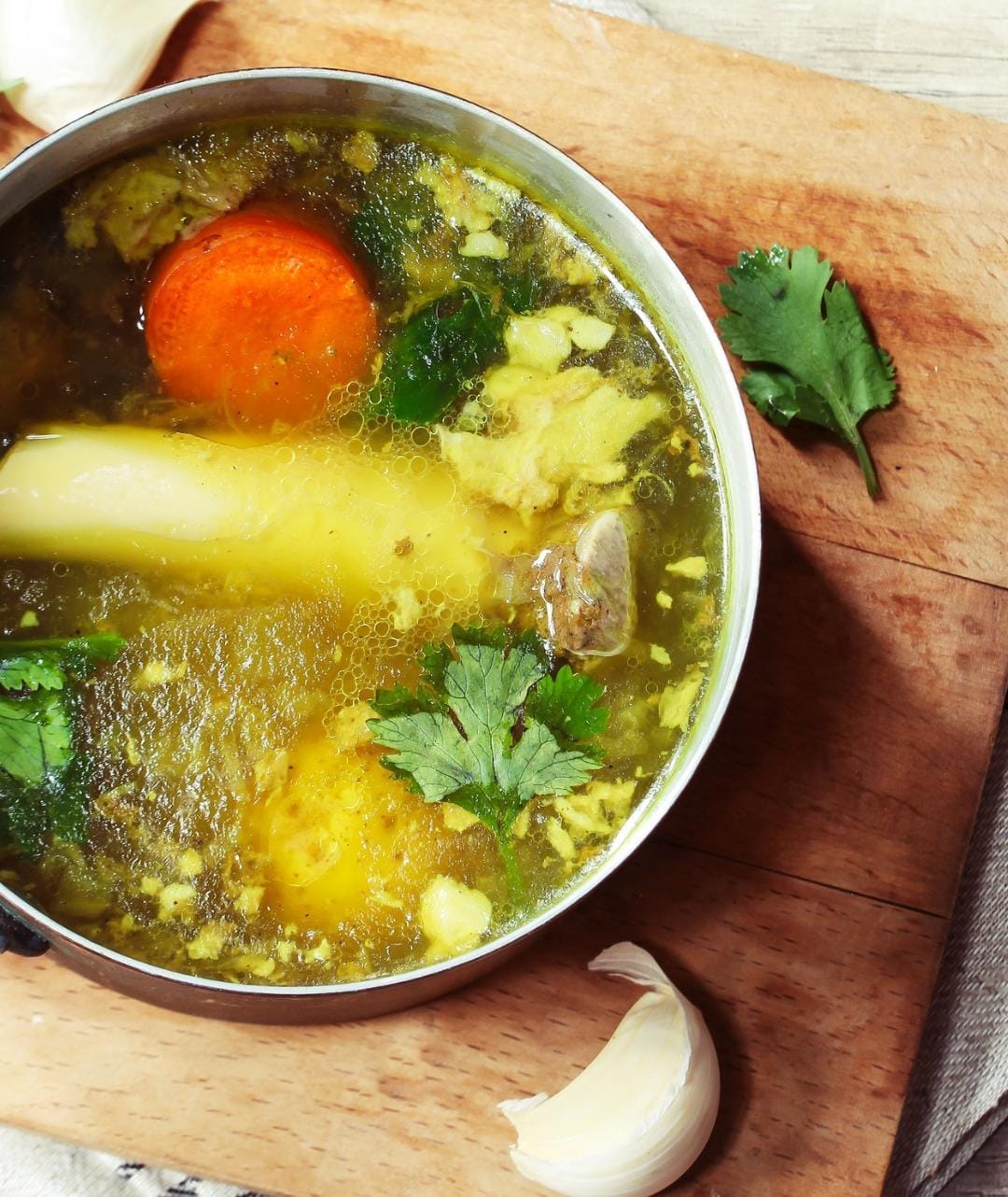
Serves 4–6
Ingredients
1 kg lamb, bone-in
½ cup chickpeas (soaked overnight)
¼ cup rice
1 cup ghee
1 cup sliced onions.
8 tsp chopped ginger
1 tsp each: cinnamon, cloves, green cardamom
½ cup almonds, fried and ground into paste
1 cup diced carrots.
1 cup spinach, chopped.(optional)
1 cup dill leaves, chopped.(optional)
Salt to taste
Method
In a deep pot, simmer lamb, chickpeas, and rice in water for 90–120 minutes, until soft. Skim the top.
In a separate pan, heat ghee. Sauté onions, ginger, and whole spices until golden.
Add this to the stock pot. Lower heat.
Add almond paste slowly
Add carrots. Simmer until just tender.
Add spinach and dill. Stir gently. Adjust salt.
Serve warm, with bread — or alone, as memory.
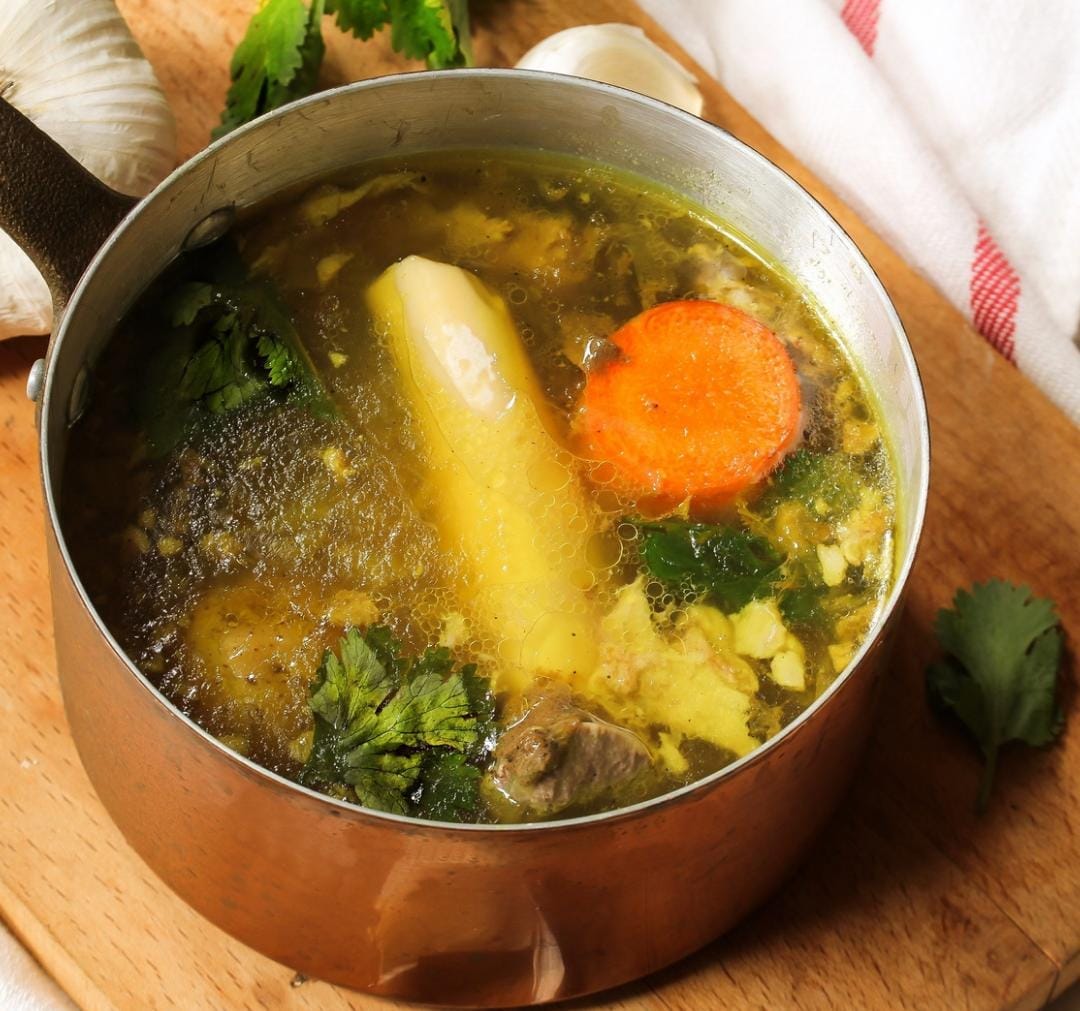
👉 Get your printable recipe card for Aash-e-Sangsheer here
III. Marag – The Jewish Indian Chicken Soup
Some recipes are not written.
They arrive with people — folded into memory, adjusted quietly, cooked again and again until they belong.
Marag was never announced.
It entered kitchens the way families did: by boat, by trade, by necessity.
It lived in the pot long before it lived in a book.
It was not named for us as children.
It was simply what was ladled over rice when the house needed grounding — before Shabbat, before a fast, before a long night.
A Name Carried, Not Conferred
In Hebrew, marak. In Arabic, maraq. A word so ordinary it barely asserts itself. The word מרק, marag (or maraq) simply means soup.
The Hebrew word marak (מרק) comes from the biblical root מ־ר־ק (M-R-Q), meaning to scour, cleanse, polish, or draw out.
In the Bible, the root does not belong to cooking at all, but to ritualised bodily preparation. Its most vivid appearance is in Book of Esther, where young women undergo months of purification treatments of oils and perfumes—before being presented to the king (Esther 2:12).
This is not cleanliness in the everyday sense. It is transformation under scrutiny: the body refined, stripped of residue, made acceptable to power. Marak here names a process of drawing something out of the body in order to render it fit—socially, ritually, politically.
Only later, in Rabbinic Hebrew, does marak migrate from the realm of the prepared body to the prepared pot, coming to mean broth or soup—liquid essence drawn out through boiling. Yet the logic remains unchanged.
Whether applied to skin or to bone, marak names purification before acceptance, preparation before entry. Soup, in this lineage, is not ordinary food but a civilising threshold: nourishment rendered safe, refined, and receivable before it becomes pleasure.
Marag is like it’s better known counterpart - chicken soup. Soup, with chicken. That’s it.
But unlike aash, whose name signals lineage and authority, marag carries no title.
It does not claim nourishment by etymology. It earns it by repetition.
When Baghdadi Jews arrived in India, the word stayed the same.
What changed was the world around it.
Its core remained simple: chicken, onions, ginger, turmeric, vegetables, oil.
No dairy, because meat and dairy don’t mix. No ceremony. No courtly refinement.
Just sustenance, adjusted.
Like chicken soup.
From Homeland to Household
Marag did not travel with empires.
It travelled with merchants, clerks, widows, cooks, and children.
In the Middle East, it had been a clear, modest broth — onion, garlic, chicken, water.
In India, it learned new surroundings.
Ginger became fresher.
Coriander replaced parsley.
Local vegetables like Pumpkin and potatoes entered the pot.
Rice became its natural companion.
Unlike Aash, which entered India through Mughal courts and instructed kitchens how to behave, Marag entered through homes and listened.
It adapted not because it sought novelty, but because survival requires fluency.
A Soup of Practice, Not Prestige
In our house, Marag was not special, it was ordinary just like its name.
Which is to say, it was essential.
It appeared on Friday evenings.
Before the fast of Yom Kippur, the day of atonement.
After Yom Kippur, to break the fast-
And on weekday evenings when no one wanted heaviness, only reassurance.
Sometimes it carried koobahs — soft meat filled rice dumplings that made the soup unmistakably Jewish, filling and a meal in itself.
Aash never does this. It does not need to. Its authority is already established.
Marag’s authority is different.
It is relational.
The Ingredients Know Their Place
There is an internal logic to Marag, even in its looseness:
Chicken: light, hydrating, sustaining
Onions: sweetness without depth-seeking
Ginger & turmeric: warmth, not heat
Potato & vegetables: body without dominance
Oil: neutrality, not richness
Coriander: lift, not display
There is no attempt to impress.
The broth is clear, golden, gently opaque from onion alone.
It does not shout.
It settles.
How It’s Made (And Why That Matters)
Marag unfolds simply:
In a deep pot, brown, chicken Chicken, onion, ginger, turmeric, oil, simmer together in water for 90–120 minutes, until soft. Skim the top.
Vegetables are added without hierarchy
Water covers, not floods
Koobahs (dumplings) may enter, quietly asserting lineage
Fresh coriander finishes, never decorates
There is no point at which Marag becomes performative.
The pot remains a pot. And the marag is served until its all gone.
That Marag is a chicken soup is not incidental. Chicken is the meat of households, not empires — of repetition rather than display. Where lamb signals wealth, herds, and courtly kitchens, chicken belongs to backyards, markets, and domestic continuity. In Jewish foodways, chicken becomes central precisely where mobility is high and permanence uncertain: it is affordable, adaptable, and suited to ritual time. Marag’s chicken does not assert itself; it absorbs. It listens to ginger, turmeric, coriander, vegetables, rice, and koobahs without losing its grammar. In this, Marag reveals its immigrant character. Unlike Aash, which enters India with lamb and authority, Marag arrives with chicken and practice — adjusting quietly as a community forms, repeating itself until it belongs.
What It Tastes Like
It tastes like arrival without conquest.
Like a dish that learned its surroundings without losing its grammar.
The broth is light but complete.
The vegetables soften without dissolving.
The koobahs — when present — anchor the soup in Jewish time.
You do not crave Marag.
You rely on it.
Marag (Jewish Indian Chicken Soup) — with Pumpkin and Koobahs
Serves 6
Ingredients
Soup
1 whole chicken (about 1.5 kg), cut into pieces
2 tbsp neutral oil (sunflower/canola/peanut)
2 large onions, puréed with the garlic and ginger (hamis paste)
4–5 cloves garlic
1 large thumb ginger
¼–½ tsp turmeric (start with ¼ tsp; increase if you want deeper colour)
Salt and black pepper, to taste
1.5–2 litres water or light chicken stock (as needed)
Vegetables
2 medium potatoes, cubed
Optional: 1½–2 cups pumpkin/squash, cubed
2 cups coarsely-chopped tomato,
fresh or canned
Optional: carrots/ green beans / cauliflower / marrow / spinach / anything (I added bok choy).
Finish
½ cup chopped fresh coriander (cilantro)
2 cardamom pods (optional)
Optional
10–12 koobahs (fresh or frozen) - recipe in link
Method
1) Make the hamis paste (the foundation)
In a blender or with a stick blender, make a coarse-smooth paste from:
the onions
garlic
ginger
(You can add a spoon of water only if needed to get it moving.)
2) Hamis (the foundational method for Baghdadi Indian cooking)
Heat the oil in a large pot over medium heat.
Add the paste and hamis it: stir constantly with a wooden spoon in circular motions until it softens, loses its raw edge, and turns lightly golden and fragrant.
This takes 8–12 minutes. Don’t rush it. This is where Marag gets its depth.
Add turmeric, stir 30–60 seconds to bloom it.
3) Add chicken, seal gently
Add chicken pieces to the pot and turn to coat and brown in the paste.
Cook a few minutes so the chicken takes on the base flavour, without browning.
Season with salt, pepper and the cardamom.
4) Add water and simmer
Add enough water to cover generously.
Bring to a boil, then lower heat, cover, and simmer 20 minutes.
Skim lightly if needed.
5) Add vegetables
Add tomato, potatoes, carrot, pumpkin (and any other vegetables).
Simmer 20–30 minutes more, until chicken and vegetables are tender.
6) Add koobahs (optional but important)
Add koobahs gently and simmer 20–30 minutes, until cooked through.
(Keep the simmer gentle so they don’t break.)
7) Finish
Add coriander.
Adjust salt/pepper. Cover and rest 10 minutes before serving.
Serving
Best served over rice.
Should taste warming, ginger-forward, turmeric-golden, fresh coriander- fresh and quietly deep from the hamis base.
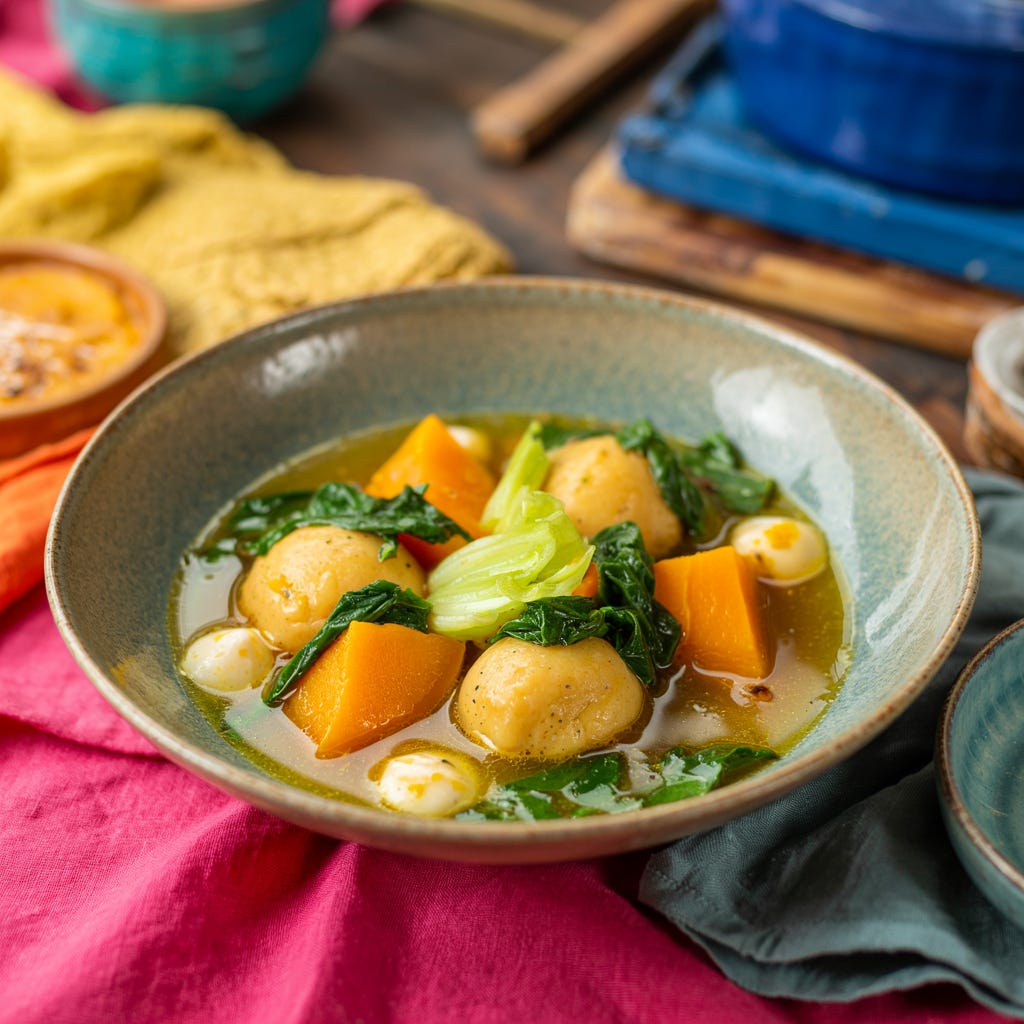
👉 Get your printable recipe card for Marag here
Closing note
What these soups show — together — is not a difference of flavour, but a difference of logic.
Aash carries nourishment far enough to become a meal.
Marag draws out essence, meant to steady the body before what comes next.
They are not interchangeable.
They are not meant to be.
What unites them is function: both exist to prepare rather than perform, to ground rather than impress. Both belong to food cultures where soup answers a bodily question before it ever becomes a course.
Soup is not what you serve before the meal.
Soup is what prepares you to have one.
Soup is a meal — sometimes complete, sometimes provisional, always intentional.
And that is what mulligatawny, for all its history and legitimacy, cannot quite carry: not because it is inauthentic, but because it was shaped to fit a different dining logic altogether.
Seen this way, the question is no longer which soup is more Indian, more Jewish, or more correct.
The question is simpler — and older:
What is the boiling meant to yield?
And who is the soup for?
✨ All posts are free; paid subscriptions are optional, and your support is deeply appreciated.
💬 Share your story in the comments, or pass this essay along.
📖 To support more work uncovering Jewish food in unexpected corners of the world, consider subscribing to Beyond Babylon.
 | A guest post by
|
So grateful this piece is now out in the world. Writing this with you was a deep, layered process . One that asked us to think not just about food, but about logic, memory, and care. Aash and Marag aren’t just recipes - they’re systems of meaning.
Thank you for this lovely collaboration Elli!
Thanks for this beautiful post! We forget the importance of communities living together and how recipes entered and left to journey around the world and be shared. I am convinced that Chicken Vindaloo was originally a dish Baghdadi Jews relocated near Goa adapted from Portuguese traders to satisfy kashrut. That practice of simmering chicken in vinegar via the East India Trading Company seems to have brought vindaloo to London and a similar dish known as Captain's chicken to Charleston, South Carolina. Your odes to ethereal soup and the many facets it's known by to almost become a ritual deeply rooted in memory and culture are artful as they remind us of the weight and the legacy of our recipes.