
DOPIAZA, my way
A love letter to onions

A Jewish Curry Culture Club Essay | By Elli Benaiah
I love onions.
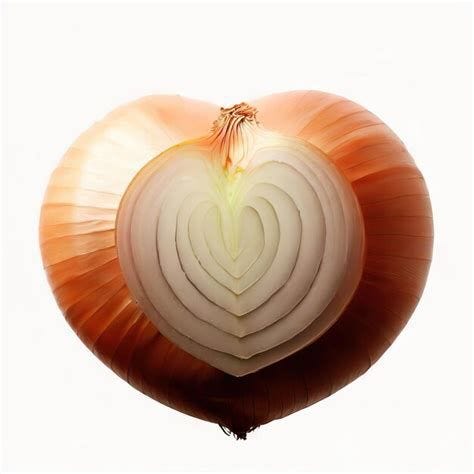
Onions are one of the oldest flavour-builders we know — so essential that in the wilderness, the Israelites begged to return to Egyptian slavery “because we remember the fish… the cucumbers, the melons, the leeks, THE ONIONS and the garlic” (Numbers 11:5). Few ingredients have inspired both devotion and complaint in equal measure.
Giving up one`s freedom for onions is one major sacrifice; maybe it was simply an ancient figure of speech (or complaint), but for me, there is no dish — other than maybe French onion soup — that showcases onions better than dopiaza.
Dopiaza is a love letter to onions.
“Do-piaza,” however spelled, literally means “onions twice” — either double the quantity of onions, or onions introduced in two stages. That’s the spine of the dish, whatever else you choose to pile on top, from muttons to mushrooms.
Strip any dopiaza recipe down and the skeleton is always the same:
Softened or paste-like onions → the foundation
Caramelised or fried onions → the second layer
Optional whole/onion petals → texture, sweetness, contrast
Everything else — mutton, mushrooms, lamb, beans, apricots, tomatoes, spices — is decoration. The onion is the architecture, from foundation to rooftiles.
To prove this to myself, I compared two unrelated dopiaza recipes:
Nisha Katona’s modern vegetarian dopiaza in Meat Free Mowgli and the classic lamb dopiaza from the Whitecap The Foods of India. Same technique, completely different moods. Katona’s version is bright, sweet–sour, and lifted by apricots and kasuri methi. The lamb version is a slow and savoury braise, built on fat and roasted spice.
The divergence only confirms the rule: the onions define the dish, not the protein.
🧅 Onion as Architecture — A Global Instinct
Once you start looking for it, you see the onion logic everywhere:
Persian khoresht-e bademjan with stewed, sweet, and crisp onions
Turkish imam bayıldı, where onions melt into the aubergine
Arab Mujaddara, held together by soft onions and crowned with fried ones
Ethiopian doro wat, Cajun gumbo, Thai stir-fries with fried shallots
Some cuisines rely on tomatoes or herbs. India and the Persianate world build in onions — layers, timing, contrast. Dopiaza belongs to this global family of dishes that don’t just use onions; they think in onions.
📜 From Khorasan to the Mughal Court
As Harshita Saxena explains beautifully in her essay, and at the risk of sounding repetitive, dopiaza is older and broader than most people assume.
Culinary evidence traces it to the Persianate world, likely Khorasan (eastern Iran/Afghanistan). The Mughal courts carried it into India, where it evolved into the versions we know now.
The 17th-century Nuskha-e-Shahjahani even includes a section on Āliyāh and Do-Piyāzah dishes — meaning the technique was already established.
The principle was simple:
Onions cooked slowly until sweet
Onions added again, raw or lightly cooked, for brightness and bite
Persian cooks did it for balance. Mughal cooks adopted it as standard technique.
And eventually, dopiaza drifted into Jewish Indian kitchens.
✡️ The Jewish Version: What Changed, What Didn’t
Jewish cooks added their own signature: hamising — slow-cooking minced onions with ginger and garlic until golden, jammy, and fragrant.
This is effectively stage one of the Jewish Indian dopiaza (as opposed to Harshita`s founding stage, which starts with slow frying thinly slice onions).
Stage two — chopped onions or large slices (petals)— completes the formula.
What disappeared in the Jewish cooking, however, was yogurt, removed for kosher reasons.
Without it, the dish becomes a weekday stew: onions, tomatoes, potatoes, meat. Comforting, familiar, but stripped of its Mughal richness. Not special.
To me, this is where reinterpretation should begin.
Not nostalgia.
Not forced “heritage angles.”
Just: What would dopiaza become if we gave it back everything it lost — but kept the Baghdadi technique?
⭐ A Modern Dopiaza: Four Onions, Aubergine, and Kumquats
This version restores the yogurt, keeps the hamis technique, removes the stodgy potatoes and peas, and brings dopiaza into modernity with ideas inspired by Ottolenghi’s test kitchen:
Yellow cherry tomatoes → sweetness + colour
Aubergine wedges → velvety structure
Kumquats quartered lengthwise → citrus brightness without acidity
Four onion forms → technique elevated
The Four-Onion Structure
Hamised a minced onion-ginger-garlic paste
Soft, golden chopped onion petals
Charred Pearl onions
fried onions on top for garnish
This isn’t nostalgia.
This is dopiaza rebuilt from the ground up — structural, aromatic, bright, layered.
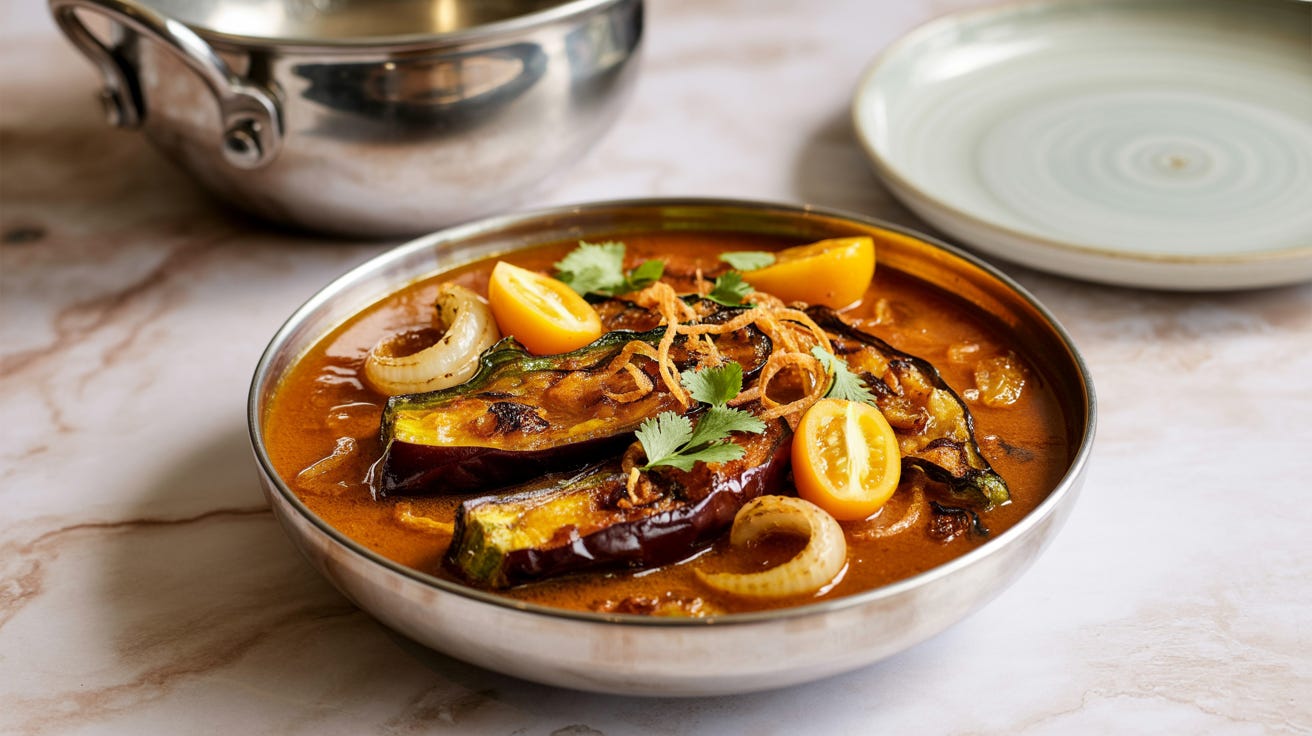
⭐ Four-Onion Dopiaza with Charred Aubergine & Kumquats
Serves 4
Ingredients:
🥒 Hero Vegetables
2 large aubergines, cut into thick wedges
Neutral oil, turmeric, and salt for roasting
🧅 Onions (Four Forms)
2 large onions, minced with ginger–garlic into a paste (hamis base)
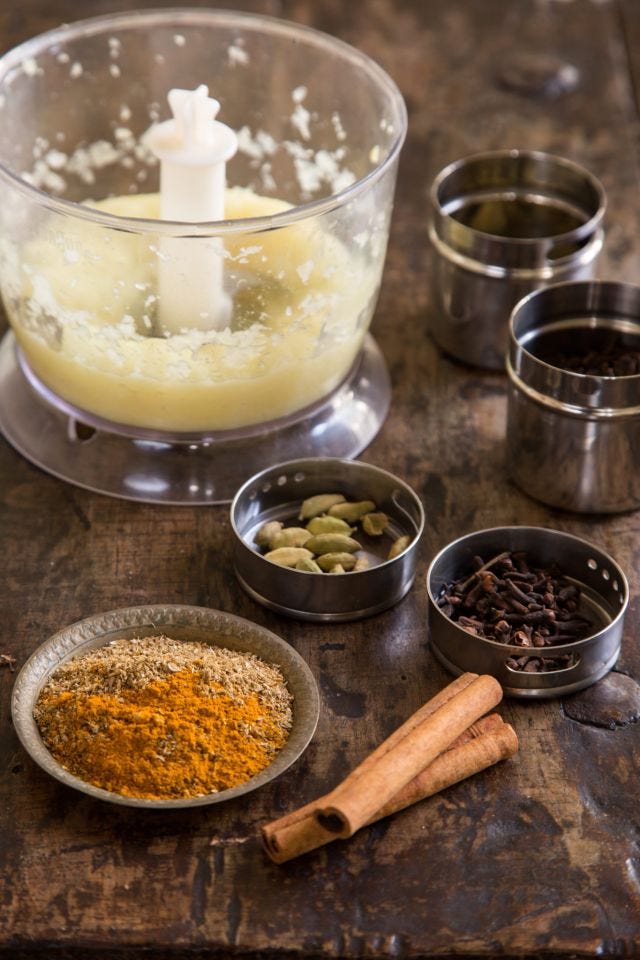
1 large onion, cut into quarters or thick petals (for charring)
12–15 pearl onions, peeled (kept whole)
3 tbsp crisp fried onions (for garnish)
🌿 Aromatics & Spices
2 tbsp ginger–garlic paste (in hamis)
1 tsp turmeric
1 tsp mild chilli powder or Kashmiri chili
2 tsp coriander powder
2 tsp cumin powder
Salt and pepper to taste
🍅 Tomato & Citrus
200 g yellow cherry tomatoes, halved
6–8 kumquats, quartered lengthwise, seeds removed
🥛 Yogurt Base
1 cup full-fat yogurt, whisked smooth
🔥 Method:
1. Char the aubergines
Toss aubergine wedges with mustard oil, turmeric, and salt. Roast at 220°C (430°F) for 20–25 minutes until golden and blistered. Set aside.
2. Char the onion petals
Grill or pan-sear onion petals in a dry pan until edges are blackened and soft but intact. Set aside for garnish.
3. Hamis your onions
In a heavy pan, heat oil (or ghee). Add the minced onion + ginger–garlic paste. Sauté gently with turmeric, coriander, and cumin. Stir often with a wooden spoon in circular motion, letting it turn deep golden, sticky, and fragrant — around 20–25 minutes.
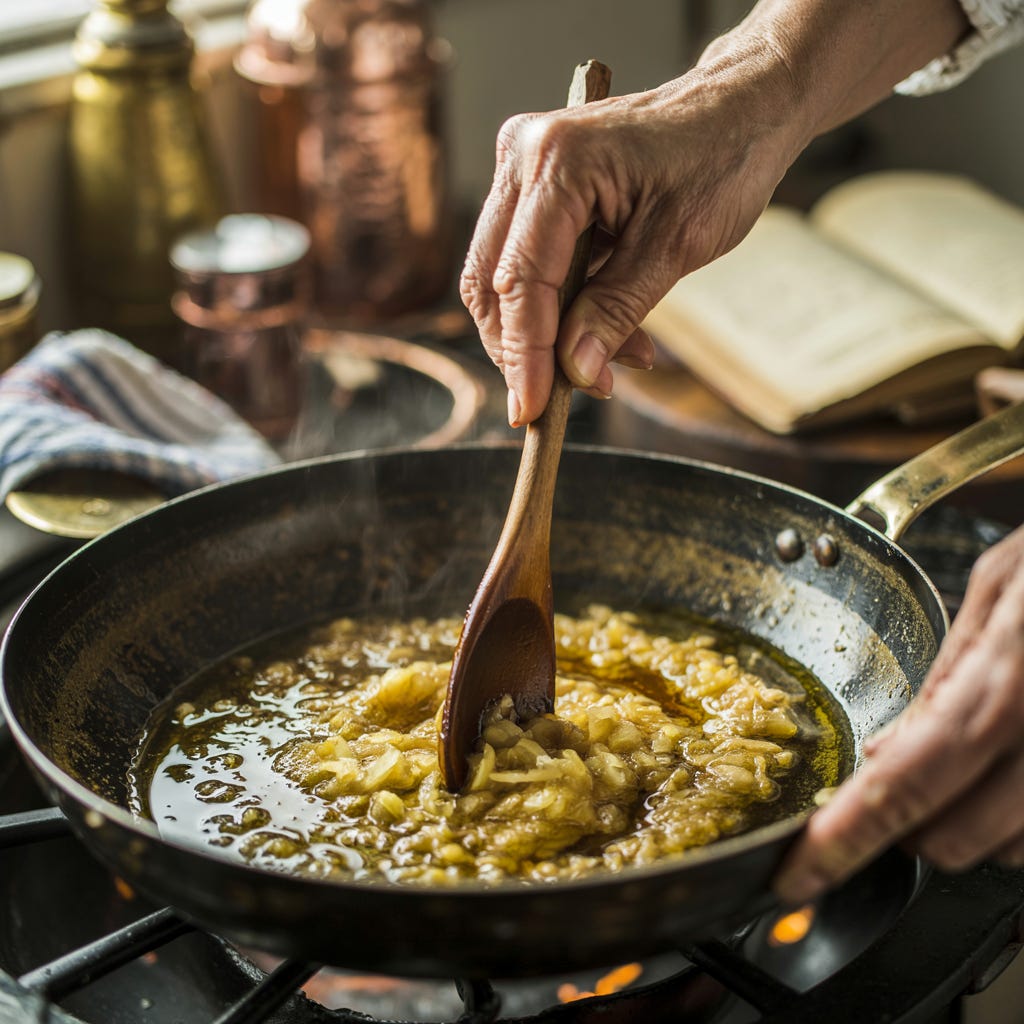
4. Add pearl onions + quartered onion
Add whole pearl onions and the remaining quartered onion. Cook until soft, sweet, and slightly caramelised — about 10 minutes more.
5. Add tomatoes + kumquats
Add yellow cherry tomatoes and kumquats. Let them collapse and melt into the sauce, stirring occasionally. Their juices should balance the onion’s richness.
6. Stir in yogurt
Lower the heat. Slowly whisk in the yogurt (optionally stabilized with chickpea flour), stirring gently to avoid splitting. Let it simmer briefly until thick and glossy.
7. Add roasted aubergines
Fold in the blistered aubergines. Simmer uncovered for 5–8 minutes to allow flavours to mingle.
8. Finish
Scatter over the charred onion petals, fried onions, and fresh coriander and/or mint leaves.
🧅 Why This Works
Onions in four forms give architecture, contrast, and depth.
Aubergine acts as the perfect “carrier”—soft, smoky, generous.
Kumquats add brightness without sourness.
Yellow tomatoes lift the colour and echo the citrus.
Yogurt restores the Mughal richness Jewish versions lost.
👉 Get your recipe card here.
Give it a try.
Not sure its worth giving up your freedon for, but to me it’s the kind of onion dish that earns its tears…
✨ All posts are free; paid subscriptions are optional, and your support is deeply appreciated.
💬 Share your story in the comments, or pass this essay along.
📖 To support more work uncovering Jewish food in unexpected corners of the world, consider subscribing to Beyond Babylon.
This is masterful, Eli. Your dopiaza doesn't just restore the lost architecture, It expands the whole blue print. Layering of hamis with charred petals and kumquats is something very inspiring.
Reading this after publishing my own was like watching someone unfurl the other half of a map. Same language of onions in different dialects. I am moved and inspired to dive into more recipes, that may came from the same part of the history , Just different sides.
Another excellent piece, a little history, a story, and a gorgeous recipe. Well done.