
Dol, Dol, Dol
The Sound of a Cochini Coconut Fudge Stirring Its Way to Calcutta

Today we will have something lighter - and sweeter.
This essay begins with a single recipe that appears once, almost in passing. The question is not how it is made, but why it is there at all.
Doldol appears only once in the Jewish culinary record I work with - in Copeland Marks’s The Varied Kitchens of India. It does not appear in Mavis Hyman’s Indian-Jewish Cooking. It does not appear in Claudia Roden’s The Book of Jewish Food. It does not appear in my own family memory.
Marks describes it briefly: a coconut-milk fudge, eaten with coffee or tea, permissible after meat because it contains no dairy. He suggests it comes from Cochin - perhaps because coconut points south.
That small suggestion turns out to be right.
But not in the way one might expect.
Doldol: A Sweet That Traveled
Doldol (also spelled dol dol or dodol) is a dense, glossy sweet made from coconut milk, rice flour, and sugar or jaggery, stirred and cooked slowly until it reaches a chewy, toffee-like consistency. Dark, sticky, and deceptively simple, it belongs to a family of sweets that appear wherever coconut, starch, and patience coexist.
At first glance, doldol resembles Kerala’s black halwa, particularly the famous Kozhikode halwa. Both are dark, sticky, and cut into slabs. But the resemblance is visual rather than structural. Black halwa is built on ghee and water, its lineage tied to Arab–Malabar halwa traditions adapted to jaggery and flour. Doldol, by contrast, is architecturally coconut-based: thick coconut milk supplies both fat and body, producing a chewy, elastic sweet closer in technique to Southeast Asian dodol than to Indian halwa. Where black halwa belongs to the market, doldol belongs to the home.
Black halwa represents a local Kerala evolution of Indian halwa traditions. Doldol, by contrast, is an Indian Ocean coconut sweet that settled in Kerala. They converge visually but diverge genealogically.
What makes doldol interesting is not its ingredients, but its movement - and the fact that its name already records that movement.
Across the Malay world, dodol does not primarily name a thing. It names an action, and even a sound. In Malay and Javanese, the word is widely understood to echo the heavy, rhythmic motion of stirring a thick mass in a pot: the repetitive dol… dol… dol… of a wooden paddle dragging through viscous batter. The word is onomatopoeic, born not of origin stories or place names, but of process and sound. It emerges from the act itself.
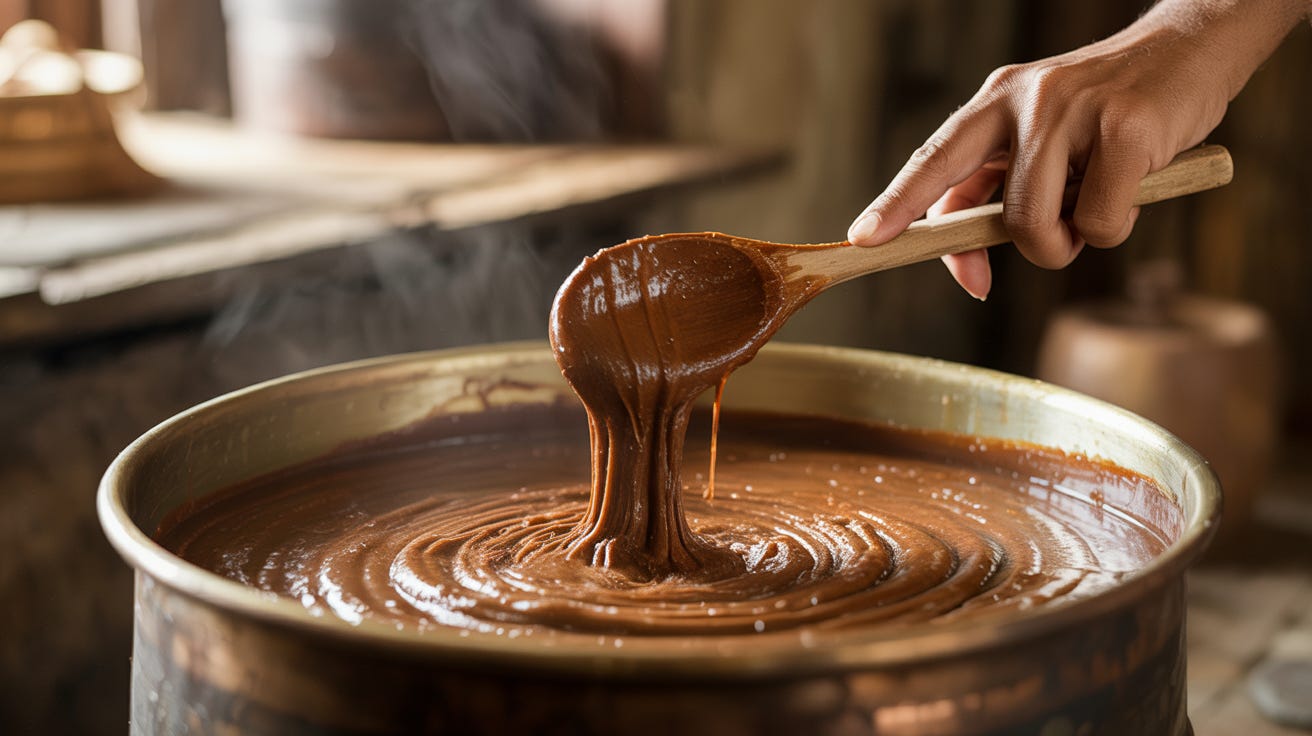
Dol dol.
The name comes from the sound: a spoon dragging through thickening sweetness.
A dish whose name is tied to motion rather than location is already predisposed to travel. Dodol names something that happens - not where it began.
Versions of this sweet appear across regions once linked by Indian Ocean trade and later by colonial circulation: Indonesia and Malaysia, Sri Lanka, Goa, Kerala, Anglo-Indian enclaves, and Jewish homes in Cochin and Calcutta. The ingredients - coconut milk, palm sugar, rice flour - are indigenous to Southeast Asia, as is the technique of slow reduction until the mixture thickens and releases its oils. What is not indigenous is the later geography.
That expansion follows not migration so much as circulation. From the sixteenth century onward, Portuguese networks linked Southeast Asia to India’s west coast, creating corridors through which techniques, tastes, and domestic practices moved. Goa absorbed dodol into its Catholic festive repertoire, where it became a Christmas staple alongside bebinca. From there, the sweet travelled further south, settling easily into Kerala and Tamil Nadu, where coconut-based halwas were already familiar.
Food historian Bridget White-Kumar’s description of Anglo-Indian doldol as a “black halwa - like Christmas delicacy” is useful here. It situates the sweet not as an exotic import, but as something that made immediate sense locally - a form that could be recognised, adapted, and made at home.
This essay is not about proving where doldol “comes from,” but about understanding how it moves, how it settles, and how a word that began as a sound in a pot became a marker of shared domestic practice across cultures.
Onomatopoeia: Naming Sound Before Meaning
Onomatopoeia is a linguistic phenomenon in which a word is formed by imitating or echoing a sound associated with the action, object, or process it describes. Unlike descriptive or etymological naming - which often points to origin, function, or classification - onomatopoeic words arise directly from sensory experience.
These words are shaped by the ear rather than by taxonomy.
Across languages, onomatopoeia commonly appears in early speech, in verbs of motion, and in contexts where sound is repetitive, rhythmic, or difficult to abstract. The resulting words tend to be short, doubled, or phonically blunt. They prioritise recognisability over precision.
Importantly, onomatopoeia does not name what something is, but what it sounds like while happening. The meaning is inseparable from action. A drip, a hum, a buzz, a knock - these words do not describe an object or a place, but a moment.
Because of this, onomatopoeic terms are unusually mobile. They translate easily across contexts, often surviving migration and adaptation because they remain intelligible even when other linguistic structures change. Sound travels where explanation does not.
Only once this principle is understood does it become meaningful to notice how sometimes food is named this way - and what it reveals when it is.
Sound as Origin: Onomatopoeia and Culinary Naming
Doldol belongs to this small and revealing class of foods whose names arise from sound - more precisely, from the sounds produced during cooking itself.
In the culinary realm, such naming is rare, and when it occurs, it almost always points to process rather than product. The name does not describe what the food is; it records what the cook does and how it sounds when he does it.
Across the Malay world, dodol is understood less as a noun than as an echo of action. The repeated syllable mirrors the repetitive labour required to make it: the steady, dragging pull of a wooden paddle through thickening batter; the dull resistance of starch, sugar, and coconut milk as they bind. The word captures duration and effort. It is a sound stretched across time.
In Malay and Indonesian food vocabularies, several staple foods derive their names from sound-symbolic roots. Bubur, a black rice porridge we once showcased, carries doubled syllables associated with bubbling and simmering.
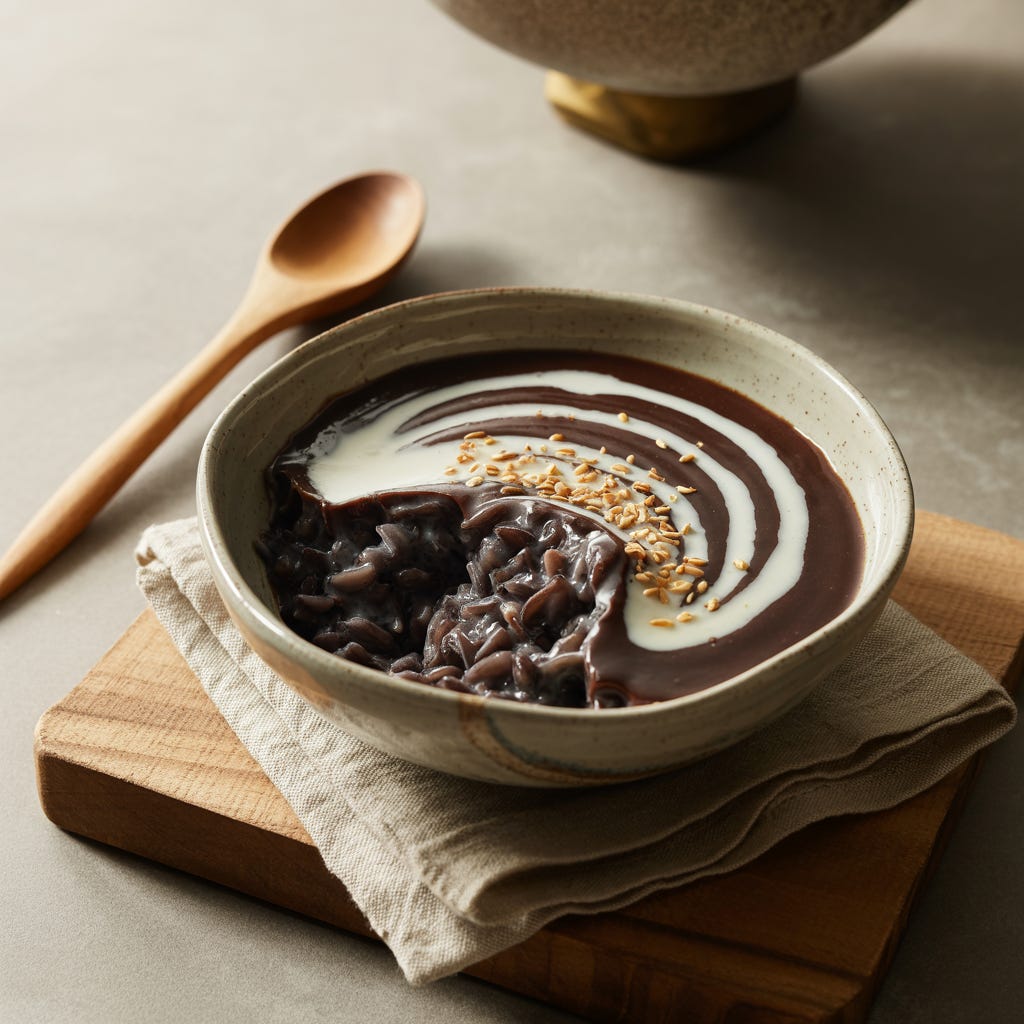
Bubur
Rice reduced to softness.
The sound of simmering, remembered in the name.
Kukus, meaning steamed, echoes the hiss and release of vapour. These words do not point outward to origin or inward to identity; they point downward, to the pot.
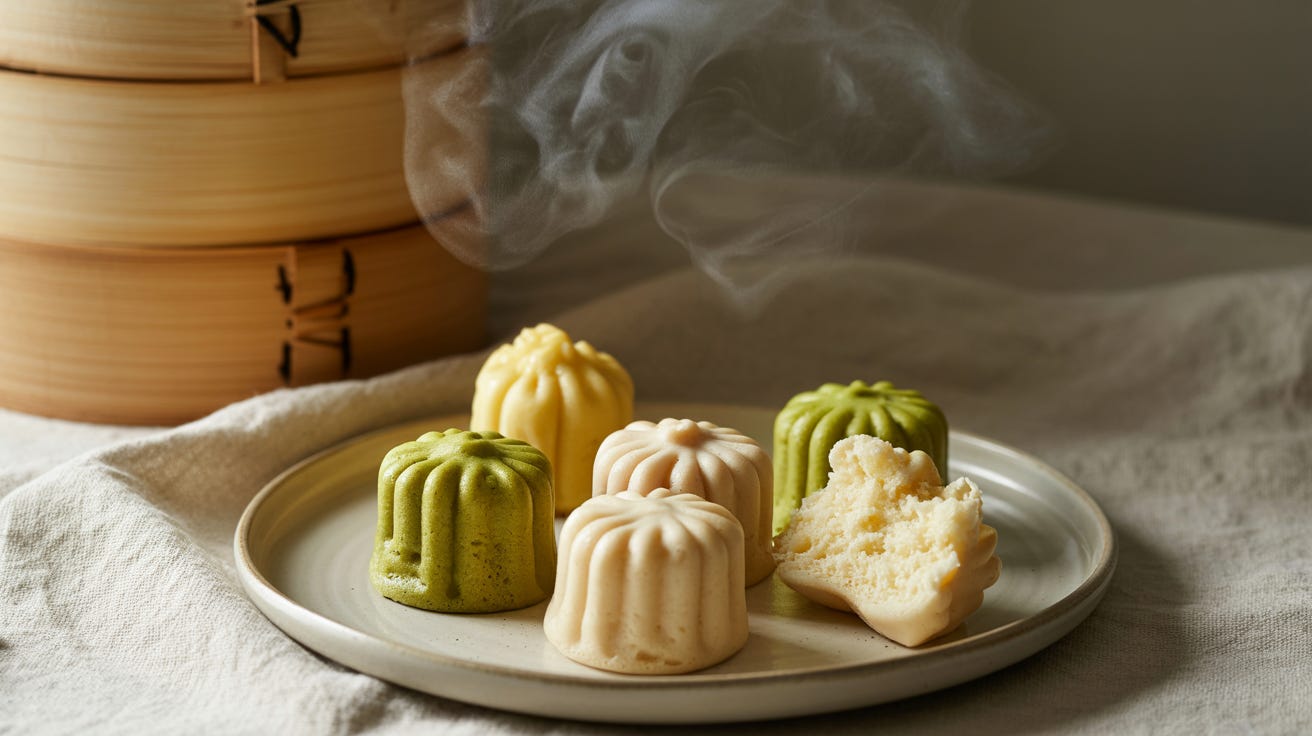
Kukus
Steam, contained.
The hiss that names the act.
Outside Southeast Asia, the pattern appears again in different forms. Popcorn in English is named for the sound of heat rupturing kernels. The word captures the instant of change, not the ingredient itself. Even informal culinary terms like sizzle or chop-chop begin as sound, only later settling into names for dishes or techniques.
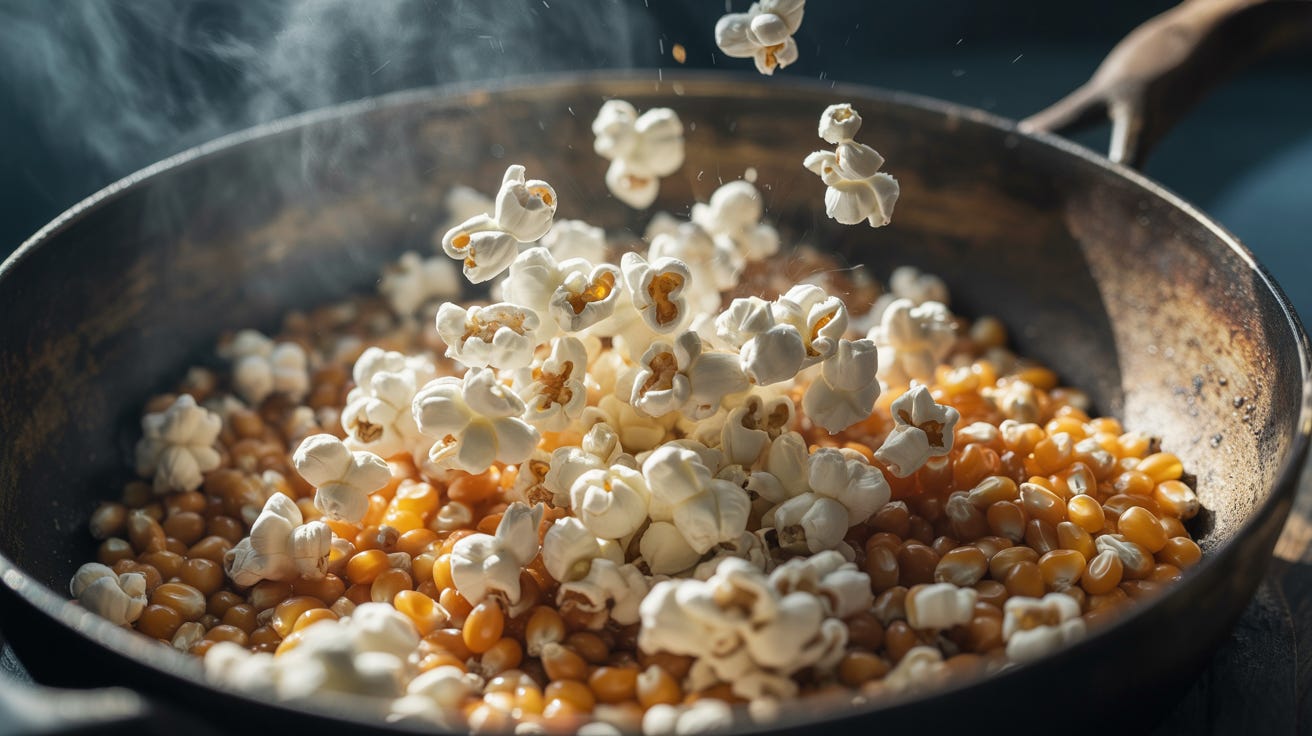
Popcorn.
A food named for its moment of becoming: heat, pressure, and the audible crack that turns kernel into cloud.
What unites these examples is not language family but function. Onomatopoeic food names arise where cooking is repetitive, audible, and communal - where sound accompanies labour. The name becomes shorthand for a process everyone recognises.
Doldol fits squarely within this pattern. Its name does not anchor it to Java, Goa, Kerala, or Calcutta. It anchors it to motion: to stir, to thicken, to persist.
Foods named after places tend to defend borders. Foods named after people accumulate authority. Foods named after sounds remain mobile. They describe something that can happen anywhere the conditions are right: coconut milk, sugar, starch, heat, and time.
Before it becomes a symbol of migration, doldol is already a record of motion - not across maps, but across pots.
Jewish Kitchens: From Cochin to Calcutta
For Cochini Jews, doldol was never a ritual sweet tied to the Jewish calendar. There is no evidence of it being required for Shabbat or festivals in the way merubba, almond halwas, or fried pastries were. Those sweets carried liturgical or calendrical meaning. Doldol did not.
Instead, it occupied a different position: familiar, secular, and regional. Living for centuries within Kerala’s foodscape, Cochini Jews encountered coconut-based halwas as part of ordinary life. Such sweets were known, sometimes made, and eaten alongside neighbours’ foods. Their durability, neutrality, and suitability for a humid climate made them practical in mixed social environments, where Jewish kitchens were never sealed off from their surroundings.
This distinction matters when the sweet is followed beyond Cochin.
The appearance of doldol in Baghdadi Jewish cookbooks from Calcutta reflects movement rather than inheritance. Baghdadi Jews did not arrive in India with this sweet as part of an Iraqi repertoire, nor does it belong to the canonical Baghdadi kitchen of Baghdad or Basra. Its presence in Calcutta is therefore not ancestral, but acquired.
That acquisition becomes legible once we consider the domestic ecology of colonial Calcutta. Anglo-Indian families - many with roots in South India and Goa - migrated east for work and settlement. They carried with them foods strongly associated with Christmas and domestic celebration, including doldol. Baghdadi Jewish households in Calcutta lived in close proximity to Anglo-Indian and Goan Catholic communities, sharing cooks, markets, and informal exchanges. It is within this shared domestic space that doldol enters Jewish kitchens.
Copeland Marks’s placement of doldol in a Baghdadi-Calcutta context can appear puzzling if read through origin alone. Read through movement, it makes sense. The recipe does not signal a pukka Baghdadi inheritance; it records learning. Marks’s archive captures a kitchen that absorbed what worked - foods suited to climate, scale, and everyday use - regardless of where they began.
The same pattern appears elsewhere in Jewish cooking.
When Ilanit Menachem shared her pastel filling recipe with me - a mixture of potato, egg, and chicken - I was struck by how closely it resembled my grandmother Ruby’s Shabbat lunch salad.
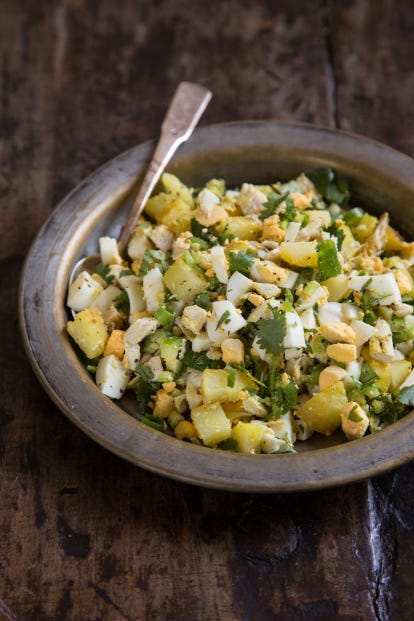
Egg, potato, chicken, coriander.
A structure that keeps reappearing - in kitchens that never met, yet somehow mirror each other.
That structure appears again in Iraqi Jewish foodways. The components of sabich - egg, potato, herbs, acidity - derive from Iraqi Jewish breakfast traditions. Here, the direction of travel runs the other way: an Iraqi breakfast becomes a sandwich in Tel Aviv, an egg salad in Calcutta, and a pastry filling in Cochin. A form migrates, adapts, and settles.
What emerges is not a single line of descent, but repeated circulation. A Malay coconut sweet arrives in Kerala through Portuguese circuits; it reaches Jewish Calcutta through Anglo-Indian kitchens. An Iraqi breakfast becomes a Shabbat salad; its structure reappears as a pastel filling. Nothing arrives intact. Everything is learned.
In Jewish kitchens, doldol does not mark ritual continuity. It marks contact. Its presence records how Jewish cooking in India functioned: attentive, pragmatic, and porous. Recipes entered not by declaration, but by usefulness. What traveled well traveled on.
The resemblance was not cosmetic. It was structural: the same components, the same balance, the same logic of assembly.
Not diffusion, but circulation.
A culinary doldol: not a fixed recipe, but the slow stirring of many pots.
Dol Dol (Coconut Creamy Fudge) - the recipe
From Copeland Marks, The Varied Kitchens of India, p. 109
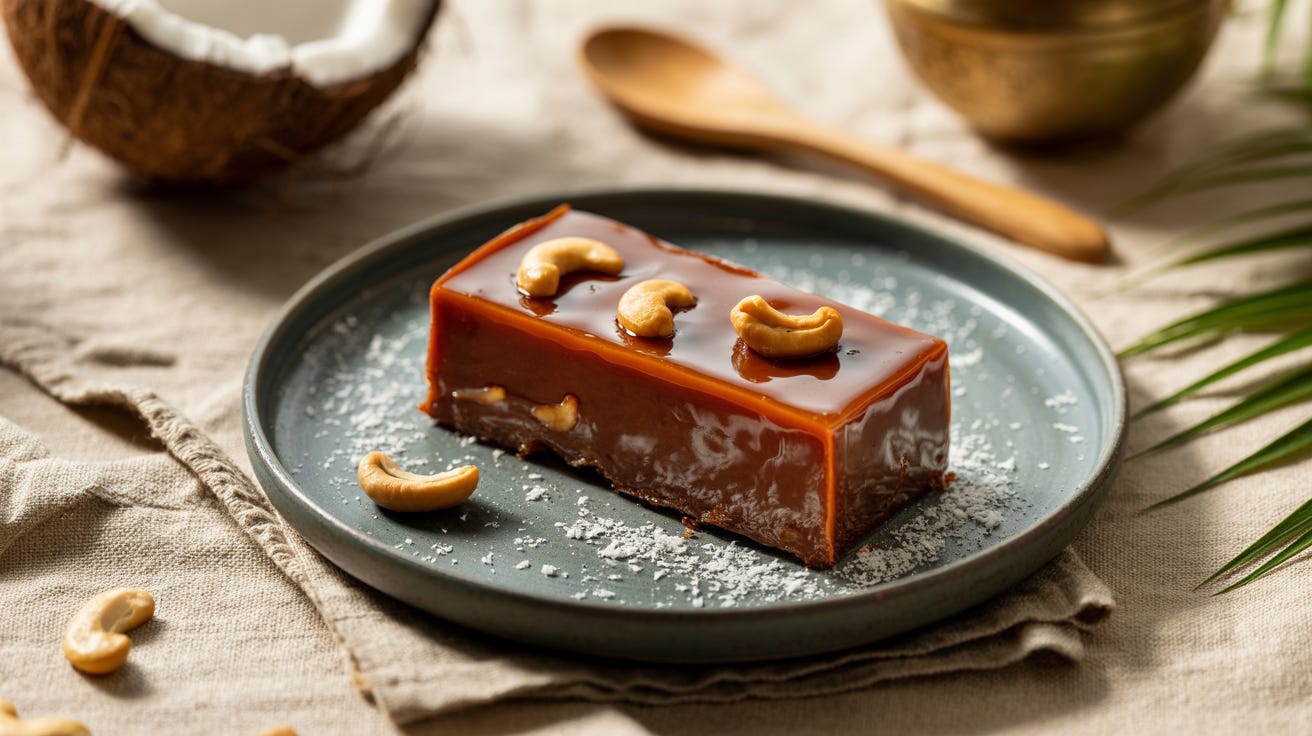
Makes about 20 pieces
Ingredients
6 cups rich coconut milk (see Index)
1½ cups rice flour
1½ cups sugar
1 teaspoon rosewater (optional)
Method
Mix the coconut milk, rice flour, and sugar well together in a large saucepan. Bring this to a boil over moderate heat, then turn the heat to low. Stir continuously to prevent burning and continue to simmer the mixture for 30 to 40 minutes. The mixture will reduce to a thick paste and the coconut oil will rise, giving a shiny appearance to the surface.
When the dol dol comes away from the sides of the pan toward the end of the cooking, add the rosewater if used and stir it into the mixture for 5 minutes more.
Turn out the dol dol into a glass or metal pan about 6 × 9 inches or a bit larger. Smooth over the surface. The fudge should be 1½ to 2 inches thick. Cut the fudge into generous diamond-shaped pieces.
Turn out the fudge pieces from the pan and serve at room temperature.
Note
Doldol is fragile and should be eaten the same day, or at most the next day, after it is made. It should not be refrigerated for longer than 1 day.
👉 Get your PDF printable recipe card here
Circulation
Trying to assign doldol a single origin misses what it teaches.
The sweet is a record of circulation - of a Malay technique moving through Portuguese routes, settling into Goan, Anglo-Indian, Cochini, and Baghdadi kitchens, and being reshaped just enough to remain useful. Its name already tells us this story. Doldol does not point to a place or a people. It points to motion.
The sound survives even as ingredients shift, sweeteners change, and communities move. Long before it becomes evidence of migration, doldol is already an archive of process: stirring, thickening, persistence.
This is why Copeland Marks cannot pin it down. There is nothing to pin.
Doldol belongs wherever it is stirred.
And that, perhaps, is the most honest archive we have.
✨ All posts are free; paid subscriptions are optional, and your support is deeply appreciated.
💬 Share your story in the comments, or pass this essay along.
📖 To support more work uncovering Jewish food in unexpected corners of the world, consider subscribing to Beyond Babylon.
Lovely post! Just saying the names brings a sense of intimacy and immediacy, sending you straight back into the kitchens of your childhood.
The bukbukbuk of porridge as it simmered gently. The hissss of nasi kukus as the grains swelled and the heady aromas wafted out.
As kids, we loved kueh tu tu - we always giggled when the brass moulds they were steamed in over charcoal went tuktuk-tuktuktuk in the most cheerful fashion.
And even today, I'll travel for hours to any stall that still sells kok kok mee. Roaming hawkers would announce their arrival in the neighbourhood by knocking a pair of chopsticks against a plate, hence the name.
There was no "one" kok kok mee. Every hawker had his own secret formula for ingredients, broths, toppings - and his own signature kok-kok-kok. That was what sent us running out the door to see if our favourite one was nearby.
Your post woke up such happy memories, thank you! Some foods really do transcend geography, first because you remember the hands that made them, the way they were made, how they were offered to you. And then because they live on in new hands that bring new life and energy to the processes that created them.