
Cracking Bitchees
How a bag of seeds carried a family habit from Baghdad to India to Israel

Before I ever learned that the word could be an English insult, bitchees was simply what my parents called sunflower and pumpkin seeds. The word embarrassed me, but they used it so naturally that it seemed entirely ordinary to them.
On weekends they would buy small bags of them, bitchees - black sunflower seeds and white pumpkin seeds - to crack while reading the newspaper or playing rummy.
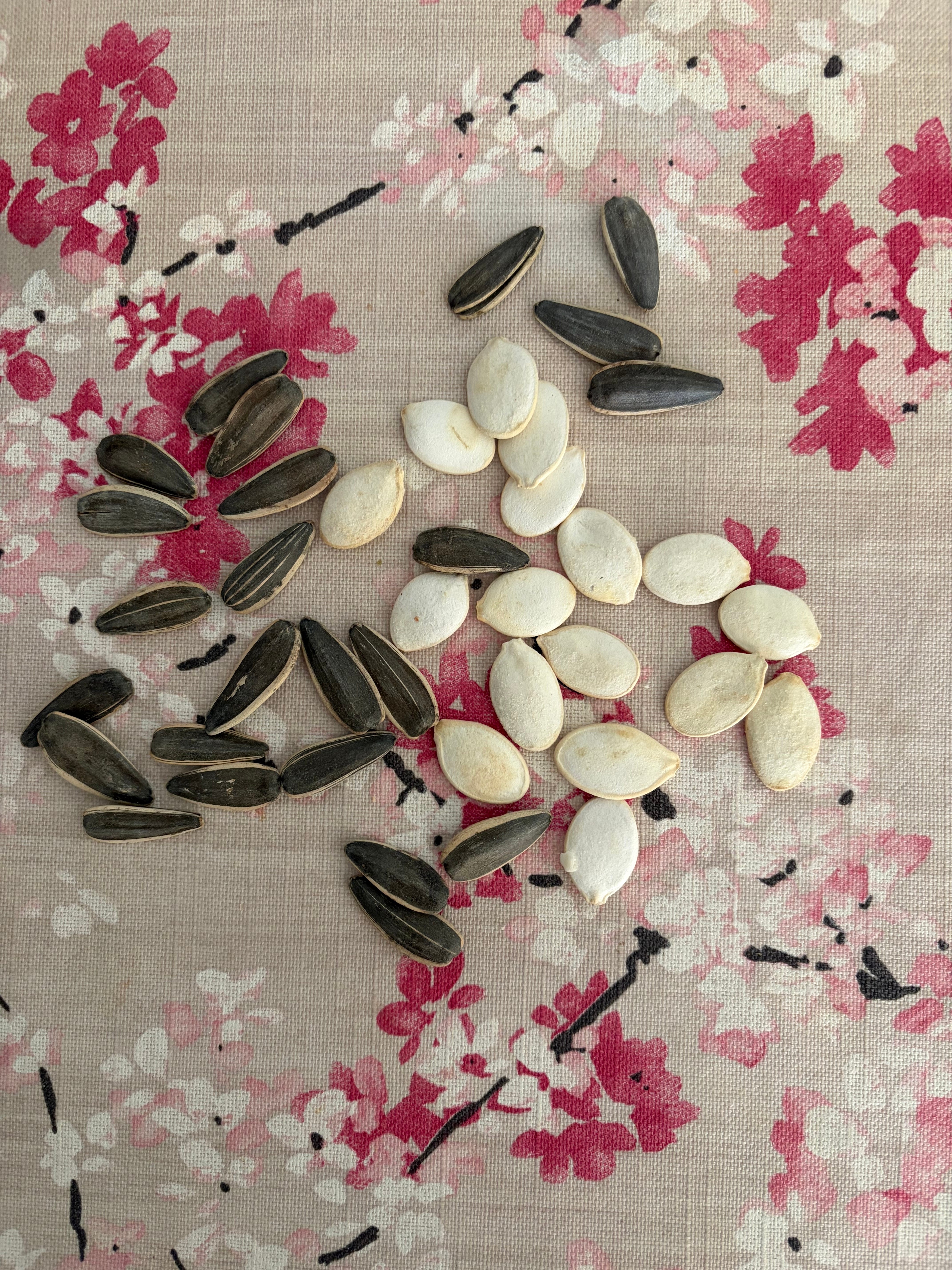
Sunflower and pumpkin seeds — “bitchees.” Israel, 2026.
For me it belonged to the same mysterious category of human abilities as putting two fingers in your mouth and producing a piercing whistle. I admired those who could do it but never joined their ranks. I was just not cool enough, or so I always thought.
Another bitchee anecdote stayed with me.
My brother once took me to see a house he had just bought. It was still under construction, and he hadn’t visited in months. But the backyard was strangely filled with pumpkin plants, little orange spheres dotting the grass.
Only later did we realize what had happened.
The neighbours next door had spent years sitting in their backyard eating pumpkin seeds and flicking the empty shells over the fence. Some of those seeds had landed in the soil and taken root. My brother had unknowingly inherited an accidental pumpkin patch.
Recently, while visiting my mother in Israel, I decided - if only for nostalgic reasons - to buy her a bag of bitchees, perhaps to take her mind off the nonstop bomb-shelter visits while rockets and interceptors whistled overhead.
Lately I have found myself collecting the stray words of childhood, trying to understand where they came from and to to catalogue them in a kind of family glossary - even though I sometimes seem to be the only one who still cares.
I began to investigate this strange family word.
The answer turned out to reveal something much larger.
Across South Asia it is common to eat roasted seeds as a casual snack. People sit, talk, and crack seeds while playing cards or passing the time - a scene that looks remarkably similar to balconies in Israel today.
The Hindi word for seeds is beej (बीज).
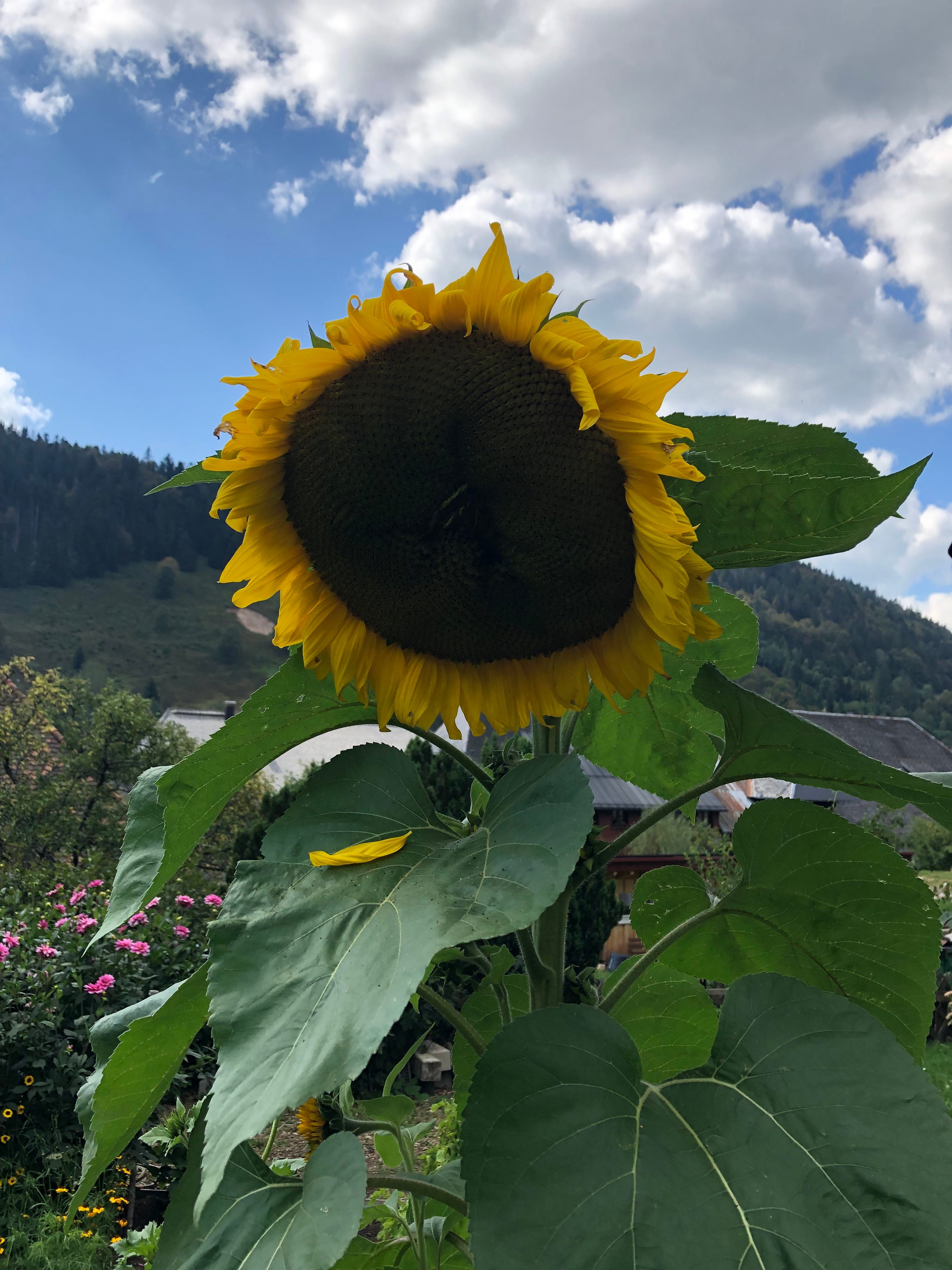
Sunflower, St. Blasien, Black Forest, Germany, 2023.
In everyday speech you might hear phrases such as:
surajmukhi ke beej - sunflower seeds
kaddu ke beej - pumpkin seeds
Phonetically, beej is very close to the word I remembered: bitchees.
In Baghdadi-Indian families where Arabic, Hindustani, and English mixed freely, words often shifted shape in the mouth. A word like beej could easily become something like beejes, beeches, or bitchees in family speech.
The seeds themselves also tell a historical story.
Pumpkins arrived in India after the Columbian exchange, when American crops spread across the Old World in the sixteenth century. Pumpkin seeds were soon roasted and eaten as snacks.
Sunflowers arrived somewhat later but eventually joined the same habit of seed-snacking.
But sunflower and pumpkin seeds were never the only ones.
Across India people snack on many kinds of seeds this way - watermelon seeds, melon seeds, roasted chickpeas, even fennel seeds served after meals as mukhwas.
The habit of cracking seeds while talking or playing cards existed long before sunflower seeds became common.
Which suggests something interesting: if my parents used the word bitchees, they must have encountered the habit earlier - perhaps already in Baghdad, and certainly in India.
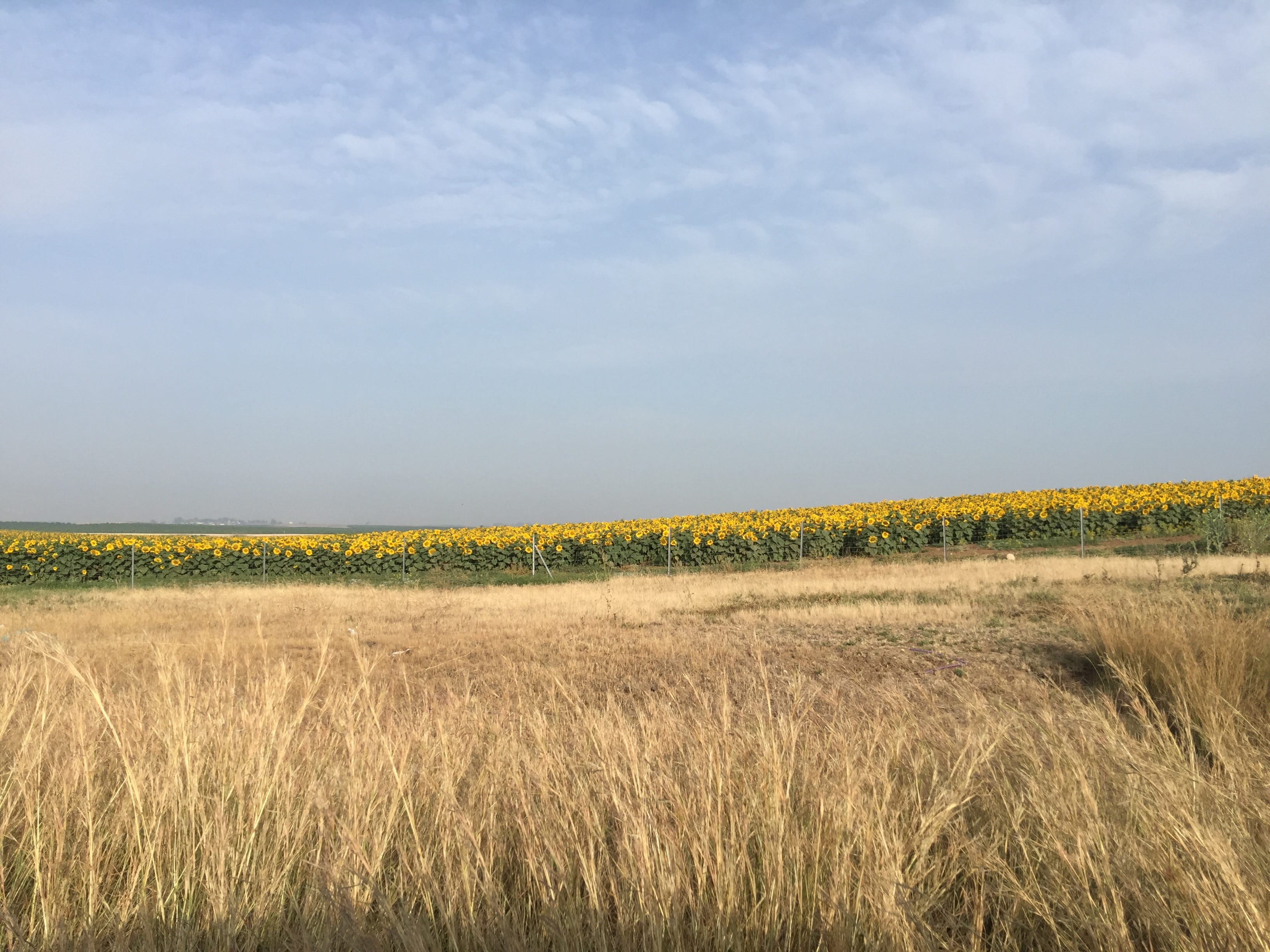
Sunflower field, southern Israel, 2016.
In fact, the habit stretches across much of the Middle East.
From Istanbul to Tehran to the Levant, roasted seeds are among the most common social snacks. Across the Levant people crack bizr (roasted seeds). In Turkey they are called çekirdek; in Persian-speaking Iran people crack tokhmeh late into the evening; across Syria, Lebanon, and Iraq the casual invitation to sit and share seeds is simply to eat ḥabb (حب). Bowls of sunflower, pumpkin, or melon seeds appear at card tables, beside games of backgammon (tawle), in tea houses, and at family gatherings.
The shells accumulate slowly as conversations unfold. Like olives or nuts around the Mediterranean, seeds are less a food than a rhythm of social life - something to occupy the hands and mouth while time passes in company.
Further north the habit appears again. In Russia and Ukraine people sit together cracking roasted sunflower seeds known as semechki, the shells gathering in small drifts beside park benches, train platforms, and football stadiums. In Spain they are called pipas, eaten in much the same way - slowly, conversationally, often by the handful during long evenings or public gatherings.
The habit is not confined to the Middle East or Europe. Across China roasted sunflower seeds - 瓜子 (guāzǐ) - are cracked in exactly the same way while people talk, play cards, or celebrate festivals. The practice goes back centuries: watermelon seeds were eaten in China long before sunflower seeds arrived.
From Istanbul to Tehran, from Baghdad to Beijing, from Odessa to Madrid, the simple act of cracking seeds has become one of the most durable social snacks of the Eurasian world.
Seen from this perspective, my childhood word begins to make sense.
Bitchees may have been a small linguistic fossil - a hybrid word shaped by Arabic, Hindustani, and English in a Baghdadi-Jewish household that had once lived in India and later in Israel.
The seeds had moved again - from the casual social snack of my parents’ balcony to the mortar and pan of a South Indian kitchen.
In Cochin I encountered another version of the same story.
One morning I ate dosas served with a chutney made from roasted pumpkin seeds, coconut, mustard seeds, and curry leaves.
Food travels.
But so do the small words families invent along the way.
If your household had its own strange word for an everyday food, I would be curious to hear it.
Pumpkin Seed “Bitchee” Chutney
A South Indian–style chutney inspired by the pumpkin seeds my parents called bitchees.
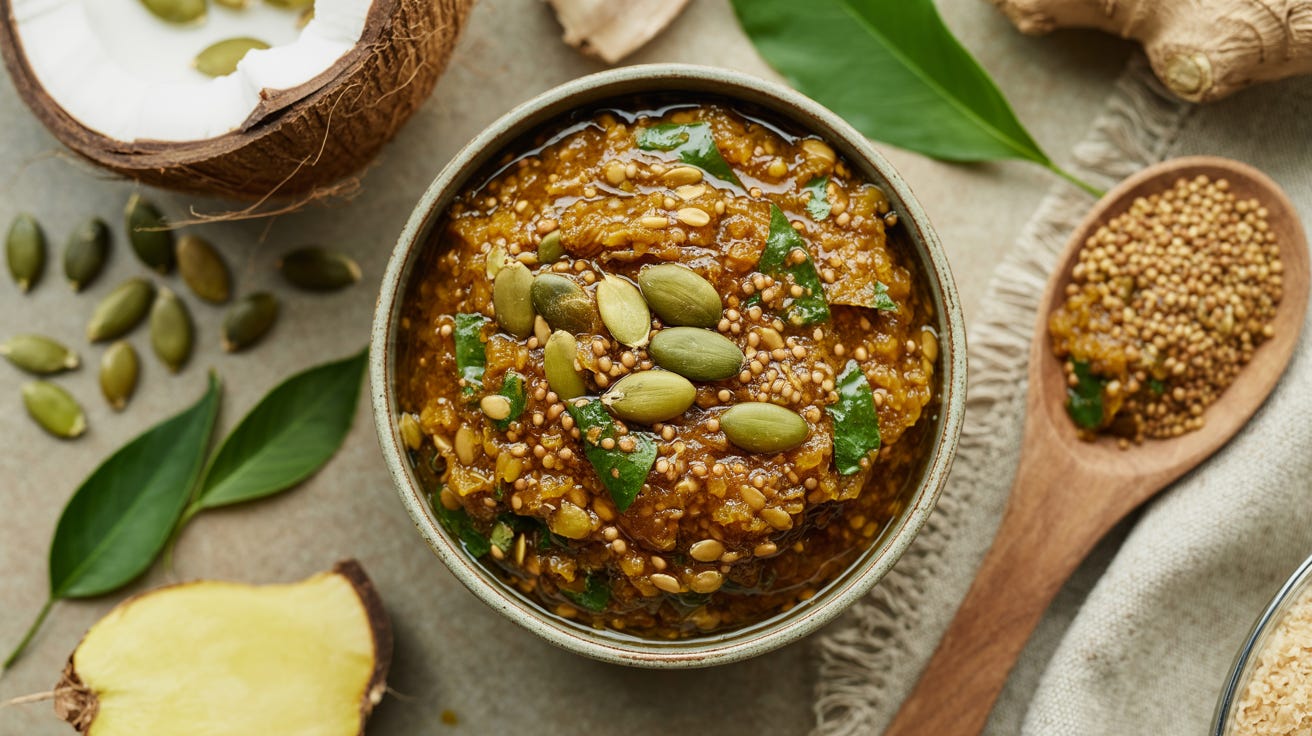
Where the balcony snack of Baghdad and Israel meets the kitchen of Cochin.
Ingredients
1 cup raw pumpkin seeds
2 tbsp coconut oil
½ tsp mustard seeds
6–8 curry leaves
½ cup grated coconut
1 small red onion, finely chopped
1 tbsp fresh ginger, grated
pinch cayenne or chili powder
⅓ cup coconut water (or water)
salt to taste
Method
Lightly grind half the pumpkin seeds in a blender or spice grinder. Leave the rest whole.
Heat coconut oil in a pan. Add mustard seeds and curry leaves and let them crackle.
Add onion and grated coconut and cook gently until soft.
Stir in ginger and chili.
Add the pumpkin seeds and coconut water and simmer briefly.
Season with salt and serve warm or at room temperature.
Note: For a more traditional South Indian finish, heat a teaspoon of coconut oil and briefly crackle mustard seeds, curry leaves, and a dried chili. Pour the hot oil over the chutney just before serving.
Serve with dosas, flatbread, or simply as a dip.
👉 Get your pumpkin seed “Bitchee” Chutney recipe here
If this essay resonated with you, I’m grateful you’ve read this far.
Beyond Babylon continues to trace Jewish life and food across unexpected geographies.
You’re welcome to subscribe or share the piece with someone who might enjoy it.