
Can rice poison you?
Part 1: The sticky truth about Rice
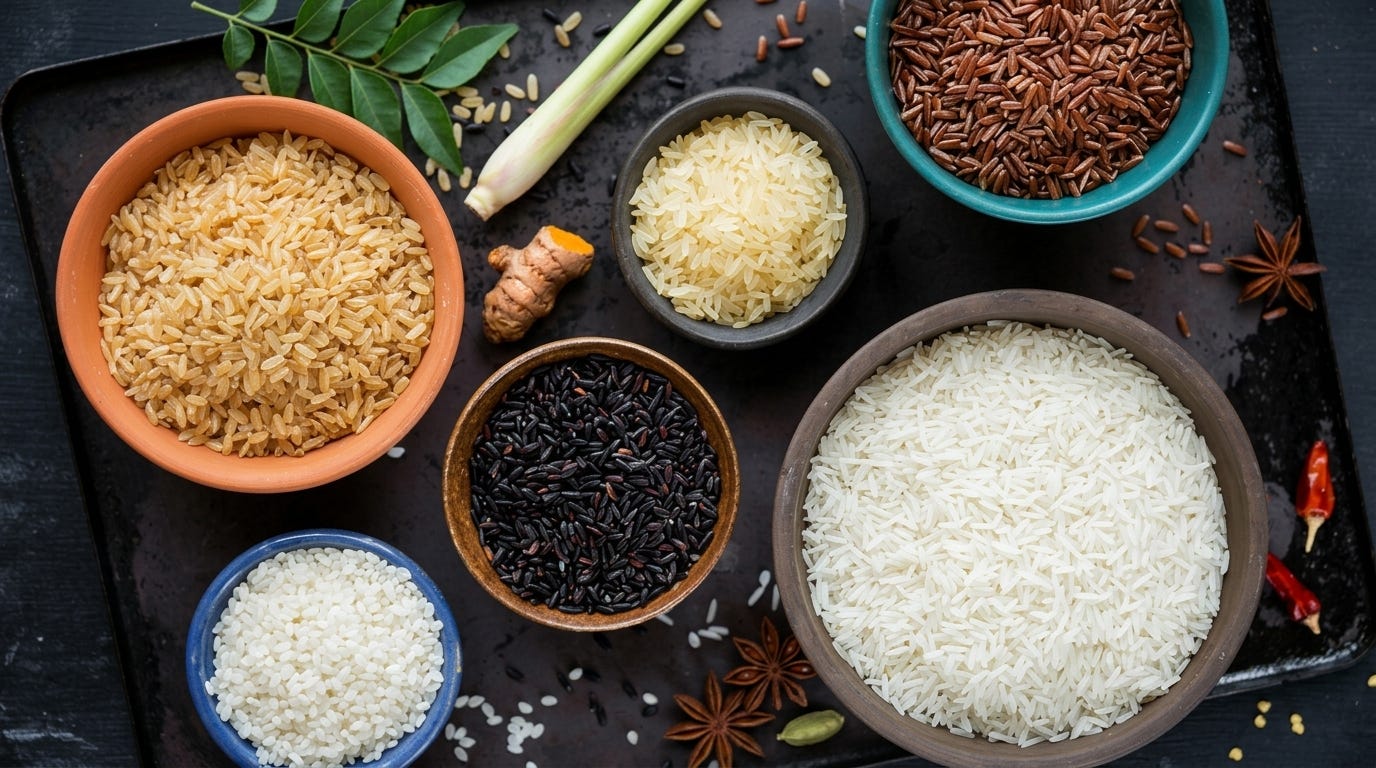
Rice is not one thing. Different grains, different starches, different cuisines - and often different histories of migration.
Beyond Babylon is a rice-forward blog. I grew up with rice as a staple and I write about it as such. Potatoes in the kitchens I explore were overwhelmingly part of the main, and even those potatoes are incomplete unless they are accompanied by rice (I remember being asked in Europe: what?? TWO carbs??)
But I am certainly not alone.
Rice is the most important food in the world. Not wheat. Not potatoes. Not maize. More than half of humanity depends on rice as a staple. For billions of people, the question is not whether they eat rice, but what kind, and how it is prepared.
Yet rice is one of the great culinary illusions. We speak of it as though it were a single ingredient. It is not.
Before I became a professional cook, I thought it was enough to love rice to understand it. I learned my family’s method - passed down without explanation, performed with the confidence of someone who has never once considered doing it differently. Rinse until the water runs clear. Fry briefly in oil. Cover with water to one centimetre above the rice line. Bring to a boil, then low heat, covered, until done. Fluff and serve.
The method was fixed. So was the grain. In my family the choice was between basmati and patna. Persian and jasmine were not even considered. That was already considered a choice.
When I became a professional chef in Switzerland, it took me a while to get used to that soggy side considered to be rice, often made with an Uncle Ben type parboiled product. I had no idea at the time quite how much that rice was hiding.
After experiencing both rice worlds, I thought what I knew was enough for a lifetime. It wasn’t. It turns out the grain I thought I understood was hiding more than one surprise.
The difference between basmati and arborio is not a matter of taste or preference. It is molecular.
Rice contains two starches: amylose, a long straight-chain molecule, resistant to heat, reluctant to release; and amylopectin, highly branched, eager to gelatinize, ready to cling. The ratio between them determines everything about how rice behaves in a pot.
Basmati is high in amylose. Each grain cooks separate, architectural, self-contained. Arborio and carnaroli are high in amylopectin - starch escapes into the liquid, and the cook’s constant stirring is not about preventing burning. It is about friction: coaxing amylopectin out of the grain and into the sauce. The Italian rice cook and the Indian rice cook are not disagreeing about technique. They are disagreeing about physics.
Jasmine sits between them - more amylopectin than basmati, softer, slightly clingy, built to absorb a sauce rather than stand apart from one. Sticky rice and sushi rice sit further along the same spectrum, prized not for separation but for cohesion.
The basmati cook wants definition. Each grain an individual. The sticky rice cook wants cohesion. Everything together, warm, inseparable.
One is amylose. One is amylopectin. I was not raised wrong. I was raised by a different starch.
The Baghdadi Jews who moved from Iraq into India did not merely encounter new spices, new languages, new climates. They encountered a new rice civilization - and then, as they moved onward, another, and another. Basmati in Bombay and Calcutta. Ponni and sona masuri in the south. Jasmine threading through the kitchens of Rangoon and Singapore. And beyond them, rice cultures built around grains that behaved in entirely different ways. Each grain a different starch ratio, a different philosophy of the pot. What the community carried was not a single rice but a willingness to learn each new one - and a loyalty, always, to the long-grained, amylose-rich basmati of the north Indian plain, the rice that tasted like home even when home was ten ports behind them.
That is the kitchen I grew up in.
That is the rice I am writing toward.
There is no perfect rice. Only rice suited to a particular tradition.
Tell me how you cook rice and I can often tell you where your culinary ancestors came from.
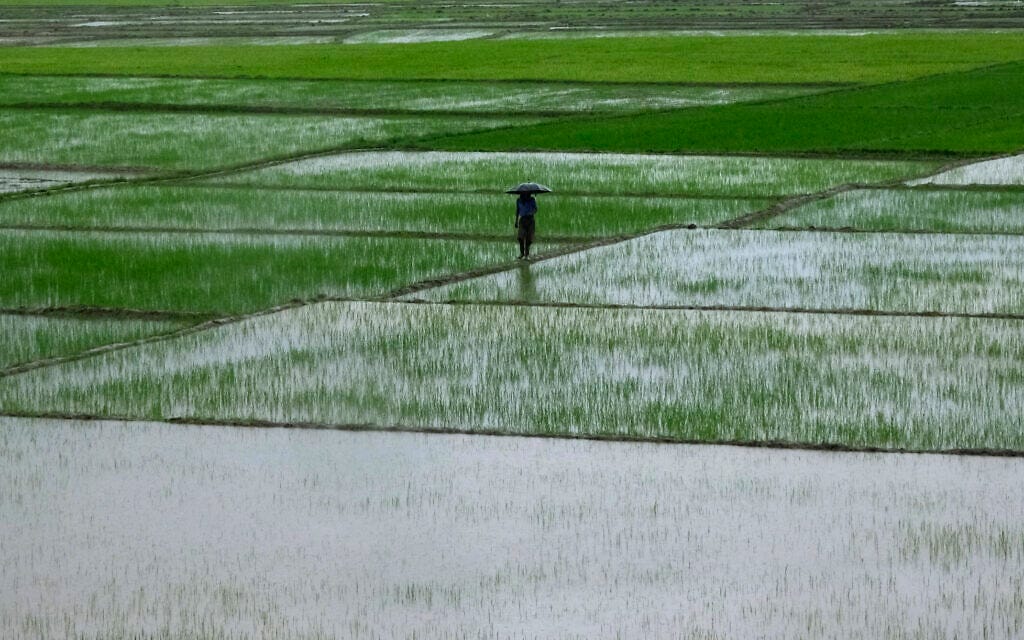
Rice is not one thing. Different grains, different starches, different cuisines - and often different histories of migration.
I grew up on basmati. My partner grew up on potatoes. We have managed. But I sometimes think the real test of a relationship is not rice versus potatoes. It is basmati versus sticky rice. That is the irreconcilable difference. That is Kramer versus Kramer. That is whether you squeeze the toothpaste tube from the top or the bottom.
There is, however, one thing my grandmother never taught me. Not because she didn’t know, but because nobody did - the science arrived after the habit was already ancient.
Arsenic.
Rice is grown in flooded fields, and flooding creates an oxygen-free environment at the bottom of the paddy where anaerobic bacteria decompose organic matter and mobilize arsenic from the soil into the water column. The rice plant absorbs it through its roots. It travels from flooded soil into water, from water into root, from root into grain, from grain onto your plate.
This is why rinsing rice until the water runs clear - which most cooks do, and should - removes surface starch and improves texture, but does relatively little for arsenic. The arsenic is locked inside the grain, not sitting on its surface.
Here is the first paradox: brown rice, widely considered the healthier choice, typically contains more arsenic than white. Arsenic accumulates in the bran and outer layers that polishing removes. The healthier grain carries more of the toxin.
Here is the second: where rice is grown matters as much as how. Rice cultivated on land previously used for cotton - particularly in the American South - tends to carry significantly higher arsenic levels than rice grown elsewhere. The reason is historical. Arsenic-based pesticides were used extensively in cotton farming for decades, and the residues remain in the soil long after the cotton is gone. The rice that grows there today is absorbing a legacy. California rice often tests lower. If you eat American rice regularly, origin matters.
What actually works against arsenic is cooking rice in excess water - six parts water to one part rice, then draining as you would pasta. This removes forty to sixty percent of inorganic arsenic depending on the variety. The best method, for those who want maximum reduction with minimum nutrient loss, is to parboil in excess water for five minutes, drain, then finish in fresh water on low heat. This removes up to seventy percent of arsenic while preserving most of the nutrients.
My grandmother cooked rice because she knew it worked. Food science arrived later and explained some of the reasons.
Rice looks simple because it is familiar. But beneath that familiarity lies a history of migration, chemistry, agriculture, memory - and yes, a toxin few people think about until they learn where rice comes from.
One grain. Thousands of cuisines. A world hidden inside a pot.
The same flooded fields that account for more than a third of all irrigation water on earth are also producing methane at a scale the planet can no longer absorb. If rice built civilization, what happens when the way we grow rice stops working?
In Part 2: whether it can be saved - and what saving it actually means.
The shape has not changed in a thousand years. Everything else is negotiable.
Beyond Babylon continues to trace Jewish life and food across unexpected geographies.
If this piece found you, feel free to share it.
Today I’m having sticky rice with my lunch and basmati rice with my dinner. I live in New York City, so all rice is good rice. 😄
I'm looking forward to part 2! I live in China and rice or noodles are inescapable 3 times a day. What alternatives do you tend to cook with when you want a dish that normally comes with rice, but you feel like you need some space? Please don't say potatoes, my English upbringing put potatoes on every plate 😂