
Can Rice Farming Be Fixed?
Yes, If We Can Grow Rice Without Flooding the Field

My grandmother’s method assumed water. Rinse off the loose starch, fry briefly, cover to a centimetre above the grain, boil, then cook over low heat until done. So does almost every pot of rice. And much of the grain that reaches that pot has already spent its life standing in water.
Every rice recipe begins by assuming the rice will be there. That assumption has held for so long that nobody thinks to examine it.
We also assume how rice grows. Flood the field. Plant the seedlings. Wait. The water suppresses weeds and provides the conditions in which rice flourishes. It is one of the most elegant agricultural solutions in human history. Asian rice was domesticated in and around the Yangtze basin. Over millennia, wet-rice cultivation spread across much of Asia, feeding cities and civilizations that could scarcely have existed without it.
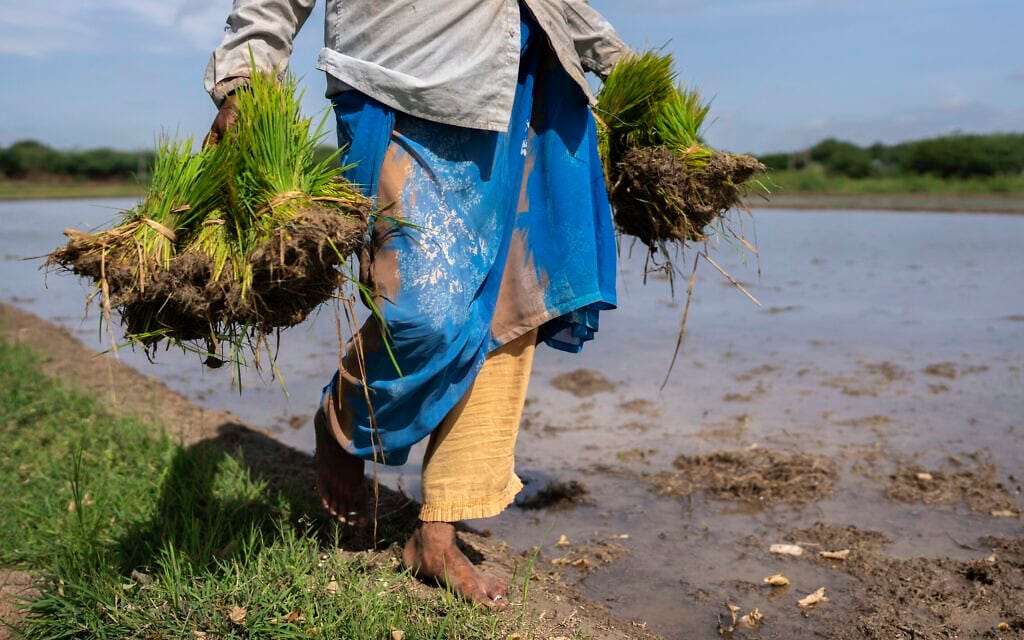
Plain: Transplanting rice seedlings into a flooded field.
Rice does not need to grow in standing water. About eleven percent of the world’s rice area is upland, neither flooded nor irrigated. It is simply that rice tolerates waterlogged soil better than most of its competitors. Flooding suppresses weeds and gives the crop a considerable advantage. That is the trick, and farmers have built much of the world’s rice cultivation around it.
It has worked for millennia. But the system carries three costs that are becoming harder to ignore.
It can draw arsenic into the grain. Flooding creates oxygen-poor, chemically reducing conditions in the soil. Microbial activity helps dissolve the iron oxides to which arsenic is bound, releasing it into the water around the roots. There, much of it takes the form of arsenite, which rice absorbs through some of the same transport pathways it uses to take up silicon.
It travels from soil into water, from water into root, from root into grain. As the first part of this series established, ordinary rinsing removes very little because much of the arsenic is inside the grain, not merely on its surface. How much reaches the grain depends on the geology of the soil, the irrigation water, the rice variety and the farming method. Flooding is not the only variable. It is the condition that makes arsenic more mobile.
None of this is visible in the pot. The grain arrives white and clean and indistinguishable from any other.
It emits methane. In my previous essay, can rice poison you, we spoke about how the same oxygen-free conditions allow methane-producing microbes to flourish. Methane has roughly eighty times the warming power of carbon dioxide over a twenty-year period. The Food and Agriculture Organization attributes about eight percent of human-caused methane emissions to rice paddies; some recent scientific reviews put the figure between ten and twelve percent.
It uses water at a scale that is becoming harder to sustain. Irrigated rice receives an estimated 34 to 43 percent of the world’s irrigation water. The rivers and aquifers feeding the great rice-growing regions of South and Southeast Asia are under increasing pressure, from falling groundwater levels in Punjab to drought and salinity in the Mekong Delta.
For centuries, dry places solved the problem of rice by importing it.
Coasts that could not grow enough of the grain built maritime economies to bring it in, and whole cuisines organized themselves around something the land could not provide.
In the Negev desert, farmers confronted the larger problem differently.
They changed the way water reached the plant.
I remember drip irrigation from my childhood in Israel. In orange groves, and even along ordinary streets, black tubes circled the trees, releasing water according to timers. I did not know that I was looking at a recent invention. It already seemed part of the landscape.
In 1965, Kibbutz Hatzerim joined forces with the engineer Simcha Blass to establish Netafim around a new form of drip irrigation. Blass had recognized that water delivered slowly and directly to the root zone could produce more growth with less waste. Commercial production began the following year.
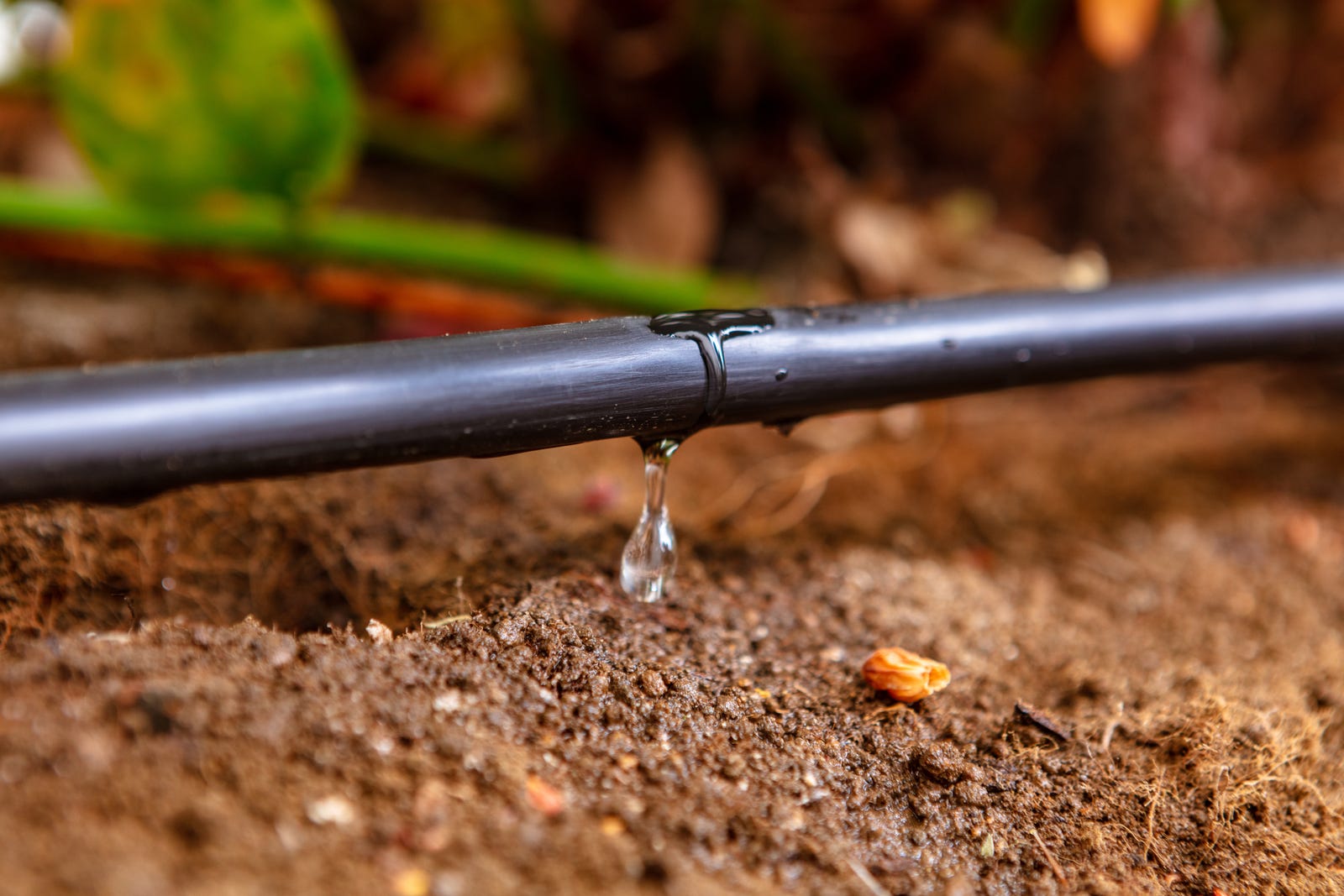
Blass had recognized that water delivered slowly and directly to the root zone could produce more growth with less waste. (courtesy Netafim.India)
Netafim became one of the world’s largest precision-irrigation companies, eventually operating in 110 countries and delivering water to cotton, citrus, tomatoes, sugarcane and, after years of research, rice.
The difficult part was never the drip line. It was producing rice commercially at competitive yields without standing water. The entire grammar of conventional lowland rice cultivation assumes submersion: the transplanted seedling, the flooded paddy, the suppression of weeds and the drawdown before harvest. Replacing flooding required different planting methods, different spacing, varieties suited to drier conditions and a new relationship with weeds, which could no longer simply be drowned.
Netafim reports substantial results from its rice projects: sharply reduced water use, methane emissions falling close to zero in some cases, significantly lower arsenic uptake and yields at or above those of conventionally flooded fields.
Those are the company’s figures from particular sites, not independently established outcomes across the world’s rice systems. Independent field research supports the direction of those findings: reducing the time soil remains flooded generally lowers methane emissions and often reduces arsenic in the grain. But independent research has not established Netafim’s full package of claimed reductions across the world’s rice systems.
Netafim's own presentation of its rice programme. The company's claims are its own; independent field research supports the direction but not the full package. (courtesy Netafim India).
Results vary by soil, climate, variety and management, and drier cultivation can increase weed pressure, nitrous oxide emissions or cadmium uptake.
Drip irrigation is also not the only route, or the cheapest.
Alternate wetting and drying allows the water level in a paddy to fall below the soil surface before the field is flooded again, rather than keeping it continuously submerged. Where farmers can control irrigation, the method may require little more than a perforated tube to show how far the water table has fallen. It can reduce both water use and methane emissions, although the results vary considerably from one field to another. Early work also suggests the change is not entirely invisible in the pot: rice grown this way has been found slightly chalkier, and slightly softer when cooked, than rice from continuously flooded fields.
The differences are small and the research is thin, but almost nobody has looked.
Direct seeding, which skips the labour of transplanting seedlings into a flooded field, is also spreading across South Asia. Farmers are adopting it partly because agricultural labour has become scarcer and more expensive, not necessarily because of methane or arsenic. Both methods are already being adopted at substantial scale and are more accessible to many small farmers than complete drip-irrigation systems.
That is worth saying plainly, because the reason drip irrigation has not transformed global rice cultivation is not simply that Netafim’s owners failed to understand its importance.
Netafim also passed through several owners. Permira acquired a controlling 61 percent interest in 2011. The Mexican conglomerate Mexichem, later renamed Orbia, bought 80 percent in 2017, valuing the whole company at $1.895 billion. by 2025, Orbia was looking for another buyer. A proposed sale to a Chinese investor subsequently ran into American regulatory difficulties. The rice projects multiplied. The global transformation did not come.
The rice projects multiplied. But the global transformation did not come.
It is tempting to blame owners whose principal interests lay elsewhere. But the obstacles sit at least as much in the field as in the boardroom: conversion costs, pumps and filtration, maintenance, weed pressure, access to credit, uncertain returns and the difficulty of changing a practice carried out on roughly 144 million farms worldwide, most of them smallholdings.
Carbon credits are often presented as the mechanism that will finance the transition. They may help. Early Netafim projections suggested that the system might generate around ten carbon credits per hectare annually. At the carbon prices cited at the time, that represented gross revenue of a few hundred dollars per hectare, before verification, administration and project costs. Meaningful at the margin, perhaps. Not a windfall, and not yet income reaching rice farmers at scale.
Which brings me back to the rice pot.
Everything in this series has been about a grain that arrives from somewhere else. In the kitchens I write about, rice often did, moving through the ports of Bombay, Calcutta, Rangoon, Singapore and Shanghai and across the Arabian Sea toward Persia, a loyalty maintained across ten ports and four generations.
The rice was never local. It was never supposed to be. What made those kitchens possible was that the grain kept coming.
That is the part nobody thinks to worry about. We write beautifully about rice. We argue about the correct crust on a tahdig, the resting time for a biryani, whether the grain should be rinsed once or three times. I have written that way myself, at length. We ask whether the recipes will survive, whether anyone still knows how a dish was made, whether the women who cooked from memory wrote anything down before they died. Those are the right questions, and I have spent years asking them.
But they all assume the rice. And they assume it will always be available.
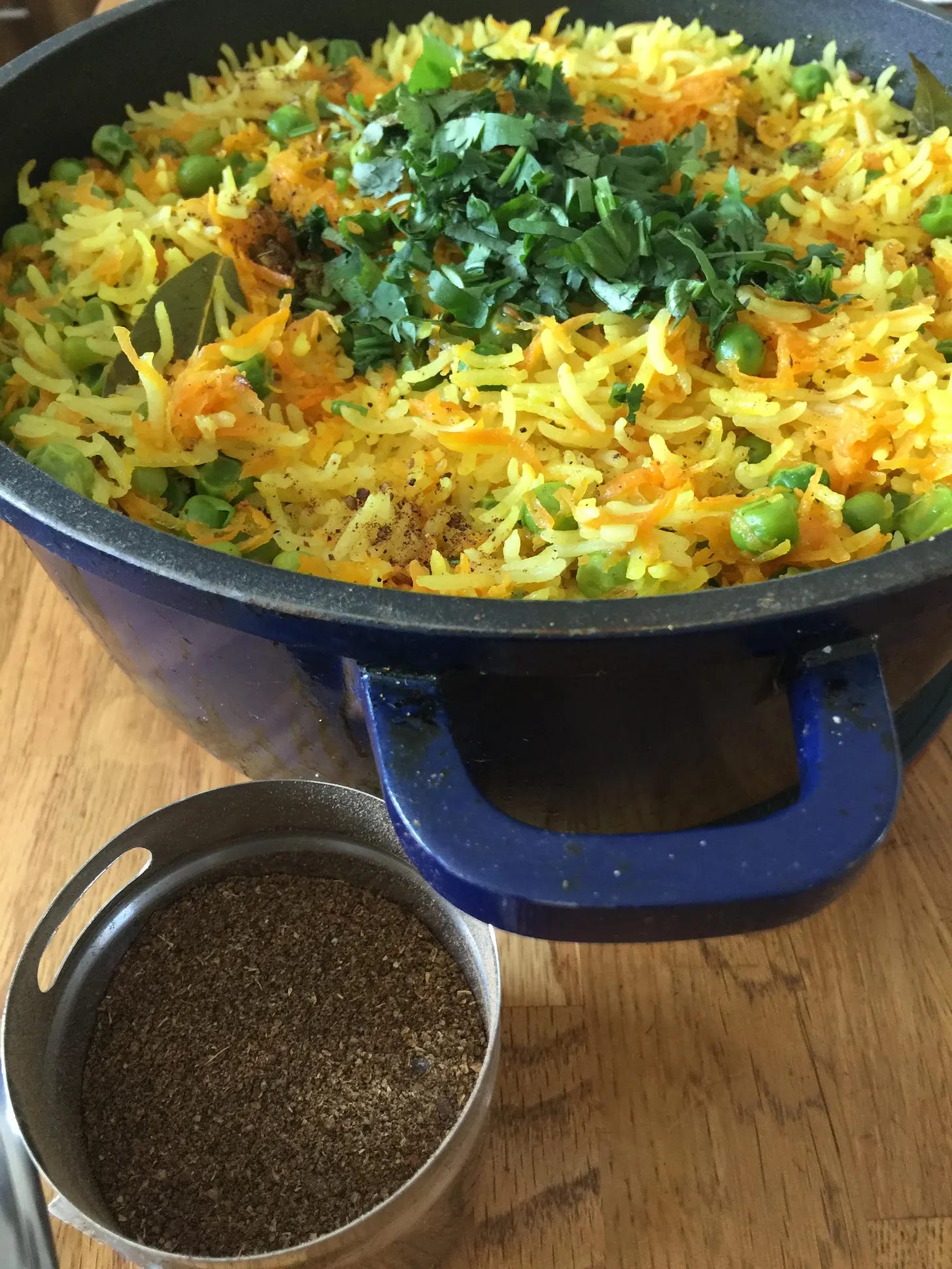
Pilau. The recipe begins with rice.
They assume the grain will keep travelling, that a field somewhere will keep producing it, and that the water will still be there when the farmer needs it.
That assumption is getting harder to make.
Rice itself does not need fixing. The way much of it is grown does.
Stimulating post. I know that there is considerable discomfort with paddy rice agriculture among environmentalists. And, of course, calls to try alternative grains like millet (this is a big thing now in China as modernization has brought the usual health problems, and older people look for healthier options than refined grains). But here is a question I have, and it is probably a silly one: the Chinese are very picky about their rice, and there is a distinct preference for the slower growing, Japonica varieties. The texture, fragrance, flavor--all of this is different. So I wonder whether there is a way to make highland rice more appealing to the Chinese-- a lot of the fast growing, drought-free varieties from Song to the Socialist period met with resistance from Chinese consumers.
Interesting, but: I can find no evidence that farmers rotate between plots or terraces.
Likewise, I cannot substantiate this claim that the head of manageme is always the person farming the plot at the bottom of the terrace. The subak leader is elected by the members. I found no evidence that leadership automatically belongs to the downstream farmer.