
Breaking the Chains
Chad Gadya and the Logic of Violence

Not every structure is a recipe.
Some are inherited the same way.
I heard Angelo Branduardi on the radio today, singing Alla fiera dell’est, and it brought me back to the Passover Seder of my childhood.
The original song is called Chad Gadya - “one lamb,” in Aramaic.
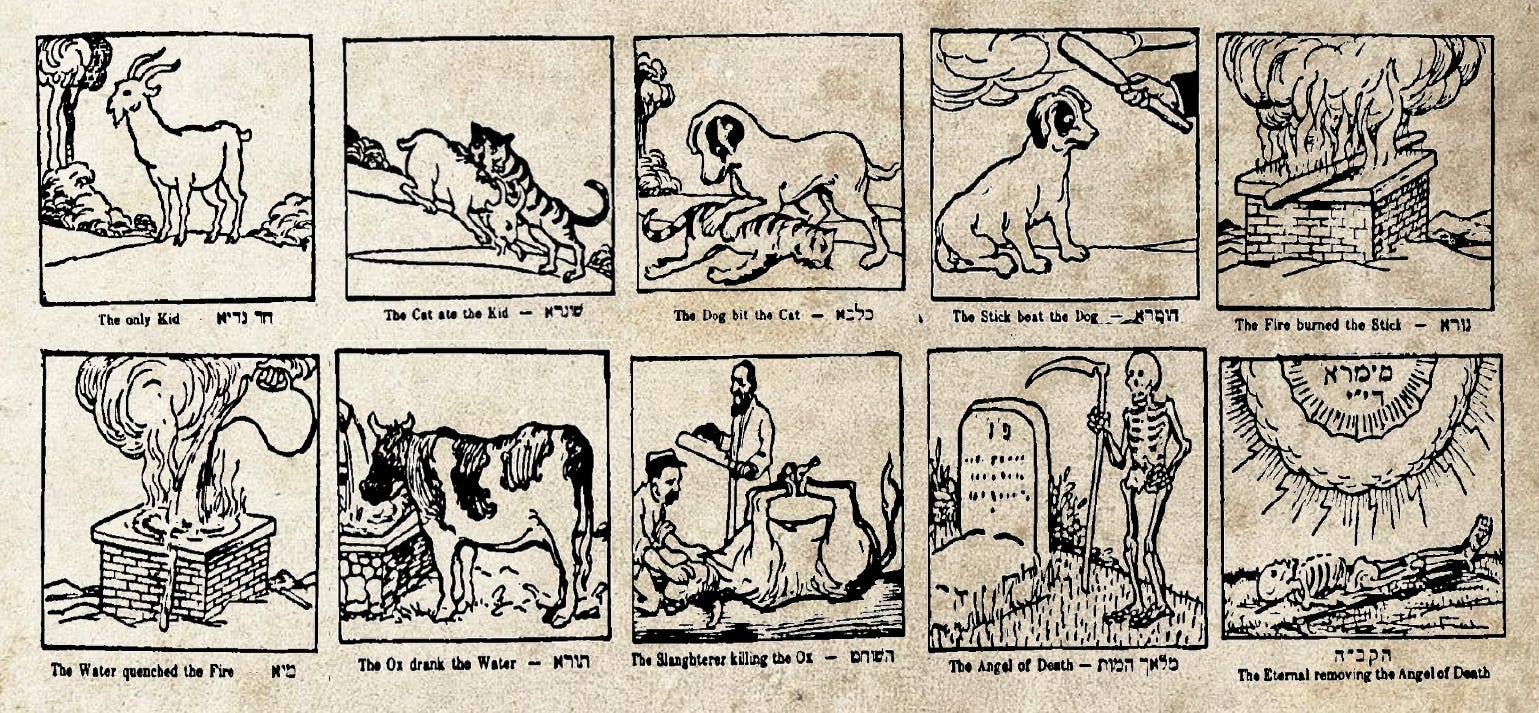
Chad Gadya sequence from a late 19th–early 20th century illustrated Haggadah
It is sung at the very end of the Passover Seder, built as a chain: one act answered by the next - cat, dog, stick, fire, water - until the sequence ends with god.
The Seder is the ritual meal held on Passover night, where families gather to retell the story of the Israelites’ escape from slavery in Egypt.
The very word Seder means structure in Hebrew.
The entire evening is structured by the Haggadah - the liturgical text that combines narrative, symbolic food, song, and performance, collapsing past into present and telling the story of a people across time.
One of those songs is Chad Gadya, recited at the very end.
Written in a mix of Hebrew and Aramaic, Chad Gadya unfolds as a cumulative chain of escalating acts: a young goat bought for two coins, eaten by a cat; the cat bitten by a dog; the dog struck by a stick; the stick burned by fire; the fire extinguished by water; the water drunk by a bull; the bull slaughtered by a butcher; the butcher taken by the angel of death - until, finally, god intervenes in a last act of violence against the angel of death.
It sounds like a children’s rhyme.
It isn’t.
Its authorship is unknown. It entered the printed Haggadah in Prague in 1590, though versions circulated earlier across medieval Europe.
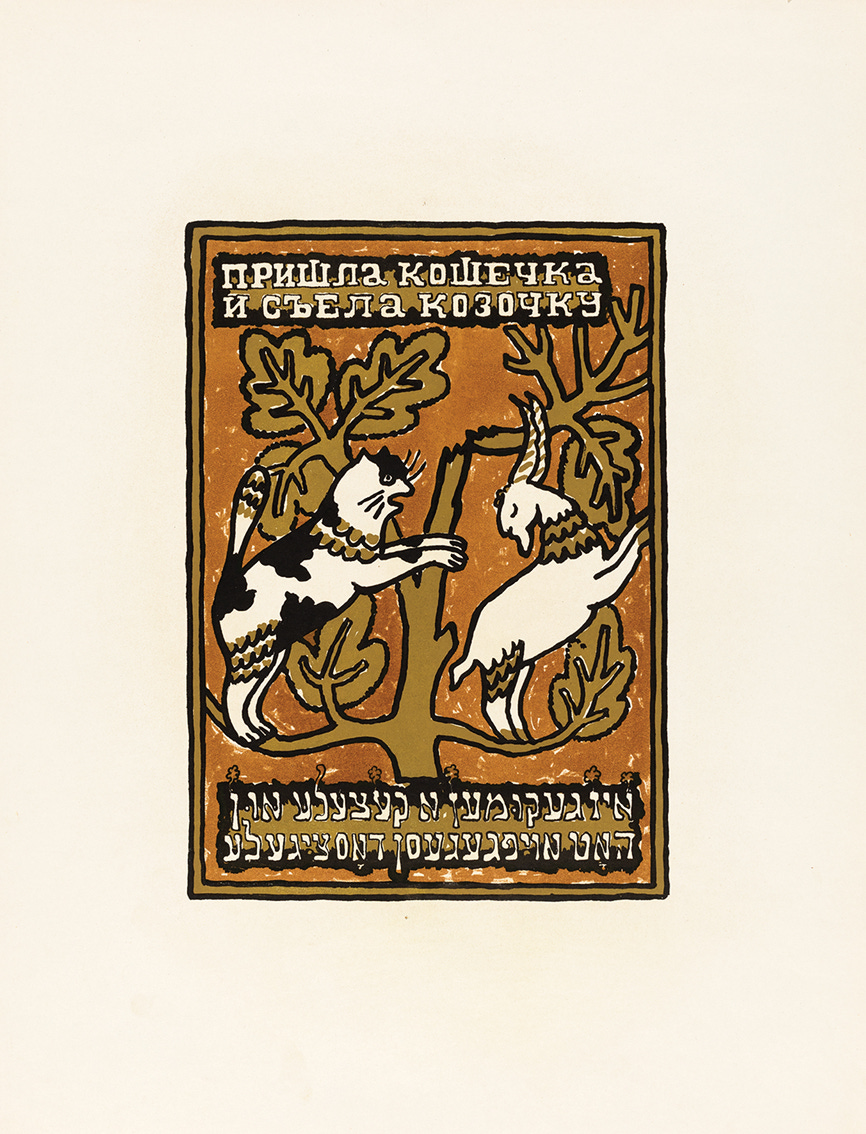
A traditional Eastern European Chad Gadya illustration, most likely from a late 19th–early 20th century printed Haggadah. The text at the top is in Russian/Cyrillic (“the cat came and ate the goat”), and the bottom line is in Yiddish (Hebrew script).
Its instability across versions - goat or mouse, coin or coinage - marks it not as a fixed text, but as part of a wider folklore ecology.
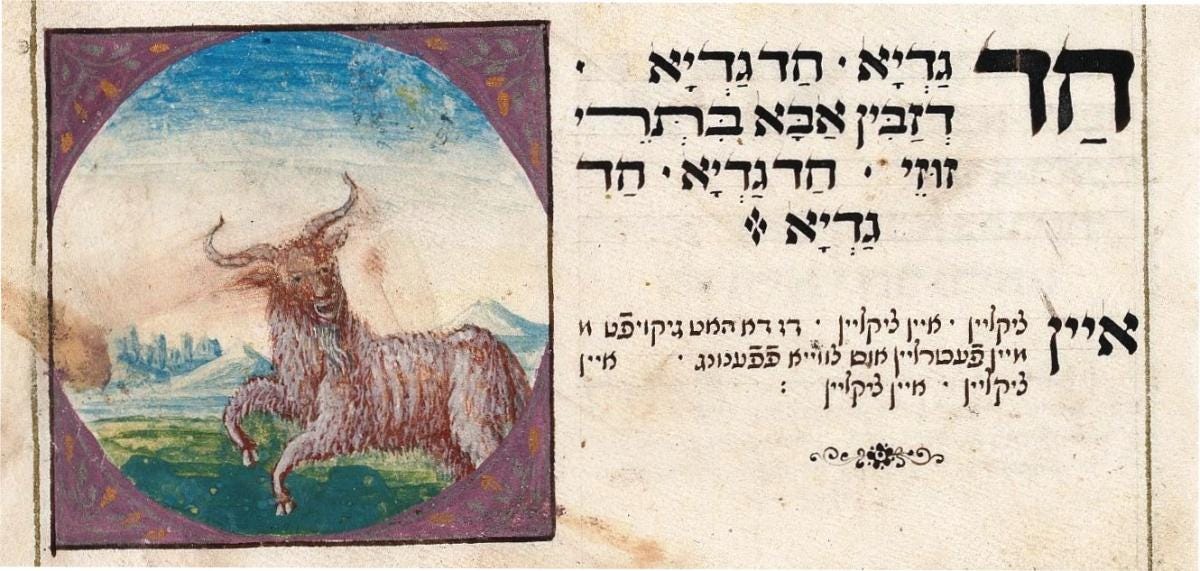
This image is a traditional illustrated Haggadah page of Chad Gadya—the opening stanza with the goat (“חד גדיא”), with Yiddish transliteration, a visual form that has appeared in many manuscripts and printed editions over centuries.
Chad Gadya belongs to the long tradition of religious fiction: parable, fable, didactic narrative. Its value is not factual, but structural. It teaches how to believe the world works.
Traditional readings see in it an allegory of empires - each replacing the last, a chain of domination that cannot end on its own.
Chad Gadya has its own Seder - its own structure.
Its structure is precise. Each verse repeats the previous chain and adds a new agent. Each stage is resolved by violence, but violence does not resolve; it accumulates. Justice appears only as succession. No one acts out of character.
The sequence begins in the market. A father buys a kid - not out of malice, but for food, or perhaps for sacrifice. An ordinary act. A permitted one.
From there, the chain moves by substitution: the cat eats, the dog bites, the stick strikes, the fire burns, the water extinguishes, the bull drinks, the butcher slaughters.
By the time the butcher enters, the logic of nourishment is still visible - but no longer decisive. We no longer think food. We think just desserts.
When god enters, it is not to reconcile but to strike - ending the sequence not through resolution, but through a final act of force.
The language of the song is also not fixed. It appears across Jewish languages and geographies, shifting in form but not in structure.
Yehoram Gaon, a Sephardi Israeli voice, sings Chad Gadya in Ladino (Judeo-Spanish).
Un cavretico.
Another language. The same chain. (Credit Youtube).
I remember loving the song as a child because it told a story, one with a beginning and an end.
And I love stories, as much as I love storytelling.
At some point, I turned it into a performance: each family member was assigned a verse. A meowing cat was easy, a barking dog too. But then it became harder - stick, fire, water, butcher, angel of death, and finally, god.
It required imagination, and a willingness to inhabit roles one did not fully understand.
We laughed. It made the song lighter. It made it playable.
In 1976, Angelo Branduardi relocated this structure to an Italian fair. Alla fiera dell’est replaces the ritual frame with a marketplace, the ancient “two zuz” coinage with everyday currency, and the goat with a mouse. This substitution is not arbitrary: variants of the song across Europe already feature a mouse, situating Branduardi’s version within a broader transregional tradition. Something closer to commedia dell’arte than to story.
Musically, the tone shifts from didactic to carnivalesque. Folk-baroque instrumentation - violin, lute, woodwinds - produces a circulating, almost festive energy.
Violence becomes spectacle.
But it remains violence.
The structure remained.
And that structure began to trouble me.
Each act appears justified because each figure acts according to the role nature or society assigns to it, and does what is expected of it: the cat eats, the dog bites, the stick strikes, the fire burns, the water extinguishes, the bull drinks, the butcher slaughters, death takes.
Violence becomes inevitable,
not by intention,
but by inertia.
By the time the chain reaches death itself, the system has no internal stopping point.
The final intervention - god defeating the angel of death - does not emerge from within the chain. It interrupts it from outside.
But it does not change the logic.
Order is not produced.
It is imposed.
God does not break the chain. He fulfills it, legitimises it.
And even then, the logic does not change. god triumphs over death by killing it.
George Carlin once said that talk of the “sanctity of life” is selective - that it is we who decide whose life is sacred, and whose is not.
Chad Gadya does not argue this.
It performs it.
Once you see it this way, the song changes.
And I began to look for an alternate meaning.
Chava Alberstein - Israeli singer-songwriter - transforms Chad Gadya into a question: who strikes next?
The chain does not end. It begins again. (Source: YouTube)
In 1989, Chava Alberstein takes that same melody and turns it into a question: who strikes next?
Placed against the First Intifada - a largely civilian uprising marked by protest, repression, and cycles of retaliation - the song ceases to be allegory.
It becomes diagnosis.
In Alberstein’s final stanza, the return to Chad Gadya is no longer a refrain but a verdict.
The chain does not end.
It begins again.
What was once a sequence becomes a structure that sustains itself. The victim has learned the role of the predator. The logic no longer requires interruption from outside.
Violence continues through inertia.
She makes this explicit:
“And in every generation
the one who is beaten becomes the one who beats.
And the one who is oppressed
becomes the one who oppresses.”
The chain is no longer a story.
It is a pattern.
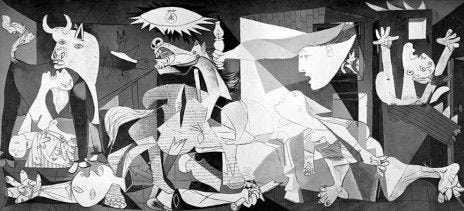
In Guernica, Pablo Picasso’s 1937 depiction of the bombing of a Basque town, that pattern appears without sequence. There is no first blow and no final answer - only a field in which violence has lost its order but not its force.
If Chad Gadya teaches how violence escalates, and Alberstein asks how it repeats, Guernica shows what remains when repetition no longer even requires time.
A world in which everything acts according to its nature is also a world in which the only imaginable end is a greater violence still.
The sequence ends.
The structure does not.
What changes is not the pattern, but its authority.
Violence becomes the norm.
That is the danger.
Not that violence exists,
but that it becomes justified - first as function, then as justice, and finally as divine will.
If the chain is to be broken, it will not be broken from above.
Everything that enters from above becomes part of the chain.
The only break is refusal.
Not to act according to role.
Not to answer force with greater force.
Not to become what the structure requires next.
The chain does not depend on violence.
It depends on obedience.
The chain does not stop itself.
It stops here.

The chain does not stop itself. It stops here.
If this essay resonated with you, I’m grateful you’ve read this far.
Beyond Babylon continues to trace Jewish life and food across unexpected geographies.
You’re welcome to subscribe or share the piece with someone who might enjoy it.
Refusal without fear has always been the key to breaking the chain. Not an easy feat.
Fascinating, as always.
Magnificent, I think. It is always fascinating to see what a children's song can reduce to be examined under a lens of what adults wrought