
Bird Food
How Prussia’s eighteenth-century Sparrow Wars brought the house sparrow to the Jewish table

This essay was triggered by a discussion in a family WhatsApp group.
My cousin had posted something about the Jewish dietary laws governing birds. Buried in it was a reference to an old German Jewish custom: in Frankfurt and Halberstadt, the leaders of the Jewish communities had once slaughtered sparrows publicly every year, so that the tradition that the bird was permitted would not be forgotten.[1]
Halberstadt is the German city where my mother was born. Her father, Rabbi Dr Hirsch Benjamin Auerbach, served from 1932 to 1938 as the last rabbi of its historic Jewish community, before that community was destroyed under Nazism. He was the fourth generation of the Auerbach family to serve as a rabbi there.
This was no marginal provincial congregation. Halberstadt had once been the largest Jewish community in Prussia and became one of the principal centres of German Orthodoxy: a place of synagogues, schools, scholarship and an unusually durable Jewish institutional life.

Berend Lehmann established a Klaus, a house of study, around 1700 and financed the magnificent Baroque synagogue inaugurated in 1712, and razed in 1938. A photo that hung in my grandparents’ apartment in Tel Aviv.
The Halberstadt line began with Benjamin Hirsch Auerbach, who took up the rabbinate in 1863, and continued through his son Selig and his grandson Isaac Emil to my grandfather, Hirsch Benjamin.[2] They were observant Jews and thoroughly German. They believed that centuries of belonging placed both identities in harmony and beyond question. The family had lived in Germany for almost seven hundred years.
The first Auerbach rabbi of Halberstadt wrote the history of the community up to 1844. My grandfather, the last, wrote its history from 1844 to its end.
What had appeared to be an esoteric fragment of Jewish food history had wandered into a modern family discussion. And I had some fairly obvious questions.
Why had my ancestors cared whether a sparrow was permitted? Who eats sparrows? The birds are edible; it is largely a psychological barrier that prevents most of us from thinking of them as food. But we do not ordinarily imagine these small garden birds on a plate, still less on a Jewish table.
I am often asked what makes a food Jewish. Here was a test case too strange to ignore. To answer it, I needed to ask not only whether the sparrow was kosher, but why it had mattered so much to my German Jewish ancestors that it should be.
That turned out to depend on a piece of Jewish law I will come to shortly. Birds, unlike mammals and fish, cannot be identified as kosher by any physical test; permission to eat one rests instead on an inherited tradition, a mesorah, that a community has eaten it before.
We Eat What Everyone Else Eats
There is nothing particularly unusual, historically, about eating the animal that is eating your dinner.
Human beings have repeatedly turned abundance, particularly destructive abundance, into food. Locust swarms have been harvested for consumption across Africa, the Middle East and Asia. In the Mekong Delta, rice-field rats are trapped before and after the harvest and sold for food, so that the same activity protects the crop and adds animal protein to the diet. Even the garden snail has occupied both categories: transported and cultivated as food in some places, condemned as an agricultural pest in others.[3]
When something appears in enormous numbers and insists on eating your harvest, one possible response is to eat it back.
The sparrow fitted that logic, although not quite as neatly as I had first imagined.
The house sparrow, Passer domesticus, has lived alongside human beings for thousands of years. Genetic research places the emergence of the human-associated house-sparrow lineage around the time of the Neolithic agricultural revolution and connects its later expansion with the spread of farming. It did not merely learn to live beside us. It appears to have adapted to the world we created: settlements, buildings and, above all, starch-rich cultivated grain.[4]
It likes what we like, and lives where we live. That intimacy made it both companion and competitor.
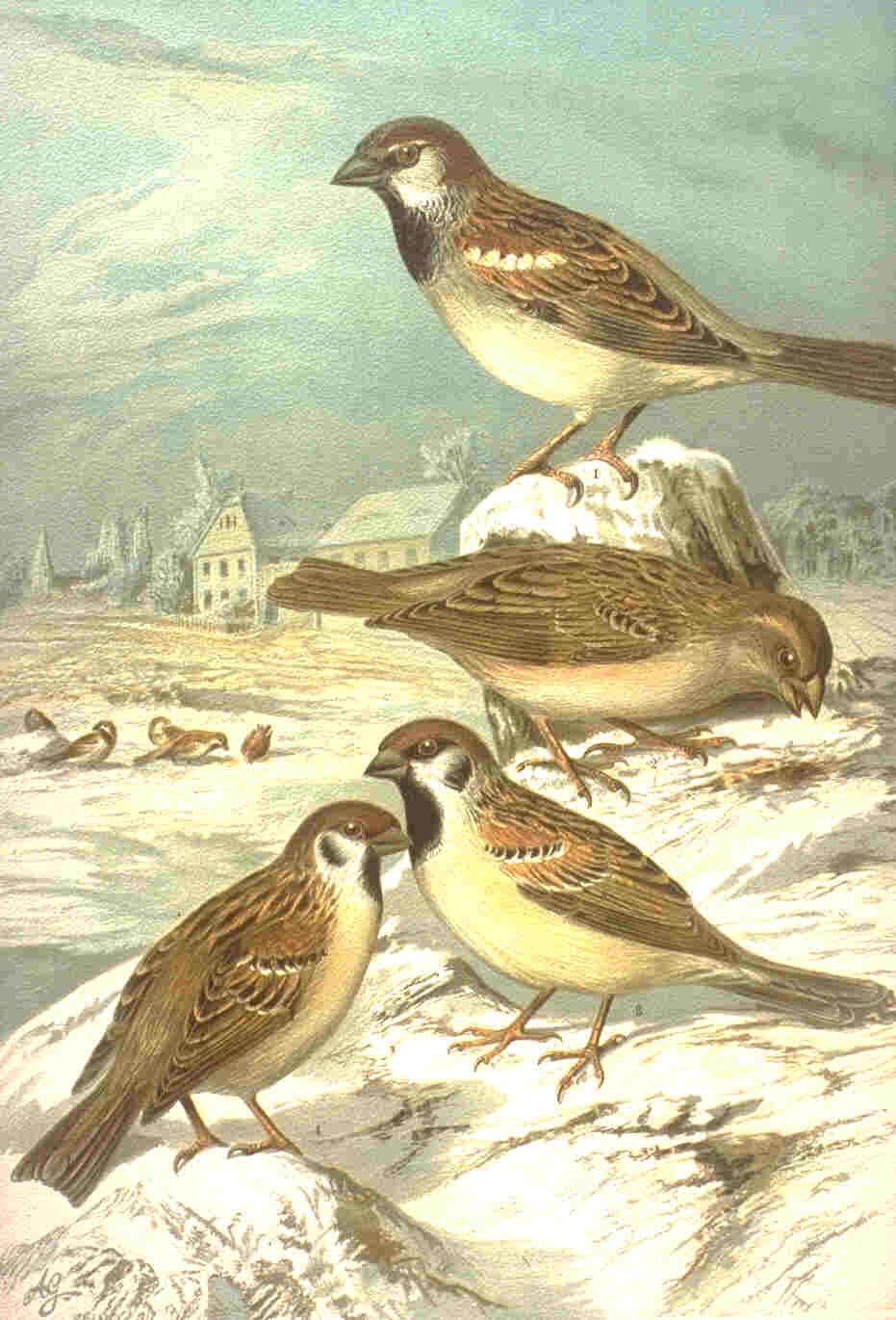
House sparrows (Passer domesticus), male and female, above; tree sparrows (Passer montanus) below. From Johann Friedrich Naumann, Naturgeschichte der Vögel Mitteleuropas, 1905 edition. (Johann Friedrich Naumann/Wikimedia Commons. Public domain).
The historical authorities were less precise in their ornithology. German regulations usually referred simply to Sperlinge and did not consistently distinguish the house sparrow from the tree sparrow, Passer montanus. What mattered to the official mind was not the exact species but the accusation: sparrows descended upon gardens and fields, ate seed and grain, and multiplied with alarming speed.
Public campaigns against them followed crop failures in the seventeenth century. In Hesse-Kassel there were local precedents by the end of that century, followed by a more systematic rural regulation in 1739. Brandenburg-Prussia introduced its first systematic measure in 1701. A substantial farmer, or Hufner, was ordered to deliver twelve sparrow heads annually; a Kossät, or smallholder, eight; and other inhabitants, including shepherds, herdsmen and millers, six.
A renewed edict of 1721 imposed a payment of three pfennigs to the village poor fund for every missing head. The obligation was extended to towns in 1731 and sharpened again in 1744. As late as 1767, Brandenburg recorded the delivery of 345,650 sparrow heads.[5]
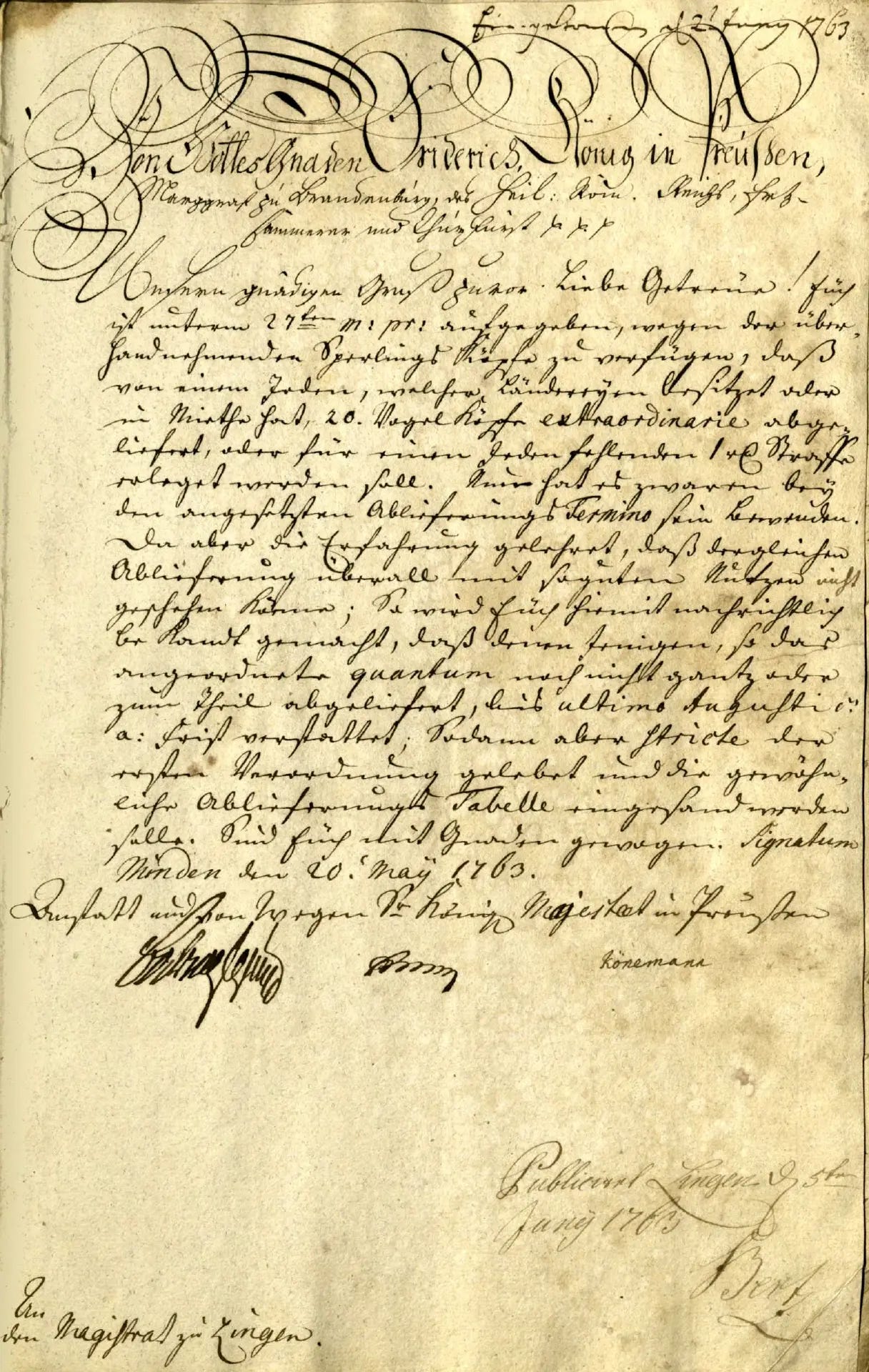
In the name of Friedrich the Great, the war and domains chamber at Minden calls on the magistrate of Lingen to deliver sparrow heads, 1763. Twenty per inhabitant, within fourteen days, on pain of a Reichstaler. Stadtarchiv Lingen, Altes Archiv, Nr. 4108. Reproduced by Heimatverein Lingen, “Der Spatzenkrieg,” Archivalie des Monats, August 2017, text by Dr Mirko Crabus.
These campaigns were common enough, and pursued with enough official seriousness, to acquire a name. German writers called them Spatzenkriege, sparrow wars. Friedrich the Great opened his in 1744 with an order to kill sparrows throughout Prussia — which included the Principality of Halberstadt — each subject to deliver a set number of heads within a fixed period.
The Prussian town of Lingen shows what that meant in practice. The 1744 command reached it through the war and domains chamber at Minden. In 1763 a fresh royal call arrived: despite persecution the birds had multiplied so successfully in gardens and fields that every inhabitant was now to deliver twenty sparrow heads within fourteen days, and the penalty for failure had risen from three pfennigs to a Reichstaler.
The Lingen Drost wrote back to the king that his subjects could not possibly comply. The sparrows were only then beginning to breed. Shooting had begun the previous afternoon, but he feared that a householder discharging a gun without proper care would sooner or later cause an accident. The fine was so high and the deadline so short that he expected it to impoverish the cottagers. And since ordinary people could not tell one small bird from another, they were delivering the heads of edible and game birds along with the sparrows.
The quota went unmet. Five years later the order was repeated, this time demanding sparrow heads and crows’ claws on pain of the king’s highest displeasure. In 1778 the magistrate had to account for the missing heads, and was told instead that every house and roof in and near the town must be sealed within six weeks so that sparrows could neither nest under them nor shelter there in winter, with a Reichstaler fine for any nest discovered, payable to whoever reported it. Then nothing happened.
In 1781 came a complaint that not the slightest thing had been done, and an instruction to the Reformed pastor to seal the lowest stones of his church roof with lime or clay. Nothing happened again.
In 1783 the royal chamber observed with displeasure that its orders were not being followed in the least and that the birds were nesting undisturbed on almost every house in town. A man named Berend Overhuß was eventually engaged to clear the Kollegienhaus of nests. He claimed it had taken him more than nine days, and billed over three Reichstaler [6]
These were therefore not always bounties in the modern sense. They were frequently compulsory levies, sometimes described as a Sperlingssteuer, or sparrow tax. The number owed was generally calculated according to the household’s economic or legal position and, in some regulations, its ownership of fields, gardens or vineyards, not simply by measuring the acreage under cultivation.
The logic was brutally simple.
Grain fed people. Sparrows ate grain. Therefore fewer sparrows meant more grain.
The arithmetic was less reliable than it appeared. By the end of the eighteenth century, naturalists were pointing out that sparrows also ate caterpillars and other insects harmful to crops. Hessen-Kassel abolished the general delivery obligation in 1818 because the birds were no longer considered sufficiently destructive to justify it, although districts were permitted to revive the old measures during exceptional increases in the sparrow population. An official inquiry conducted around Kassel in 1853 found rural opinion still divided between those who regarded the sparrow as a grain thief and those who considered it useful. The argument between pest and ally continued long after the simplicity of the original policy had begun to collapse.[6]
But killing sparrows and eating sparrows are two different historical claims.
Small birds certainly belonged to the European kitchen. For centuries, bird-catching provided both food and supplementary income, particularly for poorer rural families. Some species crossed social boundaries: larks, thrushes and ortolans could become expensive delicacies, while less prestigious birds supplemented meat-poor diets. Seventeenth-century German cookery books gave general instructions for preparing small birds with onions, pears, apples, mustard or cream, or for stuffing and roasting them together. A collection of tiny birds made a dish even when one bird alone offered hardly a mouthful.[7]
There is also direct evidence that sparrows themselves were recognised as food. A Hessian market regulation of 1622 placed official prices on sparrows alongside starlings, pigeons, chickens, ducks and geese. Yet the sparrow stood close to the bottom of the culinary hierarchy. Contemporary writers were almost comically reluctant to admit that it was food:
“Sperlinge sollen in unsere Schüsseln nicht kommen … weil es schwer zu verdawen.” “Sparrows should not come into our dishes … because their flesh is difficult to digest.” — Johann Sigismund Elsholtz, Diaeteticon, 1682
And a century later:
“Sein Fleisch wird zwar hin und wieder gegessen, soll aber nicht sehr gesund seyn.” “Its flesh is eaten here and there, although it is said not to be very healthy.” — Christoph Wilhelm Jacob Gatterer, Abhandlung vom Nutzen und Schaden der Thiere, 1782
A head delivered to a magistrate proves only that a bird was killed. The kitchen evidence has to come from elsewhere: from the market regulation and the cookery books, not from the edicts.
For anyone willing to eat them, however, sparrows possessed an obvious economic attraction. Unlike a chicken, which had to be raised and fed on grain a poor household might rather consume itself, the sparrow had fed itself, sometimes on the very grain human beings were attempting to protect.
It was free-range in the most literal and least fashionable sense of the expression.
Halberstadt sat in Prussia’s Province of Saxony, surrounded by the fields, barns and villages in which the sparrow was both pest and possible food. What Jews ate, and what they refused to eat, was visible. Culinary difference could easily become an object of social judgement or antisemitic caricature.
The sparrow was not an intrinsically Jewish dish. There was no Sabbath sparrow, no festival association and no treasured Auerbach family recipe that I know of. German Jews encountered a humble bird that already belonged to the food culture around them.
But food was also a measure of belonging. Jewish dietary laws could be portrayed by hostile neighbours as evidence that Jews considered themselves separate from ordinary German life. One can easily imagine the accusation:
We are forced to eat sparrows while you Jews feast on beef.
We have no evidence that anyone addressed those exact words to the Jews of Halberstadt. But the Auerbach practice supplied an answer:
We eat what everyone else eats.
Why these two cities
It is worth asking why we hear of this custom in Frankfurt and Halberstadt, and not in Breslau, Königsberg, Berlin or Munich.
The obvious answer is that Halberstadt was a small city surrounded by grain fields, where the sparrow was close at hand. But that explanation collapses on contact with Frankfurt, which was a major commercial centre.
What the two places share is not size. It is position. They were the twin capitals of German Orthodoxy in its most self-conscious form: Samson Raphael Hirsch’s Frankfurt, and the Halberstadt of the Auerbachs. These were the communities that made an argument the rest of German Jewry was in the process of abandoning, that nothing in Jewish law had to be surrendered in order to be fully German, and that the two could be reconciled into a single consistent person. [10]
The sparrow states that argument in miniature, and it states it in two directions at once. To the reformer it says: we did not have to give anything up in order to eat the food of this country. To the older separatism it says: the law never told us to refuse it.
Note where the polemical weight sits. It is in the form, not the fact. The sparrow was always permitted; no ceremony was needed to establish that. What an annual public slaughter produces is a demonstration, witnessed by the community, performed by its leadership, at a fixed point in the year.
The Auerbachs were not the only Jews to preserve a sparrow mesorah.
Among Yemenite Jews, the house sparrow was known by the Arabic name ʿuṣfūr. Professor Zohar Amar of Bar-Ilan University, a scholar of natural history in Jewish sources who has made a particular study of disappearing traditions concerning kosher animals, collected testimony from Yemenite Jews who remembered sparrows being trapped, ritually slaughtered and eaten. The birds were cooked slowly in large pots, roasted or made into soup; some informants recalled that even the softened bones could be eaten. There need have been no connection between Yemen and Halberstadt. The point is precisely that distant Jewish communities could encounter the same ubiquitous bird and preserve independent chains of permission for eating it.[9]
The bird problem and the concept of “mesorah”
Jewish dietary law identifies some animals through physical signs. An animal permitted under these rules is called kosher.
Land mammals must both chew their cud and have completely divided hooves. That is why a cow is kosher and a pig, despite its divided hooves, is not. Aquatic creatures must have fins and scales.
Birds are more difficult.
The Torah - the first five books of the Hebrew Bible - does not provide an equivalent test. Instead, Leviticus and Deuteronomy list the birds that may NOT be eaten.[4] By implication, other birds are permitted.
The problem is knowing which modern species correspond to ancient Hebrew names. Languages change, names migrate between animals, and ancient writers did not classify birds according to modern scientific species, certainly not beyond the region they lived in.
Instead, the rabbis described several physical and behavioural signs that might help, including whether a bird was predatory, like an eagle for example, which is considered to be not kosher.[5] But these signs did not always remove the uncertainty.
Jewish law also relies upon knowledge passed from one generation to the next. The Hebrew word translated as “transmitted” comes from the same root as mesorah: something received from those who came before and handed to those who follow.
With birds, this principle became unusually physical. A community needed more than an argument that a bird appeared to be kosher. It needed an inherited tradition identifying that particular bird as one Jews had eaten. Someone could point to the creature and say:
This is the bird our community knows may be eaten.
Because diasporic Jewish communities lived among different birds and in different continents, this knowledge was often local. A bird recognised in one community might not be recognised in another. Among Ashkenazi Jews—the communities of Central and Eastern Europe, the cautious rule was not to eat a bird without an accepted mesorah.[7]
Mesorah was therefore a chain of recognition: part oral testimony, part visual memory and part repeated practice.
Seen from the kitchen, it preserved not a recipe but an ingredient.
Which brings us back to Halberstadt.
Suddenly the strange little ceremony makes sense.
The Auerbachs were not preserving a favourite meal.
They were preserving the possibility of one, even where there was no popular demand pressing up against the law. Sparrow was never going to become the Sunday roast. The Auerbachs were maintaining a permission that had almost no constituency, which means the ceremony has to be understood as something other than the ratification of an appetite.
And so far as I can discover or remember, it never creazed an appetite for sparrow. Four generations of Auerbach rabbis performed this ceremony, and I have found no trace of anyone in Halberstadt (or anywhere else our family dispersed) actually eating a sparrow. No recipe, no dish, no family story about the taste. If the purpose was to put the bird on the table, it failed for eighty years running and nobody appears to have minded.
Which suggests it was never the purpose. What the ceremony produced was not sparrows in kitchens. It was the sight of the thing being done, a community watching its rabbis exercise a permission nobody intended to use, and seeing, once a year, how a permission is kept alive at all.
So mesorah did not make the sparrow a “Jewish food”. Rather, it made a local bird available as kosher food.
The problem of belonging
This is where the Halberstadt sparrow becomes more than an eccentric footnote in the history of dietary kosher rules, but also sadly failed to meet the German loyalty test.
German Jews, and Jews elsewhere, spent generations confronting a difficult question: how does a minority belong to a place without disappearing into it?
Food made that question unavoidable.
You can learn your neighbour’s language. You can wear his clothes, read his poets, attend his university and fight in his army.
Eating together is harder, even meant to be harder by biblical stricture calculated to separate. The dietary laws marked the Jewish kitchen off from the kitchen next door. Meat required ritual slaughter. Some animals could not be eaten at all. Meat and milk could not simply be combined. Food prepared in another household could present problems that had nothing to do with whether it tasted good.
Food was therefore one of the places where the desire to participate in German life repeatedly encountered the requirements of remaining Jewish.
The sparrow case offers a wonderfully small example.
This was not a Jewish bird imported from an ancestral homeland. It belonged to the roofs, farms and grain fields of Germany. Christians ate it. Jews encountered precisely the same creature, and the mesorah preserved in Halberstadt made that route possible. Assimilation would have meant eating the sparrow simply because everyone else did.
Belonging meant being able to eat the same sparrow but arriving at it by a different route.
The local supplied the ingredient.
Jewish tradition supplied the justification, and the sparrow ritual showed that it all had to be done in a systemic and organized fashion.
And then it didn’t matter anymore
For generations German Jews negotiated ways of being both Jewish and German. The Auerbachs themselves embodied one version of that project. Benjamin Hirsch Auerbach, who became rabbi of Halberstadt in 1863, was both a traditional rabbinic scholar and university educated; the Jewish Encyclopedia notes that he was among the first Orthodox rabbis to preach in polished German.[13] Halberstadt subsequently became an important centre of German Orthodoxy.[14]
The sparrow fits almost comically well into that world.
Here was something unmistakably German and unmistakably Jewish at the same time.
For four generations, according to the family testimony, the rabbis kept that possibility alive. Every month of Elul, the last month before the Jewish new year, they performed this tiny but symbolic act that maintained the connection between Jewish law and the landscape in which their community lived.
And then it didn’t matter anymore.
The Nazis were not interested in how successfully Jews had reconciled Jewish practice with German life. They did not care how German their language was, how long their families had lived in German towns, what they had contributed to German culture or how carefully they had negotiated the boundary between participation and difference.
Jewishness itself became grounds for persecution and exclusion.
In November 1938, Halberstadt’s synagogue was destroyed during the pogroms. My grandfather, Hirsch Benjamin Auerbach, the city’s last rabbi, was arrested and sent to Buchenwald. After his release, he succeeded in getting his family out of Germany and to British mandatory Palestine.[15]

What remains. Halberstadt 2015
The sparrow court disappeared.
And so, of course, did the German sparrow from the Jewish kitchen.
Elli Benaiah spent thirty years as a trial lawyer, then cooked professionally and managed restaurants in Switzerland and Germany before turning to food history. He is at work on a history of the Jewish food of the Indian Ocean.
Sources and Notes
Sources and Notes
[1] Zohar Amar, “ציפור הדרור – כשרה?” [”Is the Sparrow Kosher?”], Shabaton, 4 April 2022. Amar states that community leaders in Frankfurt and Halberstadt publicly slaughtered sparrows annually until the Nazi period to prevent the eating tradition from being forgotten. See also Zohar Amar, Masoret ha-Of [The Tradition of Fowl] (Neve Tzuf, 2004), pp. 69–87.
[2] The Jewish Encyclopedia records Benjamin Hirsch Auerbach as rabbi of Halberstadt from 1862/63, followed by Selig Auerbach and Isaac Auerbach; the City of Halberstadt describes the Auerbachs as providing four generations of community rabbis from the mid-nineteenth century. See Gotthard Deutsch and B. Auerbach, “Halberstadt,” Jewish Encyclopedia; Stadt Halberstadt, “Stadt Halberstadt würdigt Ehrenbürger mit Straßenbenennungen.”
[3] On locusts as both destructive agricultural organisms and traditionally harvested food, see J. P. Egonyu et al., “Global Overview of Locusts as Food, Feed and Other Uses,” Global Food Security 31 (2021): 100574. For the particularly clear example of rice-field rats in Vietnam — trapped before and after harvest, sold for food and understood as both pest control and a source of protein — see Nguyen Van Cuong et al., “Rodents and Risk in the Mekong Delta of Vietnam,” Vector-Borne and Zoonotic Diseases 15, no. 1 (2015): 65–72, especially 65. On terrestrial molluscs as agricultural pests, see G. M. Barker, ed., Molluscs as Crop Pests (Wallingford: CABI, 2002). The snail comparison describes overlapping cultural categories; it does not mean that every species regarded as a pest was also eaten.
[4] Mark Ravinet et al., “Signatures of Human-Commensalism in the House Sparrow Genome,” Proceedings of the Royal Society B 285 (2018): 20181246. The authors estimate a divergence between the commensal house sparrow and the non-commensal bactrianus lineage approximately 11,000 years ago and an expansion of the house sparrow about 6,000 years ago, consistent with the spread of agriculture. On the house sparrow as a human commensal and on the historical failure to distinguish consistently between sparrow species, see Niklot Klüßendorf, “Schädlinge oder doch Nützlinge? Das ‘Sperlingsjahr’ 1853 im Lichte einer Umfrage in den Landgemeinden des Kreises Kassel,” Zeitschrift des Vereins für hessische Geschichte und Landeskunde 122 (2017): 105–6.
[5] Johannes Klose, Aspekte der Wertschätzung von Vögeln in Brandenburg: Zur Bedeutung von Artenvielfalt vom 16. bis zum 20. Jahrhundert (Göttingen: Cuvillier, 2005), 152–59. Klose reproduces and analyses the Brandenburg-Prussian edicts of 1701, 1721, 1731 and 1744. His evidence also shows that the quotas followed social and property categories rather than a uniform acreage formula. For Hessen-Kassel and the term Sperlingssteuer, see Klüßendorf, “Schädlinge oder doch Nützlinge?,” 105–8. These examples concern particular German territories; they should not be presented as a single law operating uniformly throughout “Germany.”
[6] Rudolph Aefner et al., Friedrich der Grosse, vol. 1 (1861), 413, for the 1744 order. On Lingen: Stadtarchiv Lingen, Altes Archiv, Nr. 4108, and Allgemeine Sammlung, Nr. 636; H. Kumerloeve, “’Spatzenkrieg’ in Lingen,” Jahrbuch des Emsländischen Heimatbundes 6 (1959), 53–61; and Mirko Crabus, “Der Spatzenkrieg,” Heimatverein Lingen, Archivalie des Monats, August 2017. On the wider campaigns in the Habsburg lands, Georg Wacha, “Spatzenvertilgung unter Maria Theresia,” Naturkundliches Jahrbuch der Stadt Linz 6 (1960), 21–53.
[7] Klüßendorf, “Schädlinge oder doch Nützlinge?,” 106–21. The general Hessian obligation was abolished in 1818, but an 1823 provision allowed districts to reintroduce head-delivery campaigns during exceptional increases in sparrow numbers. The 1853 survey demonstrates that villagers and officials remained divided over whether the birds’ consumption of insects compensated for their attacks on grain.
[8] Klose, Aspekte der Wertschätzung, 69–78. Klose distinguishes between the economic importance of small-bird catching to poorer households and the transformation of selected birds, especially larks and thrushes, into commercial delicacies. For the recipes from Johannes Colerus’s 1680 household book, including birds cooked with onions, pears, apples, mustard and cream, see 74–76. These are general small-bird recipes and should not automatically be identified as recipes for sparrows.
[9] Edith Schlieper, “Nahrungsmittel und Ernährung im alten Kassel (1585–1632),” Zeitschrift des Vereins für hessische Geschichte und Landeskunde 79 (1968): 55–76, at 57. The 1622 price regulation establishes that sparrows were recognised as a marketable food; it does not tell us how frequently they were eaten. Johann Sigismund Elsholtz, Diaeteticon: Das ist, Newes Tisch-Buch (Cölln an der Spree, 1682), 170; Christoph Wilhelm Jacob Gatterer, Abhandlung vom Nutzen und Schaden der Thiere, vol. 2 (Leipzig: Weygand, 1782), 413. For the markedly unfavourable assessments by Elsholtz, Breidenstein and Gatterer, see Johannes Klose, Aspekte der Wertschätzung von Vögeln in Brandenburg (Göttingen: Cuvillier, 2005), 93–94. Their comments establish occasional consumption while also demonstrating the sparrow’s poor culinary reputation.
[10] On Halberstadt as a centre of German neo-Orthodoxy arising in response to the Reform movement, see Stadt Halberstadt, “Deutsch-jüdische Geschichte und Kultur”; and on its pairing with Frankfurt am Main as a centre of German Orthodoxy into the twentieth century, “Halberstadt (Sachsen-Anhalt),” Jüdische Gemeinden in Deutschland. The central organisations of German Orthodox congregations were located in Halberstadt until 1930: see “Halberstadt,” Encyclopaedia Judaica. The Bund der gesetzestreuen jüdischen Gemeinden Deutschlands was founded there after the First World War, drawing up to two hundred member communities, and was succeeded in 1922 by the Preußischer Landesverband gesetzestreuer jüdischer Gemeinden, known as the Halberstädter Verband. On Auerbach’s own position: he served as Landesrabbiner at Darmstadt from 1834 and was forced to resign in 1857 over the congregation’s move toward Reform, spending the years to 1863 in Frankfurt before the Halberstadt call; see Isidore Singer and Gotthard Deutsch, “Auerbach, Benjamin Hirsch,” Jewish Encyclopedia, and “Auerbach,” Encyclopaedia Judaica.
[11] Amar, “ציפור הדרור – כשרה?”; Amar, Masoret ha-Of, pp. 69–87. Amar records traditions of sparrow consumption in numerous Jewish communities beyond Germany. For the halachic identification, see Rabbi Yaakov Chaim Sofer, Kaf HaḤayyim, Yoreh De’ah 82:27, discussed by Amar: the formulation identifies the small bird living around houses by the Arabic ʿuṣfūr and refers to those whose custom was to eat it. On the wider identification and halachic traditions surrounding Passer domesticus, see “ציפור דרור,” Encyclopedia of Torah and Agriculture, Machon HaTorah VeHa’aretz.
[12] Leviticus 11:13–19; Deuteronomy 14:11–18. For the distinction between the treatment of mammals, fish and birds, see Ari Z. Zivotofsky and Zohar Amar, “The Halachic Tale of Three American Birds: Turkey, Prairie Chicken, and Muscovy Duck,” Journal of Halacha and Contemporary Society 46 (Fall 2003), pp. 81–103.
[13] Mishnah Chullin 3:6 (59a). The Mishnah discusses dores, an extra toe, a crop (zefek) and a peelable gizzard (korkuvan). The precise meaning of dores and the application of these signs became subjects of substantial halachic disagreement. See Zivotofsky and Amar, “Three American Birds,” pp. 81–103.
[14] Shulchan Aruch, Yoreh De’ah 82:3, and Rema ad loc. The later Ashkenazi practice gives decisive importance to a reliable mesorah identifying the species as one traditionally eaten as kosher.
[15] Ari Z. Zivotofsky and Ari Greenspan, material associated with their mesorah dinners and the recorded Auerbach testimony concerning Halberstadt. A published account reports the Auerbach family tradition that during the four generations in which the family served the Halberstadt rabbinate, a sparrow was slaughtered before the beit din during Elul to preserve the mesorah. This testimony should be treated as a family and community recollection rather than as four independently documented contemporary records of the ceremony. On the dinners themselves, see Ari Greenspan, “Quail, Water Buffalo, And Locusts For Dinner: It’s All About Tradition,” Mishpacha, 11 August 2010.
[16] Isidore Singer and Gotthard Deutsch, “Auerbach, Benjamin Hirsch,” Jewish Encyclopedia. Auerbach studied at the University of Marburg, served as an important defender of German Orthodoxy and was noted as one of the early Orthodox rabbis to preach in polished German.
[17] Yad Vashem, “Halberstadt, Germany.” The Auerbach family shaped the community’s Orthodox character, and Halberstadt became an important centre of German Orthodox Jewish life; the Halberstädter Verband was founded there in 1922.
[18] Stadt Halberstadt, biographical account of Jzchak Auerbach (my uncle) and the Auerbach family. The city records that Hirsch Benjamin Auerbach, the last rabbi of Halberstadt, was arrested during the November 1938 pogrom, sent to Buchenwald, released, and subsequently organised his family’s escape to Palestine. The city’s account also records the destruction of the Halberstadt synagogue in November 1938.
The intricacies of the Sparrow as a living species and as a meal. Fascinating.
I love reading these Jewish historical stories. Thanks for sharing this