
Amrita and the Haldi Grinders
How a Hungarian-Jewish Indian Artist Painted the Indian Kitchen

People who live between worlds often create new forms of seeing.
Not by choosing one culture over another, but by blending them.
By the ability to walk in and out of scenes like an actor in a play.
I came across an article about Amrita Sher-Gil. It began, as these things often do, with a painting.
There was something in the image that immediately caught my attention - the colours, the shapes, the quiet gravity of the three women seated together. I could not yet say why, but the picture felt strangely familiar.
Perhaps because I recognized the feeling immediately - the sensation of looking at a culture both from inside and from slightly outside at the same time.
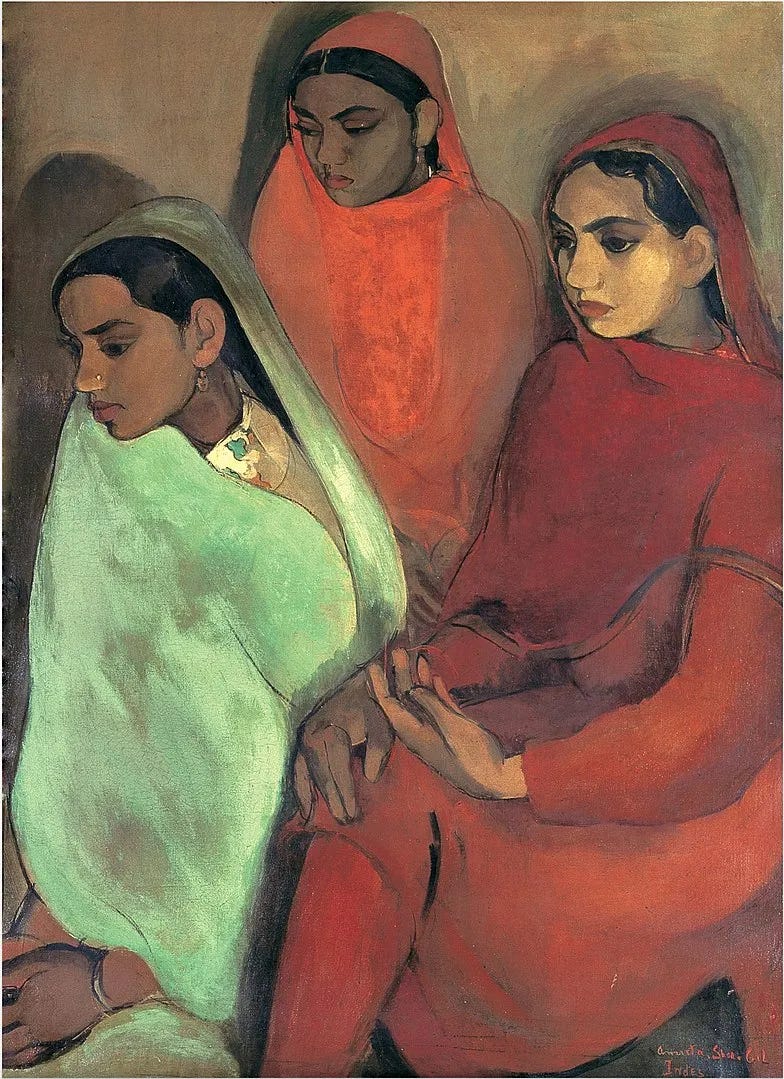
Amrita Sher-Gil, Three Girls, 1935.
Oil on canvas. (National Gallery of Modern Art, New Delhi).
Then I realized what I was seeing.
There was something unmistakably European in the faces, yet unmistakably Indian in the setting. The composition carried echoes of Paris, but the colours belonged to the subcontinent.
And in that moment I understood why the painting was speaking to me.
It was speaking in my voice.
Amrita Sher-Gil was born in Budapest in 1913, the daughter of a Hungarian mother of Jewish descent and an Indian Sikh father.
Trained in Paris and later working in India, she painted from a position that was never fully European and never fully Indian. Although she would later become one of the founding figures of modern Indian painting, her life always unfolded between Europe and India.
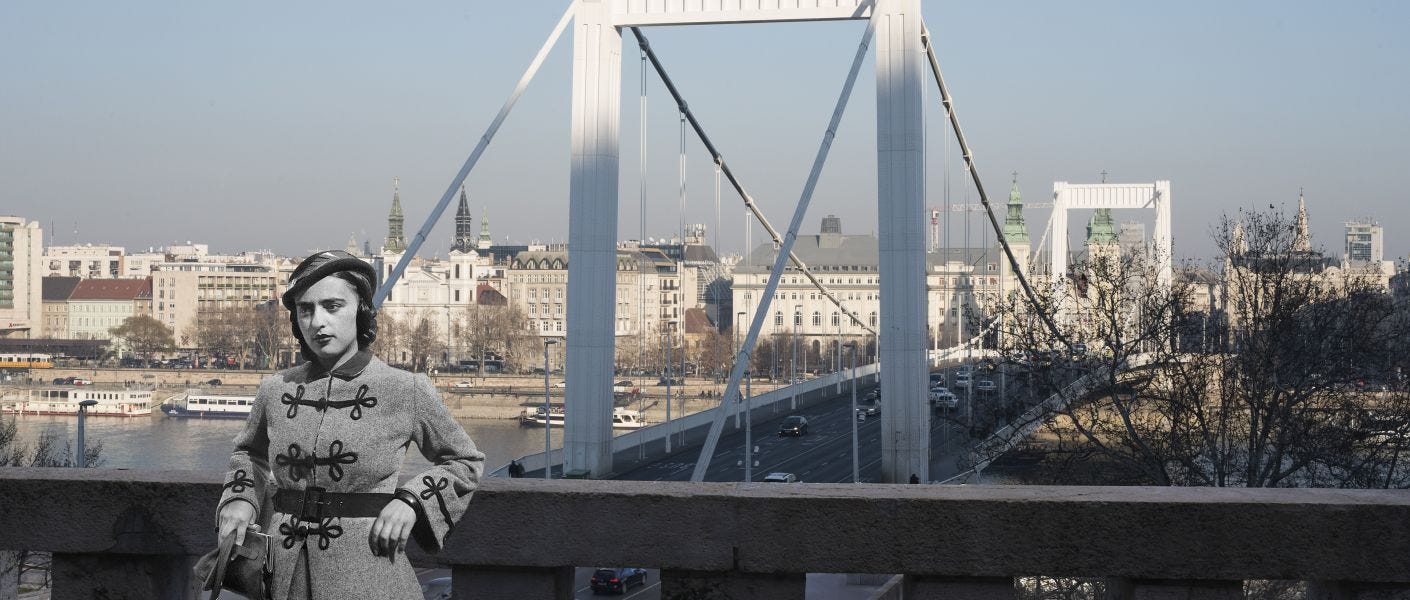
Amrita Sher-Gil in Budapest, with the Elisabeth Bridge over the Danube in the background. (Courtesy of the Sher-Gil family / public domain reproduction).
That dual heritage explains why exhibitions of her work in Europe remain rare but deeply symbolic. In 2025 the Ferenc Hopp Museum of Asiatic Arts in Budapest opened an exhibition exploring the Sher-Gil family’s artistic legacy, and later in 2026 the Drents Museum in the Netherlands will present one of the largest European exhibitions of her work in decades, featuring around sixty paintings and drawings on loan from the National Gallery of Modern Art in New Delhi.
Such exhibitions are unusual: Sher-Gil’s paintings are considered part of India’s national heritage and seldom travel abroad. When they do, they remind European audiences that the artist who once studied in Paris and was born on the banks of the Danube ultimately chose to paint the everyday life of India.
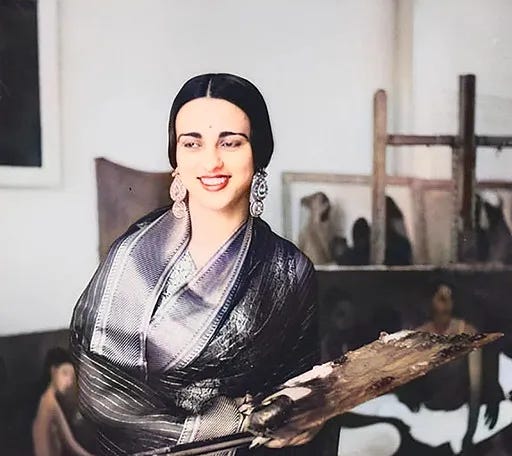
Amrita Sher-Gil in her studio, 1930s.
Sher-Gil worked between worlds - bringing the structure of European modernism to the colours and everyday life of the subcontinent. Archival photograph.
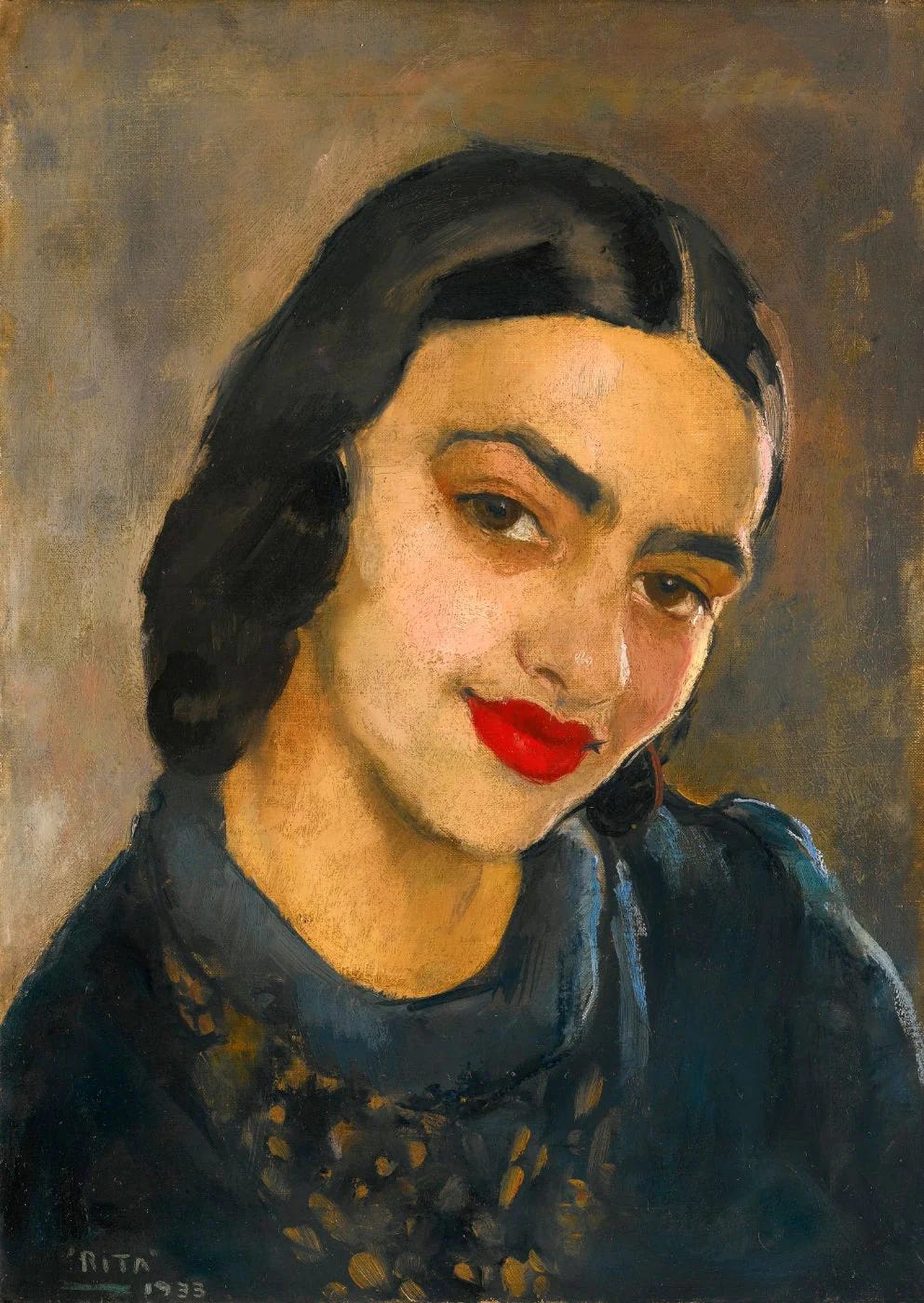
Amrita Sher-Gil, Self-Portrait, 1933. Painted in Paris while she was still a student, before her return to India transformed the subjects of her work. (Collection of the National Gallery of Modern Art, New Delhi).
She painted from the space in between.
That position allowed her to see India differently. Many European painters before her had treated India as an exotic spectacle - temples, princes, dancers, a distant decorative world.
Sher-Gil instead painted ordinary people: village women resting, peasants walking to market, quiet domestic moments.
India in her work is not an exotic stage.
She was not painting India as spectacle. She was painting India from inside its kitchens and courtyards.
It is simply daily life.
That is the position of diaspora: seeing from two places at once.
Double vision is not confusion.
It is the ability to see two worlds at once.
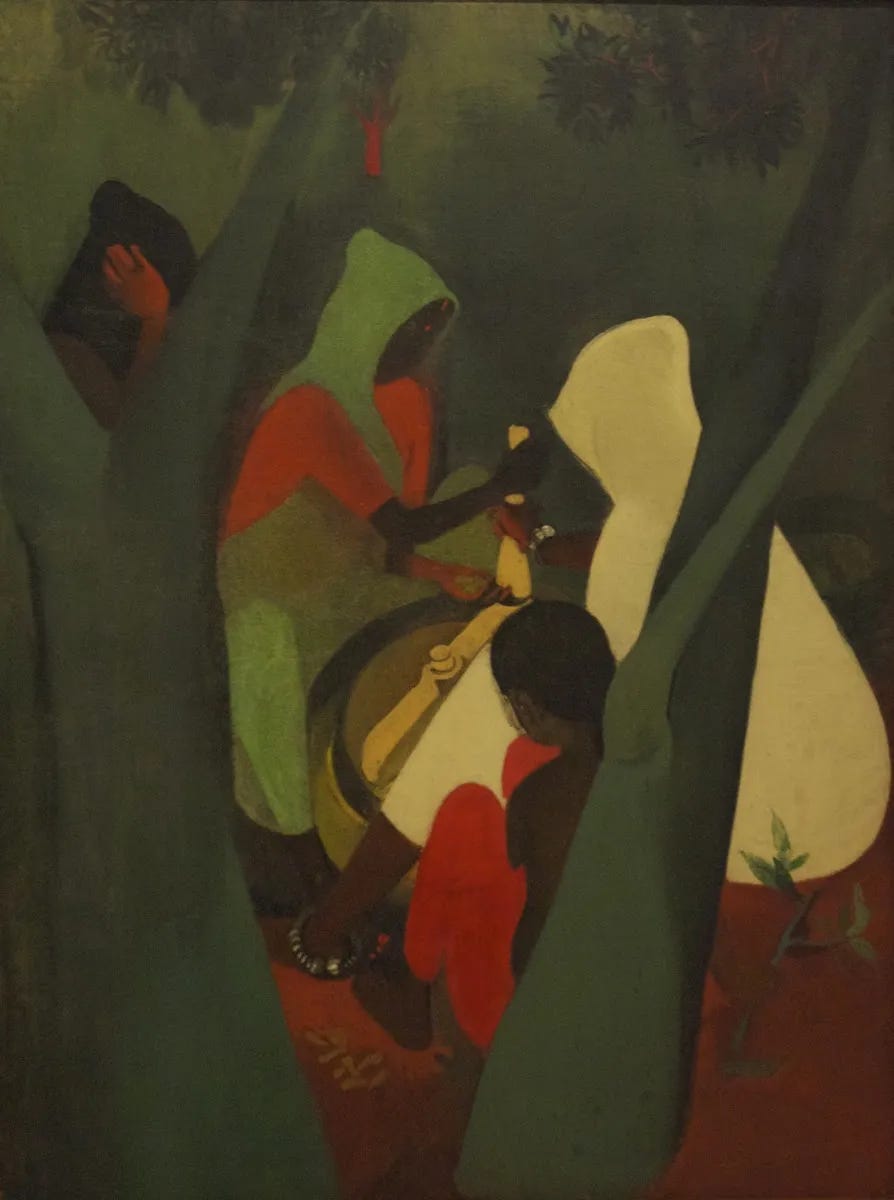
Haldi Grinders - Amrita Sher-Gil, 1940
Oil on canvas, National Gallery of Modern Art, New Delhi.
Sher-Gil depicts three village women grinding turmeric (haldi), a traditional domestic task in rural India. Painted during the final years of her short life, the work reflects her shift toward portraying everyday Indian life with bold colour and simplified forms influenced by both European modernism and Indian miniature traditions. (Collection of the National Gallery of Modern Art, New Delhi).
One of Sher-Gil’s later works, Haldi Grinders, captures this beautifully.
Three women sit grinding haldi - turmeric - not as some exotic spice for export, but as part of the daily labour of life..
Turmeric itself belongs to a much larger geography than the village in which Sher-Gil placed it. Long before it reached European kitchens as safran des Indes, haldi travelled the same Indian ocean maritime routes that carried pepper, cinnamon, and cloves across the Indian Ocean. Arab merchants knew it as kurkum. In Southeast Asia it became kunyit in Malay and Indonesian. In Indian households, as in my family, it remained simply haldi - a root ground daily into food, medicine, and ritual.
What Sher-Gil captured in her painting was not merely a kitchen scene but the quiet domestic end of a vast trading world.
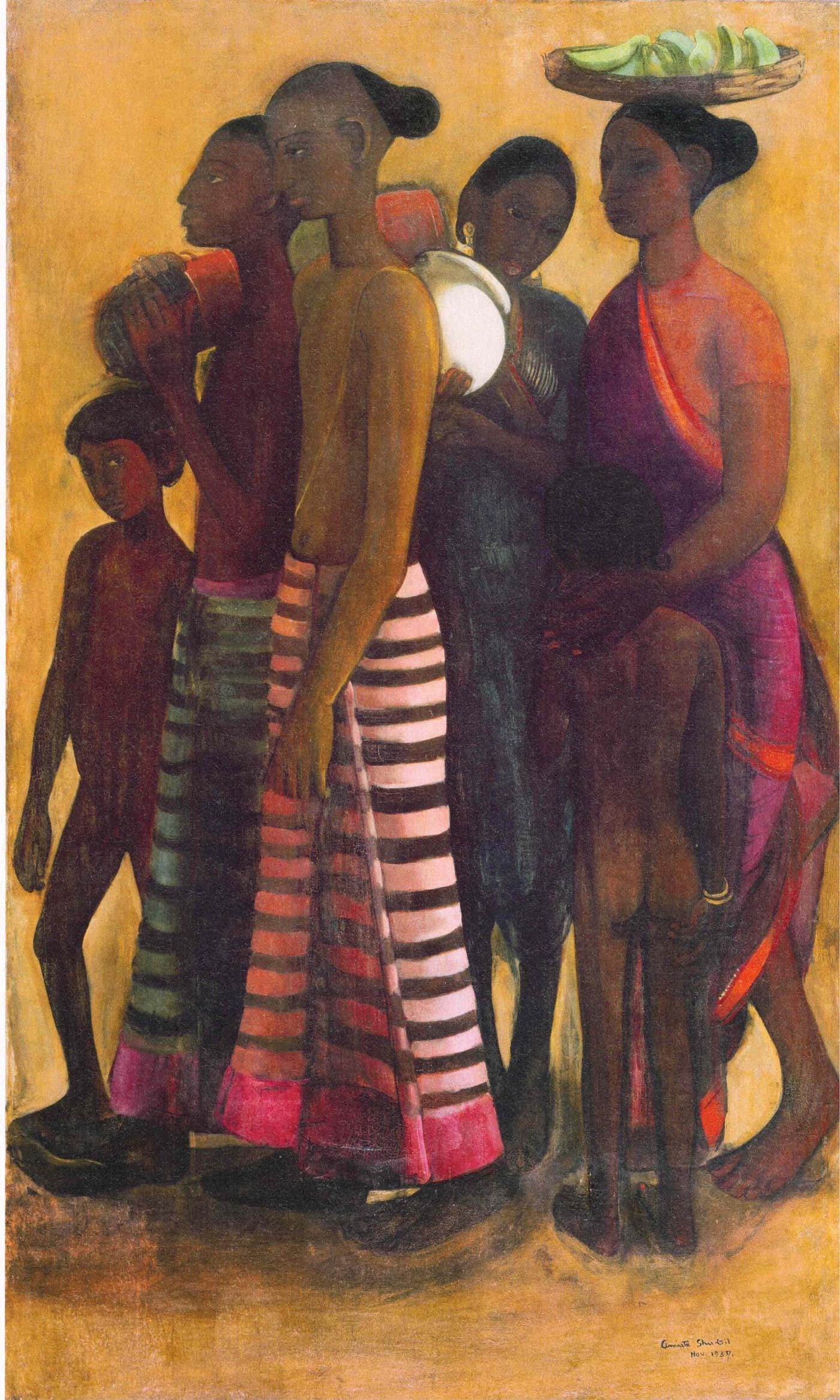
Amrita Sher-Gil, South Indian Villagers Going to Market, 1937.
Painted during her travels in South India, the work shows Sher-Gil’s mature style: simplified forms, rhythmic movement, and an emphasis on the dignity of everyday labour. (Collection of the National Gallery of Modern Art, New Delhi).
Haldi itself is an ordinary substance - a rhizome of the ginger family (Curcuma longa) whose deep golden colour has shaped kitchens and rituals across a vast region stretching from India to the Middle East and Southeast Asia.
Copeland Marks notes that turmeric later became the colouring agent in many commercial curry powders, providing the yellow tone Western diners came to associate with “curry.”
Yet in India turmeric was never merely a substitute for saffron.
Haldi is part of the ordinary grammar of daily cooking.
Sher-Gil’s painting is not really about turmeric.
It is about the quiet labour that turns plants into food.
It is about the moment when that spice becomes part of daily life - hands moving, stones grinding, three women sharing the quiet rhythm of work.
In the kitchen the process looks much simpler.
Traditionally turmeric was not bought as powder. The dried rhizomes were washed, briefly boiled to cure them, and then sun-dried until hard. In the kitchen they were ground on a sil-batta - a flat stone slab and grinding stone - or pounded in a mortar and pestle.
Grinding haldi with a traditional grinding stone. (Credit youtube @Jyotshna888)
The turmeric was crushed slowly with steady, rhythmic pressure until it became a fine powder, or a thick yellow paste if a little water was added. The slow grinding released the natural oils of the spice and produced a deeper aroma and colour than modern factory powders.
Hands turned gold.
Utensils turned gold.
Food turned gold.
In many households the grinding stone itself became permanently stained with turmeric’s colour.
When I recently visited Cochin, I saw another version of the same story.
In a dim warehouse two men were weighing dried turmeric roots and pouring them into burlap sacks. On the floor lay small piles of rhizomes waiting their turn on the scale.
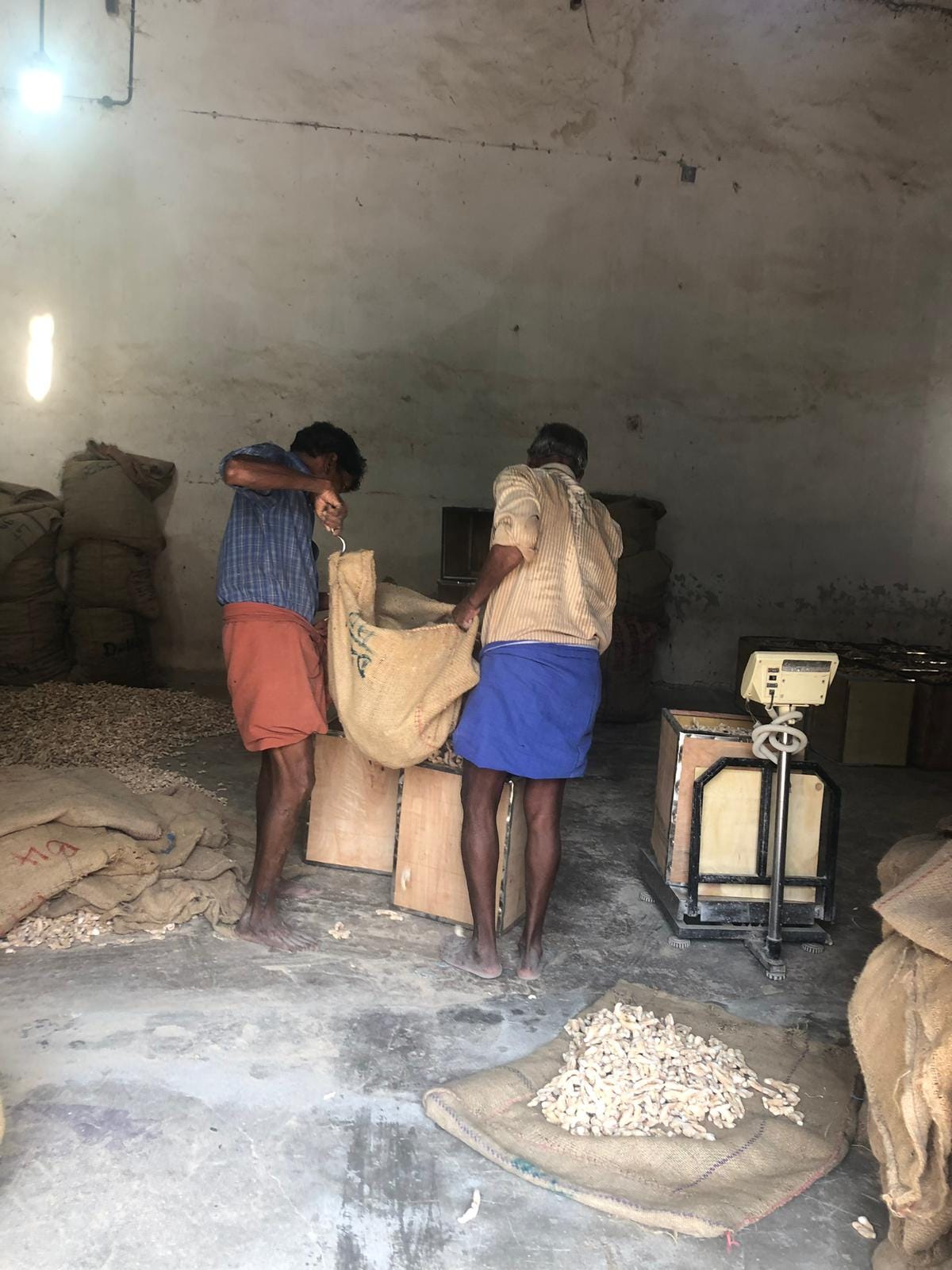
Cochin.
The commercial end of the story.
What begins here as sacks of turmeric and scales eventually becomes colour on a plate.
What begins in a kitchen as flavour and colour begins somewhere like this - as sacks, dust, and labour.
Sher-Gil painted the domestic end of the story.
This was the commercial one.
India thus becomes a world of ordinary gestures whose meaning becomes visible only when you learn to look at it from two places at once - from inside the kitchen and from the outside.
I brought a turmeric root back with me to Germany and planted it in a pot. It has begun to sprout.
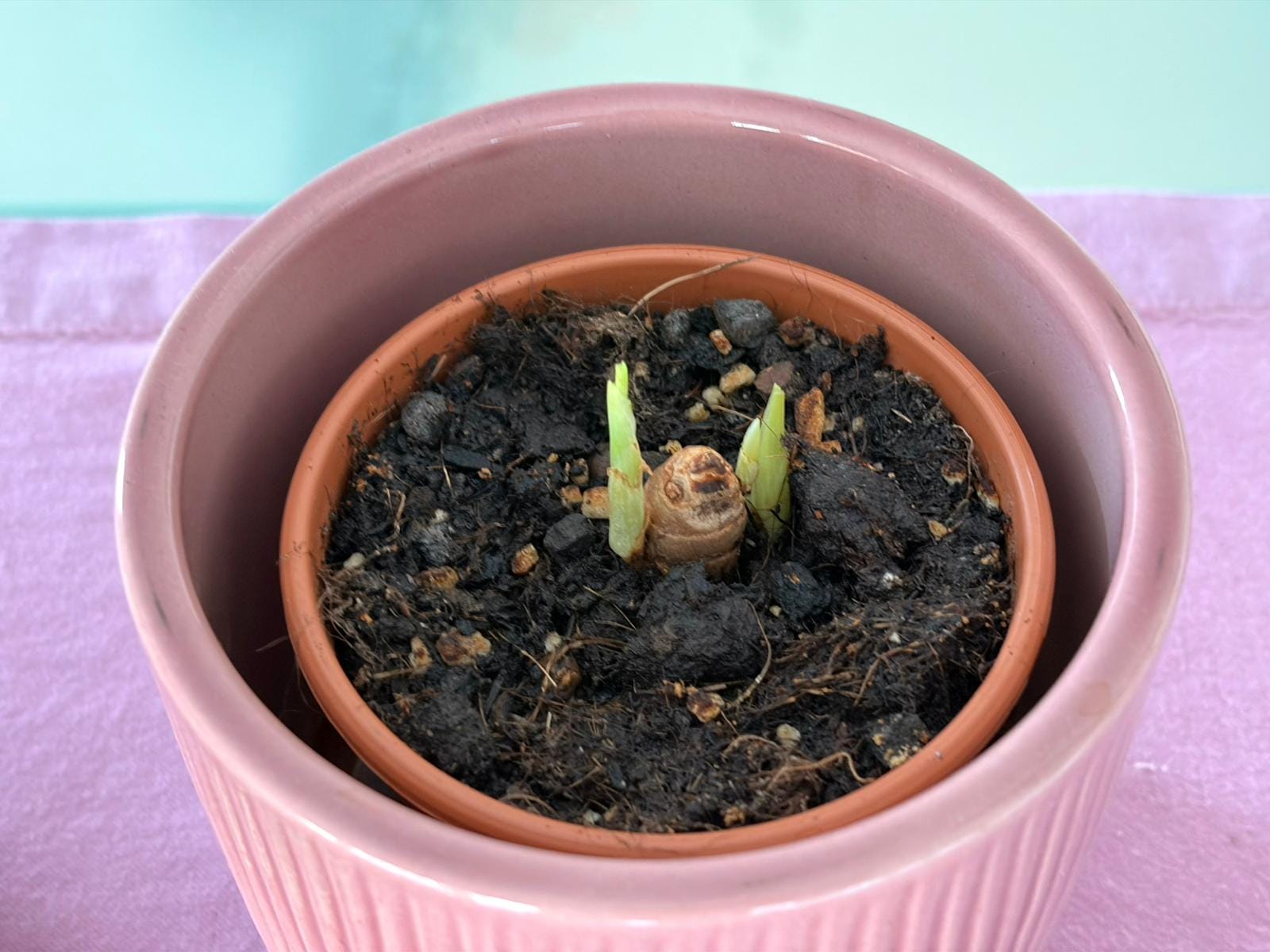
Halde grows again. In Germany
And suddenly the long journey of these plants - from tropical fields to Indian kitchens to European windowsills - becomes visible again.
The dried haldi I carried home I now grind myself in a coffee grinder.
Stone grinding probably works better. The rhizome yields slowly under stone in a way that the blades of a modern grinder cannot quite reproduce.
Watching Sher-Gil’s painting, one might imagine that world has vanished.
But the gestures she painted are still visible today.
Recently I came across a Facebook page called Old Cooking, filmed in rural West Bengal, where village meals are prepared outdoors over wood fires.
Homestyle Chicken with Cabbage Curry | Simple & Tasty Bengali Recipe. (courtesy facebook @oldcooking)
One of the videos shows a woman cooking a simple chicken and cabbage curry over an outdoor fire. I reconstructed the method and turned it into a small printable recipe card for readers who want to try it.
The method is straightforward:
Mustard oil in a pan.
Bay leaves, cumin seeds, cardamom and cloves.
Sliced onions fried until soft.
Garlic and ginger crushed together.
Tomatoes, turmeric, cumin, coriander, chili, salt.
Then cubed chicken goes in, followed by shredded cabbage. Everything is stir-fried together until the cabbage softens and the spices coat the meat.
Nothing elaborate. Just a village curry built from what is at hand.
Watching it, I had the strange sensation of stepping into a Sher-Gil painting.
Not because the turmeric is being ground - it is not - but because the gestures are the same. The rhythm of cooking, the quiet coordination of hands, the transformation of roots and leaves into food.
What Sher-Gil painted in the 1930s still exists today.
The quiet labour of turning plants into food continues largely unnoticed - even as the spices themselves travel the world.
European cooks encountering turmeric often struggled to categorize it. The French sometimes called it safran des Indes - Indian saffron - because it lent food a similar golden hue. Yet turmeric was never merely a substitute for saffron. In India it was part of the ordinary grammar of daily cooking.
Sher-Gil’s painting works in much the same way.
The composition carries the structural gravity of Cézanne - solid figures, triangular balance, the quiet architecture of European painting.
But the colour belongs unmistakably to India: ochres, reds, turmeric yellow.
Indian pigment on a European canvas.
The same gesture can happen in the kitchen.
A French pilaf made not with saffron but with turmeric.
Riz pilaf au safran des Indes.
Butter, rice, onions, perhaps almonds - and a pinch of haldi turning the entire dish gold.
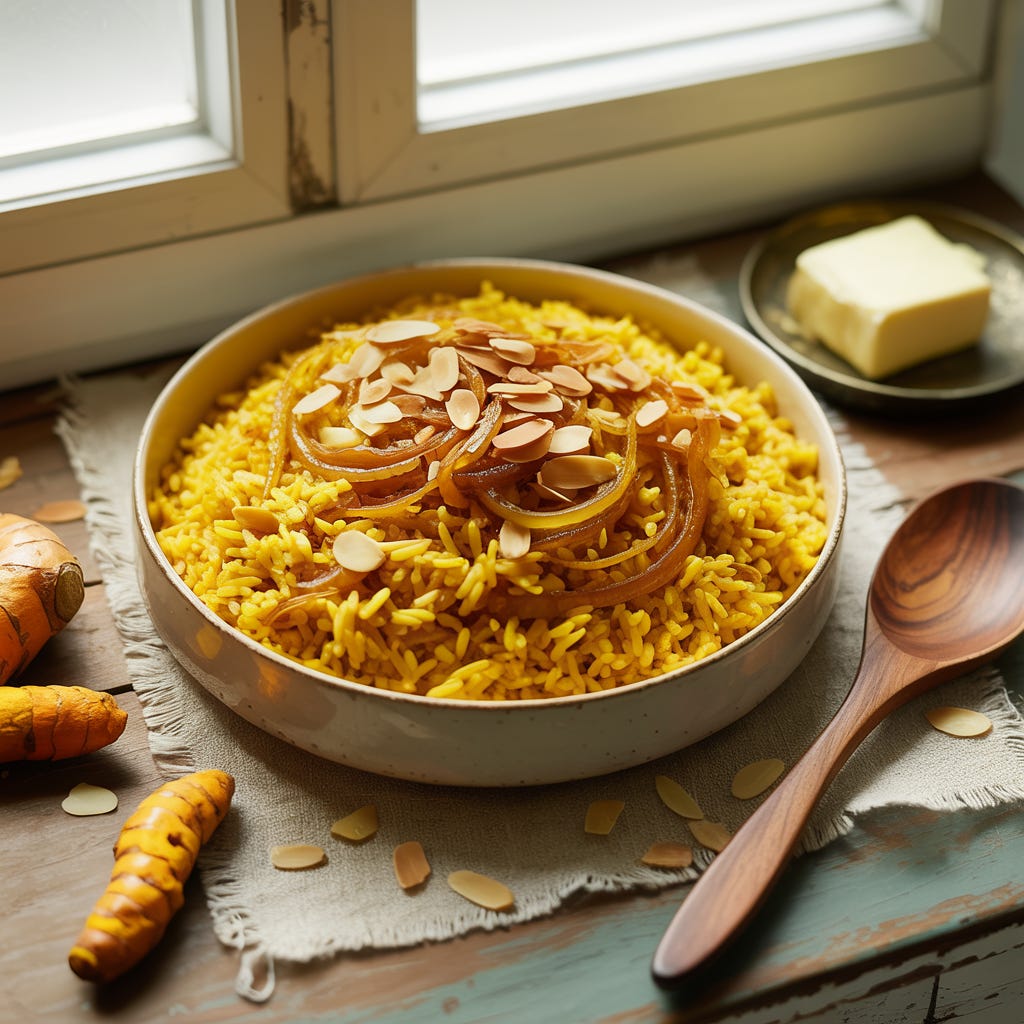
Turmeric travelling again - this time into a French pilaf.
It is not Indian cooking.
It is not French cooking.
It is cooking between worlds.
And perhaps that is the real lesson of Sher-Gil.
People who live between cultures rarely choose one over the other.
They create something new instead.
Somewhere between a Paris studio, a Punjabi courtyard, and a turmeric plant quietly growing on a German windowsill.
That is where new kitchens are born.
And where new ways of seeing the world begin.
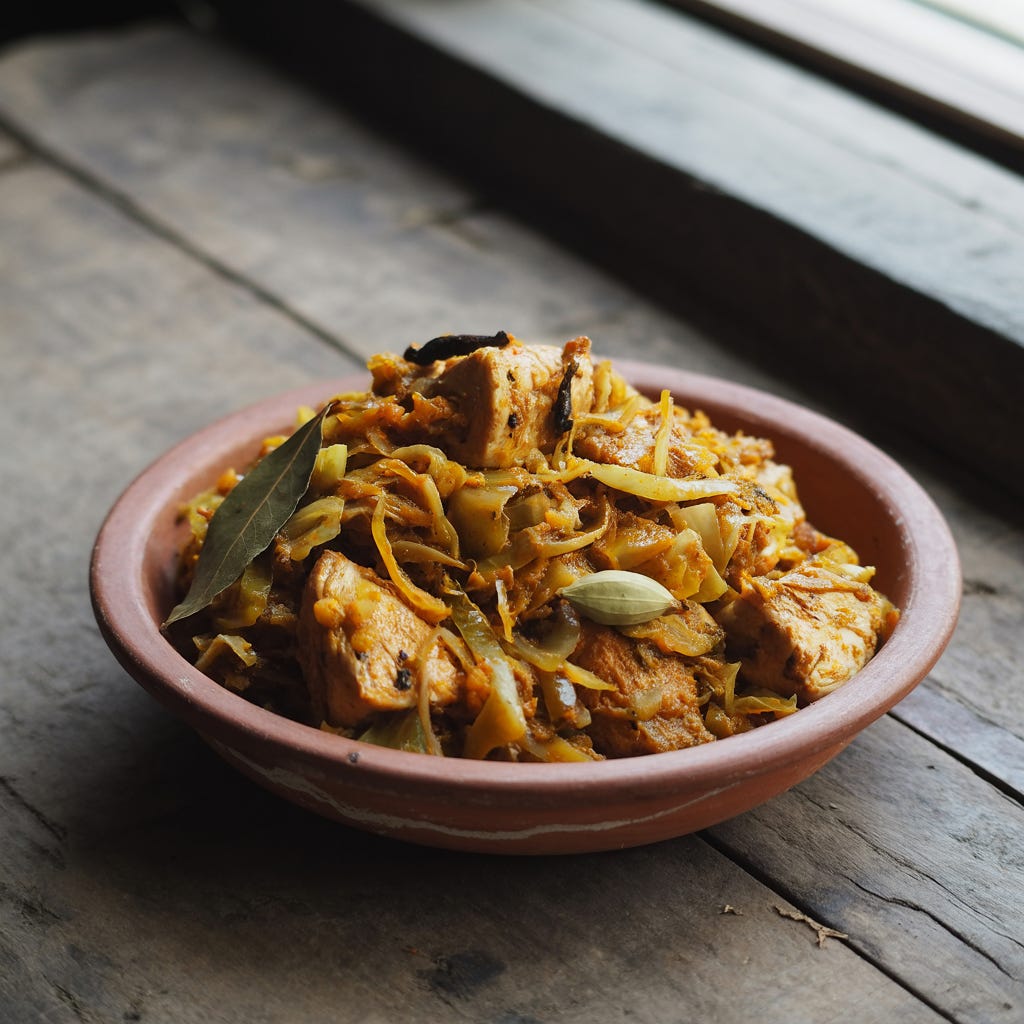
A village curry built from what is at hand: chicken, cabbage, turmeric, onion, cardamom and clove.
👉 Get your Bengali Village Chicken & Cabbage Curry recipe here
Sometimes a painting is not really about the subject it depicts.
Sher-Gil’s women grinding haldi are not simply preparing a spice. They are performing one of the oldest gestures of daily life: turning a root into colour, flavour, medicine, ritual.
The act is ordinary, almost invisible.
Yet that simple gesture connects kitchens to trade routes, villages to ports, and domestic labour to the vast movement of spices across the Indian Ocean.
Perhaps that is why the painting feels so familiar.
People who live between worlds often recognize these quiet continuities.
A root travelling across oceans.
A spice changing names in different languages.
A kitchen absorbing influences from far away.
Somewhere between a Paris studio, a Punjabi courtyard, and a turmeric plant quietly growing on a German windowsill, those worlds meet again.
And from that meeting, new ways of seeing - and new kitchens - are born.
If this essay resonated with you, I’m grateful you’ve read this far.
Beyond Babylon continues to trace Jewish life and food across unexpected geographies.
You’re welcome to subscribe or share the piece with someone who might enjoy it.
Such a lovely piece!..
I absolutely love this essay!! You're absolutely right--being between cultures is not confusion. It widens one's perspective!