
Amba
Funky spicy mango sauce - A Dip Fit for a Prince

Beyond Babylon | May 22, 2025
I’ve been quiet for the past three days—because I’ve been busy making a video. Not just any video: a full step-by-step of how to make homemade amba, that tangy, golden sauce of diaspora legend.
It turned out surprisingly well.
The only catch? Uploading it here was a bit of a struggle — but I got there in the end.
I’m genuinely proud. This is my first real attempt at kitchen storytelling on screen — not just to share recipes, but to bring you into the kitchen I’ve carried with me, and still have so much to say about.
I suppose that means I’ve (almost) joined the TikTok generation.
Here it is. Judge for yourself…
What I am trying to showcase here is a fermented mango pickle that crossed empires, cuisines, and borders—becoming a symbol of diaspora on a plate.
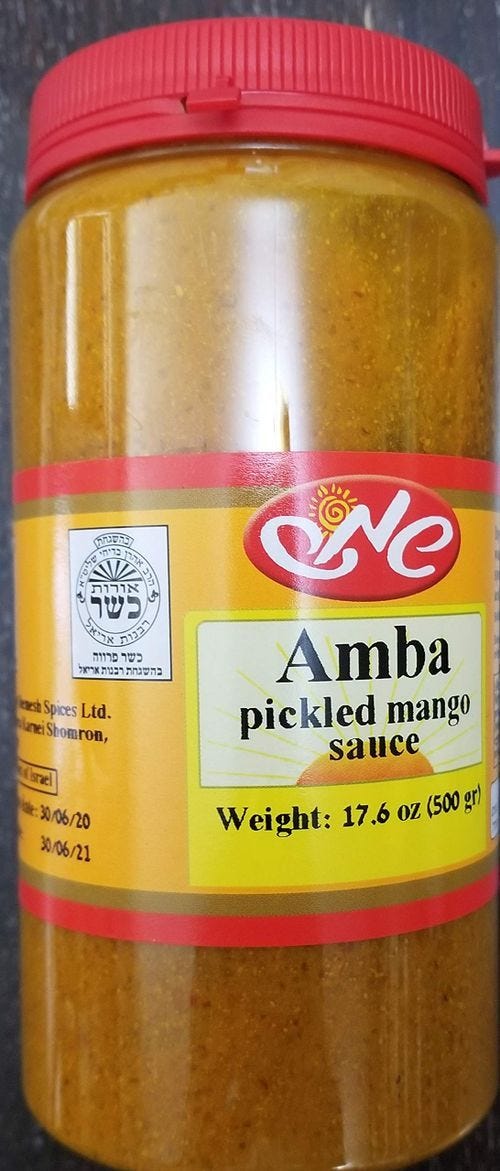
If you’ve ever ordered falafel or shawarma in Israel, you may recall the squeeze bottle of spicy, yellow-orange sauce next to the tahini. That condiment is amba—a funky, tart, pickled mango sauce with a history that spans continents. It has an Indian name (from Sanskrit āmra, meaning mango), a Baghdadi Jewish origin, and an Israeli identity.
In a twist of culinary fate, this zesty mango pickle no longer truly exists in India or Iraq the way it once did. Instead, it has become a defining flavor of Mizrahi Jewish kitchens, Israeli street food, and diasporic memory.
Sourness as a Cultural Compass
Naomi Duguid’s reflections on tart, acid, and sour flavors provide a powerful sensory and cultural backdrop to amba. In her essay The Gift of Tart, Acid, Sour, she writes that sourness is not simply a flavor—it is "a jolt, a lift, a cleansing brightness."
Amba is built on that same principle: a sharp, assertive condiment whose sourness doesn’t overpower but enlivens.
Whether it’s the dried green mangoes in India or the vinegar-laced Iraqi versions, acidity in amba cuts through richness, awakens the palate, and deepens flavor. Duguid describes sourness as something that connects us to place and memory, from pomegranate molasses to tamarind paste. In amba, fenugreek and turmeric join that tart base, forming a sensory geography that stretches from Bombay to Basra, Tel Aviv to Toronto.
It also gives an upwards kick to the bland, which is why it has become so indispensable to the traditional Iraqi breakfast, which need amba like a fish needs water.
A Culinary Framework: Sour as Structure
In Iraqi Jewish cuisine, tart and acidic elements are not side notes; they are structural. Amba is part of a constellation of sour accompaniments:
Hulba : a frothy, lemony fenugreek coriander dip
Torshi: vinegared vegetable pickles
Sweet-and-sour stews: with tamarind, pomegranate, or dried fruits
Each of these adds bite and brightness to meals often built on rice, legumes, and slow-cooked meats. The sourness doesn’t just refresh the palate—it defines the dish.
From India to Iraq: A Pickle in Transit
Much of what I write about has to do with food that travelled from the Near East to the Far East—or the reverse. Amba is one of those foods that travelled back.
Its journey began not in a kitchen, but along the trade routes of the 19th-century British Empire. Baghdadi Jewish merchants—most notably the Sassoon family—discovered India’s green mango pickles and sought to bring them back to Iraq. The solution: pickle them in vinegar and spice before shipping.
Barrels of mango slices travelled from Bombay to Basra. At first, the flavor—sharp, sour, and yellow—was met with suspicion. Then it became beloved.
By the early 20th century, amba was everywhere in Baghdad—from the homes of Jewish elites to the Shorja market stalls. It was spooned into samoon bread, drizzled over grilled masgouf, and wrapped in childhood memories of school lunch rebellions.
Even a Prince Couldn’t Resist
During the 1875 royal tour of India, the Prince of Wales (later Edward VII) was hosted by the Sassoons. He so adored Farha Sassoon’s hospitality that he remembered her farewell gifts decades later: dried apricots and amba.
In 1891, when another Sassoon visited him in England, the prince reportedly said he had eaten "a spoon of it every day from Bombay to Suez."
Even royalty knew: amba travels well. And it lingers.
An Iraqi Condiment Becomes Israeli (and Swiss)
In the 1950s, over 120,000 Jews were airlifted from Iraq to Israel in Operation Ezra and Nehemiah. Among their suitcases and stories: amba.
In early Israel, mangoes were rare. Iraqi Jews began recreating amba from memory. At first, it stayed within the community. But through sabich—a sandwich of fried eggplant, boiled egg, and tahini—amba went mainstream.
Even at Numnum, the restaurant I ran in Basel, amba had its place: on shawarma.
We didn’t have a spit, but we had a pan. I used Limor Tiroche’s stovetop method: chicken thighs marinated in olive oil, turmeric, cumin, coriander, cinnamon, paprika, and baharat. Then seared and served in laffa with tahini, pickles, onion—and amba. That final drizzle was memory.
What Makes Amba Amba?
Surprisingly, the defining ingredient of amba isn’t mango. It’s fenugreek.
Fenugreek (hilbeh) adds more than bitterness. It thickens. It blooms. In my essay on hulba, I wrote about its medicinal and symbolic power. But in amba, its mucilaginous quality gives the sauce heft.
In Israel, many commercial versions use "amba powder"—a blend of turmeric, citric acid, salt, and powdered fenugreek. Mango optional.
But amba without fenugreek is just mango sauce.
It’s the fenugreek that makes it hum—bitter, earthy, and unmistakable.
I remember when my father, who had heart disease, was prescribed fenugreek capsules by a homeopath.
He took them, but swallowing a dry pill with water wasn’t the same.
It had none of the special smell, none of the texture. No warmth.
In a dish, fenugreek had presence. In a capsule, it was just an obligation.
Diaspora in a Jar
As Iraqi Jews spread worldwide, so did amba. In London’s Golders Green and Borough Market. Even in Bethlehem and Ramallah, where Palestinian vendors picked it up through proximity.
Some versions are chunkier. Some spicier. Some have no mango at all. But every jar carries a whisper of Baghdad.
The Legacy of Amba
In every spoon of amba, there’s a story of movement. From Bombay to Baghdad, from exile to adaptation, it is more than a condiment. It is a cultural algorithm: fermented, thickened, carried forward.
As Chef Meir Adoni says, “Amba is the Middle Eastern equivalent of umami.”
It is. And it’s more. It is bite. It is brightness. It is diaspora.
So next time you drizzle it over your falafel, pause. You’re not just tasting mango. You’re tasting migration, a fork in the road.
Amba – Spiced Pickled Mango Sauce (Quick-Cook Version)
Yields: About 1 jar (1.5 cups)
Ingredients
2 large green (unripe) mangoes, peeled and sliced thin
2 tsp salt
1½ tbsp ground fenugreek seeds
1 tbsp ground turmeric
1 tbsp mustard seeds (yellow or black)
1½ tsp ground cumin
½ tsp ground coriander
½ tsp chili powder (adjust to taste)
2 cloves garlic, minced (or ½ tsp garlic powder)
½ cup white vinegar
¾ cup water
2 tbsp brown sugar (optional)
1–2 tbsp vegetable oil
Method
Salt mango slices and let sit 1–2 hours. Rinse and drain.
Heat oil in a pan. Add mustard seeds and let them pop. Stir in turmeric, fenugreek, cumin, coriander, and chili powder.
Add mango, garlic, vinegar, water, and sugar. Simmer 20–30 min until thick.
Blend smooth or leave chunky.
Cool and refrigerate. Best after 24 hours.
Serving Suggestions
With sabich, shawarma, falafel, eggplant, roast chicken, or plain rice
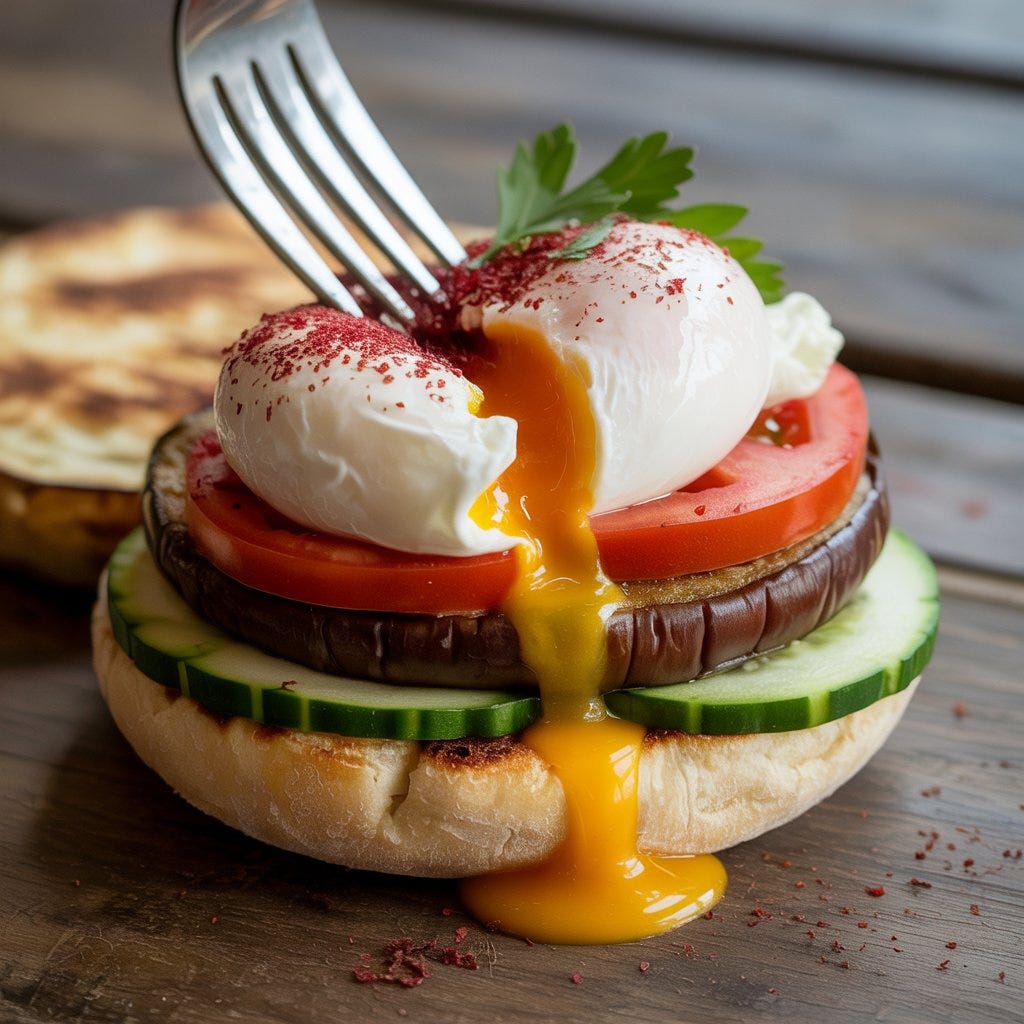
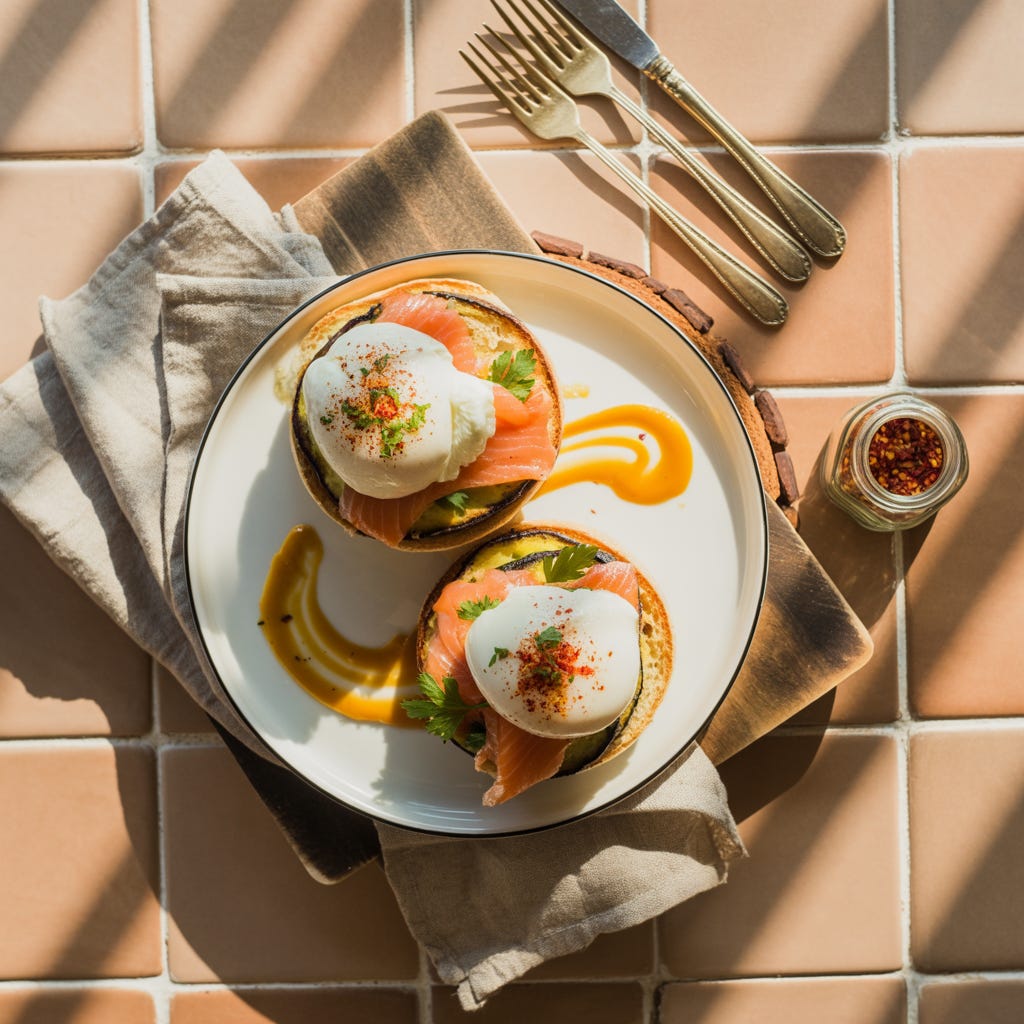
Or: Try it with a twist — Sabich Benedict: toasted English muffin, tahini, fried eggplant, poached egg, cucumber, tomato, a slice of gravlax and a final drizzle of tehina amba.
Garnish with parsley or sumac.
📬 Want a printable version of this recipe? Click the link below
quick cook amba - spicy mango sauce
Originally published on Beyond Babylon.
I spent many years harboring a deep suspicion of amba- I think mainly due to its color. But living in Israel, you have to confront it eventually. I actually enjoy the sourness now but it's not no.1 on my condiments list. Thanks for enlightening me! I'm gonna go eat a sabich for lunch now.:)
Nice video! That Sabich Benedict looks scrumptious! I was wondering why Amba sounded familiar . . . and then I realized I had saved a recipe for an Iraqi Amba a couple of weeks ago! So, now I have two recipes . . . will definitely have to try it as I think it's up my alley! 😋