
All about Eve
The Case of Sir Victor Sassoon’s Missing Chicken Curry

By Elli Benaiah | The Jewish Curry Culture Club
(A Jewish–Asian mystery across empires)
The criminal lawyer in me never really went away.
And I still love a good mystery.
A good mystery begins with a tip.
Mine arrived while I was deep in the Shanghai chapter of Beyond Babylon.
A message from Tina Kanagaratnam — the force behind Historic Shanghai, who knows the city’s Jewish past the way some people know their spice racks.
She wrote:
“Victor Sassoon, for example, was very proud of his chicken curry — and they still serve it at his hotel.”
A Sassoon curry.
Still being served.
In his hotel.
If you’re tracing the culinary footsteps of the Baghdadi Jews across the Indian Ocean — the very routes the Sassoons themselves laid down — this is not a casual remark.
This is a clue.
A door cracked open to a secret Jewish curry.
And an invitation to follow.
What I found was… an eye- and mind-opener.
Clue 1 — The Man Who Shouldn’t Have Had a Curry
The Sassoons were the great Baghdadi mercantile dynasty — builders of ports, mills, synagogues, schools, and entire Jewish neighbourhoods from Bombay to Shanghai.
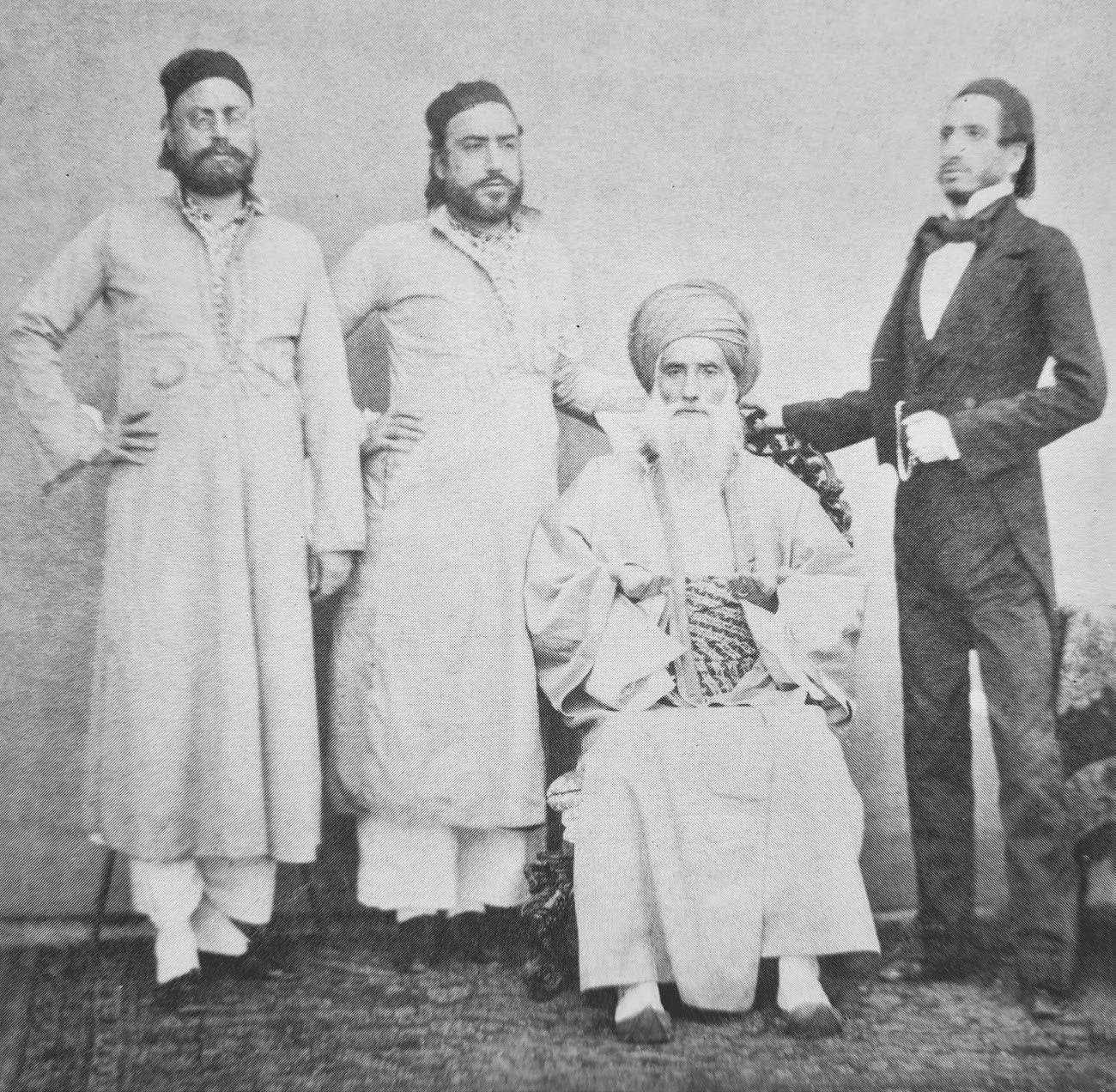
David Sassoon (seated) and his sons, Bombay, mid-19th century. The original Baghdadi Jewish merchant dynasty — devout, disciplined, rooted in communal life. A sharp contrast to Victor, who inherited the name but not the tradition. (Illustration from Stanley Jackson, The Sassoons, Heinemann, 1968)
My family followed in their footsteps, from Baghdad through British India, the gateway to the Far East.
Surely the Sassoons must have left a culinary trace — a signature curry to match the family crest.
But the man in question, Sir Ellice Victor Elias Sassoon (1881–1961), was the least Sassoon-like Sassoon ever born.
Yes, he carried the name. But not the lineage.
David Sassoon, the patriarch, fled repressive Ottoman Baghdad for British India, carrying with him a profoundly Jewish kitchen which, over the centuries, became uniquely Far Eastern — the kitchen I grew up with: turmeric, ginger, dill rice, masala fish, and the Sabbath stews of a deeply rooted Baghdadi-Indian world.
Victor was not that.
Born in Naples to a Baghdadi father and a French Rothschild mother, Victor grew up between Cairo, Paris, and London — elegant, drifting, cosmopolitan, and wholly uninterested in the family business.
He preferred:
• actresses over ledgers
• photography over profit
• horses over accounting
• Eton, Cambridge, champagne
• silk dressing gowns and mischief
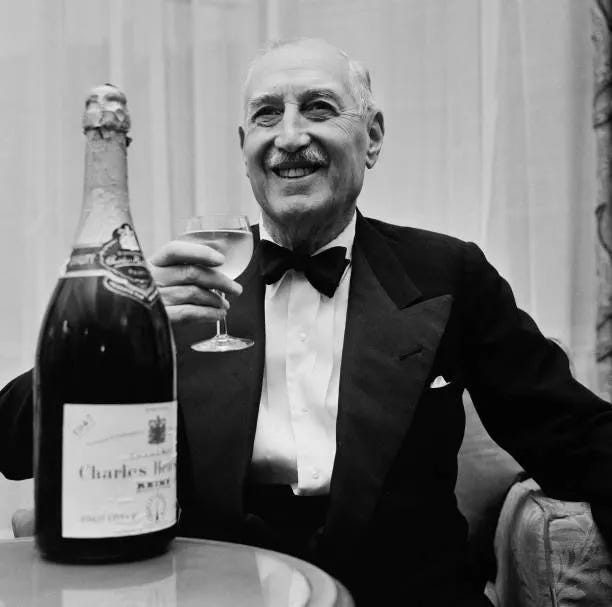
Victor Sassoon in his natural habitat — the consummate bon vivant. Champagne, charm, and a world constructed from pleasure. Savoy Hotel, London, 6 June 1957, raising a glass of champagne after his horse won the Derby — the perfect embodiment of the pleasure-driven, theatrical world he built around himself. (courtesy Getty Images)
Then came the First World War. And the crash.
His cockpit shattered; his legs crushed. The pain stayed for life.
Victor responded the only way he knew: he built artificial worlds he could control — hotels, parties, cabarets, women, photography — beauty as architecture, architecture as anaesthetic.
Bombay was shrinking; Shanghai was expanding.
So in 1931, he shifted the centre of Sassoon gravity from Bombay to the Bund — the riverfront boulevard of colonial Shanghai.
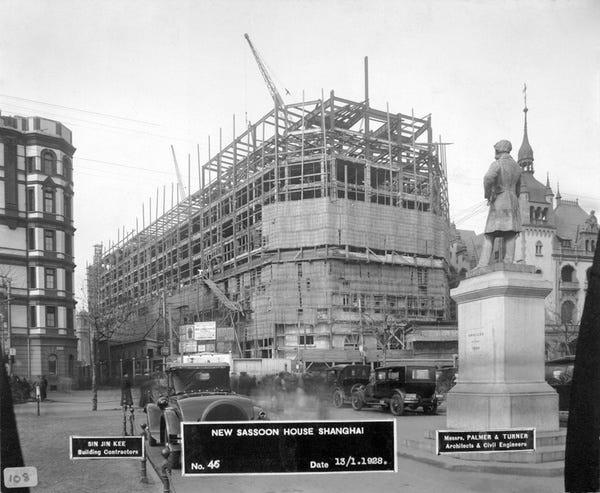
The Cathay Hotel (Sassoon House) rising on the Bund, January 1928. Victor’s architectural monument — the building that would later serve his “ghost curry” to generations of travelers. (Courtesy University of Bristol)
Clue 2 — The Empire on the Bund
Old Shanghai had a joke:
“You can ride a Sassoon tram to a brothel in a Sassoon building, sleep in a Sassoon bed, wash clothes in a Sassoon laundry, and drink Sassoon beer after.”
At the centre stood the Cathay Hotel — green pyramidal roof, art deco lines, telephones in every room, cocktails, sequins, air-conditioning, swing bands, velvet chic.
Fortune magazine crowned him “Shanghai’s No. 1 realtor.”
Emily Hahn immortalised him in China to Me — fabulously rich, socially magnetic, presiding over a world where gossip, cocktails, and deals flowed as freely as the Huangpu River.
But Victor’s Jewishness was evaporating. Shanghai’s Baghdadi Jewish community, tiny and wealthy, was anglicising at high speed. Victor — secular, theatrical, and wounded — became the final spark of the Far Eastern Sassoons, the last chapter of a dynasty that once stretched from Baghdad to Bombay and finally to Shanghai.
Surely, I thought, somewhere in this glamour, he must have had a curry he adored.
A Straits curry, perhaps — the Anglo-Indian–Malayan club curry:
• coconut milk & lemongrass
• cardamom, cloves & cinnamon
• turmeric, ginger & mustard seed
Exactly the flavour map Baghdadi Jews carried across oceans.
So when Tina wrote, “They still serve it at his hotel,” I thought I knew where to look.
Clue 3 — The Archives That Should Have Saved Us
“Start with the diaries,” Tina said.
Not just any diaries — the colossal Sassoon archives at Southern Methodist University, the same archive Professor Joseph Sassoon mined to write The Global Merchants, the book that inspired this project.
Victor’s diaries run from 1929 to 1969. He recorded everything:
• weather
• visitors
• gossip
• horseback bets
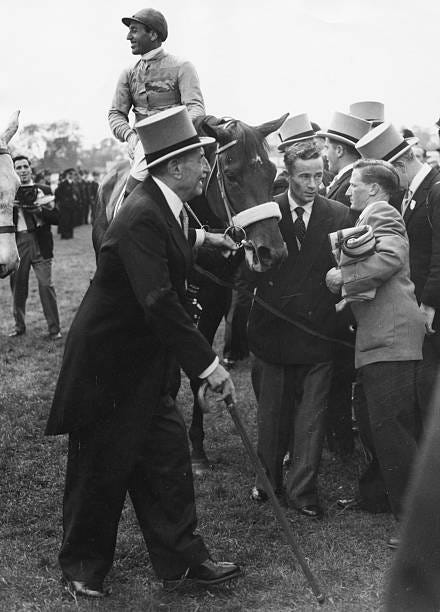
Sir Victor Sassoon with Lester Piggott after winning the Derby, Epsom, 1957.
Sassoon’s colt Crepello took the crown under the legendary jockey Lester Piggott — one of the finest riders of the century. Racing was Victor’s truest passion, and this victory was among the brightest moments of his sporting life (Lester Piggott was my father’s favourite jockey — a small coincidence that made this image hit home.) (Courtesy Getty Images).
• actors and actresses
• cabaret line-ups
• the Japanese invasion of Shanghai
• pain in his legs
• the Nassau years
• cocktail recipes
Surely — surely — a curry would appear.
A menu. A shopping list. A turmeric stain.
A note: “excellent curry tonight.”
Nothing.
After hundreds of pages, only a whisper in a yellowing newspaper clipping:
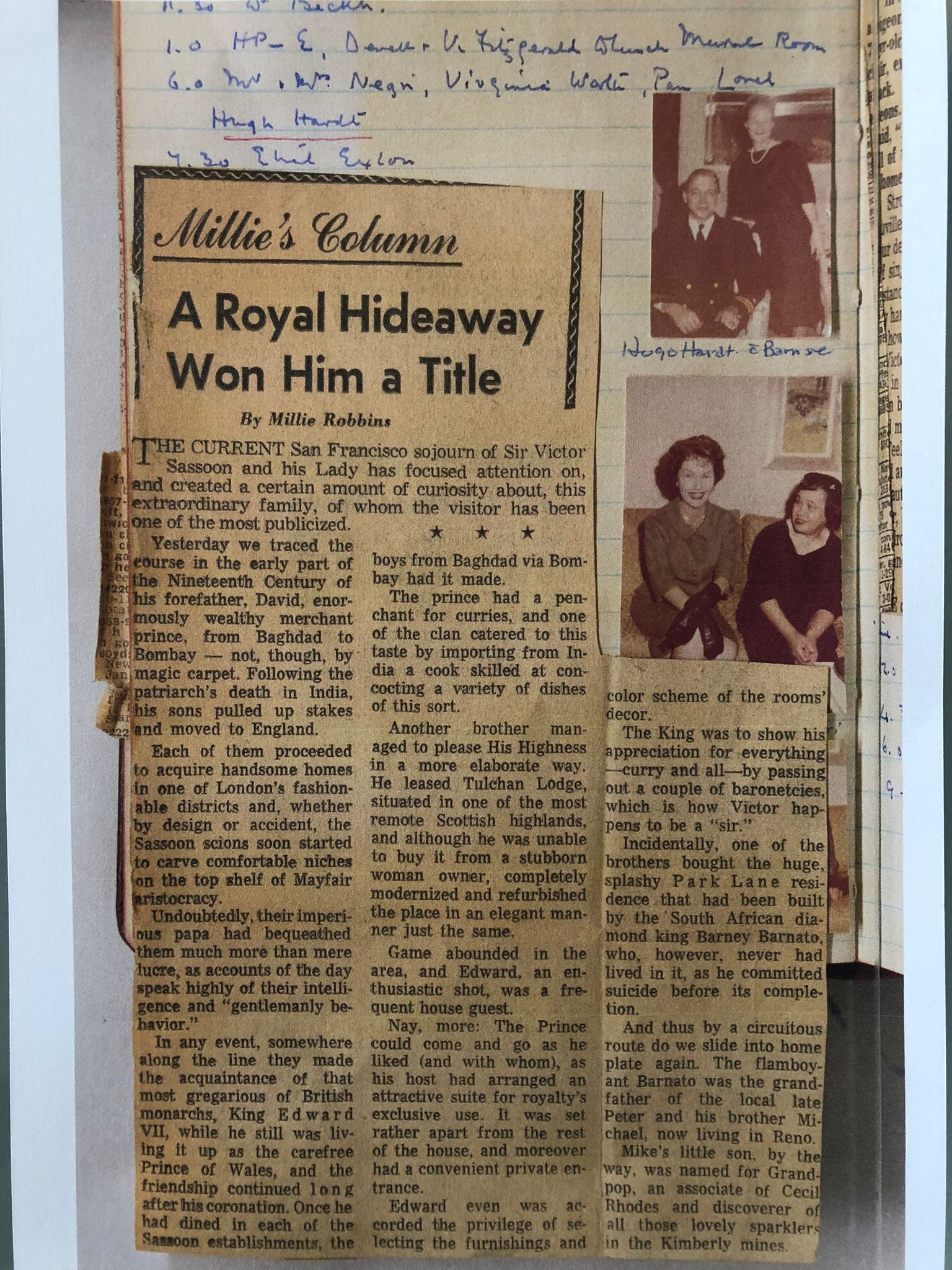
The only ‘curry clue’ Victor bothered to keep: a 1961 SF Examiner column joking that his baronetcy came from a royal taste for curry. He saved the joke — but never the recipe:
“The Prince of Wales had a penchant for curries… and rewarded his curry maker by passing out a couple of baronetcies — which is how Victor happens to be a ‘Sir.’”
A joke. A rumour. Nothing more.
Victor recorded pain and pleasure but almost never food.
If a particular curry gave him pleasure, it escaped the diaries.
Clue 4 — The Hotel That Serves a Ghost
I turned to the hotel itself.
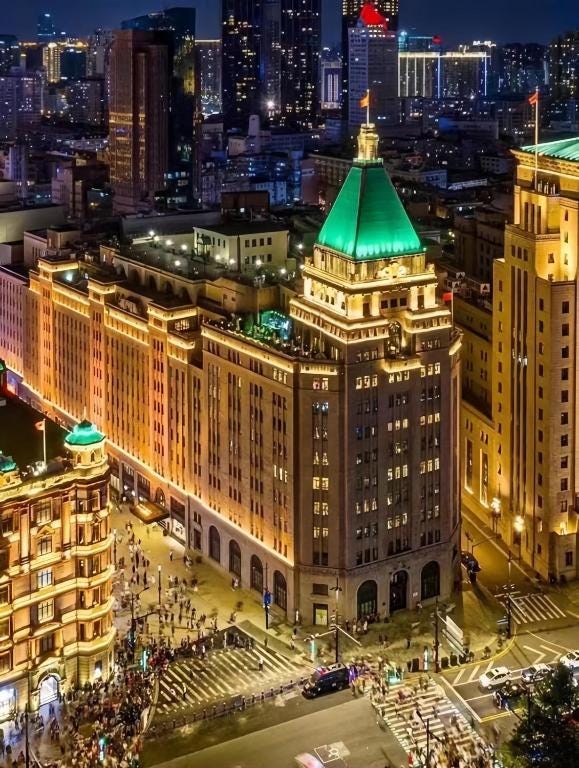
The skyline today: the Cathay Building, now the Fairmont Peace Hotel, stands at centre with its distinctive green, obelisk roof illuminated. In the background loom the skyscrapers that have emerged since the economic reforms of the 1980s (courtesy booking.com)
And here the mystery deepened.
A China Daily article from 2016 adds an unexpected twist. For an Art Deco conference that year, the Peace Hotel staged a full “Old Shanghai” banquet. Chef Jeremy Harris explained that the dishes came from a 1931 menu discovered in the hotel’s own museum — a daily menu from the Cathay’s Fine Dining Room.
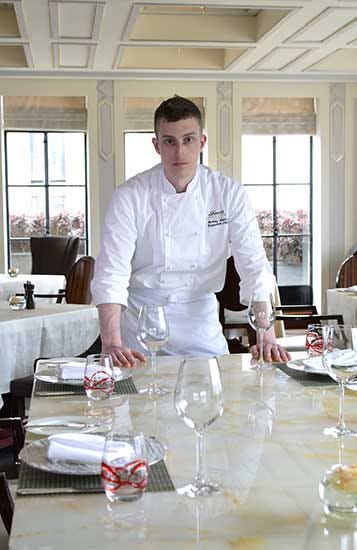
They replicated several dishes, modernised others —
but the menu contained no curry at all.
No “Sassoon curry.”
No chicken curry of any kind.
Not even a whisper of the coconut-rich Straits-style curry the hotel serves today under Victor’s name.
In other words:
the Peace Hotel’s historical menus do not support the existence of a ‘Sir Victor Sassoon curry.’
Which leaves us with a sharper question:
If the Cathay kitchen wasn’t serving curry in 1931, then where did this dish come from?
According to Tina’s tip, the Fairmont Peace Hotel still serves “Sir Victor’s Curry” in Victor’s Café.
It is no longer his hotel — but it is still a grand hotel, with suites that now reach $14,000 a night.
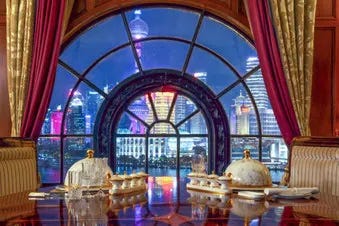
Where Victor once entertained princes: the Presidential Suite of the former Cathay Hotel, now the Peace Hotel, still gazing out over the Bund he helped define.
(courtesy Tripadvisor)
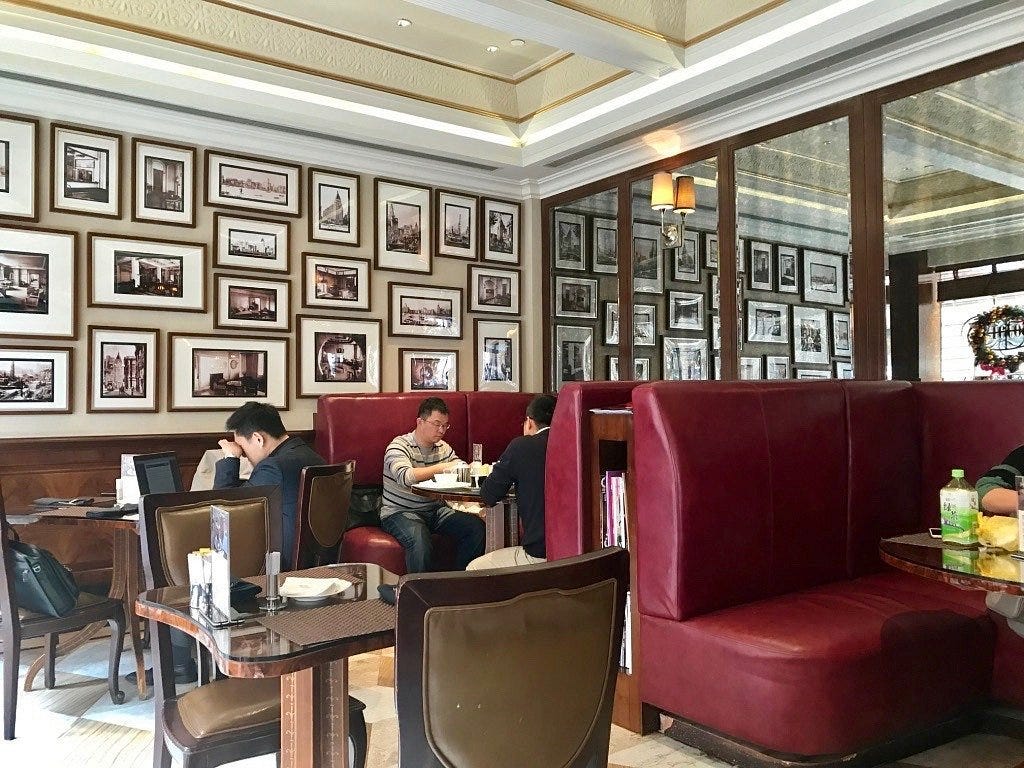
The modern Victor’s Café — comfortable, curated, and lined with photographs — but far removed from the real Cathay Hotel where Victor once staged Shanghai’s glittering nights.
(courtesy Tripadvisor)
I wrote to the hotel on their website. No answer.
TripAdvisor offered help — or perhaps a misdirection.
A guest had even posted a real photograph of “Sir Victor’s Curry” as served today at Victor’s Café: a vibrant yellow broth, coconut-rich, dotted with chicken and herbs.
I studied the image carefully. The placemat beneath the bowl caught my eye — a woven mat remarkably similar to the ones visible in photographs of Victor’s Café today. It suggests that the dish was indeed eaten on-site.
But that is all it proves.
A matching placemat only confirms where the diner sat, not what the dish represents. It cannot tell us whether the bowl in the photo is truly “Sir Victor’s Curry,” a Straits-style reinterpretation, or—as Tina now suspects—simply a laksa that a guest mis-identified.
In other words: the photo shows a meal at Victor’s Café.
It does not authenticate the curry’s lineage.
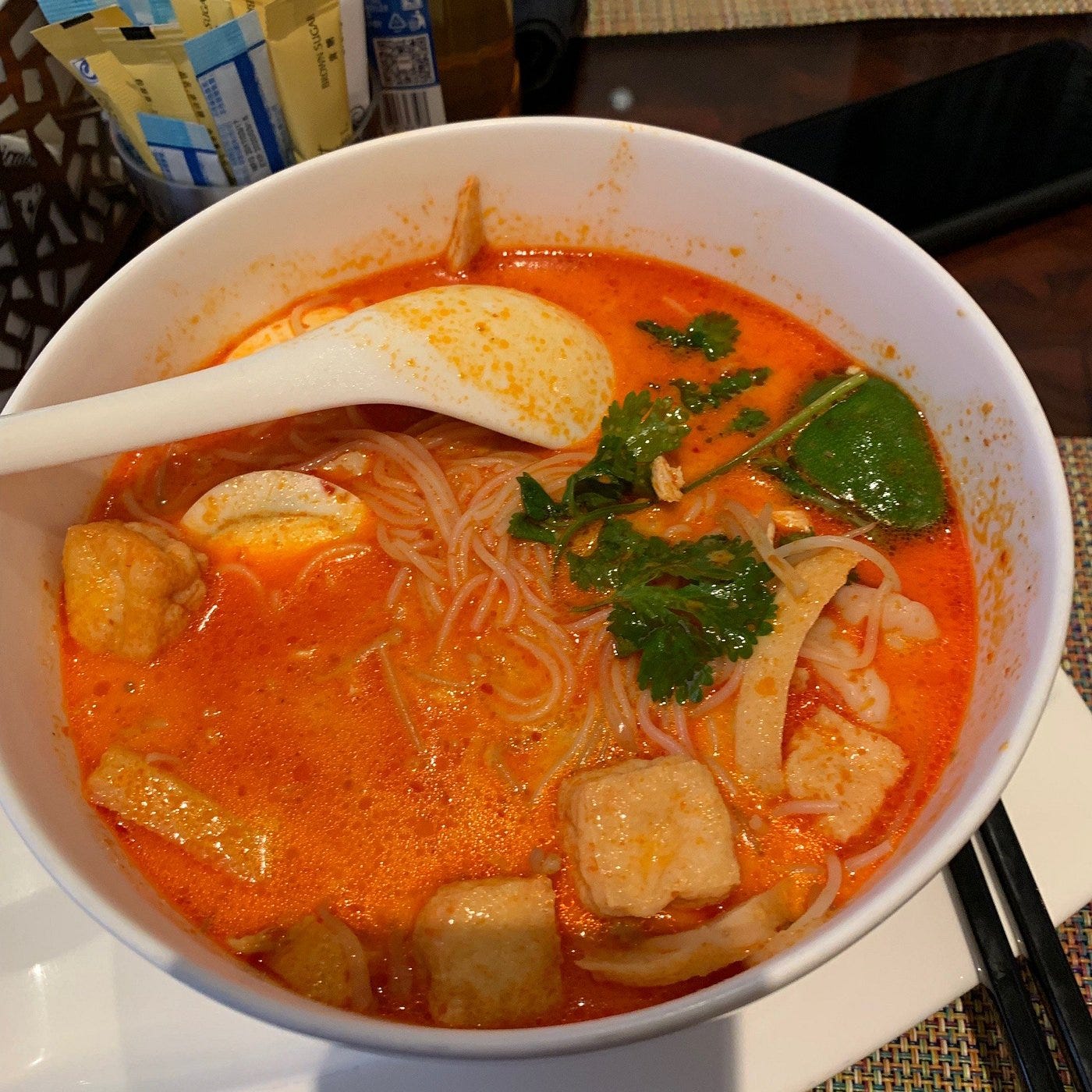
In fact, when I sent the photo to Tina, I wasn`t completely surprised.
“This might not be a curry at all,” she said. “It looks like a laksa.”
Not a Straits–Malayan club curry.
Not an Anglo-Indian dish.
But something closer to a Singapore/Malaysia laksa — the kind you’d find in a hawker stall, not the Cathay Hotel’s Fine Dining Room in 1931.
At this point, everything remains suspiciously speculative.
Tina plans to go next week and order it herself.
Until then, this is the best we can say:
The photo is authentic — a real customer photograph.
The dish clearly exists on the modern menu (which we do not have).
But whether it is a curry, a laksa, or a branding invention… remains unconfirmed.
Which only deepens the mystery:
If the Peace Hotel’s historical menus show no curry, and the modern dish resembles a laksa, then where — and when — did “Sir Victor’s Curry” truly originate?
A ghost dish.
A name with no lineage.
A story plated to match a legend.
And the truth is still out there — perhaps in the bowl Tina will order next week.
Clue 5 — The City That Fell
Then the bombs.
14 August 1937 — Japanese planes struck Shanghai.
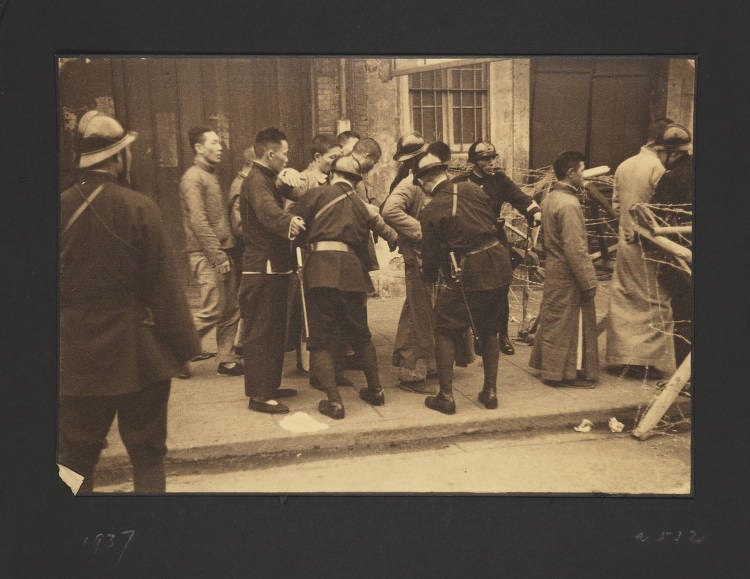
14 August 1937 — Japanese bombs struck Shanghai. Victor took his camera into the streets and captured scenes like this one: Japanese soldiers frisking civilians at a checkpoint outside the International Settlement.
Buildings shattered. Civilians died by the thousands. One bomb landed outside Sassoon House.
Victor climbed to the upper floors and photographed the destruction of his own empire.
The next morning, the Cathay reopened.
Tablecloths ironed.
Silver polished.
Guests drifting back in.
Survival as theatre — Victor’s deepest instinct.
But Shanghai could not hold him.
He used to say: “I left India for China, and China left me.”
He fled in 1941. Sold everything by 1949.
And the Asian Sassoon story ended.
Yet the curry resurfaced — not in Shanghai, but in Nassau.
Clue 6 — The Curry That Turned Up in Nassau
In the late archives, a breakthrough:
Sports Illustrated, 24 October 1960 — Mary Frost Mabon publishes:
“A Curry Named for Eve.”
(E.V.E.S. — Ellice Victor Elias Sassoon)
Not biblical Eve.
Not a Chinese curry.
Not a Bombay curry.
A bachelor’s curry — the curry Victor cooked for himself in Nassau.
The ingredients were not elegant, not refined, but deeply colonial and entirely practical:
• onions
• turmeric
• fried potatoes
• frozen green beans
• curry powder + vinegar
• Worcestershire
• Tabasco
• ketchup
• piccalilli
• chutney
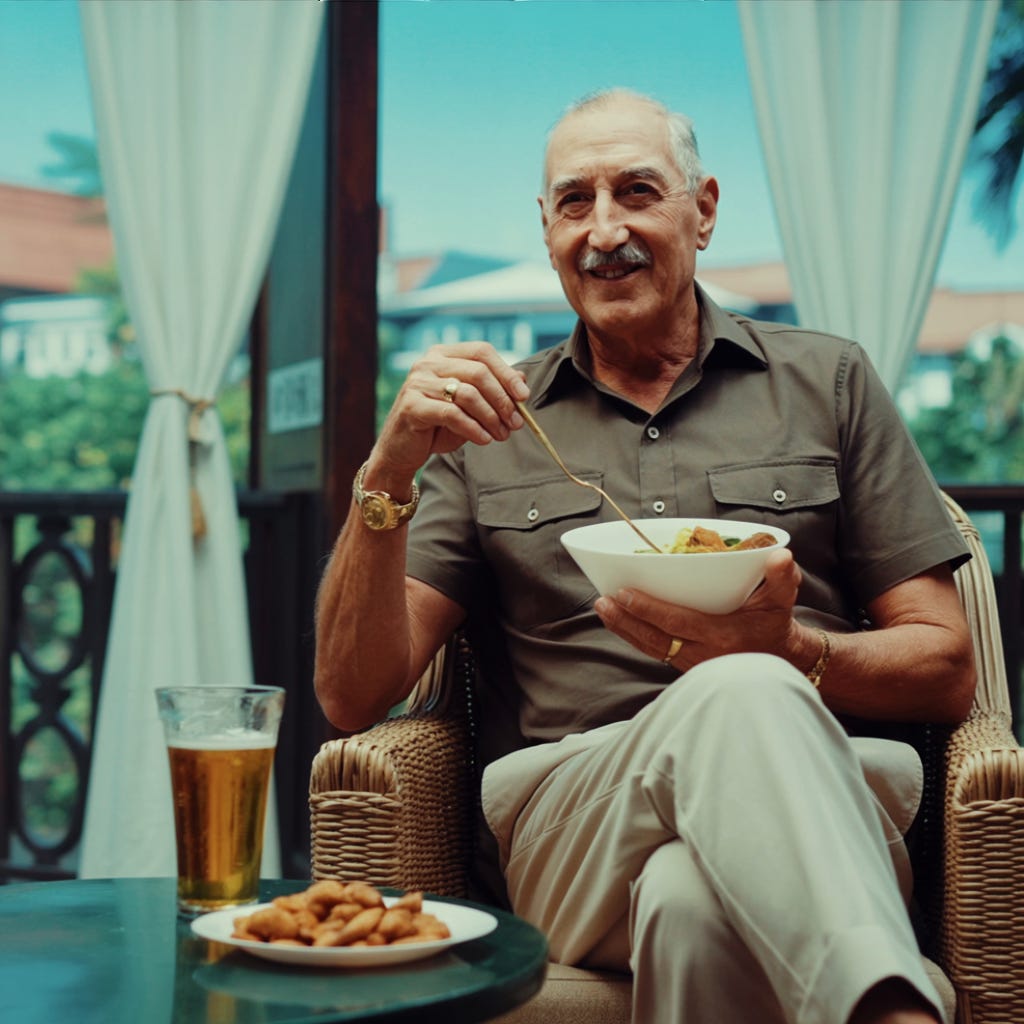
Victor Sassoon in retirement — or so it feels. A Nassau afternoon, a bowl of curry, and a cold Tuborg. Exactly as Mary Frost Mabon described it in 1960.
Then Mary Frost Mabon adds the detail that changes everything:
“The curry sauce — thick, spicy and relatively mild — was one of many accompaniments the Sassoons served with a Persian chicken and rice. It improves after being left to stand in the icebox.”
A curry that improves with neglect — possibly the most Victor Sassoon detail of all.
She goes further:
“Served cold and thick, the sauce is an excellent relish for cold meats; heated and thinned, it becomes a savory sauce for broiled fish.”
And then the flourish:
“Sir Victor’s curry is on the mild side, but the Sassoons always have on hand Tabasco, chutneys, popadams… To cool the curried throat, Sir Victor recommends a half-and-half mixture of Tuborg beer and Bass ale, ice-cold.”
This — finally — was Victor’s own curry, witnessed, tasted, documented.
What, Then, Is the Real Victor Sassoon Curry?
Two curries. Two continents.
To ask which one is “real” is to misunderstand the man.
Yesterday I spoke with Ester Benjamin Shifren, whom I connected with after Tina ’s suggestion.
Ester grew up in the Baghdadi Jewish community of Shanghai and Hong Kong.
Her parents worked within the orbit of the Sassoon enterprises — she herself was a child there before the Japanese interned her family in the Stanley Civilian Internment Camp, a story she later told in her book Hiding in a Cave of Trunks.
She didn’t remember any “Sir Victor curry.”
But she remembered all the dishes of my childhood — the Baghdadi kitchen that travelled intact across Bombay, Rangoon, Shanghai, Hong Kong: mahmoosa, mahasha, kubba, yellow rice, Sabbath eggs, our stews and fish and chilies.
Her memory confirmed the truth I had already begun to suspect:
The Baghdadi kitchen travelled through south east Asia.
Victor’s curry did not.
Victor lived everywhere and belonged nowhere:
Baghdad + Bombay + Shanghai + Nassau
Jewish + Rothschild + British + Asian
heir + exile
showman + survivor
Of course he had two curries.
He probably had more.
Victor lived in the present, not in posterity.
He never bothered to write down what mattered only in the moment.
The Last of the Far Eastern Sassoons
Victor built a hotel to outlast him.
He photographed everything except the thing we wanted most.
His diaries brim with life but reveal no recipe.
He wasn’t the last Sassoon by lineage —
but he was the last Far Eastern Sassoon,
the final expression of a dynasty that once linked Baghdad to Bombay and Shanghai.
After his death, the press was stunned by how modest his estate was.
He inherited an empire — and left almost nothing.
As Professor Joseph Sassoon notes in The Sassoons, the dynasty’s decline was not sudden but generational. Anglicization, aristocratic imitation, and the abandonment of David Sassoon’s disciplined work ethic slowly hollowed out the empire. By the fourth generation, little remained of the fiercely rooted Baghdadi identity that had built it.
Joseph Sassoon’s verdict is brutal and accurate:
Victor Sassoon embodied the dynasty’s collapse — a man who inherited an empire but not a tradition.
The Sassoons declined because they lost the things their forefathers prized:
• connection to roots
• a hard-work ethos
• community
• Jewish continuity
Victor had none of these.
The more I read, the clearer the truth became:
Victor was not a man who left recipes.
He left photographs, parties, debts, mistresses, horses, and glittering evenings —
everything about himself, nothing rooted.
A man who belonged everywhere and nowhere leaves traces in hotel lobbies and faded photographs —
not in kitchens, and certainly not in the spice-box of Jewish memory.
The End of the Chase
In the end, my hunt for Victor’s curry led to the only honest conclusion:
There is no Jewish Sassoon curry.
And that absence is the most Victor Sassoon thing of all.
But the chase was worth it.
Because in searching for his curry, I finally understood my own.
The curry of my family’s kitchen —
the Baghdadi–Indian matrix I am documenting —
has boundaries, history, memory, and meaning.
Victor’s does not.
His absence clarified my presence.
And that, perhaps, is the real ending of this search.
The end.
📜 Appendix: The Two Victor Sassoon Curries
🍛 1. “Sir Victor’s Curry” — The Peace Hotel Version
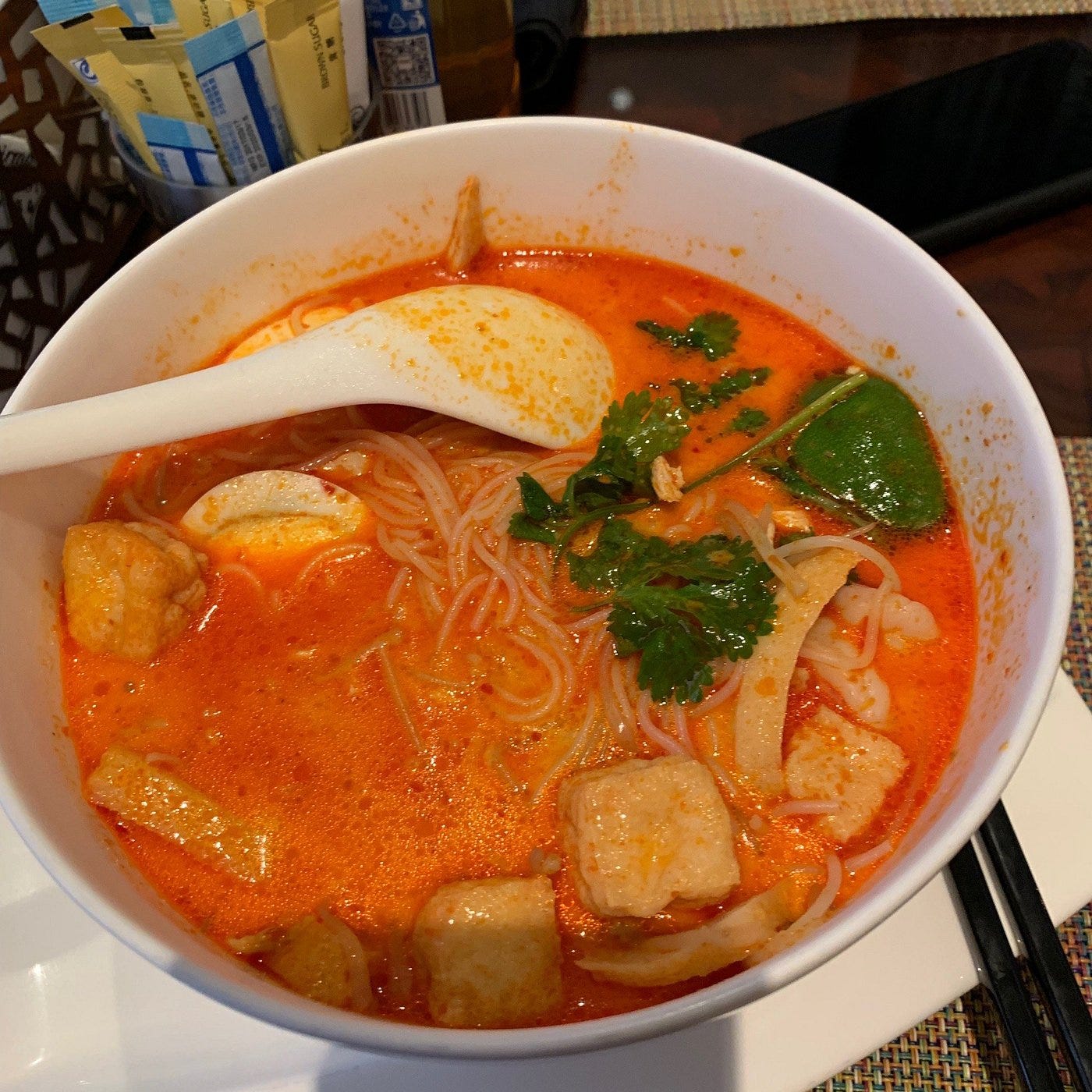
Straits–Malayan style. Likely a hotel creation, not Victor’s own — but historically plausible. ‘Sir Victor’s Curry’ at the Peace Hotel — a ghost dish with a great story (courtesy Tripadvisor)
Ingredients
700 g chicken thigh, cut into chunks
2 tbsp oil
1 onion, sliced
3 cloves garlic, minced
1 tbsp ginger, minced
2 tsp turmeric
1 tsp coriander powder
1 tsp cumin
1 tsp fennel seeds
½ tsp cinnamon
3–4 cardamom pods
2 cloves
1 tbsp Singapore-style curry powder
1 stalk lemongrass, bruised
1 tomato, chopped
250 ml coconut milk
250 ml chicken stock
Salt + a pinch of sugar
Fresh coriander, to garnish
Method
Heat oil; sauté onions until soft.
Add garlic + ginger; fry till fragrant.
Add turmeric, coriander, cumin, fennel, cinnamon, cloves, and curry powder.
Add chicken; brown lightly.
Add tomato + lemongrass.
Pour in coconut milk and stock; simmer 25–30 minutes.
Season with salt and a touch of sugar.
Garnish with coriander and serve with rice.
A classic Straits club curry — coconut-rich, aromatic, Anglo-Malayan. A curry of empire.
🍲 2. The Original 1960 “E.V.E.S. Curry”
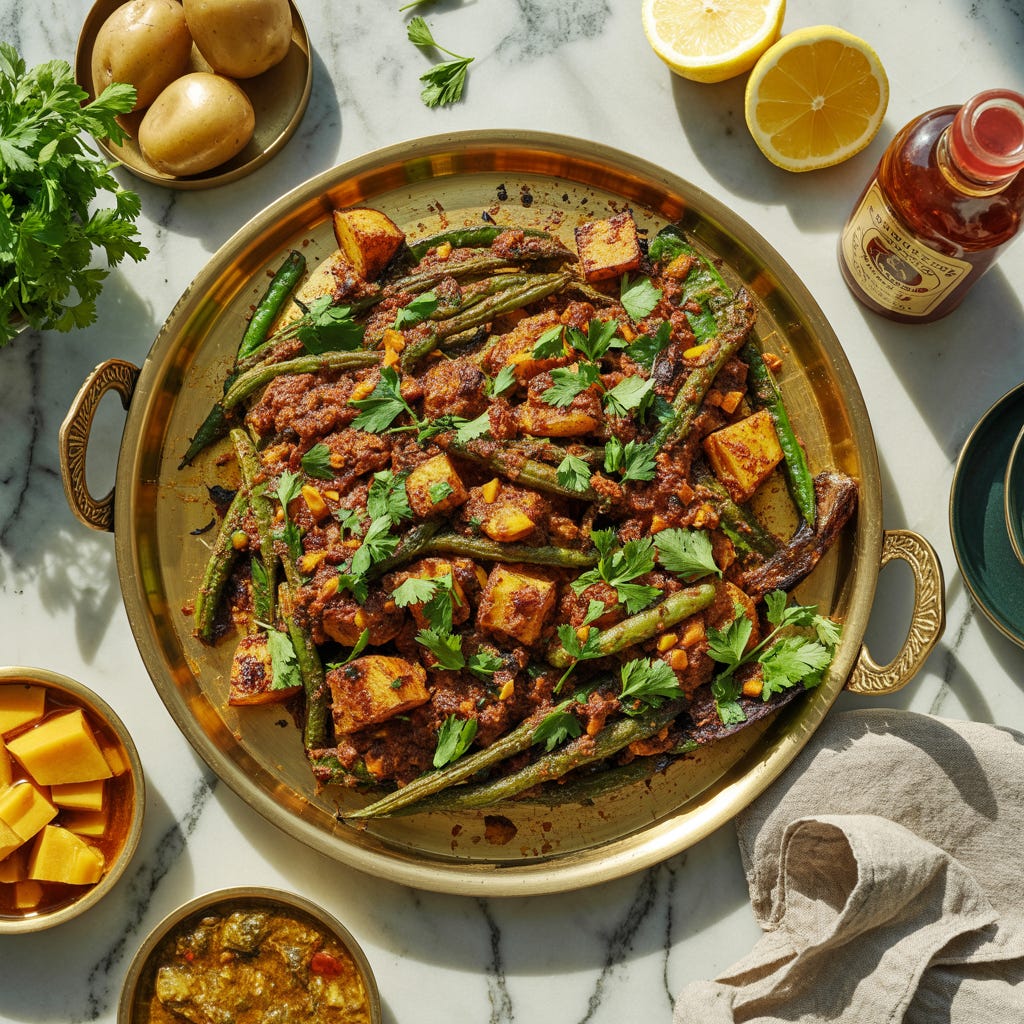
Ellice Victor Elias Sassoon’s bachelor curry — as documented by Mary Frost Mabon.
This is the only authentic Victor Sassoon curry ever recorded by an eyewitness.
A pantry curry. A Nassau curry.
Practical, colonial, oddly charming.
Ingredients
2 onions, chopped
2–3 tbsp oil
2 tsp turmeric
2–3 potatoes, peeled + diced
Oil for frying potatoes
200 g frozen green beans
1–2 tbsp curry powder
1 tbsp white vinegar
1–2 tsp Worcestershire sauce
A few drops Tabasco
1 tbsp ketchup
1 tbsp piccalilli
1 tbsp chutney
Salt + pepper
Method
Fry potatoes until golden; set aside.
In a pan, fry onions in oil until soft.
Add turmeric; stir until fragrant.
Add fried potatoes + green beans.
Add curry powder + vinegar.
Add Worcestershire, Tabasco, ketchup, piccalilli, and chutney.
Simmer gently 10–15 minutes.
Adjust seasoning. Serve with rice, toast, cold meat — or however Victor liked it.
Mary Frost Mabon’s notes (1960):
“The curry sauce — thick, spicy and relatively mild — improves after being left to stand in the icebox.”
“Served cold and thick, it is excellent with cold meats; thinned, it becomes a savory sauce for broiled fish.”
“For heat, Sir Victor kept Tabasco, hot chutneys, and popadams.”
“To cool the curried throat, he recommends a half-and-half mixture of Tuborg beer and Bass ale, ice-cold.”
👉 get your printable recipe here
A curry as unrooted as its creator — yet unexpectedly useful, adaptable, and alive.
✨ All posts are free; paid subscriptions are optional, and your support is deeply appreciated.
💬 Share your story in the comments, or pass this essay along.
📖 To support more work uncovering Jewish food in unexpected corners of the world, consider subscribing to Beyond Babylon.
Wonderful article, Elli, and a terrific way to tell the story through the missing curry! Thank you! But the photo with "Sir Victor's Curry - Peace Hotel version" is not the curry they serve at the hotel. (Looks like a laksa to me.) I'll send you a photo next week when I have it!
I am going to try the original Curry recipe. Thank you for insight into the Sasson legacy for which i am priviliged to know several members of their extended families even though my roots also passed through Shanghai! It explains much of what i have seen through the Elias/Sasoon connections i have in Australia and Israel!