
After the violin
On Jewish klezmer, and the Roma hand that tuned it

It was raining in Berlin, which felt correct.
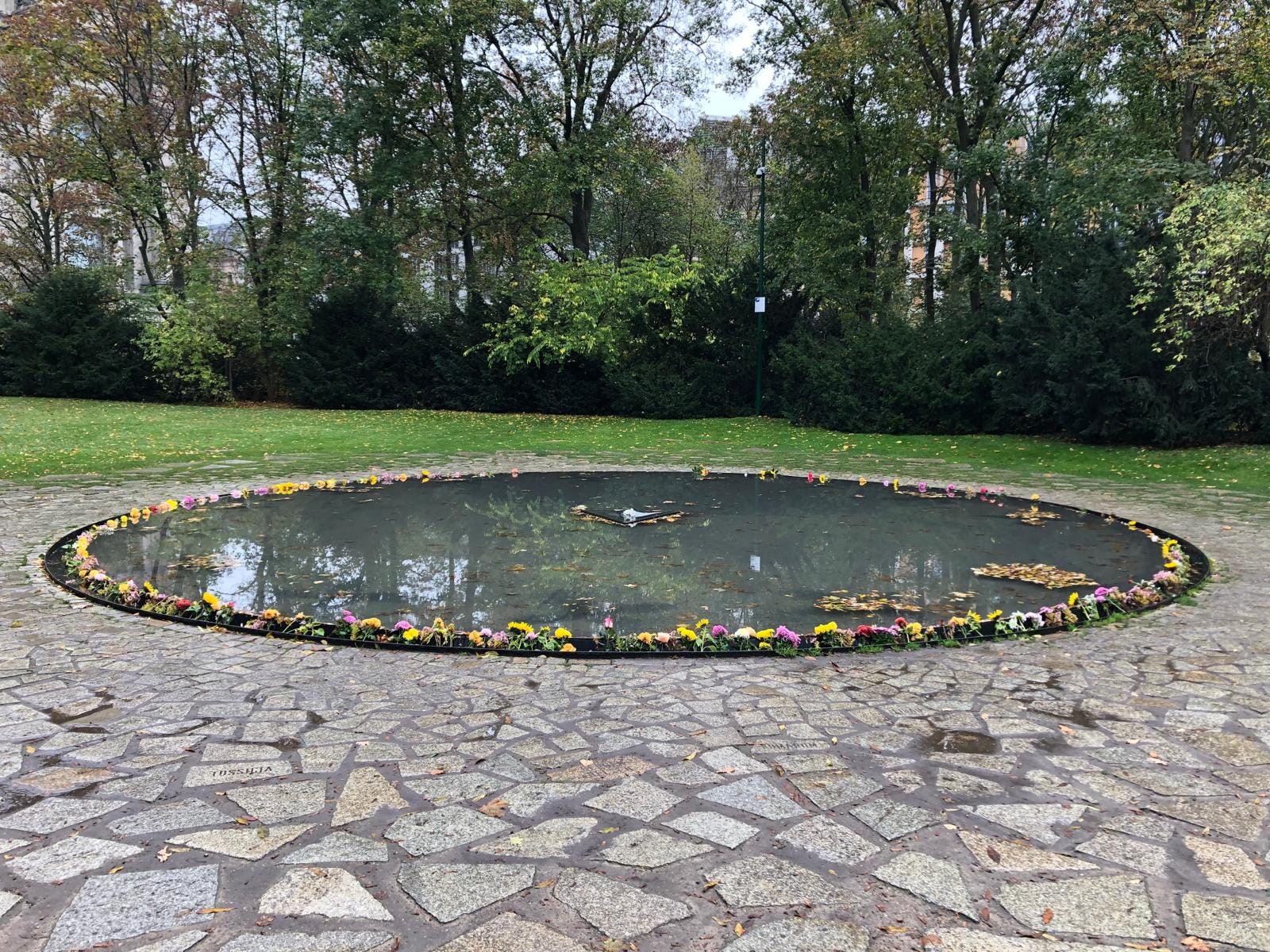
The memorial to the Sinti and Roma murdered under National Socialism sits in a corner of the Tiergarten, close enough to the Reichstag that you can see the dome through the trees. It is a circular pool of black water, flush with the ground, rimmed with rough stones.
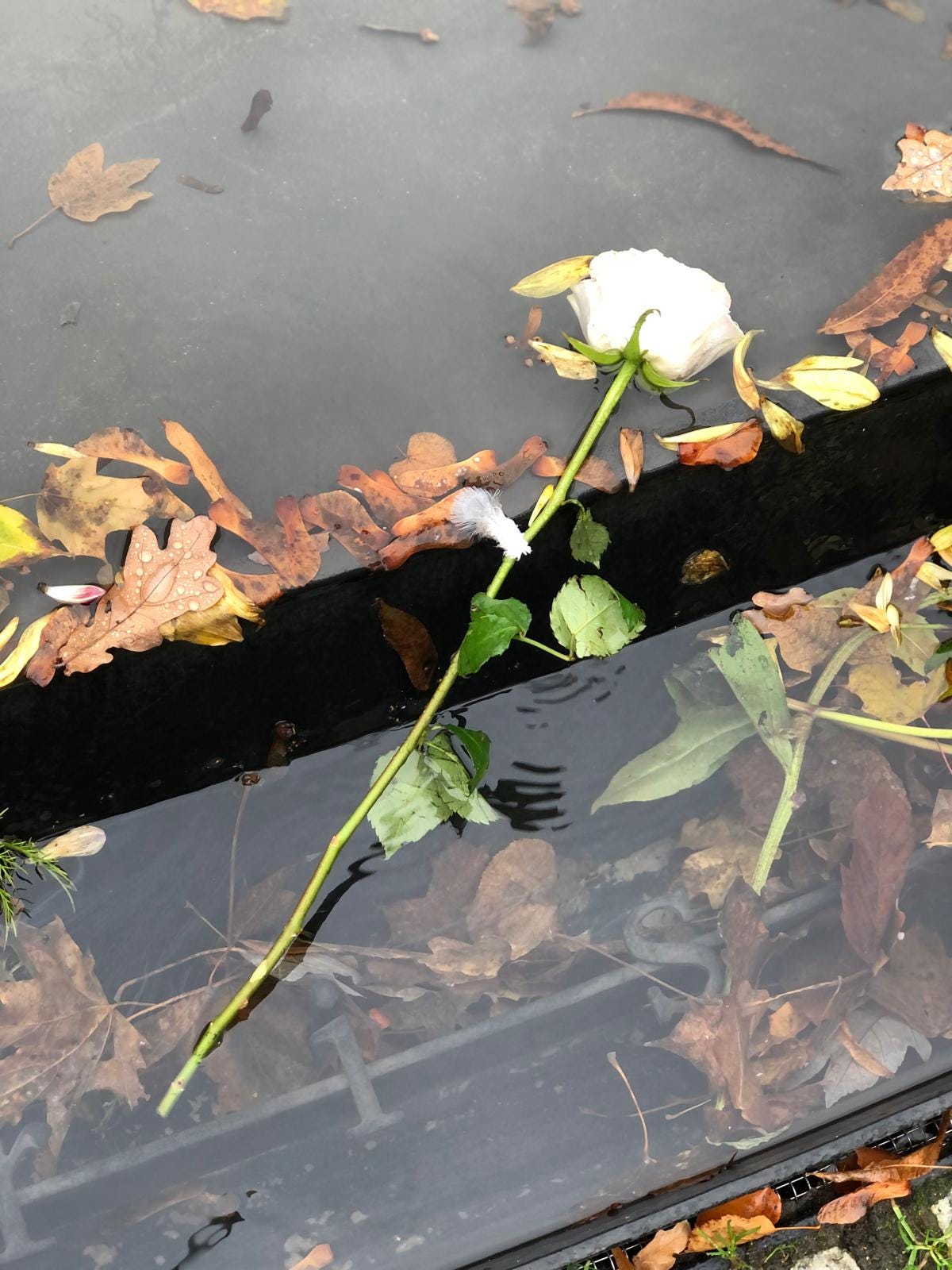
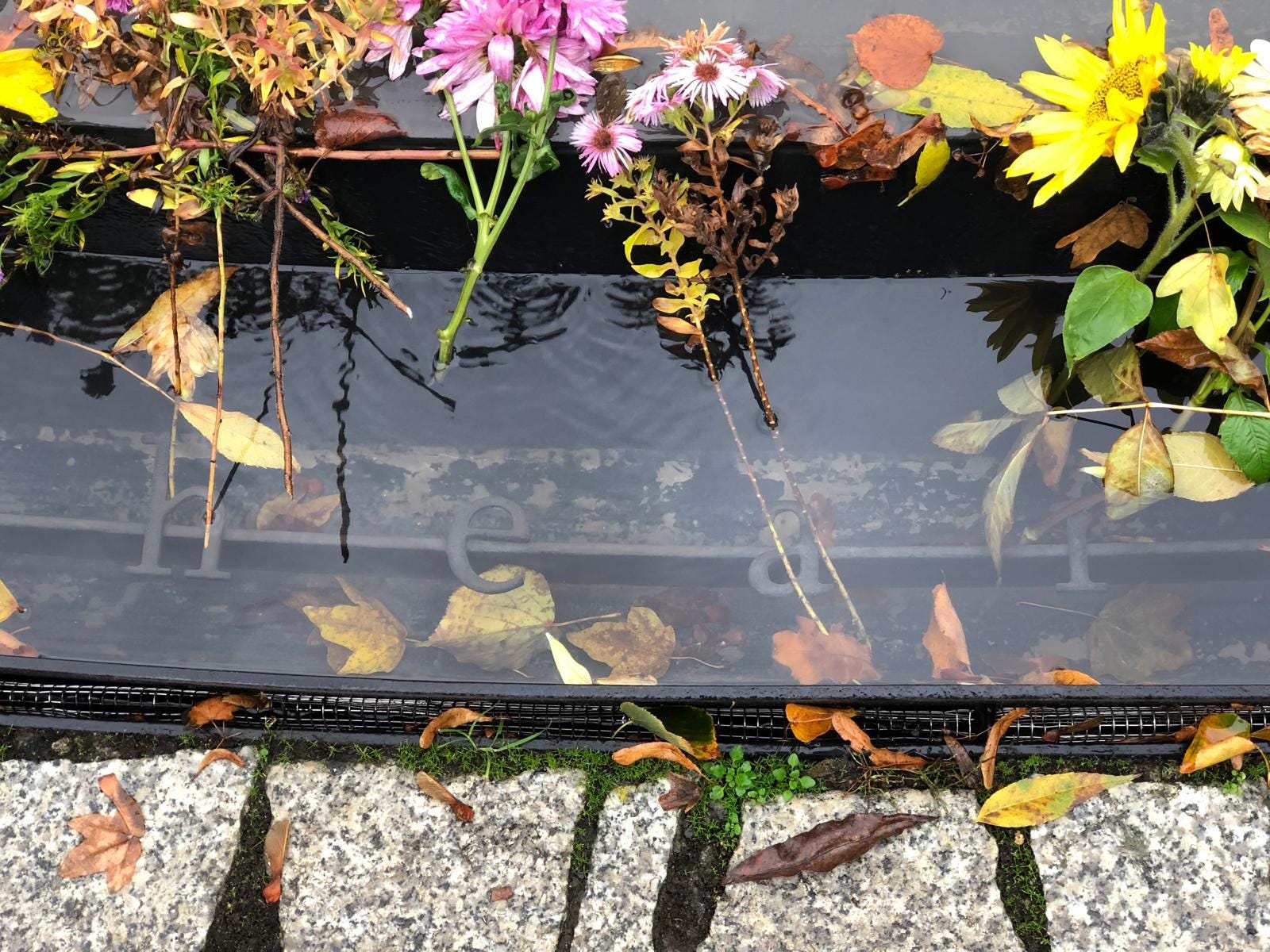
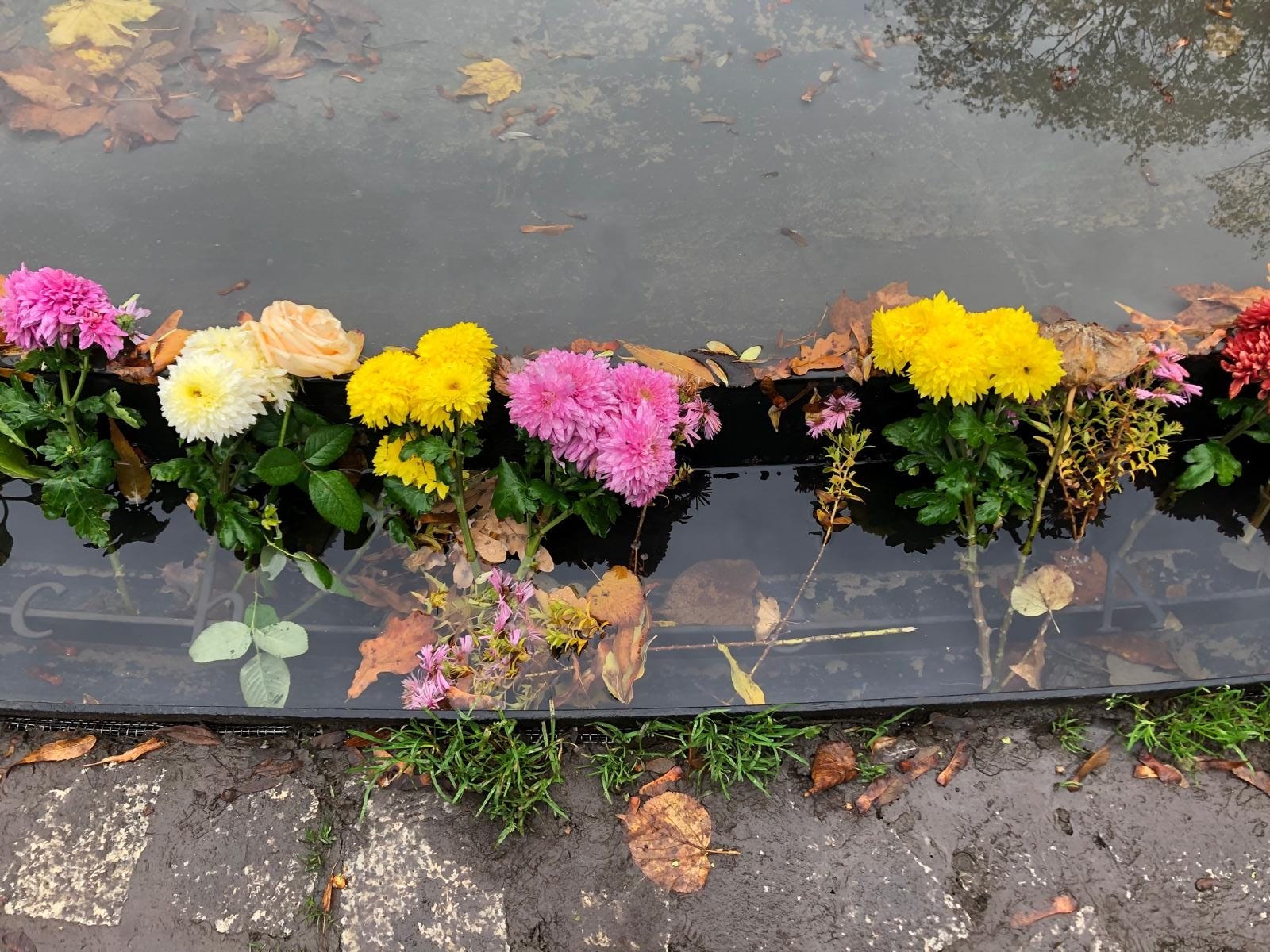
Into the paving around it, someone has set the names of the camps. On the day I visit, the rim of the pool is laid with flowers - sunflowers, asters, chrysanthemums going soft in the wet - and autumn leaves have drifted onto the water and stopped there, as if the surface were holding them.
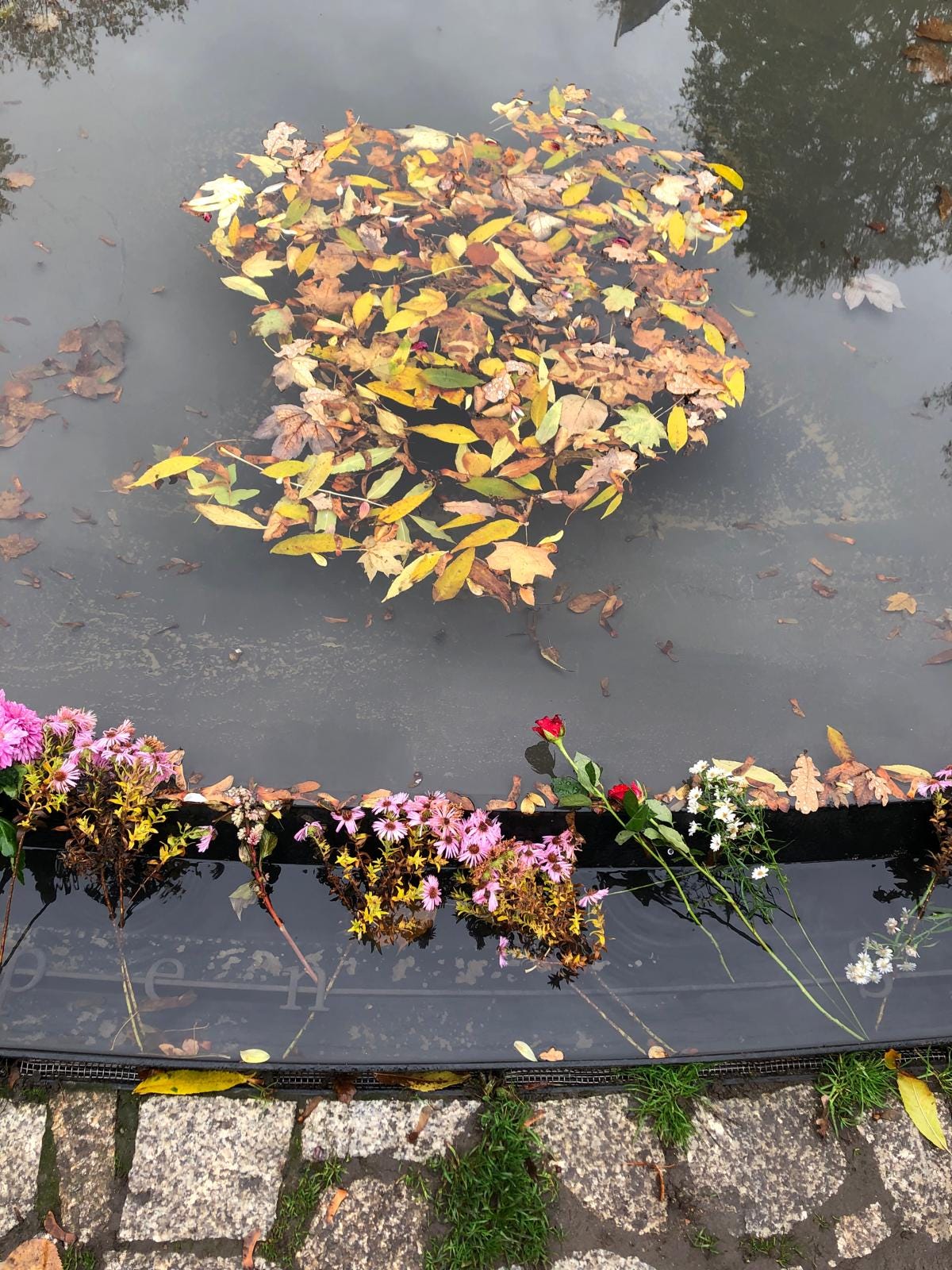
At the centre of the pool is a stone triangle. Every day it is lowered into the ground, and every day it comes back up carrying a single fresh flower.
Someone, somewhere below this park, performs that small act of transmission every morning: the same gesture, repeated, so that the memorial is never finished mourning and never allowed to stop.
And over all of it, a violin is playing. A thin melody - Mare Manuschenge, “Our People,” composed by the Sinti violinist Romeo Franz - threads out of hidden speakers and across the water. Franz has said that when he was asked to play a single mourning note at the memorial’s opening, he found he could not bear it; instead he took the whistle Sinti parents use to call their children, a signal every Sinto knows, and set it in the minor scale of his own tradition.
Working in collaboration - Sinti and Roma memorial, Berlin. Collaborative video by art students Sarah Anderson and Clive Matthews suring a recent visit to Berlin, Germany. (Credit Youtube).
What plays over this water, forever, is a parent calling a child. It is the only sound apart from the rain.
Last time, a violin broke in Calcutta, and a city’s habit of repair became a way of remembering. N.N. Mondal repaired Yehudi Menuhin’s instrument because that is what Calcutta does with what arrives from elsewhere: it absorbs the foreign into its ongoing life instead of freezing it into a museum piece. The violin got fixed.
The shop stayed open.
Here, a violin plays in a city that repaired almost nothing.
That difference is what this essay is about.
The people the melody belongs to
The people this pool remembers came, a very long time ago, from India.
This is not oral tradition or romantic guesswork.
Romani was identified as an Indo-Aryan language in the eighteenth century, after a Hungarian pastor noticed that Roma acquaintances of his could hold a conversation with visiting students from South Asia, and philologists traced the connection formally back towards Sanskrit. Modern linguistics has only sharpened the picture: Romani preserves an Indo-Aryan grammatical skeleton and a substantial inherited vocabulary, and its closest relatives are the languages of northwestern India - Punjabi, Rajasthani. Genetic studies point independently to the same region. When two unrelated methods agree that precisely, historians call it about as close to certainty as the past ever offers.
The detail that matters most, for my purposes, is what happened to the language on the way. As Romani moved west - out of India sometime between the fifth and eleventh centuries, through Persia, Armenia, Byzantium, into the Balkans and Europe - it picked up distinct, datable layers of vocabulary from each region it passed through. Persian words, then Armenian, then Greek, then Slavic and Romanian. Linguists can read the migration route off those loanword layers.
Which is, of course, exactly what I have spent this entire project doing with recipes. The kitchens I have been tracing across the Indian Ocean - Baghdad to Bombay, Calcutta, Rangoon, Shanghai, and Yemen and Portugal to Cochin - are legible in the same way: a route written in borrowed ingredients laid down over a structure that refused to change. Vocabulary travels. Grammar endures.
With the Roma, that is not a metaphor borrowed from linguistics to describe a cuisine. It is simply true of the language itself - and then, it turns out, true of everything else they carried.
What the kitchen kept
The names set into the stones around this pool speak a language whose nearest cousins are still spoken in Rajasthan.
So the obvious question, for someone who reads history through kitchens: after a thousand years, what remained of the food?
Almost nothing - and that is the finding.
Among the Jewish communities I have been following, both the culinary grammar and a remarkable number of actual recipes survived migration intact. An Iraqi structure absorbed potatoes, local fish, mangoes, the spice logic of Bombay and Calcutta, and stayed legible for generations.
You can taste Baghdad in a Calcutta aloo makala, and Yemen in Malabari fenugreek sauce, the way you can hear Sanskrit under Romani.
The Roma kitchen kept the grammar but let the recipes go.
There is no more a single Roma cuisine than there is a single Jewish one - in Bulgaria alone the community fractures by trade, religion, and settlement history, each group with its own festival meat, its own spice logic - but across all of them, after ten centuries, recognisably Indian dishes are essentially gone.
What persists instead is a set of rules about what food means.
Start with the flavours. Sharp, preservative, robust - chili, garlic, vinegar, salt, the pickled and the fermented, what Italian Roma call baxtale: lucky, clean foods. That is not really a preference at all but a record of the conditions the cuisine evolved under, survival logistics retrofitted into taste.
Then the law. A purity system, marime, polices the boundary between the community and the world through food - customary rather than codified, portable rather than written, built for a people who could not carry the same walls twice or count on standing on the same soil.
The law even has a garment. The fàld is an apron worn not to protect the clothes from the food but the food from the body - the whole system made visible in a single inverted apron.
And the whole of it runs, as it runs everywhere in this project, through women: mother to daughter, mother-in-law to daughter-in-law, never written down - the same women most tightly bound by the rules they keep.
The keeper of a tradition is never a neutral position.
That is as true here as in Cochin or Calcutta.
Remove the household and the dish stops being itself: my old test holds. A Kardarashi Bango Vasil without its boiled goose is a different holiday. But the deeper result is the asymmetry. The Jewish diaspora proves that recipes and grammar can survive together for centuries, reinforcing each other.
The Roma case proves something quieter and more radical: given a thousand years instead of a few generations, the recipes can fade almost entirely, and the grammar underneath them keeps standing. Migration strips away ingredients, then recipes, sometimes even much of the language. What it struggles to erase are the invisible rules that tell a community what food means — how it is made, shared, guarded, understood.
The vessel empties.
The shape still holds.
The city that did not repair
Why did one diaspora keep its recipes and the other only its rules? I do not think it was a choice.
Calcutta absorbed its Jews the way it absorbed everything: into commerce, into neighbourhoods, into a repair economy where a broken violin was simply another thing the city knew how to fix. A multi-religious Indian trading port with centuries of practice metabolising outsiders offered density - the mahallah, the community thick enough on the ground that identity could be built daily rather than merely defended.
Europe offered the Roma the opposite deal. Expulsion edicts, enslavement in the Romanian principalities, the endless legal architecture of exclusion, and in the twentieth century the camps whose names are set in the stones around this pool. A community that is never allowed to arrive cannot keep a pantry.
It can only keep the rules for what a pantry would mean. Where Calcutta’s threshold opened, Europe’s sealed - and a sealed threshold is precisely the condition under which a portable, unwritten, body-borne food law makes sense, and a recipe archive does not.
The Porrajmos did to the Roma what the Shoah did to the Jews of Europe: it murdered not only people but kitchens, wedding bands, ritual specialists, and the uncountable small acts of oral transmission that never reached paper.
That both peoples still exist - that there is anyone left to lay sunflowers on this rim - is the whole argument in one image.
Culture regularly outlives the institutions built to destroy it.
What survives is never everything.
It only has to be enough.
What the musicians carried
We married in Venice and hired a klezmer band. One musician turned up. He had been told it was a funeral and had brought the appropriate sheet music.
Nobody noticed, because in the Jewish tradition grief and celebration were never kept in separate rooms - which is the clearest place to hear everything I have been arguing, clearer than any kitchen.
The marriage did not last.
The musician, it turned out, had been correctly informed.
Which brings me back to the melody playing over the water, because the clearest place to hear all of this is not the kitchen at all.
For centuries across eastern Europe, Roma musicians and Jewish klezmorim worked the same world. The word itself starts as an object, not a person - kli zemer, Hebrew for "vessel of song," meaning the instrument before it ever meant the musician who played it, or the music itself. They played the same weddings, travelled the same roads, competed for the same patrons, absorbed the same Ottoman and Romanian and Balkan lines.
The musicians are the legendary Taraf de Haïdouks, a Roma ensemble from the village of Clejani in southern Romania. Formed after the fall of Communism, they introduced the world to the extraordinary virtuosity of Romani village musicians whose tradition had been passed from generation to generation, almost entirely by ear. Their music is not a museum reconstruction or a concert-hall arrangement; it is the living sound of weddings, baptisms, funerals and village celebrations. If this essay argues that cultures survive by continuing to be used rather than preserved behind glass, then Taraf de Haïdouks are the musical equivalent of the Mondal workshop in Calcutta.
It runs forty-four minutes - watch as much of it as you like.
Neither community could count on land or fixed property, so both invested in what could not be confiscated: portable skill. A violin, a clarinet, a cimbalom needs no workshop and no permanent address. Like a family recipe, a repertoire can be carried in memory and handed down whole. The two communities did not merely trade melodies. They inhabited the same economy of survival.
Three violinists can stand for what came of it.
The first is the fiddler everyone thinks they know - the Chagall figure on the shtetl roof, shorthand for Jewish music itself. He learned his trade in a landscape he shared with Roma bands, playing a repertoire neither side could have produced alone.
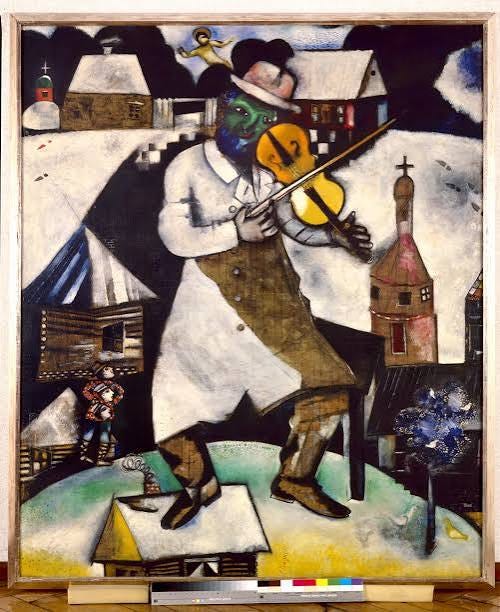
Marc Chagall, The Green Violinist (c. 1923–24). For Chagall, as for the Roma musicians and klezmer players of Eastern Europe, the violin was never just an instrument. It was something a people carried when almost everything else had to be left behind.
The second is Dave Tarras - born Tarasyuk, around 1897, in a Ukrainian shtetl, raised in a klezmer family whose band worked the same circuit as the Roma. He carried that Bessarabian sound to New York and made the bulgar the defining rhythm of American klezmer. Most listeners today hear it as simply, authentically Jewish. That is precisely the point - the third kitchen hiding inside the cookbook.
The third is Menuhin himself. His great teacher was George Enescu, and Enescu’s first violin lessons, at four years old, came from a Roma lăutar named Lae Chioru — a village fiddler, long before any conservatory. Enescu later folded that inheritance into his own concert music: the melody in his Romanian Rhapsody most audiences remember, Ciocârlia, “the lark,” was itself composed by a Romani panpipe player and carried into the violin world by his grandson. The tune didn’t stop there — it went on to become a klezmer standard, sung and played in Jewish weddings an ocean away from where it was born. Everything Enescu passed to his most famous pupil carried that inheritance inside it.
The violin that broke in Calcutta had Roma music in its lineage all along.
So, decades later, did Itzhak Perlman - though by his own account not until adulthood. Perlman grew up on classical repertoire in Tel Aviv, and only found his way to klezmer, and its own tangled roots in the same Eastern European fiddling world as Ciocârlia, after a klezmer band invited him to sit in for fun. What Enescu inherited without choosing it, Perlman went back and chose.
Itzhak Perlman, recording In the Fiddler's House, New York, 1995 - a classical violinist returning, in adulthood, to a tradition he grew up beside but not inside.
Ten and a half minutes - watch as much as you like.
And Menuhin, late in his life, was pulled towards India - the recordings with Ravi Shankar, the long fascination with a musical tradition he approached as a devoted outsider. He almost certainly never thought of it this way, but there is a route hidden in that biography: a musical grammar left northwestern India a thousand years ago, flowed through lăutari and klezmorim and conservatories into the hands of a Jewish violinist from San Francisco, and then went home - carried by a man who had no idea he was completing anyone’s return journey.
The recipes never made it back.
The sound did.
And it is still moving. I know, because a few summers ago I helped it along.
In Basel, through my kosher restaurant, I brought the Roma saxophonist Muhi Tahiri and his band to play eastern European Roma jazz in the courtyard of the Jewish community - bagels at the bar, the old minor lines drifting over tables on a Sunday afternoon.
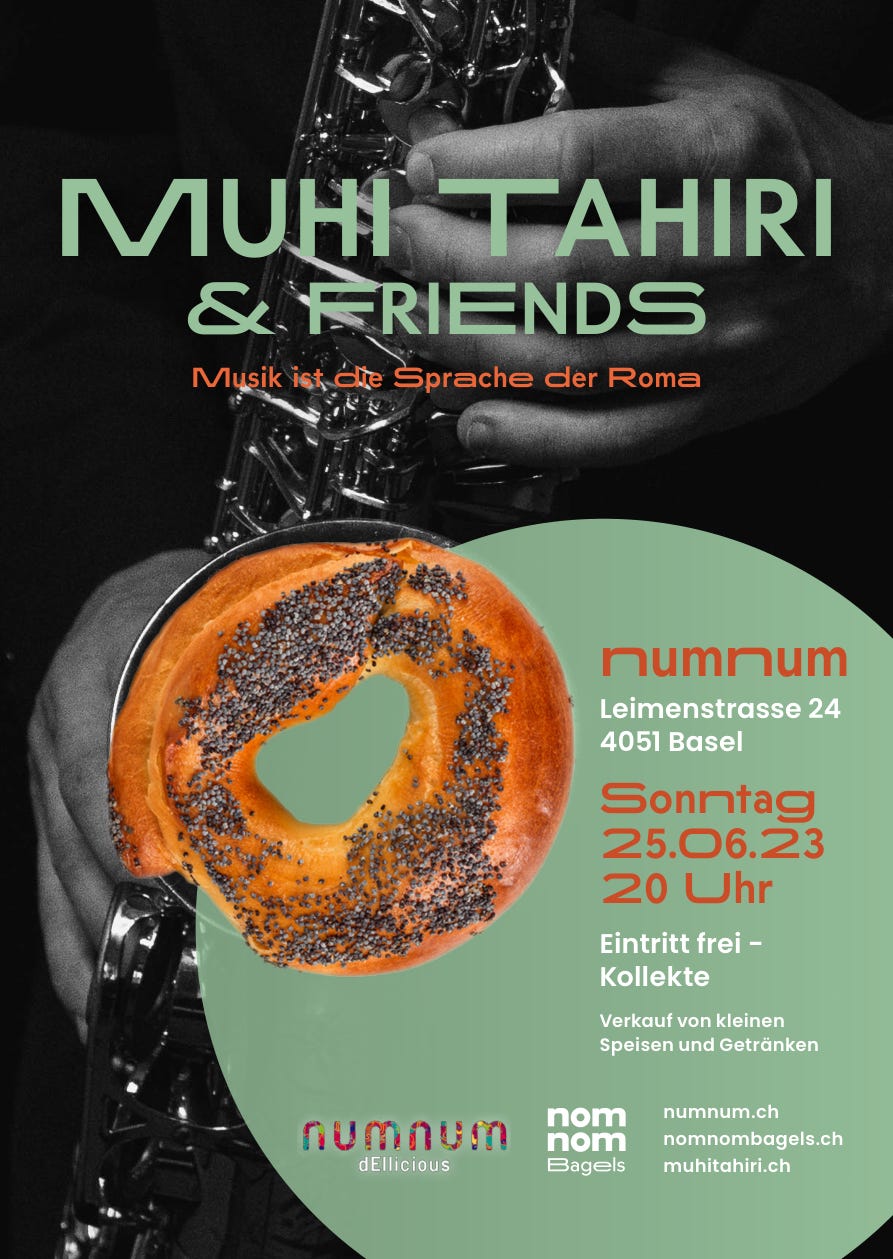
I did not think of it as a historical reenactment at the time. But that is what it was: the shared economy of Jewish and Roma musicians, the one Tarras was born into and the lăutari sustained, reconvened for three hours in a Swiss courtyard.
Nobody needed to explain the pairing to the audience.
The grammar still held.
Coda
My father loved the clarinet. He came to it the way most people did - through the radio, through Benny Goodman and Artie Shaw, bandleaders whose names sounded thoroughly American and whose grandparents, more often than not, had not been born speaking English. Nobody called it Jewish music by then, and nobody at all called it anything else. He never knew about Bessarabia, or the wedding circuits, or the Roma bands two generations behind the swing. He just loved the sound.
Perhaps that is how cultural grammar works. By the time it reaches the next generation, the vocabulary has changed so completely that the journey disappears.
In the Tiergarten, the rain keeps falling on the black water, and the triangle at the centre waits to rise tomorrow with a new flower. The violin plays its thin line over the names of the camps, over the sunflowers going soft at the rim. It sounds like mourning, and it is. But listen longer and it is also the other thing - the proof.
A melody that crossed a continent and outlived everything built to silence it, still recognisably itself, still being handed on, one morning, one flower, one listener at a time.
Beyond Babylon traces the foodways of Jewish communities across the Indian Ocean world. If this essay reached you, consider becoming a paid subscriber.
That's so beautifully narrated. On the topic of language, I would highly recommend, if you have not already read it, Peggy Mohan’s fantastic book: Wanderers, Kings, Merchants